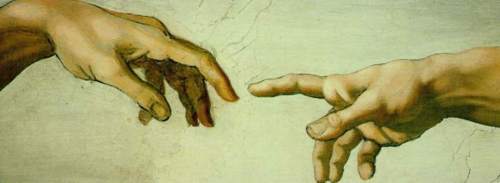
For a long time, I’ve seen God as a transcendent presence in the universe. I assumed God to be outside of our present reality, as a distant observer. I wrote about this in a post a couple of years ago, wrestling with deism and using the Clockmaker metaphor for my understanding of God.
But this conception of the Divine has never set totally well with me. Something seemed to be off about it, about a distant God. Because I have also always believed in the idea of God as in all things, in all of us and all of Creation. But I could never reconcile these two competing ideas.
 Recently, that has all begun to change. It began with my reading of The Divine Relativity by Charles Hartsthorne. This work, a seminal text in the canon of process theology, posits God not as wholly supreme and dominant, but as relative and personal. Hartsthorne’s conception of God is one defined by its relation to Creation, and to us. God is not an omnipotent king, looking over the world with perfect foreknowledge and control over our actions, completely absolute and thus unable to be affected by us. Instead, God grows and changes in relation to us, based on our own actions. Now, this necessarily implies some sense of limitation on God, but that is an acceptable thought if you think of God choosing to limit God’s self in order to more perfectly be in communion with us.
Although the text was dense and highly academic, I really feel drawn to this conception of God. This still doesn’t mean I believe in a God who works active miracles and changes in the world; Harthsthorne thoroughly dismantles this idea as tyrannical and illogical, which I completely agree with. However, I do think God is relatable, and is affected by our ability to act and interact with the Divine Being.
My thoughts of this have continued to expand on this subject recently as a result of Richard Beck’s series on immanence and transcendence over at Experimental Theology. Beck dismantles the idea of a wholly transcendent God and really sums out my feelings:
The irony of transcendence, often celebrated in praise music as the “awesomeness” of God, is how it tends toward disenchantment. With God exalted as King ruling over and above creation, God is subtly pulled out of creation. Rather than indwelling God evacuates creation.
Transcendence also tends toward deism, furthering our disenchantment. When transcendence is emphasized, highlighting God’s separateness and Otherness from creation, God’s actions in the world are conceptualized as intrusions, miraculous suspensions of the daily flux of cause and effect. But as science has progressed these miraculous intrusions are harder to believe in. And when you starting doubting the miracles of the transcendent God you, by default, find yourself in deism. A God who is out there, somewhere, but a God who doesn’t miraculously intrude upon creation.
Basically:
Transcendence + Doubt (mainly in miracles) = Deism
I love this. This is exactly the dissonance and problem I’ve been struggling with in my understanding of God. And in his next post, Beck provides an answer to this problem: immanence. Or as he calls it here, a sacramental ontology:
In a sacramental ontology there is an overlap between God and creation–an intermingling of the earthly and the heavenly, the human and the divine, the mundane and the holy, the secular and the sacred, the natural and supernatural, the material and the spiritual.
With a sacramental ontology the world is “haunted” by God continuously from the insiderather than through episodic and miraculous intrusions from the outside. Creation itself, because it is “charged with the grandeur of God,” is miraculous, sacred and holy. Creation is an ongoing and unfolding miracle rather than a disenchanted machine occasionally interrupted–if God answers our prayers–by an external miraculous force.
To rethink a famous metaphor, creation isn’t a mechanism, a watch separate from the Watchmaker. Creation isn’t a machine. Creation is alive.
God exists in all things; not in the sense that all things are God, but in the sense that God is all-enveloping. Hartsthorne makes this distinction by replacing the term pantheism (all things are God) with panentheism (all things are in God.) God is not separate or distant; God is near, one with us and all of creation. God is personal and loving, not impersonal and dominant.
I’m still working this out in my personal theology, and how it affects everything. But I do know this: it reaffirms my commitments to liberation theology, universalism, social justice and environmental justice. It adds a layer of depth and sacredness to all Creation and all human beings. Sacred worth is all around us; we must do our best to preserve it where it is and revive it where it is fading. The Immanence of God deserves no less.