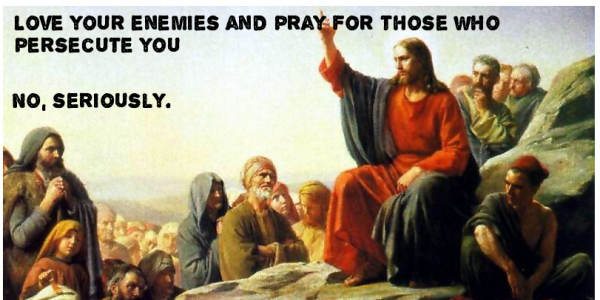
You Can’t Love Your Enemy If You Are Too Busy Hating Them

loveyourenemies
This wasn’t a metaphor y’all.

You can’t love your enemy is you are too busy hating them.

You can’t love your enemy if you are too busy advocating for them to be carpet bombed into oblivion.

You can’t love your enemy if you are too busy calling for their families to be tortured and killed.

You can’t pray for your enemy if you are too busy scapegoating and stereotyping them.

You cannot put others first if you are only thinking about yourself.

You can’t turn the other cheek if you are too busy trying to punch back.

You can’t bless the poor if you are too busy blaming them for their situation.

You can’t be meek if you are too busy blustering about your own greatness.

You can’t feed to hungry if you are too busy means testing them.

You can’t show mercy if you are too busy accusing.

You can’t show mercy if you are too busy demanding an eye for eye.

You cannot heal others if you are too busy looking for new ways to defeat them.

You can’t let justice roll down like mighty waters if you are too busy oppressing.

You can’t be a peacemaker if you are too busy calling for more and more war.

You can’t be a peacemaker if you are too busy creating conflict.

You can’t give freely if you are too busy worrying about who is taking.
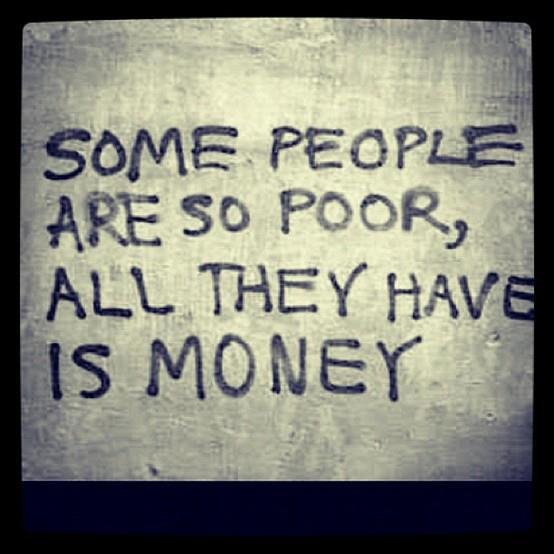
poorYou cannot serve God if you are too busy serving money.

You cannot work for God’s Kingdom if you are too busy trying to make Empire great.

You cannot love if you are too busy hating, hurting, fighting, and ridiculing.

You cannot follow the Way of Jesus if you are trying to master the arts of greed, power, and coercion.

You cannot be of God if you are of the world.

Finding Meaning in Metaphors

The following is a reflection post from my Vocation Matters class this last spring at Phillips. We were studying metaphors of ministry, and relating them to our own calling to ministry.

I was really struck by some of the metaphors for ministry mentioned in the lecture from Donald Messer’s Contemporary Images of Christian Ministry. In particular, servant leader, political mystic in a prophetic community, and enslaved liberators in a rainbow church caught my attention. I find meaning in all three.

At my undergrad, Oklahoma City University, the university really pushed the idea of developing students as servant leaders. I had never heard that term before, but I always liked the sound of it, and contemplating what was meant by it. Five years later, being steeped in seminary and theological thought, I find it to be a good description of the type of leadership Jesus practiced. Through service to those around him, especially those considered lesser or in need, Jesus gained authority as a leader willing to embody the things he was asking of his followers. As the modern earthly representatives of Christ and the Kingdom of God, those of us called to ministry are obligated to pick up that example, and practice it towards our own flocks.

The second, political mystic in a prophetic community, also speaks to me because of my background in political work, and that fact that the motivations that took me into policy and politics (namely, a drive to change the world and people’s lives for the better) also power me in ministry. I don’t believe the church, and those of us who lead the church, can disentangle from the political concerns of the world, nor should we want to. Justice is one of the ultimate callings of the church, and political happenings invariably concern issues of justice in the human community. But the church is not called to identify with any one political movement or ideology, but instead, to act as a prophetic outsider, ala Isaiah or Amos or Hosea or any other of the prophets, calling the powers and principalities back towards a closer approximation of the Kingdom of God.

Finally, being a strong believer in the ideas of liberation theology, the metaphor of enslaved liberators in a rainbow church captures my attention for obvious reasons. However, I am having a difficult time wrapping my mind around what this meaning-packed phrase means. The possibilities contained in the three keys phrases-enslaved, liberators, rainbow church-are exciting, but I have to figure out what Messer is saying about they work together in the context of ministry.

All in all, I think there are a wide, wide variety of metaphors that can describe the vocation of ministry, and as those looking to move into ministry, we should cultivate a wide variety of images for understanding what we want to do, in order that it should not become stale or uni-dimensional throughout a life of work.

Summer Plans, and Reading List!

Summer’s here, and I made it through my first semester at Phillips. I got my grades just yesterday, and I managed all A’s and B’s. I found that the reading and writing requirements are just as onerous as everyone tells you, leaving little time for non-class related activity.

allsouls
All Souls Unitarian Church, at 29th and Peoria in Tulsa

So what am I doing this summer? Well, since the campus ministry obviously doesn’t operate during the summer, I will be working part time at All Souls Unitarian Church, as the Worship Coordinator. All Souls is the largest Unitarian-Universalist Congregation in the country, and I will be working with the ministers and worship team to plan, prepare and execute all three services every week. If you are in the Tulsa area and need a place to attend, come by some Sunday! We have a Traditional service at 10am, and a Contemporary (Pentecostal praise-and-worship) service and Humanist service at 11:30. It’s a great place to be!allsoulslogo

(Yes, there could be some ordination implications here. I’ll discuss that more in the future.)

Also, I am going to try to post regularly this summer, and I have a extensive personal reading list I hope to get through before class starts up again. Here is what I will be reading (and perhaps commentating on) over the next few months.

Called to Community, ed. by Charles E. Moore (reviewing this for Plough Publishing; watch for that in the next couple of weeks!)

The Art of Possibility by Rosamund and Benjamin Zander (required reading for all staff at ASUC.)

Dynamics of Faith by Paul Tillich

Honest to God by John A.T. Anderson

A Theology of Liberation by Gustavo Gutierrez

The Crucified God by Jurgen Moltmann

Becoming Wise by Krista Tippett (a gift from my professor Dr. Ellen Blue, as an award for my Context Matters class!)

Pedagogy of the Oppressed by Paolo Friere

The Big Short by Michael Lewis (We watched the movie recently and loved it, so I can’t wait to dig in.)

Sophie’s World by Jostein Gaarder (rereading this; I first read this about seven years ago.)

and then rereading the Game of Thrones series, in anticipation of Winds of Winter arriving this fall! (Hopefully.)

That’s what my summer looks like. How about you? Got a reading list? Share below!