The Difficulty of Being Nonviolent in a Violent World

As I shared here, I will be posting a few of my papers and reflections from this first half of my first semester at Phillips Theological Seminary. This piece was written for a discussion board in my Vocation Matters class; our topic was violence and pacifism, and the ethics of each. The book I reference here (and in quite a few of the pieces I’ll share) is Gilead by Marilynne Robinson, which really is a masterful work.

The idea of pacifism is one I have struggled with for a while. One of the early formative voices in my Christian journey was Shane Claiborne, and especially his book “Jesus for President.” For so long, based on readings there, and contemplation of Scripture, I have taken a hard pacifist stance. I think Jesus’ instruction to “turn the other cheek” was sincere and fairly unambiguous.

However, despite being pretty set on this in theory, I have still struggled with the practicality of it internally. How does pacifism work in real life? What if someone is attacking my family? What is someone is attacking me? What if our nation is actively under attack? What if a violent act is the only way to prevent an atrocity? When does the act of pacifism in effect become violent in its inaction? All these questions trouble me.

But I have managed to come to some conclusions on the topic. For instance, personally, I believe nonviolence and a pacifist stance is one of my callings in the world. I am inspired by the actions of Gandhi and King and Mandela and others who have stood against violence with nonviolence, and thus proved the inadequacy and ineffectiveness of violence. I believe widespread acts of nonviolence can change the world for the better. I think it important to stand against the use of violence by the state, in whatever form that takes. I identify with John Ames II here, in his role as a pacifist pastor. As a representative of Jesus and the Church, I believe I have a duty to stand for radical nonviolence in a violent world, holding on to my ardent belief that it can change things, one small act at a time.

I also understand that, if I was a national leader, I would have a specific obligation to protect those who have entrusted me with that leadership. Sometimes, that means the use of violence. Ideally, that violence should be tempered with ideas such as Just War theory. Personally, I think it would be an act of violence to stand aside as someone is under attack, especially my own family. I have an obligation to protect my children, even if that means using violence. While I can’t imagine ever owning a gun, I think some sort of weapon or tool that could deliver proportional violence in the act of defense would be advisable. Here, I see the position of John Ames I, who felt that nonviolence in the face of such a violent thing as slavery was in fact violence. To not act was ethically wrong, even if the acts taken were undesirable in other contexts. The difficult part becomes not being caught up in that violence after it is no longer necessary, which Ames I seems to have become for a time.

Ultimately, I have realized something that was quite useful to me: we are imperfect people in an imperfect world. Bad things can and will happen. Sometimes, there is no good option, and no perfect response. Sometimes, the best thing that can be done is also something that would considered “Wrong” or “unethical.” That is the nature of the world. That’s why I think the role of secular leader and church leader are both crucial, to counterbalance one another, in the hope of creating a better, more peaceful world.
Reflecting on the first half of Seminary Year One

It’s the midway break of my first semester at Phillips Theological Seminary, and I am currently enjoying a break from class and discussion boards and writing and reading. (Ok, so I’m not actually able to take a break from reading. More on that in a sec.)

We’ve been on break from weekly classes for two weeks now, and we have next week off for Holy Week celebrations. Last week, I had an intensive course all week called Theological Issues in Film, taught by Brandon Scott. The class was really great, and Dr. Scott is basically a celebrity in the theological world (Google him: Bernard Brandon Scott.) It was a long, exhausting week though, with class everyday from 9am to 4:30pm. I thoroughly enjoyed it, but I am grateful for this week of rest. (TU is on spring break this week too, so there is little Blue House work to do.)

But, as I am finding is the norm in seminary life, the work is never really done. I have spent all week reading and taking notes for my big paper in Context Matters, which I am writing about Archbishop Oscar Romero. I’m so excited to do this paper, and more importantly the research, because I consider Romero my personal patron saint, and probably the key figure in my return to Christianity 7 years ago. The paper is a look the Archbishop, the context he lived and worked in, the forces that shaped him, and the way in which his memory and martyrdom continue to shape the world. I am centering it around Romero, Pope Paul VI, and Pope Francis, as kind of a line of continuity centered on an embodied faith that has that “preferential option for the poor” so central to liberation theology.

Besides this paper, I have a paper for the film class that I am beginning to contemplate, which requires us to take a film of our choosing and explain how it tells a version of the Gospel. I’m not sure what film I am going to do yet. I also have a series of essays for my midterm in Vocation Matters, as well as a paper on a spiritual practice for Context. For that last paper, we are to take a practice we observe in our research paper (Romero) and reflect on it. I am strongly considering looking at the practice of martyrdom for this paper.

Needless to say, all of this constant reading, writing, and reflecting hasn’t left me much time or energy to write blog posts, obviously. But in order to make up for my silence, and atone for the future prospect of silence between now and May, I want to share some of my papers and reflections from class from this first half of the semester. These were all written as assignments, and I’ll try to share their context and some links to some of the referenced pieces. I hope you enjoy them, and I would love feedback on my work so far.

Thanks for all who have stuck around here despite the quiet, and I hope you will keep coming back. Wish me luck!

On Being a Writer, Part 2

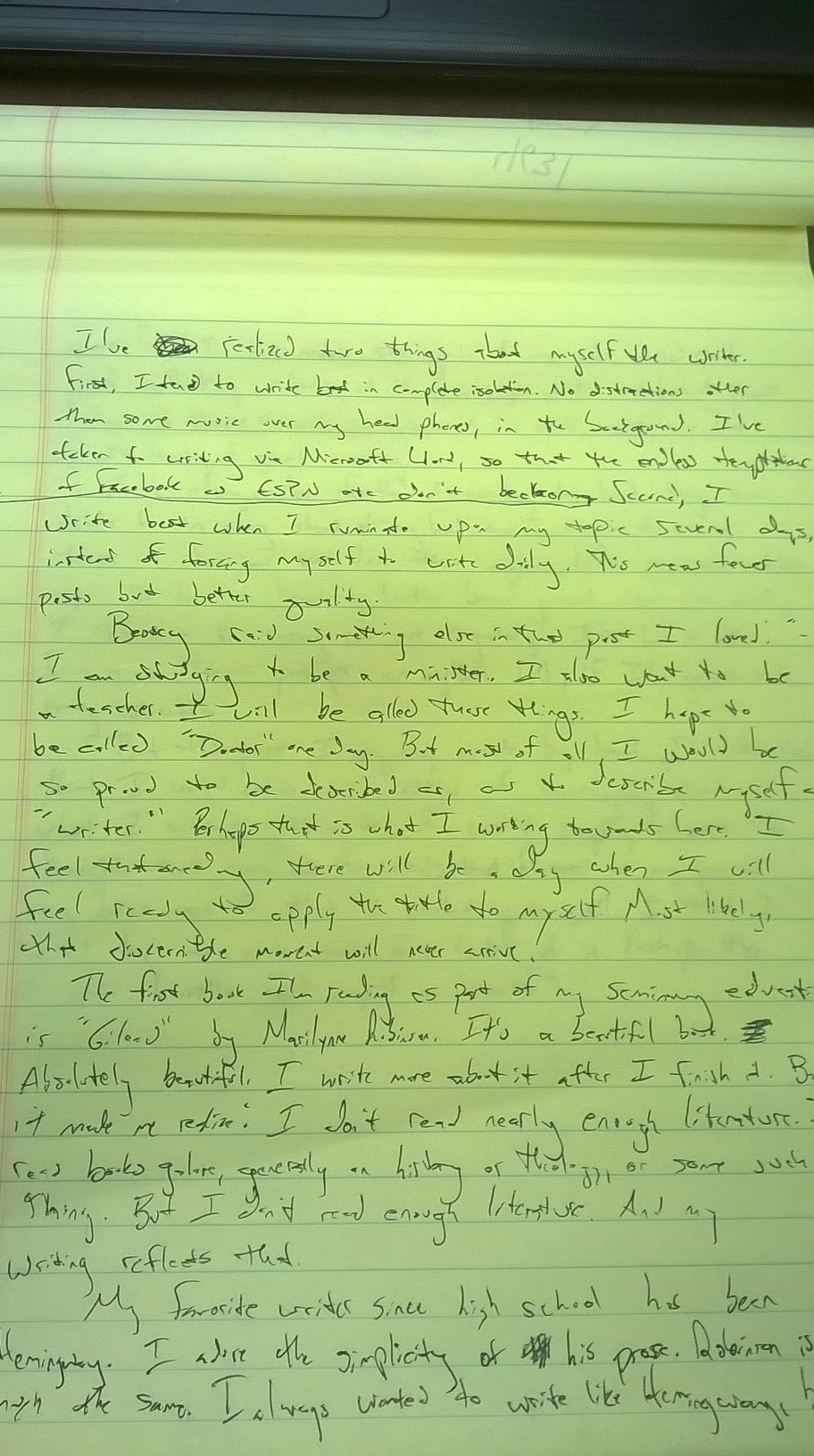
I’ve realized two things about myself, the writer.

WP_20160202_16_07_52_ProFirst, I tend to write best in complete isolation. No distractions, other than some music over my headphones, in the background. I’ve taken to writing via Microsoft Word, instead of in the browser, so that the endless temptations of Facebook and ESPN don’t beckon. Sometimes even this doesn’t work. I’ve come to sympathize with author Sarah Bessey:

I hear from big and good writers that they require regularity and discipline to write: I am the same way. I know when I write the best stuff (early in the morning) and I know what helps me to write my best stuff (time outside in the wilderness, a clean house, a plan for supper, quiet, solitude) and yet I am rarely in that sweet spot.

Second, I write best when I ruminate upon my topic several days, instead of forcing myself to write daily. This means fewer posts but better quality.

Bessey said something else in that post I loved:

Now that I’ve published two books and countless articles, I have some legitimacy to my scribbling hobby. People call me a writer and the big miracle is that the word doesn’t make me feel like an imposter anymore, I even say it out loud when people ask me what I do (“I’m a …writer….”)

I am studying to be a minister. I also want to be a teacher. I will be called those things. I hope to be called “Doctor” one day. But most of all, I would be so proud to be described as, and to describe myself as, “Writer”. Perhaps that is what I am working towards here. I feel that one day, there will be a moment when I will feel ready to apply the title to myself. Probably, that discernable moment will never arrive.WP_20160202_16_07_58_Pro

The first book I’m reading as part of my seminary education is Gilead by Marilynne Robinson. It’s a beautiful book. Absolutely beautiful. I may write more about it when I finish processing it. But it made me realize: I don’t read nearly enough literature anymore. I read books galore, generally history or theology or some such thing. But I don’t read enough literature. And my writing reflects that.

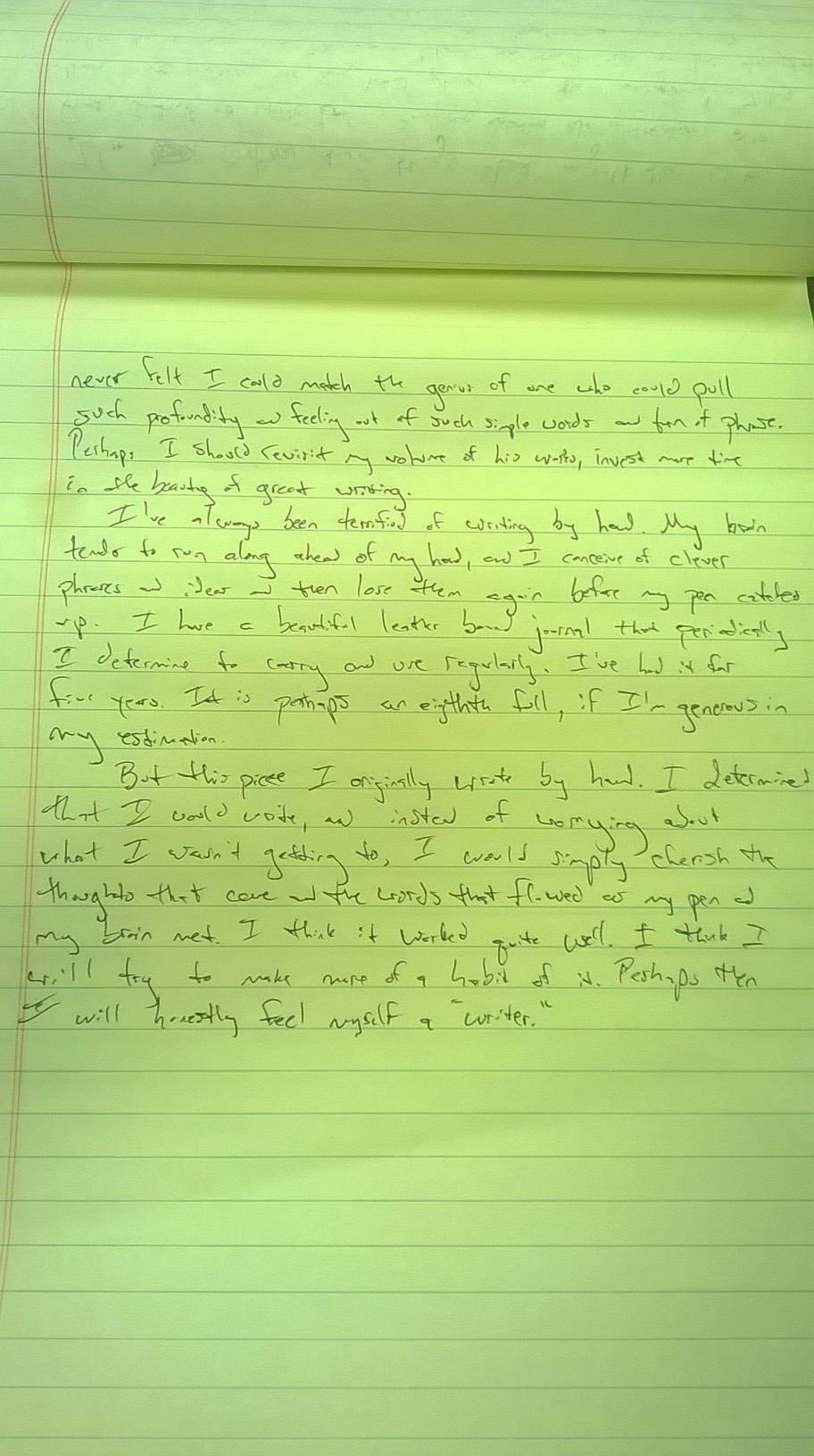
My favorite writer since high school has been Hemingway. I admire the simplicity of his prose. Robinson is much the same. I always wanted to write like Hemingway, but never felt I could match the genius of one who could pull such profundity and feeling out of such simple words and turn of phrase. Perhaps I should revisit my volume of his works, invest more in the beauty of great writing. Perhaps I should not try to be Hemingway.

I’ve always been terrified of writing by hand. My brain tends to run along ahead of my hand, and I conceive of clever phrases and ideas and then lose them again before my pen catches up. I have a beautiful leather-bound journal that periodically I determine again to carry and use regularly. I’ve had it for five year. It is perhaps an eighth full, if I’m generous in my estimation.

But this piece I originally wrote by hand. I determined that I would write, and instead of worrying about what I wasn’t getting to, I would simply cherish the thoughts that come and the words that flowed as my pen and my brain met. I think it worked quite well. I think I will try to make more of a habit of it. Perhaps then I will honestly feel myself a “writer.”