The Sanctity of Death

It is a mistake to assume that the “sanctity of life” us a sufficient criterion for an appropriate concept of death. Appeals to the sanctity of life beg exactly the question at issue, namely, that you know what kind of life it is that should be treated as sacred. More troubling for me, however, is how the phrase “sanctity of life,” when separated from its theological context, became an ideological slogan for a narrow individualism antithetical to the Christian way of  life. Put starkly, Christians are not fundamentally concerned about living. Rather, their concern is to die for the right thing. Appeals to the sanctity of life as an ideology make it appear that Christians are committed to the proposition that there is nothing in life worth dying for.

Stanley Hauerwas, Suffering Presence: Theological Reflections on Medicine, the Mentally Handicapped, and the Church, page 92

Considering the centrality of a “pro-life” ethos has become to many Christians today, this small passage from Suffering Presence really struck me when I read it. It did so because of the way this really strikes at some sacred cows on both sides of the left-right divide in American Christianity.

First, obviously so, this strikes hard at the borderline idolatrous way many conservative, evangelical and Catholic Christians have latched onto the “sanctity of life” as perhaps the driving force behind their political and social engagement as Christians in the world. Ever since the grounding of much of Catholic social thought in these terms in the post-Vatican II world of Pope John Paul II, the right to life has driven the priorities of millions of Christians, many them to a point that could charitably be called myopic at best.

On the other hand, in recent years, many of the Christian left have taken up sanctity of life rhetoric in a different form, in their certain insistence that this life is really all there really is, and thus, this life must take whatever form the bearer of life chooses at that exact moment, with no matter to tradition, morality, or any bounds of authority. Because the great hereafter is so unknown and uncertain (a claim I’m not denying at all), we must maximize this life for ourselves, right here and right now.

I like this passage because it makes the uniquely Christian claim that perhaps our culture is a little too enamored of life itself, at the expense of other priorities. Hauerwas reminds throughout the text that, for a Christian, life is not the Ultimate Concern of existence; rather, that Concern is God, and so our purpose becomes not to live life more fully, but to live life more concerned with what God demands of us.

In this upside down view, our faith – grounded in a Scripture that is too often held up as some users manual for how to live life well – is a way of being that teaches us what to die for, and how to do that dying well. The secret of life, in this way of thinking, is that we all die, inevitably, but we don’t all die equally. In the meantime, we should be living for things that might cost us our lives but, paradoxically, make life worth living well. We should be seeking some Good greater than that which can be contained in life. Because that is what we see in Christ: a God who does live, but who also dies, because death was ultimately less potent than the Love of God.
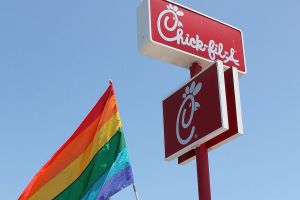
Chick Fil A’s LGBTQ+ decision really doesn’t matter much at all

chick_fil_a_rainbow_flag.0Some quick thoughts in the Chick Fil A brouhaha that has blown up (again) over the last few days as the news that the fast food chain will no longer be donating to the Salvation Army and FCA, organizations that have historically been unfriendly towards LGBTQ+ people:

Chick Fil A refraining from putting funds towards these organizations in favor of instead diverting that money towards organizations focused on homelessness, education and hunger awareness initiatives is not the equivalent of putting that money towards organizations that support LGBTQ+ people (especially LGBTQ+ youth, since homelessness is a priority for them and 40% of homless youth in America identify as LGBTQ+.) Its not like Chick Fil A has all the sudden pledged its bottom line to Planned Parenthood, GLAAD, or PFLAG, and religious conservatives need to stop acting like they have. To do so is to make clear that, first, ones abiding hatred of/disregard for LGBT people in the our country, all of whom are just regular people worthy of all the love and respect one can give. Second, the palpable anger over this decision makes it clear that many Christians continue to shove any and all other social concerns far down the list behind anything related to sex and/or LGBTQ+ people, thus confirming many of the stereotypes and assumptions people make about Christians.

Additionally, the idea that this is in some way about “leftists” or “cancel culture” or some part of some mythical war on Christianity is pretty wild. What this is is something conservatives are usually pretty defensive of: pure capitalism. Chick Fil A saw the writing on the wall, recognizing as they expand further and further across the nation that support for the LGBTQ+ community is very high across the board. If there is some underlying motive at work here, it is the profit motive: Chick Fil A wants to continue making boatloads of cash off of its food, and apparently, they recognized that continuing to stand as the premier anti-LGBTQ+ business entity in the United States was going to begin cutting into the bottom line. So they made a change. And that’s not the fault of some magical leftist-secularist cabal intent on destroying all Christians in America or something; instead, its the power of positive social change meeting the hard realities of modern capitalism.

The last point I want to make is this: I don’t think this decision moves the needle morally in any way, either positively or negatively. I think its a pretty morally neutral action; it’s not some huge moral or ethical victory for the LGBTQ+ community. Chick Fil A still continues to be associated with conservative Christianity. The wheels of capitalism continue to churn. This all plays into the same strains that drive my own personal refusal to participate in boycotts of businesses for various political or social stances. Making moral choices the driver of purchasing decisions is a fool’s errand; there are really no “good” choices when it comes to deciding with who to spend your money, outside of choosing to solely spend money locally with businesses you know and are intimately acquainted with, a choice that is largely unavailable for most people today, due to the structure of modern global capitalism. Unless you choose to completely disengage, you might as well spend money in a way that is economically and logistically viable for your family, and focus your moral energies elsewhere.

Anyways, Chick Fil A not giving money to FCA and the Salvation Army is good thing, as far as any thing good can come from modern capitalism, but really, its a mostly empty gesture that none of us should care much about. Its not worth the elation of the left, or the panicked overreaction of the right. Just like so many things our social media feeds want us to think matter.

The Shortcomings of Democracy

white and grey voting day sign
Photo by Element5 Digital on Pexels.com

I’ve written before about the relationship between democracy and Christianity. The piece linked here was from about three years ago, wherein I wrote that democracy does not ensure inherently more moral outcomes than other forms of government, but rather is just as subject (if not more so) to the poor judgment of human beings, and thus just as likely to produce immoral and undesirable governing outcomes (see Trump, Donald.)

As I was reading When War is Unjust by Yoder last night, I came across this passage that struck me as making the same point, but in a more concrete and insightful way. Here is Yoder:

In order to gain a popular mandate and seem stronger than their adversaries, politicians may exploit nationalistic and xenophobic, even racist, enthusiasms of common folk, thereby putting themselves under pressure to perform in a way as “patriotic” as their campaign language. Once the battle has begun and lives have been given, it is far more difficult to contemplate suing for peace. The medieval vision of the prince as a responsible and wise decision-maker, able to lead his people because he knew more of the facts, had studied the craft of governing, and had the courage and also the power to make unpopular but right choices, is replaced be elected politicians who become captives of the patriotic sentiments and short-circuited analyses their own campaigning stirred up. The medieval monarch could, if wise, cut the losses and make peace. Democratic leaders may be less free to be wise, especially once they have cranked up the fervor for war. Whether we speak of the relatively genuine democracies, in which popular suffrage is effective, or of the many places in which the facade of an electoral process is used to cover less worthy policies and less valid processes of decision, it often appears that to involve the masses in decisions about war and national honor does not provide for more effective defense of the real interests of most people. The issues at stake are subject to rapidly changing moods and to deceptive rhetoric. Decisions about whether to have a war, about what, and how long are not made more wisely just because there are elections. Democratic forms may well work against restraint.

I don’t post this as an endorsement of a return to medieval monarchy as a government (or, even less, as some sort of theocratic technocracy bringing together Plato and Aquinas.) Rather, I read and share this as a reminder of my point in the earlier piece: democracy is not a cure-all for what ails the world and the nation socially and economically. Those of us who have stood opposed to Trump since early on should know this as well as any, and in fact, his election is what awoke this line of thinking in myself. The same democracy that elected a Barack Obama is just as likely and capable to elect a Donald Trump. It is also just as likely to turn around and elect an Elizabeth Warren next time, and who knows what after that.

I do think this passage is interesting in the sense of what Yoder points out specifically as the things democracy does less well. He notes the accumulation of facts, the art of governance, and the ability to use restraint as three things that the idea monarch could bring to bear that democratic forms of governance fail at more often. The depredations and downfalls of monarchy often impeded the exercising of these good points, but then again, the depredations and downfalls of democracy often override the positive elements of it as well. The use of restraint, and the making of hard decisions, stands out to me most as what the American project in democracy is failing at most often; we seem unable, as a democratic populace, to make hard decisions involving sacrifice or the giving up of privileges, in order to achieve a greater and broader good. Our democratic guidance seems all too often geared towards maximizing our own good in the here and now, at the expense of any longer-term vision. This is evident on the right in the denial of and refusal to deal with the overwhelming scientific evidence of climate change; on the left, we see this in the drive for further atomization and individualization of the body politic, driving towards intensely personal understandings of cultural engagement at the expense of some form of national coherence and unity, something that is key to the success of any community of any size and form.

When I think about these shortcomings of pure democracy, it makes me think of how prescient were the Founders in this sense, in their writing in of checks and balances in our governing documents. Madisonian democracy, enmeshed in the Constitution, is representative and limited, for the purpose of ensuring some semblance of a ruling elite; I like to think that this ruling class could be one that is elite in it’s ability to make hard decisions for the greater good, in it’s knowledge of governing forms and policy, and it’s attention to facts and details. But again, the ideal runs up against the realism of human fallibility; history has shown us that any form of a ruling elite inevitably turns into a kleptocratic, oligarchic economic elite.

This all brings me around to the reminder I feel I am constantly banging away at for Christians, namely, that democracy is not a “Christian” form of governance, any more than any temporal form of human governance is. As we get closer and closer to the 2020 elections, we cannot lose sight of the fact that all the problems we face will not be wiped away by the election of more favorable candidates to higher office; even more importantly, we cannot forget that no matter who assumes (or retains) the presidency and Congress next year, our role as Christians is one outside the structures of coercive power. Even our friends need a robust voice of criticism pushing them on towards a higher vision of the Good, beyond the needs of the next electoral cycle. Christians are not democrats; we are Christians, first and last.