I had the opportunity to meet and learn from the poet and social activist Andrea Gibson this last week, as a result of the hard work of some of the students at the Little Blue House at TU, where I work. They brought them* in to perform and give a writing workshop. It was an amazing two days.
If you haven’t seen Andrea perform spoken work poetry, look them up on Youtube. It’s amazing. But I want to just ruminate on the workshop, and some thoughts I had as a result.
Andrea, at the beginning of the workshop, asked who called themselves a writer and I raised my hand. Being a pastor (or a pastor-in-training, in my case) is in large part being a writer. For me, the blogging I do here is so important to my development as a spiritual leader, and I don’t intend to ever stop writing in a public forum like this. It hones my arguments and makes me think things through, as well as sharpens my writing skills.
Doing sermons is also, in a large part, writing. Taking the time to sit and craft a message, and do it in a way that is accessible and interesting and coherent; that is what sermon writing is all about. I take pride in my sermons, and I want each one to make sense, to tie together beginning and end, to be something people want to hear and read again.
And, the way I like to preach, it also becomes something of a performance. I’m not a stand-behind-the-lectern kind of person; I like to walk and gesture and interact with the congregation. I generally have my notes on a small music stand in front of me. I want to bring that element of performance into giving a sermon, because I want my sermons to be more than just an academic lecture. I know that I have a tendency to get technical and long-winded at times, and so by making it engaging by my presence and cadence, I can pique interest and hopefully fill someone’s senses in a way that they feel enlightened and reenergized by what I am saying.
Seeing Andrea perform, and also recently Evan Koons and Rob Bell, it confirms for me that speaking in front of people is something I want to do for the rest of my life. It feels right, you know? And just the opportunity to not only teach and convince, but also to perform in a way that touches people, there is such value in that.
And finally, for me, I want to continue on into my doctorate and write and teach and speak one day, and so being a writer is, in reality, the career path I have chosen.
Writing has forced me to be more introspective and vulnerable, to make sure what I believe and think is rational and coherent and accessible. And I’ve come to realize that when I say I want to be a pastor, that I want to give sermons and teach and lead, that I am in essence saying I want to be a writer.
I’m not really going anywhere with this, other than just to get some thoughts down in writing for future contemplation, and for public feedback. Thoughts?
*Andrea is genderqueer, and does not use gendered pronouns, preferring to be addressed as “they” or “them.”
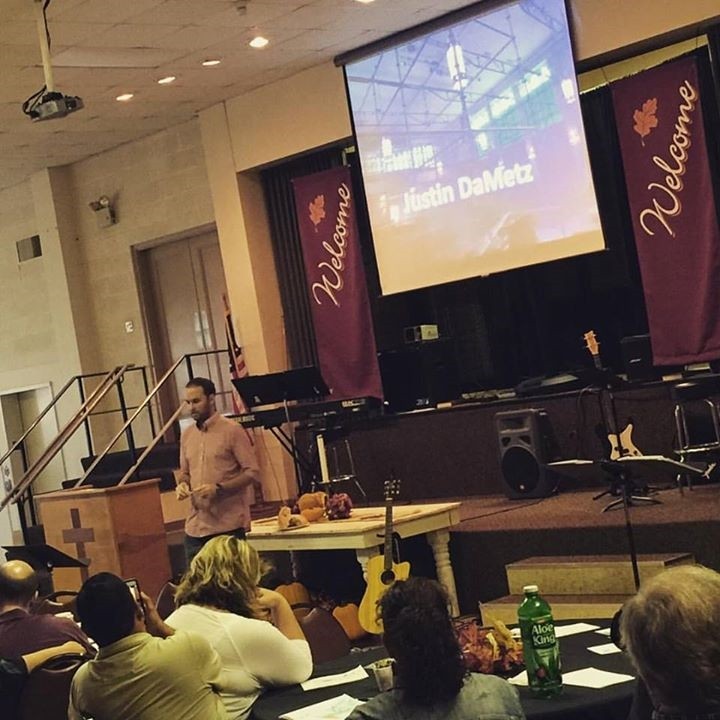
The following is sermon I delivered Sunday, October 11 at East Side Christian Church in Tulsa, OK. Our church hosted Evan Koons that weekend as well, for our Wine and Words event. Check him out here.
Myself, Evan Koons, and my wife Arianna
Does anyone here know who Kurt Vonnegut is?
Author and satirist, wrote Slaughterhouse-Five.
Well, I’ve heard a lot of sermons in my life so far, but I’ve never yet heard a sermon that quotes Kurt Vonnegut. So I’m proud to say I am breaking down that wall today.
And in fact, this Kurt Vonnegut quote is kind of the center of my message today. How about that for you?
In 1980, Kurt was invited to give a sermon on Palm Sunday, which is kind of a surprising thing in and of itself, given that Kurt wasn’t exactly a Christian or very religious, and in fact, liked to lampoon the church quite mercilessly in his criticisms of culture and modern society. But nevertheless, he was asked to preach, and he chose to talk about the same story we heard today, although he used the text from the Gospel of John.
John’s story is almost exactly the same as Matthews, except, as John tells it, it is Judas specifically who protests the women’s actions. “Why was this ointment not sold for three hundred denarii, and given to the poor?” Don’t you love that detail? Exactly 300 denarii, which was about what a laborer could expect in annual wages.
But, the author of John goes on: “Judas said this, not because he cared for the poor, but because he was a thief, and having charge of the moneybag he used to help himself to what was put into it.”
Do you see the scene setting happening here? Judas is being typecast as the bad guy he will shortly be. The author of John was many things, but subtle apparently was not one of those things.
And Jesus responds to this obvious villan, “Leave her alone….for the poor you always have with you, but you do not always have me.”
Kurt Vonnegut, in his Palm Sunday message, says:
“Perhaps a little something has been lost in translation….I would like to recapture what has been lost. Why? Because I, as a Christ-worshipping agnostic, have seen so much un-Christian impatience with the poor encouraged by the quotation “For the poor always ye have with you.”…If Jesus did in fact say that, it is a divine black joke, well suited to the occasion. It says everything about hypocrisy and nothing about the poor. It is a Christian joke, which allows Jesus to remain civil to Judas, but to chide him for his hypocrisy all the same. ‘Judas, don’t worry about it. There will still be plenty of poor people left long after I’m gone.’”
As Kurt sees it, Jesus was engaging in a little black humor at his erstwhile disciples’ expense. For three years, he has been slamming his head against a seeming wall, trying to get his people to understand what this thing he is doing is all about.
And then here we are, and Jesus has just told them just before this, literally said, “in two days, I’m gonna be executed.” And so they are sitting down to one of their last dinners together and this woman, who surely heard Jesus tell his disciples the thing about dying in two days and thus wants to do something for him, something to show appreciation and love for this man she has followed and who is tragically about to be ripped away. And so she takes this jar of expensive nard, probably one of the most costly and precious things she owns, and she breaks it and pours it on Jesus’ feet, and uses he very own hair to spread it, and commits an act of selfless love, an act of wasteful extravagance. What a beautiful moment! Jesus is touched to the point that he declares that this woman, of all the people who have followed him and worked with him, this woman will be the one remembered forever.
Have you ever been talking to one of those people who are all over the place, who talk about like sixteen different things in a minute and a half, and you try to respond to each thing as best you can, and as they just ramble on, all of the sudden, something in their brain clicks and they randomly respond to something you said like 20 minutes ago?
Yeah, that’s basically the disciples here.
Jesus has spent three years trying to get these guys to understand. And like a stubborn mule they have fought and fought, and when he points them in some direction, they go off in the complete other. And then a woman pours ointment on Jesus’ feet, and all the sudden, in their minds, the disciples are snapped back to the Rich Young Man, and like Pavlov’s dog, the bell chimes and they all go “Sell it all and give to the poor.”
And Jesus engages in the world’s first recorded facepalm.
Think about it this way: if a man’s brother died, and that man went and pulled out his meager savings, and used the little he had in the world to buy his beloved brother a small, beautifully carved grave marker. Because, he may not be able to build him a great tomb, or name a mountain after him or anything, but he can do this, to show his love. What would you think if some guy went up to this man and said, “hey man, do you know how many homeless care packages you could have put together with the money you just blew on that slab of rock?”
What a jerk move, right?
“Why do you trouble this women?” Jesus asks them in disbelief. “She has done a beautiful thing for me. For you always have the poor with you, but you will not always have me.”
And from this verse, from these simple 15 words, Christians have been weaseling their way out of serving their less fortunate brothers and sisters for two thousand years. The core message of Jesus, that we are to love one another and thus serve one another; the thing he did time and time again in his earthly ministry, is all thrown aside because of one line.
I think maybe this is one of those things Jesus looks back on in regret. I picture him remembering his ministry, and thinking about how that wonderful women anointed him, and then remembering about what he told the disciples, and thinking to himself,
Julian decided to help out a bit
“Man, I sure could have worded that a little better. Not my finest rhetorical moment.”
Because it’s true, right? How many times have you heard another Christian, someone who may not be quite so progressively inclined, justify their support for regressive policies and actions by this verse. “But we will always have the poor with us, so there is no point in trying to eradicate poverty right?” That’s what they say.
And us progressive Christians, good social justice warriors that we are, we live everyday in like direct opposition to this worldview. If there is a petition to be signed, or a protest to march in, or hope and change to be escorted in, by golly, we are so there. We know that Jesus didn’t mean we shouldn’t act to make the world better. We see it throughout his ministry, the example he lived every single day, of service and justice and love for others. We know that Jesus would absolutely be giddy if we finally beat poverty and the poor weren’t always with us anymore.
I know I’m that Christian. For me, the imperative to serve others, to, as the prophet Micah write, do justice and love kindness every day, are major reasons why I count myself as a Christian. I love a faith tradition, a way of life that is centered around making the world a better place through service to others. I love a God who identifies with the least, who calls for the liberation of those who are shackled, a God who so wanted to be in relationship with us that that God took on human form and came down and became weak like us.
But in this story, we are the disciples. We progressive, justice minded, outwardly focused Christians, we are like those foolish disciples. Remember what we were talking about? Look at your bulletin. Today’s verse isn’t “Do unto the least of these,” or “Feed my sheep.” Today, this verse is telling us, Jesus isn’t just interested in how many meals we bagged today at the food pantry, or how many children in Ethiopia we sponsored. It’s not that that stuff isn’t important; it truly is! It’s so, so important.
But, sometimes, Jesus wants us to just stand in awe at the beauty of it all. Sometimes, we need to just need to stop and be quiet and sit and listen for that still, small voice passing by. Sometimes, we need to remember the third requirement in that verse from Micah, which is to walk humbly with our God.
As progressives, we want to do, do, do. We want to fix things, and right wrongs, and make the world better. But for our own sakes, for the betterment of our own souls, sometimes, we need to practice some self love.
That’s what Jesus is saying to his disciples. It’s not that serving the poor isn’t important. And it certainly isn’t that we shouldn’t try. But sometimes, we are required to appreciate the beauty of this life. Sometimes we need to practice fellowship. Sometimes, we need to just worship.
The Bible tells us God is love. In God’s very essence, God isn’t just loving, God doesn’t just practice love towards us, God is love itself. As we are human, as we are made up of carbon and water and blood and bone and tissue, God is made up of this thing we call love. The universe was created and thus has an age, and everything in it does too, and we are one those things that are finite, and all of these ideas we have, all of these philosophical and theological principles we debate and write about and start wars over are finite and connected to our existence, but love…love is not one of those things, because love is God and God is love and God is outside of time and space and so love is too.
And the Bible also tells us that we are made in the very image of God, in the very image of Love itself. We are not made of love, but instead made in love, in the very image of that which is nothing but, and everything that is, love.
And we fall short of the God that we are modeled on, and we mess up, and thus we look to Jesus to see the example of him who most closely imitated the way of love here on Earth.
And so, all of that to say that, serving others isn’t enough in and of itself. We need to come at service not from a place of self-gratification, of patting ourselves on the back for how many good things we are doing, but from a place where the impetus for action is the very essence of God, that thing called love. And we can only do that by careful and frequent examination of and communion with Love itself, in the form of the God who created us and sent us.
Human beings, over the course of half a million years, have struggled and fought and drug ourselves up from the primordial mud and conquered the earth, and warred with ourselves, and called upon God to be on our side against ourselves. And then, with the advent of Jesus, God taught us that to prosper and flourish and bring the kingdom right here on earth, we must love each other, and thus serve each other as the only rational manifestation of that love. And for two thousand more years, we struggled and fought and ignored what we were taught. And then, in the last 150 years or so, we finally started to get it, and human rights flourished and we acknowledged the innate worth of all men and women, of young and old, of white and black and brown and yellow and red, of straight and gay and trans and. And we felt so good about ourselves, and patted ourselves on the back, and said “we figured this gig out, go us.”
And God just chuckles, and says, “no, you haven’t.” And we can’t see that because of the cascading ticker tape at the parade we threw ourselves. We are too busy congratulating each other, we can’t hear God asking for our attention. And so, like Kurt said, we are hypocrites, because we do these things, not for them, not for the glory of God, but for us.
This right here, this thing that we do on Sunday mornings and Sunday evenings, and Wednesdays, and sometimes from sunup to sundown on Saturdays, or once a year on a good Friday, this thing we call worship or temple or church, it is so so important. When we walk humbly with God, when we listen for that still small voice, when we taste God in the bread and wine, when we appreciate and engage in acts of pure love towards the One we are made in the image of, that’s when we are reminded why we are here and why we go out there and do justice.
And so that brings us back to the “divine black joke” Kurt Vonnegut references. Jesus chuckles with gallows humor because his disciples just showed that they still didn’t have what it takes to make sure there were no more poor, because when they called for the ointment to be sold “for the poor,” they were forgetting to ground themselves, to experience the beauty of a moment with God, of a moment of pure love, and thus to see the meaning of why Jesus did the things he did. And so Jesus laughed to himself, and etched a moment and a nameless woman and her selfless gift into history.
So what am I trying to send you home with? What is my “go and do?”
What we do here is to make us better at what we do out there.
There is more to this Christian life than just social justice, than righting wrongs and healing the sick and lifting up the poor.. It’s exactly like what the book of James tells us: “Faith apart from works is dead.” So often we hear that verse reminding us that we have to do things in the world as Christians, but today, I’m asking you to hear that verse as reminding us that we have to have faith, we have to been enmeshed in the love of God, in order to make those works really matter.
One of my favorite old hymns is “The Gift of Love,” and I think the words from it’s first verse are so relevant to the point I’m trying to make. It goes,
“Though I may speak with bravest fire/ and have the gift to all inspire/ but have not love/ my words are vain/ as sounding brass/ and hopeless gain./ Though I may give all I possess/And striving so my love profess/ But not be given by love within/ The profit soon turns strangely thin.”
We need to take time for ourselves, time spent worshipping and praying and filling up our tanks with love that can only be found through communion with God.
So cherish this time each week. Realize that this worship is just as important as the justice work. In fact, that work can’t happen without what we do here every week.
The following is the Invitation to the Table I gave at East Side Christian Church in Tulsa this last Sunday:
Bishop John Shelby Spong tells of an Episcopal church he once visited that had a sign on the front door. It said, “The only pre-requisite for receiving Holy Communion in this church is that you be hungry.” What a wonderful distillation of the theology of the Eucharist as we Disciples understand it.
We believe this table, the Lord’s Table, is the ultimate equalizer. All people can come to dine with Christ, and in doing so, all social status and stigma is washed away, leaving only the divine image present in each of us.
Jesus never means tested those who wanted to eat with him. He never examined their ability to pay, their purity in the eyes of the religious authorities, their moral standing, or their social identifiers. He simply broke bread and poured wine and shared it with everyone around him.
We strive to embrace the same spirit of inclusion and acceptance at this table. All are unworthy of communing with God. All of us have fallen short of our potential, have done things we aren’t proud of, things that disqualify us from sharing in the holiness of God’s presence.
But here we are.
Despite our faults and shortcomings, God desires our presence at this banquet. Like Jesus taught, God is like someone throwing a great feast, who tells their servants: “Go out at once into the streets and lanes of the town and bring in the poor, the crippled, the blind and the lame….Go out into the roads and the lanes and compel people to come in, so that my house may be filled.”
This is how badly God wants us at the table. God desires the table to be full, the house to be filled to overflowing with guests, no matter who they are or what they have done. God turns none away, and in fact, goes out and finds those who didn’t feel worthy of trying to come in the first place.
And not just so God can say that the table was full for the sake of being full. God wants this because God knows that there is no better way to a person’s heart than through their stomach. God welcomes us because God wants this to be the impetus of an ongoing relationship. God wants to meet us at the table because that is where family comes together, where lasting relationships are born and nourished. We come here week after week to continually renew that relationship that we first entered into through broken bread and a shared cup.
To come to this table, you don’t need to have this all figured out.
You don’t need all the answers.
You don’t need to fix yourself, to clean yourself up, to be respectable, or calm, cool and collected.
You don’t need to have the prayers down, the liturgy memorized, the songs sung just right.
You don’t need to unlock the magic formula that will win you a place in heaven.




 Justin DaMetz