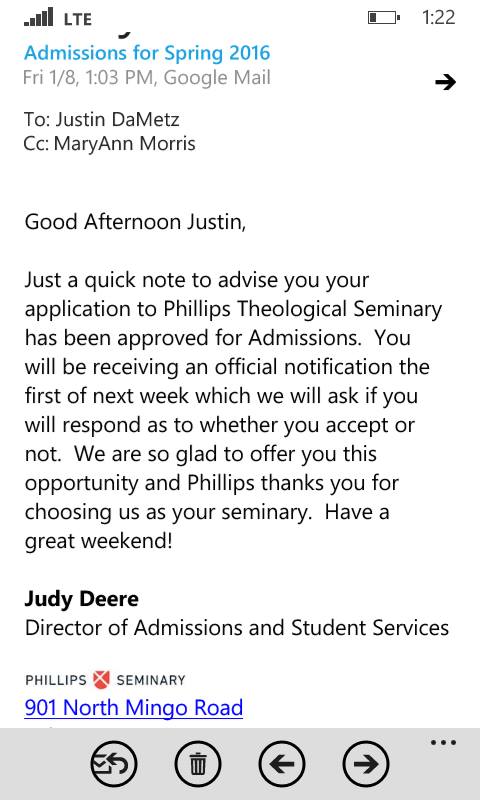
Yesterday, I enrolled in my classes for my first semester at Phillips. I have just three this semester, as most classes this spring semester have prerequisites.
New students at Phillips have to take four introductory classes known as “portal classes.” This semester, I’ll be taking two of those, titled “Context Matters” and “Vocation Matters.”
Context Matters is described as such in the course catalog:
Combining the disciplines of Practical Theology and Church History, the Context Matters course introduces students to the careful analysis of historical and cultural/situational contexts as a fundamental aspect of researching the past and exploring contemporary practical settings. This course functions as a prerequisite for all practical theology courses, upper level church history courses, and all immersion courses. Instructors: Ellen Blue, Mouzon Biggs, Jr. Professor of the History of Christianity and United Methodist Studies, and Mindy McGarrah Sharp, Assistant Professor of Pastoral Theology and Ethics.
Context has an extensive book list:
The Invention of Wings by Sue Monk Kidd
The Acts of the Apostles
The Story of Christianity, Vol. 2, The Reformation to the Present Day by Justo L. González, revised and updated.
Practicing our Faith: A Way of Life for a Searching People, 2nd edition, by Dorothy C. Bass. Jossey-Bass
St. Mark’s and the Social Gospel: Methodist Women and Civil Rights in New Orleans, 1895-1965 by Ellen Blue.
We are also required to view the films Romero (one of my favorites) and The Mission.
Vocation Matters, the other portal course, is an online course this semester. Here is the class description:
This course provides an introduction to the practices of developing and sustaining vocation, including issues of ministerial identity and professional ethics. Attention will be given to historical and contemporary models for ministry, ordination and leadership, spiritual practices, and ethical theories that will enable students to develop their own image for ministry and a professional code of ethics, both of which can serve as a continuing guide for responsible practices of ministerial leadership. This course functions as a prerequisite for all upper level practical theology courses. Instructors, Kathleen D. McCallie, Assistant Professor of Ministerial Leadership and Ethics, and Richard F. Ward, the Fred B. Craddock Professor of Homiletics and Worship.
And the booklist:
Blodgett, Barbara J. Lives Entrusted: An Ethic of Trust for Ministry. Minneapolis: Fortress Press, 2008.
Cahalan, Kathleen A. Introducing the Practice of Ministry. Collegeville, Minnesota: Liturgical Press, 2010.
Daniel, Lillian and Martin B. Copenhaver. This Odd and Wondrous Calling. Grand Rapids, Michigan: William B. Eerdmans Publishing Company, 2009.
Fluker, Walter Earl. Ethical Leadership: The Quest for Character, Civility, and Community. Minneapolis: Fortress Press, 2009.
Robinson, Marilynne. Gilead: A Novel. New York: Farrar, Straus and Giroux, 2004.
Svennungsen, Ann M. and Melissa Wiginton. Awakened to a Calling: Reflections on the Vocation of Ministry. Nashville: Abingdon Press, 2005.
Taylor, Barbara Brown. The Preaching Life. Boston: Cowley Publications, 1993.
Finally, my final class is called Theological Issues in Film. It is described as:
A study of how films represent and create an American mythology. Students will learn how to view films critically and interpret their theological and religious significance. They will explore models for understanding the place of electronic media in our culture and theological responses to related issues. Satisfies Cultures and Contexts requirement. No prerequisites. Meets during the Concentrated Course Week, March 7-11, Mon-Fri, 8:30am–5:00pm. Instructor: Brandon Scott, Darbeth Distinguished Professor of New Testament Emeritus.
As it says, this is a concentrated course that just takes place for a week in March.
My book list for this course is:
Neil Postman, “Five Things We need to Know about Technological Change.” http://www.cs.ucdavis.edu/~rogaway/classes/188/materials/postman.pdf
Nicholas Carr, “Is Google Making us Stupid,” Atlantic (July/August 2008) http://www.theatlantic.com/doc/200807/google
David Weinberger, Too Big to Know (2012)
Bernard Brandon Scott. Hollywood Dreams and Biblical Stories. Minneapolis: Fortress Press, 1994.
I’m excited about these classes. It’s a good easy entry into my first semester as seminary.
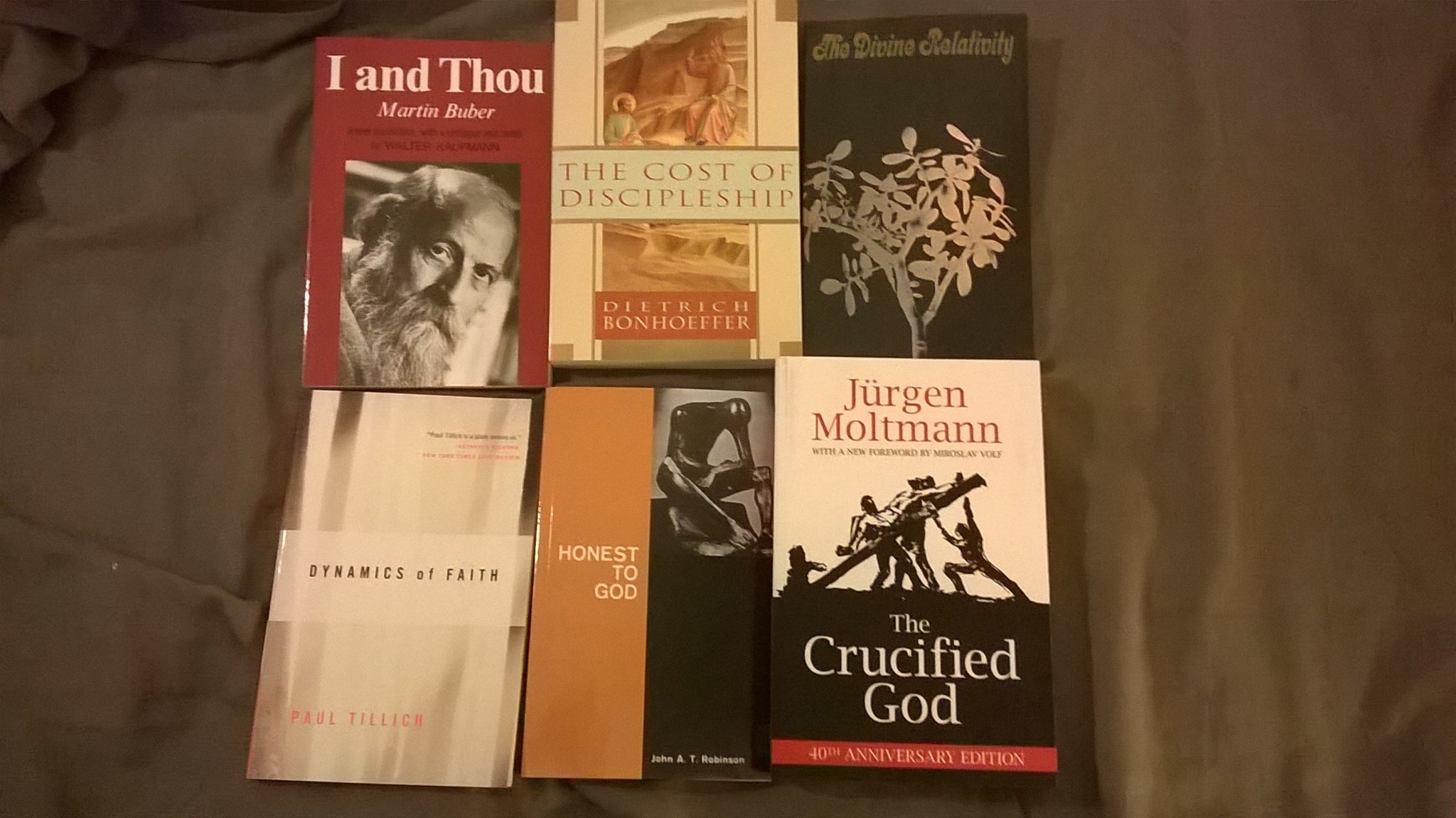 So, in addition to all this, I also was given the gift of a selection of books of my choice. I picked out six titles that are foundational texts in 20th century theology. I hope to read these along side my assigned texts, to get a better grasp on theological thought as I enter this new phase of life. My new list of books is:
I and Thou by Martin Buber
The Cost of Discipleship by Dietrich Bonhoeffer
The Divine Relativity: A Social Conception of God by Charles Hartshorne
Dynamics of Faith by Paul Tillich
Honest to God by John A.T. Robinson
The Crucified God by Jurgen Moltmann
I’m looking forward very much to all of this, and I can’t wait to share and engage here on my new learnings! Let me know what you think of my classes and reading materials.