
Looking for Jonah

I saw this headline the other day, while scrolling through Facebook. Like so, so, so many things having to do with our President, it made me angry, it offended my sensibilities as an American, a Christian, and a human being, and most of all, it just made me sad.

But it also made me think about the story of Jonah.

Anyone who grew up in Sunday school knows the broad contours of the story. God tells Jonah to do something, Jonah disobeys and runs away from God, a big fish (maybe a whale?) swallows Jonah for three days, during which time Jonah decides he’s sorry for disobeying God, the fish spits him out and Jonah goes and does what we he was told.

In this version of Jonah, the story is all about obedience and disobedience, not just of God, but also of our parents, our teachers, or really, any authority figure. Obedience to authority is a pretty important value for most parents, and this seems like a tailor made tale for teaching such a lesson.

But, this is a really shallow way to read the story of Jonah. There is a lot more going on here. There are a lot of different lessons to learn from this little book, and a lot better contemporary issues to apply those lessons to than whether or not Johnny is listening when Mom tells him no cookies before dinner.

Like, for instance, American imperial hegemony in the Middle East.

Stick with me here.

Jonah is a story that is obliquely about imperial hegemony in the ancient Middle East; in this case, Assyria is the hegemon. God asks Jonah to go to Nineveh, Assyria’s capital, to deliver a message of impending judgement and possible redemption to the Assyrians. And Jonah really, really doesn’t want to. Why is that? Because if you imagine Jonah being an American (and that’s a really problematic assumption we’ll return to), then the ancient Assyrians were like Iran, ISIS, or maybe more accurately, like imperial Japan. They had a mission of global conquest, and they were constantly attacking and invading ancient Israel. Over the course of a century, they invaded Israel at least three times, capturing the northern capital of Samaria, carrying it’s people off to captivity, and besieging Jerusalem.

So the Israelites really, really didn’t like the Assyrians. You can open to just about any pre-exilic prophet in the Old Testament and find some condemnation and judgement from God for Assyria.

So, imagine one day, you are chilling on your front porch with your dog and a some really good red wine, and then God goes:

“Hey, you, I want you to go to Tehran, and I want you to tell the Ayatollahs that I’m gonna destroy them.”

I imagine you’d be simultaneously like,

“Hey, great idea, God! Way to show those Iranians who is boss!”

and also “Wait, I can’t go to Tehran and do that, I’ll most definitely be arrested and thrown in an Iranian prison and I really don’t think that sounds great.”

And then God says, “Also, tell them if they repent of their violence, I’ll bless them and make a great nation of them,”

and now I imagine you aren’t thinking this sounds like a good idea at all.

You’d run away too, I imagine. Bless the Iranians? Or ISIS? Or imperial Japan? Make them a great nation? Not cool. They’ve all done some pretty terrible things, invaded places and beheaded people and made life pretty difficult for us. The destruction part sounds good, but the blessing, not so much.

But that’s the point. This story isn’t about obedience and disobedience (at least, not primarily.) Rather, this is a story about the universality of God’s redeeming love. As much as we want to think God’s love is mostly reserved for us good, church-going, tithe-paying Christians, it is simply not. God’s love, as we find in so many places in the Bible, cannot be contained or rationed. It extends to any and all people, no matter their transgressions, no matter their background or creed or problems. God showed love to tax collectors, to persecutors, to murderers, and even to Nineveh. So, chances are good that God also loves ayatollahs and jihadis and kamikaze bombers, just as much as he loves Presbyterians and Baptists and Methodists.

And that’s some really good news for us Americans, too. Because we need it.

Remember above, when we imagined Jonah as an American and I said that was a problem and we’d come back to it? Well, we are coming back to it.

Because, as much as we want to read a story like Jonah and imagine ourselves the hero, the fact is, we really aren’t.

In fact, in this case, America is more like Assyria.

Jonah isn’t getting sent from Akron to Aleppo. Most likely, Jonah is getting sent from Jalalabad to Washington, to deliver a warning of destruction and opportunity for repentance to us. In America, we are the ones in need of God’s love and grace. 

And that brings me back to that headline. It’s really gross and disgusting to see an arena full of self-proclaimed followers of the Prince of Peace cheering wildly at the idea of bombing the very part of the world that Prince hailed from. It’s also nothing new; America Christians were the biggest, most fervent supporters of an unprovoked war in Iraq, for death-dealing forays into Central America in the 80s, for the ill-fated effort to combat communism in Vietnam. This news item is only the most recent, and most blatant, example of the American-Christian war machine. And it is so blatant this time because we’ve been taught and conditioned for so long to associate the glory of Christianity with the success of American imperial power.

News flash: that’s not the Gospel. That’s kind of the anti-Gospel.

So, in the book of Jonah, we don’t get to play the part of Jonah. Instead, we are imperial Assyria, conquering Israel and carrying the people off and besieging their capital. We are the ones God’s anger is kindled against, the ones in danger of destruction, the ones in need of redemption.

In the book of Jonah, the Assyrians hear Jonah’s message. They repent. They wear sackcloth and cry out to God and are saved. They shelf their imperial arrogance and hubris, admit that being the biggest, most powerful country on earth, with the biggest, baddest military and the most money and the biggest egos hasn’t served them very well.

Let’s hope our Jonah shows up soon. Let’s hope we pay attention.
Why Should Christians Read the Old Testament?

The following is based on a finals project for a class I completed at Phillips this semester; for this paper, we are exploring the question of why the Hebrew Bible texts are important for Christians. I have reworked the paper for a public theology project for a different class, crafting it instead into a blog post. Enjoy!

The Hebrew Bible is an underappreciated corpus of texts in liberal and progressive Christian circles in the 21st century. The skepticism that greets the words contained in them is often well intentioned, but arises out of a deep misunderstanding of the texts, and even a deferral to a more conservative or fundamentalist-style reading of them. This is unfortunate, as the Hebrew Bible has much to offer progressive strands of Christian tradition, and those who count themselves as such should strive to reclaim them in pursuit of a more just and equitable world made in the image of the Kingdom of God.

Divine Violence in the Hebrew Bible

It is certainly true, on a very basic, narratively-minded level, that the Hebrew Bible presents an image of God distinctly at odds with the one many progressives hold; namely, that of a God more loving than angry, more merciful than vengeful, more justice-oriented than arbitrary and demanding, more rational and compassionate than unpredictable and quick to anger. The God we see in the Hebrew Bible does often seem violent and cruel. Just a few examples quickly highlight this. For instance, in the laws and instructions laid out in the books of the Torah, especially Leviticus and Deuteronomy, the Divine voice that is allegedly dictating these words commands the people of Israel to put to death violators of a variety of commandments, from the act of adultery (Deut. 22:22) to the act of working on the Sabbath day (Exodus 35:2,) to a child who disobeys their parents (Deut. 21:21.) God’s punishments for rule-breaking rarely seem to be proportional to the violation by modern-day standards.

Beyond the consequences of breaking the Torah instructions, God also makes violent appearances in the narrative sections of the Hebrew Bible. A most egregious example of an arbitrarily violent God is found in 2 Samuel 6:2-7; in this tale, the Arc of the Covenant is being transported on a cart when the ox pulling it stumbles. Uzzah, a man escorting the Arc, reaches out and steadies the falling Arc by touching it, and is immediately struck dead by God for a supposedly irreverent act.

Finally, another commonly cited text in accusing the God of the Hebrew Bible is found in the book of Joshua, when the titular character leads the people into Canaan. They are instructed to “possess the land” (Joshua 1:11), which is understood as meaning to commit Divinely-ordained genocide against the people already living there. And this is indeed what Joshua and the Israelites do, as is recounted vividly in the cases of Jericho (Joshua 6) and Ai (Joshua 8). As the account of the latter conquest states quite explicitly, “The total of those who fell that day, men and women, the entire population of Ai, came to twelve thousand. Joshua did not draw back the hand with which he held out his javelin until all the inhabitants of Ai had been exterminated.” (Joshua 8:25-26) Our modern sensibilities, rightly so, recoil at accounts of such barbaric genocide.

But to accept these stories of violence as the true actions and words of the Divine is not only to misread the Hebrew Bible, but is to accept an interpretation of such dictated by conservative and fundamentalist voices. It is an inherent contradiction of views to assert that the Bible was not in fact divinely ordained and thus a product of human hands and minds, while at the same time declaring these Hebrew Bible passages as describing an angry and violent God. One must consistently apply their hermeneutic to the entire Hebrew Bible, and understand that, just as Leviticus 18 does not carry binding weight towards the nature of same-gender relations in the eyes of God, neither does Joshua 8 definitively describe the will of God regarding violence.

Further, to reduce the Hebrew Bible to a set of passages of recounting  a violent and angry God, and thus essentially useless and discardable, is to miss out on what these texts do have to offer to progressive Christians. The Hebrew Bible is crucially important to those who consider themselves Christians, of any stripe, because it is a central current in the stream of tradition in which we count ourselves. This functions on two primary levels; the texts are crucial in that they are the paradigmatic lens through which we must interpret Jesus and the church that arose after him; they are also beautiful and instructive in their own right for any who seek the Divine, regardless of their impact of Christ and the early church. In this understanding, the violence found in the Hebrew Bible that is ascribed to God must be interpreted in the light of a people who lived in a violent world many thousands of years ago. In this contextual view, the Hebrew Bible takes its place as a progressive understanding of history and humanity, providing a view of the world shaped by the inherent goodness of people and an eye towards justice for the downtrodden and oppressed.

Reassessing the Hebrew Bible: Four Examples

Take the Psalms as a first example. Made up of 150 hymns, laments, and prayers of thanksgiving, this book is a beautiful glimpse into the worship life of the Israelite people. The theological breadth and depth of Psalms is astonishing, with these collections of works finding meaning and use in worship today, many thousands of years after they were first written and compiled. As Walter Brueggemann and Tod Linafelt write in their Introduction to the Old Testament, “…the Psalter is evidence of a long practice of Israel finding poetic, artistic ways to voice faith.” The desire to know and relate to God has never departed from humankind, and the Psalms are a beautiful collection of works that show the timelessness of such pursuits. The King James Version, another text so often derided in liberal and progressive Christianity, provides a particularly striking translation of the Psalms, and should be appreciated for its own inherent beauty.

Another text in the Hebrew Bible that stands alone in its theological complexity and ability to speak to modern sensibilities is Job. Brueggemann and Linafelt write, “It is no overstatement to say that the book of Job is a towering classic of the human literary and theological imagination.” The book presents itself ostensibly as a narrative of the tragic account of Job, who as a result of a wager between God and a figure known as “the Adversary” loses all he has, a series of poetic discourses between Job, his friends, and God grapple with the theological implications of suffering. The book doesn’t end definitively, leaving the reader to ponder whether or not God should exercise God’s power to act in such a way. The presentation of a God who takes and tests, and is thus subsequently rebuked and questioned by human beings, should be enticing and appealing to progressive Christians who look to question structures of authority and power. While certainly not a rejection of the authority and sovereignty of God, the book of Job is a powerful struggle to understand the Divine-Human relationship that carries much meaning in a world riven by injustice and oppression.

The Hebrew Bible is also important for anyone who considers themselves “Christian,” as it provides the primary lens for understanding the context of Jesus, and the church that arose around the memory of his life. Indeed, one cannot read the Epistles of Paul, or other texts such as Hebrews, without a familiarity with the Hebrew Bible and its implications. To read the New Testament without such knowledge is to court anti-Semitism, as Jewish tradition is subsumed by a western Christianity largely detached from the context in which it arose.

Jesus made a ministry of preaching justice to an oppressed people. His priorities did not arise in a vacuum. Rather, Jesus was living into a well-established Israelite tradition. The defining narrative of the Israelite people was (and is) the Exodus out from Egypt, as recounted in the Hebrew Bible book of Exodus. As a result of the story, the Israelite people understood their God as a liberating God, one who sets oppressed peoples free from bondage, and who rejects the structures of empire and power epitomized by Pharaoh’s Egypt. “The God who defeats the oppressive power of Pharaoh and who thereby emancipates Israel from slavery is characteristically the God who delivers from oppression,” Brueggemann and Linafelt remind us. Thus, in order to understand the import of Jesus speaking words of liberation against an oppressive empire, one must understand that he was necessarily alluding to the central narrative of the Hebrew Bible.

Out of this narrative of liberation and justice for the oppressed arises the tradition of the Israelite prophets, who make up the latter half of the Hebrew Bible. Again, to understand Jesus, one must understand that Jesus was stepping into the rhetorical tradition of the prophets. The prophets spoke to an Israel mired in injustice and exile, imploring them to act with justice, and promising the faithfulness of their liberating God. Likewise, Jesus speaks to a people occupied and oppressed, and presents a view of a world reordered to God’s liking. This is most explicit in the quoting of Isaiah attributed to Jesus, found in the Gospel of Mark. Isaiah, writing to an exiled people, promises God’s restorative justice, in the form of restoring those on the bottom to their dignity: “The spirit of the Lord God is upon me, because the LORD has anointed me; He has sent me as a herald of joy to the humble, to bind up the wounded of heart, to proclaim release to the captives, liberation to the imprisoned; To proclaim a year of the LORD’s favor and a day of vindication by our God; the comfort all who mourn…” (Isaiah 61:1-2). The author of Mark puts these words in Jesus’ mouth, in order to draw a parallel between the God who returned the exiles to Jerusalem, and the God who would deliver them from the Romans. In order to understand the mission Jesus felt called to, one must understand that he understood himself as working in the line of prophets stretching back a millennium.

Supersessionism and Responsible Reading

There is danger in this reading of the Hebrew Bible, of course. Supersessionism – the idea that “Christianity has fulfilled and improved on the teachings of Judaism” in the words of my professor, Dr. Lisa Davison, from a lecture she gave in January – is a dangerous habit of Christians, one that silences the authors of these texts and the faith tradition they were contributing to. I invoke Christianity here, not as the “proper” lens for understanding the Hebrew Bible, but in the illustration of the importance the authentic Jewish tradition has in shaping and forming the Christian faith. Christianity arose and formed in a primarily Jewish context; one only has to make a cursory reading of Paul or the Epistles to the Hebrews to see this. So, in order to understand and participate in the Christian tradition, an adherent needs to understand the Jewish faith; there is no better way to do this than to read and grapple with the Hebrew Bible. One shouldn’t replace or supersede the Hebrew Bible with the New Testament -there is no hierarchy of ideas here- but should instead recognize the inherent beauty, power and theological might of these texts, both for their own sake, and for how they help us understand our own faith that formed as a result of this wrestling with God.

Why should Christians read the Hebrew Bible? We should read it because, without these texts, there is no Christianity, no western civilization as we know it, no major monotheistic tradition apart from it. We should read it because we stand in a great river of tradition, and we must understand where we came from to decide where we are going.

Overwhelming Intimacy: A Homily for Maundy Thursday

I preached this homily last night at All Souls Unitarian Church, in Tulsa, for our first ever Maundy Thursday Foot Washing Service.

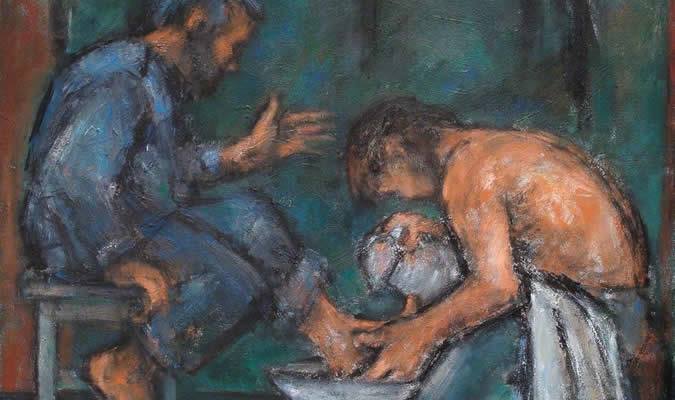
The Washing of the Feet by Ghislaine Howard (2004), Collection-Oxford Brookes University.

I know many of you aren’t used to seeing me up here during a worship service. I’m usually back there, and moving quickly between services on a Sunday morning. But I have done this before, just not here. I was a ministry intern, at East Side Christian Church here in town, and before that, I preached a few times at College Hill United Methodist in Wichita, and at Northwest Christian Church in OKC. And besides working here at All Souls, I am a full-time student at Phillips Theological Seminary, where I am getting my Masters in Theological Studies, with my area of focus being the development of theology in the early Christian church.

So all that to say, you are in good hands tonight.

And in more ways than one, because I know many folks are nervous about the concept of a foot washing ceremony; so let me also say this: I’ve done this before. Several times, in fact. And usually with youth groups. So never fear.

But that discomfort is what I want to focus on tonight. In the time since Joseph and I committed to doing this service, and began planning and executing it, the main reaction we have gotten from folks is one of discomfort. The idea of either exposing your feet and having them touched by someone else, or of touching someone else’s feet, is something that strikes most of us as something intensely intimate and vulnerable. And it makes us ask ourselves: do I want to be that vulnerable? Do I want to be that intimate with these people? With anyone really, anyone besides maybe our partner, or our children.

I know the answer for me, personally, is often “no.” Vulnerability and intimacy are things I struggle with immensely. Emotional depth, sharing intimately with others, wasn’t something I was brought up with, and so is something I’m inherently, almost to a fault, uncomfortable with. It’s not the fault of my parents; I didn’t have a poor, cold upbringing. On the contrary, my child was happy and I never doubted the love of my parents. But white Midwestern Protestantism isn’t exactly known for its expressiveness, and good rural Midwestern folks like my family aren’t known for talking about their feelings. Especially the men. They don’t call us for the “Frozen Chosen” for no reason after all.

But in a day and age when a striking proportion of white, middle America Christians voted for a politics seemingly of borders and boundaries and separation in our most recent election cycle, in a culture where individuality is often taken to a logical extreme of disengagement with those around us, even those closest to us, maybe we need more vulnerable, intimate, and uncomfortable practices in our lives.

I drew a lot of inspiration from an essay in this wonderful book, called “Christianity, Democracy and the Radical Ordinary.” It is a series of essays, letters and lectures between two men: one being Stanley Hauerwas, considered by some to be the preeminent Protestant theologian alive today, and the other being Romand Coles, a political philosopher and humanist thinker and writer. In this book, they explore the tension between democracy and Christianity, and how they can come together in unexpected and disparate ways.

In the essay I draw from, Coles is discussing the writings and practices of Jean Vanier, the French founder of the L’Arche communities, which are non-hierarchical, dignity-preserving homes for special needs adults, in which there isn’t a sense of “us and them” between the caregivers and the cared for. Instead, all are equal and full participants in the creation of the community, each with unique and wonderful gifts to give. Vanier uses the practice of foot washing in the community as a way of leveling the playing field, so to speak, breaking down any hierarchies and power structures through the radical and vulnerable practice of washing another’s feet. The word Vanier uses to describe the sense one gets from the practice, and I really love this, is “overwhelming.” Not bad overwhelming or good overwhelming, but maybe a bit of both.

And the practice is drawn from the Christian tradition, with Maundy Thursday being the night not just of the Last Supper of Jesus and his disciples, but also the night on which Jesus got down on his knees and washed the feet of his disciples during the meal. Needless to say, this was a bit outside of the cultural norms of the time. Coles quotes Rev. Paul D. Duke in the essay, who wrote of the disciples: (pg. 217)

“You can feel them squirming. Their embarrassment is palpable, as enacted by Peter. But the dread is not so much centered in how menial an act Jesus has undertaken for them, as in how painfully intimate it is…The indignity for the disciples resides in their teacher’s disarming initiative to touch them in this way, to bring himself so near and naked to their need, to apply himself to their private rankness, to cleanse for them what they would prefer almost anyone else to cleanse. No wonder Peter resists. He has signed up to follow Jesus, not to have unpleasantness at the foot of his life exposed and handled for him. He prefers the dignity of self-reliance, the fantasy of being heroic…Who can blame him? Who wants to be so powerless, so humbled?””

Who indeed?

But Jesus did this that night with intention. It wasn’t just a gesture, a throwaway act of “servant leadership” that we all hear so often about. Instead, what Jesus understood, and showed so often, was that the love that binds a community together, an authentic and full-natured love for your fellow human beings, isn’t found at arm’s length. It isn’t enacted over small talk during coffee hour or in line at dinner. The foundation of authentic community, that intimate love of neighbor that invokes a sense of shared purpose and direction, is only enacted through moments of deeply personal connection amongst members of the community.

Vanier writes, “A community will always need times of intimacy, just as it will always need times of openness. If it has only one or the other it will die.”

And those moments of connection, of intimacy build something; they are cohesive, like a good glue, that enables that community to hold together in times of stress and strain and tension, in order to continue being a group of people, together, doing good in the world as a whole.

Which, as Vanier says, are just as important. It’s a balancing act: a healthy community requires moments of inwardness, in order to feed moments of outwardness. He writes, “A community that isolates itself will wither and die; a community in communion with others will receive and give life.”

We do outward really really well at All Souls. Our justice teams attest to that. And honestly (And this is the Worship Coordinator in me speaking) we do inward really really well too, with beautiful worship and great moments of fellowship and togetherness.

But do we do intimate? Do we do vulnerable? I’m asking that as an honest question, not as a rhetorical one hinting that we don’t. Many people, I know, do in spaces like soulful circles, or ReWire and Shadz.

But sometimes, we need to get down on our knees, and touch the rankness at another’s feet. We need to wash, and be washed, by those in community with us. And in doing so, we break down walls we may have put up. We enter, each time, into a relationship with that other person, that is built on more than handshakes and conversations about local sports teams. And each of those little moments, one by one, build a foundation that our church, our community, sits upon, and which is awfully hard to shake or crack.

So that’s what I want us to get out of this act tonight. We are going to have our feet washed by one another. And its going to be uncomfortably intimate and vulnerable for many of us. And it;s going to also be overwhelming. But let it. Allow those walls to come down for a moment, and be in that close moment with the person sitting across from you, washing or being washed. And know: this is what community feels like.