Writing and Notetaking

One of the major impediments to my writing consistently (besides time, and energy, and inspiration, and…) is my note-taking and organization. I don’t really have a system for how I keep track of ideas and things I want to revisit and the like. I read articles on Substack and through an old school RSS feed, and in the New York Times and my Apple News app, and just randomly on the internet; but if one of those things piques my interest, I don’t have one spot where I can put them all, and attach notes (I’m often struck by a point while reading, but it doesn’t stick or come back if I don’t jot it down or attach it) or review them. And so I get a lot of ideas, but there is no way for me to systematically capture those ideas and revisit them later and then get them formed into something that allows me to write, either in short here, or at length on my Substack.

I am, however, trying to remedy this, and to establish a durable, user friendly system. Alan Jacobs has written multiple times about his system, and most importantly for me, he advises that you make a system, and you stick to that system for a substantial amount of time, in order to develop habits and really determine if something does or does not work for you. That’s what I’m doing. Here are the broad outlines of my plan, which will hopefully make this space and my Substack more fruitful:

  • using Google Keep to save articles and capture immediate notes
  • Once a week (likely Mondays) going back through those saved notes, organizing them, and begin to prepare them for writing
  • On that same day, going through my handwritten notes and books I’m reading for other notes and ideas
  • Publishing blog posts semi-regularly during the week
  • Publishing two Substack newsletters per week: one digest of blog posts and current reading, one longer essay (this may be more semi-regular than weekly)
  • Once a month, reevaluating and purging remaining notes that haven’t been published

I have no idea if this system will work. The biggest thing is going to be the weekly work of curating and collating. I’m hopeful that this will help better capture the ideas that come and go rather quickly, and give me some guardrails that allow me to shepherd ideas towards the page more consistently.
George Packer on the art and danger of writing

One thing I love thinking and reading about is the act of writing. I told my spouse recently that I first and foremost prefer to identify myself as a writer, and as one who struggles to overcome the tyranny of the blank page (what writer doesn’t, really?), hearing other writers describe their process, their thinking, their struggles, or their advice is very cathartic and encouraging to me.

So, all that to say, I cannot recommend George Packer’s recent acceptance speech for his Hitchins Award, published by The Atlantic, enough. I wish I could just copy and paste the whole damn thing here, because it is so good. But I’ll restrain myself, direct you to the full text, and just pull out a couple of good parts here.

For starters:

Politicians and activists are representatives. Writers are individuals whose job is to find language that can cross the unfathomable gap separating us from one another. They don’t write as anyone beyond themselves.

And this:

Among the enemies of writing, belonging is closely related to fear. It’s strange to say this, but a kind of fear pervades the literary and journalistic worlds I’m familiar with. I don’t mean that editors and writers live in terror of being sent to prison. It’s true that the president calls journalists “enemies of the American people,” and it’s not an easy time to be one, but we’re still free to investigate him. Michael Moore and Robert De Niro can fantasize aloud about punching Donald Trump in the face or hitting him with a bag of excrement, and the only consequence is an online fuss. Nor are Islamist jihadists or white nationalists sticking knives in the backs of poets and philosophers on American city streets. The fear is more subtle and, in a way, more crippling. It’s the fear of moral judgment, public shaming, social ridicule, and ostracism. It’s the fear of landing on the wrong side of whatever group matters to you. An orthodoxy enforced by social pressure can be more powerful than official ideology, because popular outrage has more weight than the party line.

And, finally, his closing:

Writers in other times and places have faced harder enemies than a stifling orthodoxy imposed across a flimsy platform. I have no glib answers to ours. What I can say is that we need good writing as much as ever, if not more. It’s essential to democracy, and one dies with the other. I know that many readers hunger for it, even if they’ve gone quiet. And I know that many writers and editors are still doing this work every day. Meanwhile, whatever the vagaries of our moment, the writer’s job will always remain the same: to master the rigors of the craft; to embrace complexity while holding fast to simple principles; to stand alone if need be; to tell the truth.

The art of writing, of crafting ideas and then putting them on paper, is indispensable in a democracy, and its increasingly fraught and under attack from both ends of the political spectrum. Packer captures it perfectly in his speech. Go read the whole thing.

On Being a Writer

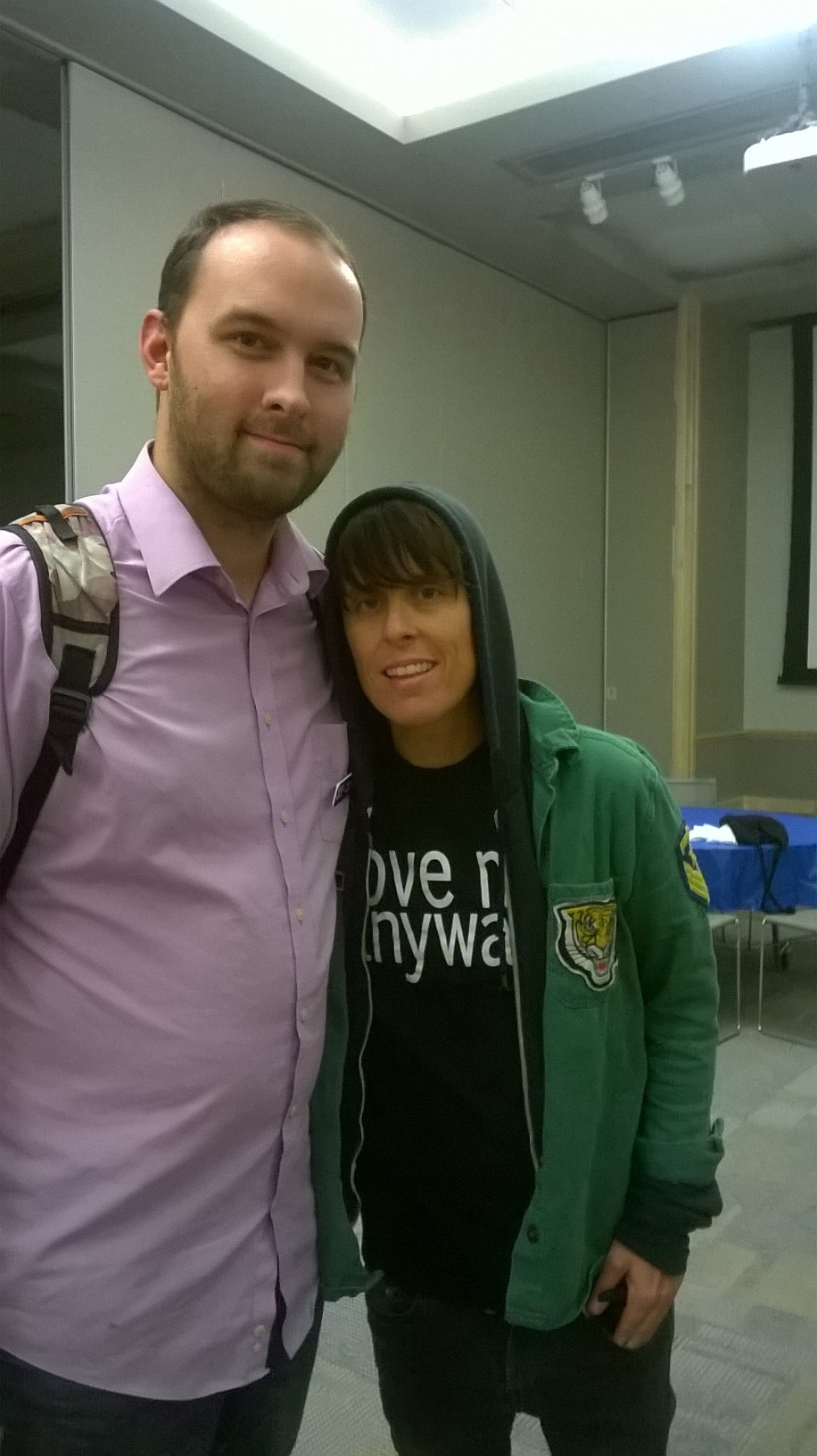
I had the opportunity to meet and learn from the poet and social activist Andrea Gibson this last week, as a result of the hard work of some of the students at the Little Blue House at TU, where I work. They brought them* in to perform and give a writing workshop. It was an amazing two days.WP_20151015_21_44_53_Pro

If you haven’t seen Andrea perform spoken work poetry, look them up on Youtube. It’s amazing. But I want to just ruminate on the workshop, and some thoughts I had as a result.

Andrea, at the beginning of the workshop, asked who called themselves a writer and I raised my hand. Being a pastor (or a pastor-in-training, in my case) is in large part being a writer. For me, the blogging I do here is so important to my development as a spiritual leader, and I don’t intend to ever stop writing in a public forum like this. It hones my arguments and makes me think things through, as well as sharpens my writing skills.

Doing sermons is also, in a large part, writing. Taking the time to sit and craft a message, and do it in a way that is accessible and interesting and coherent; that is what sermon writing is all about. I take pride in my sermons, and I want each one to make sense, to tie together beginning and end, to be something people want to hear and read again.

And, the way I like to preach, it also becomes something of a performance. I’m not a stand-behind-the-lectern kind of person; I like to walk and gesture and interact with the congregation. I generally have my notes on a small music stand in front of me. I want to bring that element of performance into giving a sermon, because I want my sermons to be more than just an academic lecture. I know that I have a tendency to get technical and long-winded at times, and so by making it engaging by my presence and cadence, I can pique interest and hopefully fill someone’s senses in a way that they feel enlightened and reenergized by what I am saying.

Seeing Andrea perform, and also recently Evan Koons and Rob Bell, it confirms for me that speaking in front of people is something I want to do for the rest of my life. It feels right, you know? And just the opportunity to not only teach and convince, but also to perform in a way that touches people, there is such value in that.

And finally, for me, I want to continue on into my doctorate and write and teach and speak one day, and so being a writer is, in reality, the career path I have chosen.

Writing has forced me to be more introspective and vulnerable, to make sure what I believe and think is rational and coherent and accessible. And I’ve come to realize that when I say I want to be a pastor, that I want to give sermons and teach and lead, that I am in essence saying I want to be a writer.

I’m not really going anywhere with this, other than just to get some thoughts down in writing for future contemplation, and for public feedback. Thoughts?

*Andrea is genderqueer, and does not use gendered pronouns, preferring to be addressed as “they” or “them.”