
It is a great pleasure for me to remember such good and kind people and to talk about them, although I no longer possess any details about them. I just remember their kindness and goodness to me, and their peacefulness and their utter simplicity. They inspired real reverence, and I think, in a way, they were certainly saints. And they were saints in that most effective and telling way: sanctified by leading ordinary lives in a completely supernatural manner, sanctified by obscurity, by usual skills, by common tasks, by routine, but skills, tasks, routine which received a supernatural form from grace within, and from the habitual union of their souls with God in deep faith and charity.
Their farm, they family, and their Church were all that occupied these good souls, and their lives were full.
Thomas Merton, The Seven Storey Mountain
Tag: Thomas Merton
this is the meaning of all created things
I’m reading Thomas Merton’s The Seven Storey Mountain for the first time, and enjoying it so far immensely. I imagine I’ll have a lot to say about it in the future, but for now, I just wanted to share this wonderful passage that stood to me, from early in the book. Merton here is describing the French town he and his father settled in during the late 1920s, Saint-Antonin-Noble-Val:
Here, in this amazing, ancient town, the very pattern of the place, of the houses and streets and of nature itself, the circling hills, the cliffs and trees, all focused my attention upon the one, important central fact of the church and what it contained. Here, everywhere I went, I was forced, by the dispostition of everything around me, to be always at least virtually conscious of the church. Every street pointed more or less inward to the center of the town, to the church. Every view of the town, from the exterior hills, centered upon the long grey building with it high spire.
The church had been fitted into the landscape in such a way as to become the keystone of it intelligibility. Its presence imparted a special form, a particular significance to everything else that the eye beheld, to the hills, the forests, the fields, the white cliff of the Rocher d’Anglars and to the red bastion of the Roc Rogue, to the winding river, and the green valley of the Bonnette, the town and the bridge, and even to the white stucco villas of the modern bourgeois that dotted the fields and orchards outside the precinct of the vanished ramparts: and the significance that was thus imparted was a supernatural one.
The whole landscape, unified by the church and its heavenward spire, seemed to say: this is the meaning of all created things: we have been made for no other purpose than that men may use us in raising themselves to God, or in proclaiming the glory of God. We have been fashioned, in all our perfection, each according to his own nature, and all our natures ordered and harmonized together, that man’s reason and his love might fit in this one last element, this God-given key to the meaning of the whole
Oh, what a thing it is, to live in a place that is so constructed that you are forced, in spite of yourself, to be at least a virtual contemplative! Where all day long your eyes must turn, again and again, to the House that hides the Sacramental Christ!
What a thing indeed! May we all be blessed to dwell in such a coherent landscape, of both the world and the mind.
The Bookshelf: “Called to Community”
Intentional Christian community is a way of living that my wife and I have been interested almost as long as we have known each other. Some of our earliest experiences together were attending a talk by Shane Claiborne, one of the leaders of the New Monasticism movement, and visiting Dr. Elaine Heath’s New Spring Communities in the Dallas-Fort Worth area for three days.
As a result of these experiences, and through reading and study, we’ve always had a goal of participating in intentional, missional Christian community. During our time in Tulsa, this goal has come closer and closer, as we have gotten involved with those pursuing the same here. Recently, we have begun looking at places to live in Turley, an unincorporated town just north of Tulsa that is hit hard by poverty and blight, and where the Third Way Foundation, led by UU Rev. Ron Robinson, has begun this missional model. Intentional living is finally within reach for us, the culmination of almost seven years of searching and discerning and hoping.
So receiving the latest book from Plough Publishing in the mail a few weeks ago was an unexpected, much appreciated surprise. Called to Community: The Life Jesus Wants for His People is a compliation of essays from a variety of Christian figures across the centuries. Divided into 52 chapters focused on specific topics (for instance, “Vocation”, “Transparency”, or “Money”), the book is designed for communal reading weekly for a year.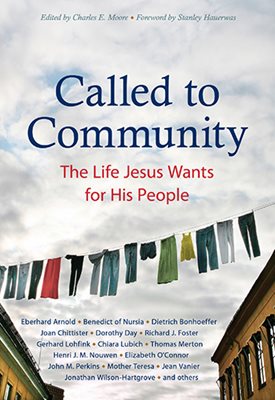
Obviously, I didn’t go the weekly route; I read it straight through. In doing so, I came to understand that reading it slowly, topic by topic, is what I really would suggest; there is not a narrative theme, so it can start to bog down in a straight read, especially if you are running through chapters that don’t speak to you.
That said, I found Called to Community a great resource, one I intend to keep close at hand as we move into intentional community. The variety of voices represented here (ranging from Dorothy Day to John Perkins to Dietrich Bonhoeffer to Thomas Merton), writing from experience on the things any Christian community will run into are invaluable. So many new ideas and questions came to me as I read and contemplated our move.
If you are involved in a missional community, or if you are contemplating it, or if you just want to know how to maximize the sense of community in your local congregation or prayer group, Called to Community can be a priceless, and much used, resource on your shelf. Not necessarily as a single read, but as a collection you can call upon in a variety of situations as you navigate life with others. Give it a read.
 Justin DaMetz