During the month of April, I’ve been leading a Sunday school class for adults at my church, titled “St. Paul: Friend or Foe?” The premise of the class is a defense of the apostle Paul against some of the critiques he gets from more progressive voices, especially around his tempering or blunting of Jesus’ ethical teachings. Any reader here knows that Paul is a particular passion of mine, and this kind of defense is one I’ve engaged in before.
For those interested, here is video of the second class, on Paul’s theology. Through the lens of seven key concepts – cruciformity, covenant, freedom, the theological virtues, justification, participation, and countercultural ethics – I show how Paul’s theology is a well thought out scaffold that comes together as an inclusive, love-centered whole. Give it a watch, and click the link below to view week one, which was a basic biographical look at who Paul was and what he wrote.
As I alluded to at the end of the last essay, we are at a turning point in this series, when we begin to turn from an extended critique of “effective” Christianity, and towards a vision of a politics of charity. In doing so, Hauerwas beautifully lays out two stories from the Gospels, and links them together in a breathtaking way to make the following case:
“What charity requires is not the removing of all injustice in the world, but rather meeting the need of the neighbor where we find him.”
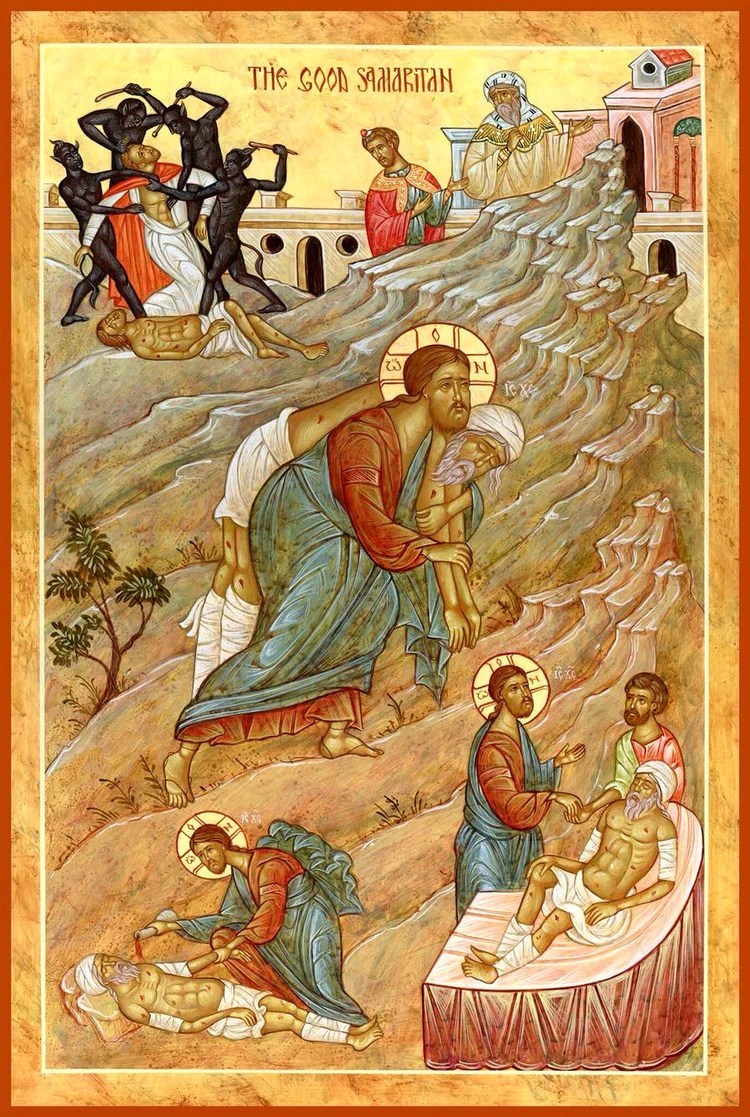
Meeting the need of the neighbor where we find him. Here we find not just the center of Hauerwas’ argument in this chapter, but the center of the Gospel message. To show us what meeting the need looks like, Hauerwas gives us a passage from the Gospel of Luke that encompasses two stories: Jesus’ telling of the Parable of the Good Samaritan, and the story of Mary and Martha. I’ll follow his lead and post the verses in full here:
On one occasion an expert in the law stood up to test Jesus. “Teacher,” he asked, “what must I do to inherit eternal life?” “What is written in the Law?” he replied. “How do you read it?”He answered, “‘Love the Lord your God with all your heart and with all your soul and with all your strength and with all your mind’; and, ‘Love your neighbor as yourself.’” “You have answered correctly,” Jesus replied. “Do this and you will live.”
But he wanted to justify himself, so he asked Jesus, “And who is my neighbor?” In reply Jesus said: “A man was going down from Jerusalem to Jericho, when he was attacked by robbers. They stripped him of his clothes, beat him and went away, leaving him half dead. A priest happened to be going down the same road, and when he saw the man, he passed by on the other side. So too, a Levite, when he came to the place and saw him, passed by on the other side. But a Samaritan, as he traveled, came where the man was; and when he saw him, he took pity on him. He went to him and bandaged his wounds, pouring on oil and wine. Then he put the man on his own donkey, brought him to an inn and took care of him. The next day he took out two denarii and gave them to the innkeeper. ‘Look after him,’ he said, ‘and when I return, I will reimburse you for any extra expense you may have.’ “Which of these three do you think was a neighbor to the man who fell into the hands of robbers?” The expert in the law replied, “The one who had mercy on him.” Jesus told him, “Go and do likewise.”
As Jesus and his disciples were on their way, he came to a village where a woman named Martha opened her home to him. She had a sister called Mary, who sat at the Lord’s feet listening to what he said. But Martha was distracted by all the preparations that had to be made. She came to him and asked, “Lord, don’t you care that my sister has left me to do the work by myself? Tell her to help me!” “Martha, Martha,” the Lord answered, “you are worried and upset about many things, but few things are needed—or indeed only one. Mary has chosen what is better, and it will not be taken away from her.”
Luke 10:25-42, NIV
Hauerwas draws a remarkable link between these two seemingly very different stories: “This is just our task, to go and do as the Samaritan did, for it is through such doing, a doing that may appear remarkably ineffective like Mary’s inactivity, that God shows us how to serve the neighbor in a manner appropriate to his kingdom.”
This is a stunning conclusion, and just really showcases how good of a theologian Hauerwas is. Often, these two stories are disconnected, held on their own as separate tales with separate messages. But Hauerwas here maintains the integrity of the Gospel, reading them as the first readers would, without headers and verse numbers and paragraph breaks. Indeed, they are stories that feed off one another. Let us unpack the linkage a bit more, to try to more fully get at the power of the point Hauerwas is making.
Every Christian is familiar with the story of the Good Samaritan; it is a staple of church life in America. Often, it is a story presented as an example of how we are to serve our neighbors, even those we don’t know or may be inclined to dislike. In more progressive circles, it also carries the added valence of a social and ethnic criticism, as we see the “respectable” figures of the priest and the Levite turning their nose, but the foreign Samaritan filling the role of the Savior here. I don’t think there is anything wrong or bad about these readings. They are quite honorable distillations of Christ’s intent.
That said, what Hauerwas draws out is fascinating, and makes his larger point well. Remember, this series, like the chapter it draws from, is about the juxtaposition Hauerwas makes, between the politics of charity and the politics of effectiveness. So how does this dichotomy come into play here? By including the story of Mary and Martha, we can see how. Mary gets criticized by Martha for not helping Martha prepare the dinner for their guest; Jesus, however, redirects Martha’s anger, reminding her that all the trappings and duties society and the world places on her as hostess are of little import in God’s kingdom. What he needs it not her skills in preparing a meal and presenting a home. Effectiveness, Jesus says, is not the point. Discipleship is.
So, too, in the Good Samaritan. Read through the lens of the antecedent story, we see here another example of discipleship as charity, as ineffective action, over effective. In the story, while the Samaritan is good and correct to take the man to an inn, to care for his wounds and pay for expenses, wouldn’t he also be obligated in some way to address an injustice, to ask questions as to why this happened, why this stretch of road is treacherous? Where are the authorities? How can the local society address the problem of rampant crime and the attendant fear?
To my mind comes the story of the man who, working alongside a river, sees a baby floating down from upriver. He saves the baby from certain drowning, only to see another, and another. Saving the babies is good, the parable tells us, but the man must then go up river, to stop whoever is throwing babies in. Justice demands it.
And that’s right! Justice does! We would be foolish to ignore the cause of something as shocking and heinous as that! But what about in this story of the Good Samaritan? Why does the Samaritan, in all of the time taking care of the man, never ask, “how did this happen? Who is responsible?” Instead, the Samaritan pays the innkeeper and goes on with his business.
To extrapolate this story out to the dilemma of justice and injustice in the world, it becomes natural to ask the question, if we see injustice, how do we stop it? If we are called to be the Samaritan (and obviously Jesus intends that we are), then what must our actions be? Surely, saving and tending to the hurt, yes, but aren’t we also called to go further, to identify the injustice, and then set about the hard, concrete work of fixing it?
Per Hauerwas’ reading of these stories, I don’t think we always are in every situation. Instead, seemingly ineffective action can become our duty as disciples. Think back to Hauerwas’ summary statement, and specifically the last clause:
“God shows us how to serve the neighbor in a manner appropriate to his kingdom.”
Appropriate to his kingdom. That is the key. Yes, pursuing structural justice is a natural inclination. But, I think one of the things we are to learn here is that, as disciples of Christ, as members of the community called the Church, that isn’t our primary task, because God’s effectiveness is not the world’s effectiveness
God’s effectiveness looks like stopping, showing compassion, caring for the hurting, not at an abstract level, but at the most intimate and personal of levels, in the blood and dirt and muck of the world. We don’t know that that priest or that Levite, after going on their way, didn’t then think “We need safer roads; I will work to make it so.” It’s very possible one of them might have! But what neither of them did was stop, and care.
One thing that is important to remember is that our focus on large policy fixes to problems we see in the world can often serve just as effectively as ways to insulate ourselves from the really hard work of loving our neighbor, not in some abstract way, but face-to-face, in a manner that is costly to us. Worldly effectiveness can shield us from the messy relationship-building that charity would demand of us.
What this story is telling us, as shocking and scandalous as it may seem, is that the charity we are called to as followers of Christ is the work of caring for one another, for showing our love to our fellow beings in our willingness to stop, notice, and heal when we see a hurt or a wrong.
Still, you may be asking, what about all that injustice in the world? No one can deny it, and surely we aren’t called to ignore it, right? I agree, we are not. So how do we adapt the work of charity, of stopping and loving and spending the time with another human being, into something that can address the injustices of the world? That’s where we turn next.
In the last essay in this series, we walked through two alternate and opposed readings of the Gospel of Luke, and specifically, how God’s work in the history of the world is interpreted. As we saw there, God does not call us to be agents of effective action in our work for justice and peace; rather, God calls us to be agents of love, through the works of charity. As I pointed out back at the beginning of this series, this is a seemingly controversial and radial statement to make in progressive Christian circles, where charity is viewed so often as a band-aid of sorts, slapped over the hurts of the world with some view to curing, but mostly with the intention of covering up and ignoring. While this instinctual suspicion is not wrong, considering how charity has come to be weaponized in our capitalistic world as a tool against just social change, Hauerwas is calling us to a different, deeper and more holistic understanding of what charity should be for the Christian concerned with social justice.
Today’s post builds on the last: if we accept that the work of making history come out right is God’s work, and not ours, then how can we know God’s work when we see it? As we noted last time, too often God’s name is applied to a range of works and deeds that are completely anti-Christian and against what God desires for our world. This makes things very confusing! How are we limited human beings supposed to identify God’s work in the world?
Luckily, we have an example, by looking at God’s very own self in the form of Christ, and the work Christ did for us, as laid out in the Gospels. Want to know what God’s work in history looks like? Read the Gospels. Want to know what grafting our story into Christ’s looks like, what kind of concrete action is required of us if we are going to be called “Christians?” Read the Gospels. Christ is a living, breathing example of not just God’s work in remaking all of history, but in what kind of work we are called to do alongside God.
Hauerwas begins by pointing out that is would be natural for us to assume that, because God’s task of setting the world right is so big, it naturally requires the mechanism of power, and thus, we like to think this must mean that Christians are called to seize the levers of power, or to at least ally with those who control them. As Hauerwas illustrates so well, “it is natural to assume that Christ should have gone straight to the top – if not Caesar, at least Pilate…Or at least, failing there, then Jesus should have gone to the Left – the Zealots or some other group of revolutionists who opposed Caesar and Pilate.”
But, as we see in the Gospels, this is not the path Christ took in his work of remaking the world. “Instead,” Hauerwas writes, “we notice in Luke it is emphasized that Jesus came to the poor and the sinners.” And further, “Jesus in Luke is almost exclusively concerned with the poor.” The first and greatest clue to how Christians are called to be in the world is to see that Christ spent his entire ministry among the poor, among the oppressed, among the sick, among the foreigners, among the unclean and unwelcome.
On the other hand, it’s not like Jesus hung out with the poor, but ignored the rich and powerful. Oh no. Hauerwas points out, “it is to the poor that the good news comes, not those of strength or wealth. Indeed, it is exactly the latter who are in deep trouble as their wealth and strength gives them the illusion they can be safe in this world. Thus Christ says with no qualification, ‘none of you can be a disciple of mine without parting with all his possessions.’” Jesus’ choice to live among and for the poor is also an active commentary on the rich and powerful; the poor are chosen, while the rich are not, to host the presence of God in the world.
But why the poor? If God is remaking the history of our world, wouldn’t it make more practical sense to reshape the loci of power? I mean, hanging with the poor is great and all, but if you really want to make change happen, shouldn’t you be influencing power, rubbing elbows, making policies, focusing power? But, again, with God, it’s not about practicality, or effectiveness, or “getting results”, at least as the world would count those things. God is with the weak because in the weak, the poor, the powerless, and the meek, we most clearly get to see what God is like, and what God wants for the world. Hauerwas writes, “what we see involved in Christ’s concern for the poor and the weak is how God chooses to deal with history, namely, through the weak. But what he does for the weak is not make them as the world knows strength, but rather provides us with a savior who teaches us how to be weak without regret.”
Weakness is the key. Effectiveness is eschewed, because weakness is not effective according to the power hierarchies of the world. And thus, our work of charity in the world becomes not about what we can achieve, but about the goodness of doing a kind deed for someone else for the sake of itself. “For we cannot give charity if we think that charity is a means to renew the world – that is, if charity is justified by its effects.” To do charity without the intention of acting with love, but with the intention of using that charity for a greater end is to turn that human being you are serving into a means to an ideological end. This is the key point on which this all turns. Just as Christ was offered all of the effective means to change the world in the Temptations, if only he would willingly sacrifice a small measure of his dependence on God, so we are called to turn away from the lure of easy, assured fixes if they cause us to stray from being a part of the story of Christ.
This seems like a rather hopeless fate for Christians. If we aren’t supposed to work with the goal to make the world a better place, what’s the point of social action? Wouldn’t we just be better off being nice to others and minding our own business? Not at all. Our ineffective stance towards the world has purpose: it makes us a part of God’s story, as witnessed in Christ. “What we are offered in Christ is a story that helps us sustain the task of charity in a world where it can never be successful…We are freed in this respect exactly because we know that charity is not required in order to justify our existence, to rid us of guilt, but because it is the manner of being most like God.” We are charitable, meek, loving, weak, ineffective because that is the form God took when God came into the word and took human form. God was not concerned with effectiveness when embodied as Christ; if that would have been the case, I doubt God would have been content with dying an early and violent death! To quote Hauerwas one final time:
“For we are commanded not to be revolutionaries, or to be world-changers, but simply to be perfect.”
One of the most powerful theological concepts out there is the idea of kenosis. Kenosis is a Greek word applied to Christ, which literally means “the act of emptying.” It derives from the great hymn of Philippians 2, specifically verse 7. Here is the context:
5 Have this mind among yourselves, which is yours in Christ Jesus, 6 who, though he was in the form of God, did not count equality with God a thing to be grasped, 7 but emptied himself, by taking the form of a servant, being born in the likeness of men.
Christ emptied himself, he made himself nothing, in order to do not his own earthly, human will, but in order to let God’s will enter him and guide his actions. Paul exhorts us in this letter to do the same: “Have this mind among yourselves.”
I think an understanding of kenosis can help us start to make sense of what Hauerwas is doing in this essay. For so many of us, the drive to make the world better, to fight injustice, to do the work of changing things becomes an overwhelming urge. Not a bad one, mind you, but one which over time becomes less and less about God’s will and more about our own. Be honest. When you go out to work for social justice, are you opening your spirit to God, asking God which direction to lead, and emptying yourself so that God’s will – whatever that may be – can guide you? Is it about a humble, self-effacing, empty way of encountering the need in the world? Or have we got the answers, got all the plans? Are we looking for those social media opportunities, so we can let the world know what is happening, what we are doing?
Emptying ourselves means letting go of the need to have control over what history looks like. It means not having all the answers. It means listening for the still, small voice of God that directs all of creation towards its fulfillment. It means simply showing up, being present to those near us, and acting with a kenotic love and charity towards those we encounter, not in the hope of reshaping the world in the image of some abstract idea of justice, but instead, just because it is the best, most Christ-like thing to do right in that moment. No, it probably won’t be systematic and organized all the time. But that’s ok. Faith means we trust that God can use each little moment of genuine love and connection among us to craft a better world for all.
Now, I can still feel all my fellow progressives and social justice-minded folks squirming at best, or more likely feeling disgusted or dismissive at this point. And let me tell you, I feel you. If this is where the chapter ended, and where Hauerwas stopped speaking, I would be too. But we aren’t done! Our next essay will be one more Scriptural illustration of this dichotomy between effectiveness and charity before we dig into the meat of how being ineffective still leads us to fighting against injustice, against suffering, and against oppression. Stick with me.




 Justin DaMetz