I mentioned this briefly in my Status Updates newsletter that went out yesterday1, but I just wanted to expand on my thoughts here briefly. I am really enjoying the new Star Wars series on Disney+, Andor. (Some minor spoilers follow here for those who haven’t watched yet.)
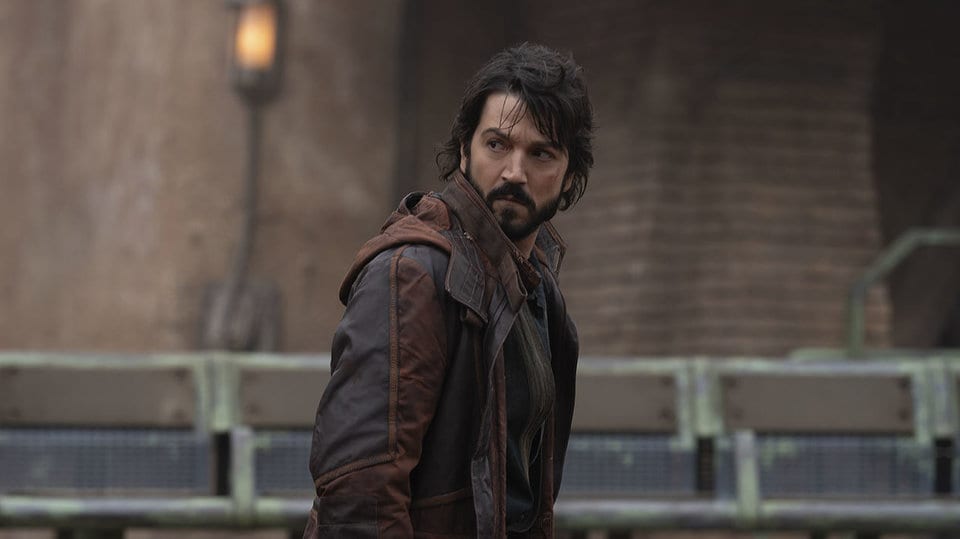
Diego Luna, who plays the title character
The story follows Cassian Andor’s entry into the burgeoning Rebellion, years prior to the events of the equally good Rogue One. The series is being presented as a more “adult” take on Star Wars, with a darker story, more mature themes, and just an overall much more serious tenor. It is a classic spy thriller, and honestly one could be forgiven for not even realizing this takes place in the Star Wars universe until several episodes in. We don’t see stormtroopers, lightsabers, classic battle ships, or hear familiar strains of orchestral music until episode 4 at the earliest, and even there, its all very muted and distant. The story stands alone really well, and while I’ve seen some criticism about this from fellow Star Wars fans, I actually really like it. The galaxy is a big place. Life in places looks different than life in other places. It is completely conceivable to me that on an mid-to-outer rim world like Ferrix, life would have its own rhythms, and the absence of the Empire in favor of a corporate security presence is very plausible. Its not that I don’t want more “classic” Star Wars stuff; I love Mandalorian and Kenobi and the other Star Wars content that scratches all those itches and includes all the Easter eggs and callbacks. But its just really cool to see something very different.
We are five episodes in, and the first three episodes in particular really stood out to me. There is a coherent storyline that makes them all feel like a movie, and they climax in a showdown where the tension builds and builds at the end of episode three that is unlike anything I have ever seen in Star Wars. It was riveting, and three weeks on from first watching it, I am still thinking about it a lot. It was just fantastic film making, which for all its glories and successes, it not something that is often said about Star Wars.
I am, all in all, a big fan of what Star Wars has become under Disney. I was a Star Wars fan before, and have only seen my love for that world grow as a result of everything we have gotten over the last seven years. I see old SW heads still complaining about all the Disney stuff, and I just think to myself, aren’t we supposed to be having fun? Isn’t this imaginary world of spaceships and lightsabers and aliens and robots supposed to be something we enjoy taking in, and something we should be overjoyed to get more of? How lucky are we, after all the years where all the Star Wars we had was the original films and a handful of less than stellar novels and comic books, to now have new Star Wars material to take in month after month! We get these really well done shows, we get some stellar novels, including the fascinating new High Republic stuff, we get some really well done video games, and even the comics are really enjoyable (and I say that as someone who is not really a comic book person at all.) This should be fun. God knows there is enough dreariness out there. Let’s enjoy2.
Anyways, I’ll get off my soapbox. Andor is good, really really good, and even if you are not a Star Wars fan, it is the kind of thrilling sci-fi – spy thriller that anyone who loves a good story can get behind. I can’t wait to see more.
1 Are you subscribed to my newsletter? No? Well, you should be! There is a lot of good stuff happening over there. Its free, check it out!
2 All of this paragraph also applies to Tolkien and the new Rings of Power series, which I am loving as well. I may write about that more soon.
I am a huge Star Wars fan. It started very young for me; I was an early reader as a child, and one of the first books I read (I kid you not) was the official novelization of The Empire Strikes Back, by Donald F. Glut, in about the second grade. I had so many Star Wars books and comics and toys growing up, it was kind of ridiculous, and I still have a pretty extensive book and comic collection (mostly Legends stuff, but working on collecting the new Canon stuff.)
I also have loved all the new Star Wars stuff from Disney. I think the sequel trilogy is great (yes, even The Rise of Skywalker – more on that below), and both Rogue One and Solo are near the top of my rankings of Star Wars movies. I love The Mandalorian, and I can’t wait for future series and movies. And, for the first time, I am working my way through The Clone Wars, Rebels, and Resistance television series.
One of the best parts of being a dad is the opportunity I’ve had to turn Julian into a Star Wars fan as well. I’ve been able to take him to every move in theaters, which is one of my prized experiences of being his dad. And I love watching him become more and more interested. This last December, I took Evelyn along to see The Rise of Skywalker as well, and having strong female heroes like Rey is so good for her. Being a Star Wars fan as a kid was a big part of childhood for me, and getting to being a Star Wars dad now is even better. Along with Lord of the Rings, Star Wars is my favorite section of nerd-dom to inhabit.
(Quick obligatory aside on Rise of Skywalker: I loved it. I had so much fun going to see it in theaters twice. I know there are problems with the story, and inconsistencies, and yes, there are story choices I wish they had made differently. But anytime I watch it, all those reservations wash away. Like the rest of this last trilogy, the movie is just so dang fun. I’ll take it over any of the three prequels any day. And don’t start talking to me about things that “aren’t realistic” or “illogical” story lines: this is a space opera about laser swords and telekinesis ninjas and faster-than-light space travel. Come on y’all. Chill, and have some fun.)
As a theologian, I also have enjoyed starting to think about the stories and themes in Star Wars along theological lines. There is a lot of stuff to unpack, especially around the Force, the conflict between the Jedi and the Sith, and the ethical and socio-political decisions and failings of the Jedi Order that paved the way for Palpatine and the Empire. Star Wars is our modern day myth, and myth always contains truth and glimpses of the priorities and beliefs of the people who create and sustain them.
But the biggest idea I’ve been playing around with when it comes to Star Wars and theology is about narratives and finding one’s place in a bigger story. One of the big through-lines in the Skywalker saga is that of unassuming, seemingly minor outsiders finding their place in the galaxy’s story. It starts with young Anakin Skywalker, a slave boy far beyond the Republic, on the Outer Rim world of Tatooine. Anakin dreams of being more than a slave, of escaping his home and traveling the galaxy. He has heard stories of the Republic, and the Jedi, and he longs to be part of that story.
Like his father before him, Luke Skywalker also looks up at the Tatooine sky and imagines more for himself. Having grown up with vague stories of a father who was a pilot during the Clone Wars, Luke harbors his own desire to become a pilot among the stars, to live into the family story he knows deep down in his being. When he meets Obi-Wan, and hears about the Jedi, this desire grows even deeper.
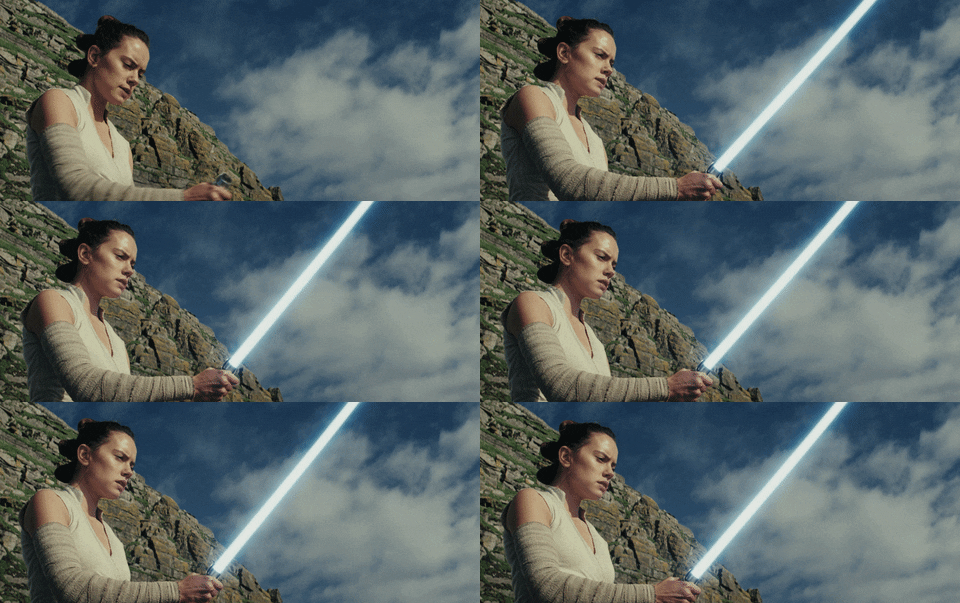
Finally, Rey carries on this legacy, on her own desert homeworld of Jakku. A scavenger and virtual slave, she too looks at the sky, and knows of vague stories of Jedis and Luke Skywalker and great battles. She holds vague memories of parents abandoning her, and feels deep down that those parents were important players in the story she knows; she, too, wants to make her mark on that story.
Through these heroes, we see a common theme: the drive to be more than the world (or the galaxy) tells them they are, to be a part of a bigger, more ancient story. All three grew up hearing just hints and rumors of the Jedi and the Republic and all that was happening at the center of the galaxy. And all three want to make their mark on galaxy, by writing their own chapters in the story of the galaxy. They must all leave their homes behind, and make sacrifices that include times of family, comfort, or friends, to go pursue that calling. Once in it, all three also find themselves challenged, tempted, tested, and most of all, accepted into the story of Jedi and the way of life if it prescribes for them.
For Anakin, his acceptance into the story of the Force is conditioned by his age and his anger, and he constantly hears worries from those around him about these things. What he also hears is that is the Chosen One, the central figure of this story, the one who can bring balance to the galaxy. Eventually, Anakin falls victim to his worst impulses, and alters the story in ways no one could have ever imagined. His fall, the central tragedy of the entire Star Wars saga, triggers the fall of the Republic, and all that comes after it. His redemption again triggers the fall of the established powers, as he kills the very man who tempted him and turned him to the dark. Anakin makes a series of important decisions throughout his life, decisions which change and shape the story he entered into as a nine year old boy. By exerting his own will on the Force and the galaxy, Anakin teaches us that our place in the story is not fixed; within the story we choose to enter, we still have the freedom and the power to shape and drive the story forward in unique, and unthinkable ways.
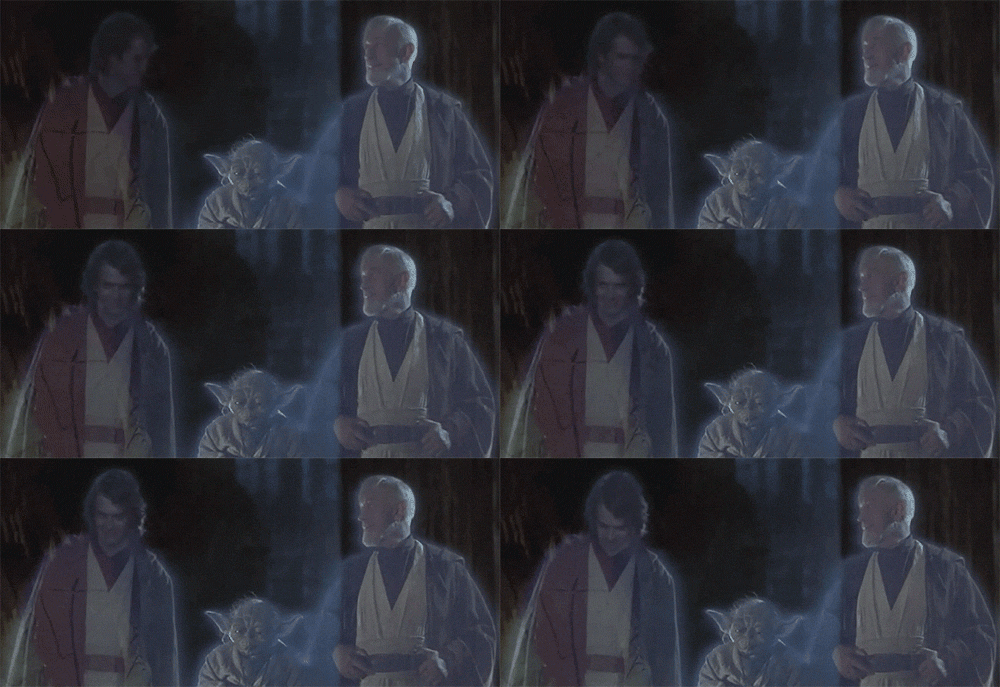
Luke, on the other hand, learns that he is part of a terrible and wonderful legacy, laid down before him by his father, and by his father’s teachers, who become his own teachers. Their hope for the galaxy has shifted from Anakin to Luke, and Luke must learn how to fit into that role. Unlike Anakin, however, Luke does not have a galaxy-spanning apparatus to guide him and teach him and help him grow. Instead, as the lone remaining Jedi to challenge the Empire, Luke must remake this ancient story, piecing it together as he can, but also writing it anew based on his own wisdom, and on the destiny imparted on him by Obi-Wan and Yoda. After he brings down the Empire and redeems the Skywalker story, Luke is then charged with rebuilding the Jedi Order. Eventually, this too comes crashing down, as he gives in to his own fears and launches his own nephew on a path all too similar to his father’s. Even so, after years of isolation and self-pity, Luke reclaims his place in the story and embraces his legacy again, sacrificing himself to give others the space needed to carry the story forward.
Through everything, Luke remains as the tie that binds together all the other characters. Despite the idea laid on him that he alone must rescue the galaxy from the fall triggered by Anakin, Luke understands that there are so many others who play an important role in rebuilding what was lost. After he disappears, the Republic begins to crumble, his friends are scattered, and his story begins to be forgotten. Yet, his memory still lingers, and his tie to the Force and the Jedi remains, for someone like Rey to rediscover and share again with the galaxy. Luke teaches us that, no matter how much the world wants us to think we are alone, we are in fact surrounded by allies on all sides when we enter and shape the story. When the way forward seems obscured or unsure, we don’t have to go it alone. We are part of a story, a tradition, and we always carry that within us. When we grow older, we will pass it along to the next generation. This is our charge, no matter how much we have failed, or been hurt, or fallen short. The story is bigger than us or our individual failings, and the galaxy relies on us to tell it anew.
Finally, Rey enters the story knowing, deep within her, that she is a part of the story, despite the very best efforts of those around her to constantly remind her that she is nothing but an orphan, a scavenger, a slave, an outsider, and that this story she has heard rumors of is nothing but a myth, far, far away from the sands of Jakku. Yet, she continues to believe, and the galaxy crashes the story down upon her, and she jumps at this opportunity to find her place. In doing so, she learns that not only is the story real, but that she is in fact a central player in it all: a Jedi, a student of Luke Skywalker, a friend of Leia and Han and Chewbacca, connected to Kylo Ren by the Force, and finally, the descendant of the Emperor himself. She is charged with carrying on Anakin and Luke’s story, and with changing it for good. Rey reminds us that hope is never a vice, and that hope lights the way towards our place in the story. No matter how dark things may seem, we have within us all that is needed to join the story, and continue it.
As Christians, we too are finding our place in a larger story. We too all grew up hearing tale of Christ, and of the Church that followed him. As we grew, we too encountered that Church, and had to make decision about whether we would accept that calling, and wed our stories to it, or remain in the comfort of home, of family, and of all we’ve ever known. That larger story becomes our story when we make the decision to write our story into it. And that story is our reminder that we are not solo actors on the world’s stage, but we are part of a bigger, more grand story, within which we find meaning and direction, and which teaches us how to cultivate the skills and wisdom needed to take part in writing the next chapter. Like Anakin, Luke, and Rey, as Christians, we learn that we can shape the story in new ways, that we are not alone in doing so, and that our hope is what sustains us, a hope embodied in the life, death, and resurrection of Jesus Christ. It is within this story, initiated on the Cross and told by the Church since, that we most fully find ourselves.
In the words of Stanley Hauerwas, “perhaps it is the case that the true stories that we learn of God are those that help us best to know what story we are and should be, that is, that which gives us the courage to go on.” It was the stories they heard that helped Anakin, Luke and Rey go on despite their circumstances, challenges, and pain. It is the story of Christ that helps us go on in the face of injustice, oppression, and violence. And it is stories like Star Wars, our modern myth, that help us keep that in perspective. The beauty of these stories, beyond just how fun they are, is that we learn from them. We learn about hope, about fear, about anger, about destiny, about fate, and about stories shape our favorite heroes and villains, how they aren’t too dissimilar from us. Any story that does that is, in my opinion, God-breathed in its own way.




 Justin DaMetz