The tension at the heart of existence, or, why Peter Thiel is not a Christian prophet (The Politics of Charity, Part Seven)

Meekness. Foolishness. Weakness. Humor. Fun. Stupid. These are just a few of the words I used in the previous essay to describe the way of the Christian in the midst of a world that is just taking itself all too seriously. But what about injustice? What about suffering? How can we laugh in the face of so much hurt? And, even more acutely, how can we embrace an ineffective weakness knowing as we do the depth of human suffering, and the shamelessness of the evil that perpetuates it? The Cross, after all, was not a humorous sign. The disciples did not laugh those three long days. Believing as we do, at the urging of Matthew 25, that Christ is present in all those who hunger and thirst and are trapped, how can urging the church to be a foolish institution address the real needs of those Christ draws our attention to?

These questions turn us back to the concept of effectiveness, and most importantly, force upon us the question that we have been grappling with throughout this series, albeit in the background so far: how can a church called to something as ineffective as Christian charity live into its calling to be the Good News to the poor, the hungry, the widow, the orphan, and the immigrant? This is the real rub of the Christian way: we confront a world thrown off its axis by injustice and pain, and the tools we are given by God in the life of Christ are submission and weakness and humility? 

Hauerwas identifies this as “the tension created between church and world brought about by how Christians have been taught to take the form of Christ.” Because Christians are presented with such a countercultural way of existing in the world, that tension is naturally opened up, at least in the spaces where churches are not trying to be a part of this or that culture (conservative, hipster, suburban, wealthy, or whichever prevailing cultural norm is seeping into any particular church.)

This tension then opens up an expectation, among Christian and non-Christian alike, that the Church, driven as it is by moral and ethical concerns more stringent than those presented by worldly cultures, must be an example or template for the way Christians hope to make the world to be. In this view, both of these groups of people expect Christians to begin trying to reshape the world in the image of the Church, not realizing that all too often, those churches are just microcosms of the culture, and thus incapable of even contemplating real, lasting cultural change. Foolishness is not something the church practices very often, even if some churches and Christians like to pride themselves on rejection of “the world” and popular culture. No rejection is actually happening for most Christians, They are still inevitably shaped by the world, even if they can’t see it in themselves. What many view as rejection is just political or social posturing, taking on an image of “good Christian” or “compassionate follower” or “devout evangelical” over and against something else. This is not a form of kenotic emptying, as we talked about in an earlier essay. This is exercising a form of power and trying to impose something on the world.

But I’m getting sidetracked, because that’s not even the real problem being confronted here by Hauerwas. Instead, he is trying to get us to understand that the “tension is not between realized and unrealized, but between truth and illusion.” At its best, the Church is not trying to present an ideal to the world, nor is it trying to shape it. Remember Hauerwas’ maxim that the goal of the church is to make the world remember that it is the world? This is where that comes into focus in a real way. The Church is not trying to change the world. The Church is trying to make the world see itself more clearly for what it really is – namely, that it is not the Church, and cannot ever be, no matter how hard it tries.

That seems like a harsh judgment, and in some ways it is. But I have put the endpoint much earlier than expected. There is a method to work through to get to this conclusion.I want to wrestle through that reasoning here. Let’s back up. Hauerwas identified the tension created by our earlier question –  how can a church called to something as ineffective as Christian charity live into its calling to be the Good News to the poor, the hungry, the widow, the orphan, and the immigrant? – as the tension between truth and illusion. The Church is “that community that trusts the power of truth and charity,” that is not built on the lie that power comes from strength, or wealth, or violence, but instead understands that power is found in the Truth and the love that testifies to that truth in every act of charity. 

The world, on the other hand, is built on a need for power borne out of a rejection of truth – namely, the truth about ourselves, about our mortality, our smallness, our sin, and our pride. We cannot stand the fact that in the end, we are all human beings who will grow old and die. We cannot stand this because we look at the others around us, and we see all the things in them that bug us, and we cannot face the fact that we are no different than them. And so, the way of the world is to build structures of power and violence and domination, lies that deceive us into thinking we are immortal, we are pure, we are better than the others. 

Obviously, it has been very easy for this worldview to infect Christians and the churches they build. I am reminded of this by a recent piece by Damon Linker, about the billionaire Peter Thiel, who incorporates a Christian veneer into his transhumanist, hyper-capitalist vision of the world he is trying to build through his wealth and the political and cultural power it commands. Linker writes, 

In Thiel’s view, recapturing civilizational greatness through scientific and technological achievement requires fostering a revival of a kind of Christian Prometheanism (a monotheistic variation on the rebellious creativity and innovation pursued by the demigod Prometheus in ancient Greek mythology). This is the subject of a remarkable short essay Thiel published in First Things magazine in 2015. Against those who portray modern scientific and technological progress as a rebellion against medieval Christianity, Thiel insists it is Christianity that encourages a metaphysical optimism about transforming and perfecting the world, with the ultimate goal of turning it into “a place where no accidents can happen” and the achievement of “personal immortality” becomes possible. All that’s required to reach this transhuman end is that we “remain open to an eschatological frame in which God works through us in building the kingdom of heaven today, here on Earth—in which the kingdom of heaven is both a future reality and something partially achievable in the present.”

This is a terrifying bastardization of the Christian worldview, wielded in pursuit of a decidedly anti-Christian world: one where our mortality is denied, where progress and consumption has no end, where wealth solves the world’s hurts, where ideas like meekness, humility, foolishness, and humour have no place. This is a vision of God’s kingdom being achieved not through the work of God and the humility of humans, but through thoroughly human means. To quote Hauerwas again, this “world is exactly that which knows not the power of truth and thus must support its illusions with the power of the sword” – or the microchip, or the dollar, or the marketplace.

Thiel’s techo-Christianity is one that tries to deny the tension we began this essay talking about. Progress and growth requires the elimination of all tension and friction, in order to grease the rails for unlimited expansion and consumption and to maximize human potential, as potential is understood by modern capitalism. There is no room for tension, and in pursuit of this world that can be tightly controlled and shaped and predicted, all institutions that stand in opposition – or even who try to stand aside and not get on board – must be swept aside or be assimilated. The Church is too old and venerable an institution to eliminate, as well as too popular among the masses who our overlords like Thiel depend on for clicks and likes and views. Thus, it has to become part of the world they are shaping in their own image. So, as Thiel describes, the Church is no longer a place for us to confront human frailty and limitation, but as another arena for the pursuit of techno-perfectionism.

This is heresy. The Church is not a tool of Silicon Valley, or of American capitalism, or of nationalism, or of social justice, or of suburban amnesia. All these structures require a wiping away of that tension between Church and World, because that tension convicts them. The tension must be eliminated, and the Church must prove its effectiveness, its utility, its fealty to the powers that be.

But, as Hauerwas reminds us, “this is a tension that is not overcome, but rather is a characteristic of our lives.” The tension exists because, despite the best efforts of folks like Thiel and the dollars and powers they wield, humanity is flawed, and limited, and mortal, and weak, and there simply is no way to overcome that. It is a fact of reality. It is a Truth of existence. And it is a truth these powers cannot handle, for it undermines their pretensions of control and stability. “For none of us desire the truth about ourselves, and we will do almost anything to avoid it”, says Hauerwas. He goes on,

“Our social orders are built on our illusions and fantasies that are all the more subtle because they have taken the appearance of truth by becoming convention. Our only recourse, when such conventions are revealed as arbitrary, is to assert the absoluteness and protect them through the power offered by the state.”

So, people like Thiel sink innumerable wealth and influence into trying to take control of the state, in the hopes that the illusion of the people’s will can maybe protect and justify their flailing about in denial of their own impending death. Christians have no place in this farce. We cannot, and should not, give it the imprimatur of our approval by allying with these forces of evil, no matter what promises they make about protecting the Church, or our way of life, or America as a Christian nation, or racial purity, or whatever abstraction they seize on this week.

The inescapable reality of this tension between the church and world, however, does not mean Christians should all withdraw from the world and leave it to figure out its own hurts and injustices. Christ, after all, went into this world, and made clear declarations with his words and his deeds about it, and about how to live in it. What Hauerwas is doing with his ongoing critique of effectiveness is “attempting to remind us just how radical the Christian demand of charity is in terms of the Christian’s learning how to embody it in such a world.” What it means to be a Christian is so much more strange and radical than any of these worldly powers could ever conceive. They simply lack the imagination to envision a way of being that embraces brokenness and frailty and foolishness, and that turns those values into strategies for pulling up the weak and the forgotten and the disenfranchised. Again, the Church’s role in the world is to remind the world what it is by being what the Church is meant to be- namely, “the community that is shaped by the story that sustains charity in a world where it cannot be effective.” Thiel’s techno-utopianism sustains itself on maximal effectiveness. The Church rejects that strategy completely – not for the sake of ineffectiveness itself, but “because we must never delude ourselves that the justice of the state is what is required of us as people formed by God.”

I still haven’t answered that question we began this essay with: how can a church called to something as ineffective as Christian charity live into its calling to be the Good News to the poor, the hungry, the widow, the orphan, and the immigrant? And I’m not going to here in this essay. Next time, we tackle justice and charity, and in those things, maybe we start to get a roadmap towards the How of this whole ineffective Christianity thing.


Laughing in the face of the tyrant (The Politics of Charity, Part Six)

In the essay posted Friday, I described how Stanley Hauerwas brings Scripture to bear in our thinking about the effectiveness of Christian action, specifically the tales of the Good Samaritan, and Mary and Martha. The implications drawn from Hauerwas’ reading of the text are certainly shocking to any politically-minded Christian. He seemingly describes a Christianity bereft of any politics, or any interest in them, a focus that certainly would seem to confirm many of the worst fears many folks have about Hauerwas’ supposed sectarian and withdrawn theology.

Hauerwas is nothing if not self-aware, and anticipates this criticism well. In fact, his anticipation of this critique serves a crucial purpose in his essay, as he uses the accusations to turn the idea of Christian politics on its head. He writes,

It is my contention that rather how Christ forces us to be charitable requires the formation of communities that are fundamentally political. It is political in the sense that the church’s primary responsibility, her first political act, is to be herself.

This emphasis from Hauerwas is one we find throughout the breadth of his work as theologian. Time and time again he emphasizes an ontological difference between the world at large and the church. One of Hauerwas’s most well known – and most often misunderstood – statements is that “the first task of the church is not to make the world more just but to make the world the world.” Although many readers and critics interpret this as a call to separation and sectarianism, it is in fact Hauerwas’ mission statement for the task of the church in and for the world. He views these two kingdoms – or better yet, the two cities first envisioned by St. Augustine – as existing in a sort of symbiotic relationship. They both need one another. And at this point in this chapter, he really makes clear how the church can help the world know that it is the world – and how much it is in need of the church – or, more importantly, how much it is in need of Christ.

That need, of course, is tied up with the notion of charity. The church, as the “community of charity”, reveals to the world its own nature. By being a community bent not on having all the answers, but instead being with and for those in need, the church can remind the world of its own limits. But this won’t be an easy reckoning for the world, as shown so clearly on the Cross.

Stanley Hauerwas

At this point, Hauerwas returns to Luke. As we saw in part two of this series, to understand the politics of charity, we must reread history, in order to see what part Christians have to play. I wrote then,

The work we are called to, in the greater task of God’s building of a nation, is to “love as God loves.” That’s it. It may not always be effective as the world counts effectiveness. But that was never really our goal.

And, as I noted at the time, this can be misinterpreted (and often is) as an endorsement of political disengagement, and in effect, silent acquiescence to the powers of the world. Hauerwas returns to that understanding here, seeing it at work even in the very text of Luke: “For one of the reasons that Luke wrote was to show that, even though Christ had been hung on the cross of political insurrection, Christianity was not subversive to the Roman Empire.” Luke, taking his cues from the Jews, was trying to make Christianity seem at the very least as not a danger to the Empire, if not as a good and quiet citizen.

And this is a good reading of Luke, not a dangerous one, “for Christ refused to take up the means of violence to secure a good and even charitable end.” Christ, in this sense, wasn’t a danger to Rome, not in the way the Zealots or many other violent revolutionaries and nationalists were. Jesus was never trying to overthrow the Romans or Herod and create a new political entity to rule in their place. Jesus wasn’t crucified because the authorities were worried he was about to overthrow their rule in Palestine. And Luke wants to emphasize that, because remember, Luke is writing to Roman citizens, trying to convince them that they can be citizens and also be followers of Christ.

But, Hauerwas points out to us that Jesus wasn’t harmless. The Romans still killed him. There must be something that Luke identifies as how Rome would justify his execution in this telling. They wouldn’t execute the leader of a popular movement without something compelling that reaction. So what was it? As Hauerwas points out, Jesus is just as politically and socially dangerous as armed revolutionaries, if not more so:

Rome was right to crucify Jesus and his followers, as they were far more subversive than the Zealots. Rome knew how to deal with Zealots, for the Zealots were willing to play the game by the rules set by Rome. Christianity was far more subversive, because it was constituted by a savior who defeated the powers by revealing their true powerlessness.

Jesus, through his eschewal of power and effectiveness, through his embrace of radical charity and love for those so often unloved, revealed the weakness at the heart of the state. Rome could only be in power as long as it could wield the fear of violence and death in order to keep people in order in a way that benefitted the great and wealthy. Jesus’ refusal to play that game, his willingness to embrace weakness, ineffectiveness, and powerlessness, in the service of those the state had long crushed, was an active danger to Rome. In Christ, the people saw the exposure of the powers and principalities and their weakness in the face of the real, authentic love of God.

“What the tyrant fears,” writes Hauerwas, “is those who insist that charity and humor is that which moves the world, for such virtues reveal the weakness of the tyrant’s power.” I love this line, and I think it is really the climax of his essay. It reveals a deep truth about human power, one that has been exploited again and again by fools and by those who refuse to play the game of the world. One of the characteristics of tyrants is their need to be taken seriously, for those around them and those they rule to acknowledge their power, their authority, their seriousness, their danger. As a result, those who would stand opposed to tyrants have weaponized humor, ridicule, and powerlessness in order to undermine those tyrants.

I started thinking about and writing this series when Donald Trump was still president, and I thought about his own very obvious and public need for people to take him seriously, how that primal drive was pushing him to take tyrannical action against those he perceived as his foes. And, I thought about how the most effective insurgents against him were not those who played the game by his rules, by punching back or tweeting or doing the things that reaffirmed his power over their lives. No, the most effective voices against the particular brand of Trumpian tyranny were the comics, the fools and those who refused to play his game. There is a reason – an important reason – Trump canceled the White House Correspondents Dinner, why his whole political excursion began after the Correspondents Dinner of 2014. There is a reason he particularly hated late night comics and Saturday Night Live. These various bodies and individuals weren’t just angry with him, as much as they just wanted to laugh at him. And if there is one thing a would-be tyrant can’t abide, it is being laughed at, instead of feared.

This same idea extends beyond individual tyrants, to the whole system of domination that the world is ruled by. The novelist and essayist Walter Kirn unpacked this in an essay, “The Holy Anarchy of Fun.” He writes,

Fun—when your rulers would rather you not have it, and when the agents of social programming insist on stirring nonstop apprehension over the current crisis and the next one, the better to keep you submissive and in suspense—is elementally subversive. Fun is ideologically neutral, advancing and empowering no cause. Fun is self-serving and without ambition. It wishes only to be. It produces nothing for the collective and may represent a withdrawal from the collective, temporarily at least. Your fun belongs to you alone.

Fun, the physical manifestation of humor, is a subversive pastime. Kirn again:

Fun is abandonment. “Don’t think. Do.” It’s a form of forgetting, of looseness and imbalance, which is why it can’t be planned and why it threatens those who plan things for us. Fun is minor chaos enjoyed in safety and most genuine when it comes as a surprise, when water from hidden nozzles hits your face or when the class hamster, that poor imprisoned creature, has finally had enough and flees its cage.

Fun is the alternative to the churn and drama of politics. The powers that be in the world don’t want us unplugged from the mess of politics and power. They don’t want us ignorant of what’s happening in the halls of power. Rather than being an alternative to the old saw of bread and circuses, politics has become the circus, and our outrage is the fuel that drives it. We channel that outrage and attention into dollars and clicks and shares, which is the oxygen the system needs to perpetuate itself and maintain control over us. This is why politics has been allowed to seep into every corner of the culture, from movies and books to food and art. Its power over us ensures the domination of the few over the many.

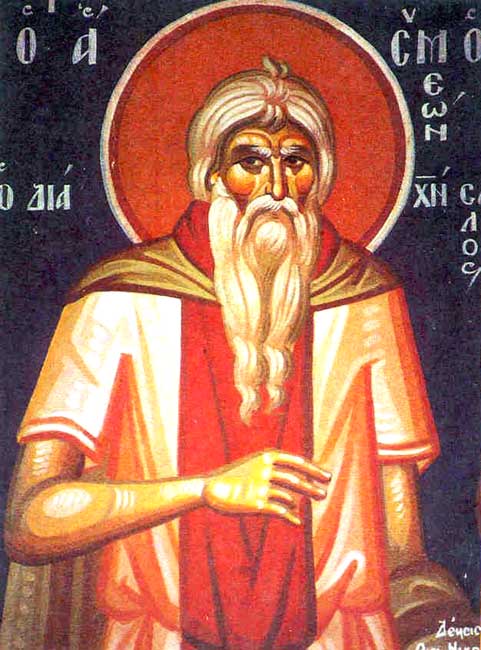
St. Symeon the Holy Fool

But, when we withdraw our attention and turn our outrage down and roll our eyes at the ridiculousness of the system and those enmeshed in it, we then find a truly dangerous freedom. We begin to live into a different kind of politics, one more concerned with the things that actually make up our lives- family, friends, the land around us, the decisions made in our neighborhood and our schools and our town. This is exactly what tyrants don’t want us to know. They want us fixated on the latest bullshit being spewed by whichever member of Congress most pisses us off. When we refuse – when we remember we are made for the Good, and that Good makes laughter erupt from deep within our soul, and we revel in it with good humor and fun – then, that is life. That fills us up. And we can pour it out on others, in charity and love and good humor. And those in charge, they can’t control or weaponize it, and thus become small and powerless and ridiculous. To reference the world of Harry Potter, the systems of power are just one giant Boggart: terrifying until we remember that power is an illusion, undone by laughter at its pretension.

The same dynamic was at play in Jesus’ ministry to the poor and the forgotten. His reminder that “Blessed are the meek” wasn’t as much a plan of political action, as it was a statement of ridicule, directed at the Powers of the world, a throwing down of the gauntlet to tell them, you may think strength is what God wants, but you would be wrong. Blessed are the meek. Blessed are the mournful. Blessed are the persecuted.

I am reminded as well of one of my favorite passages of Scripture, 1 Corinthians 1:25, where Paul writes, “For the foolishness of God is wiser than men, and the weakness of God is stronger than men.” Jesus didn’t base his ministry around showing how strong God was. No, Jesus’ ministry was about the meekness of God, and how that meekness, how the love and charity embodied in it, undermined the claims to effective power that the world depends on. Effectiveness isn’t getting things done. Effectiveness – God’s effectiveness – is just simply love, no matter what. It’s better politics, one that makes room for God’s kingdom. Oh, it certainly looks completely stupid and foolish to those without eyes to see and ears to hear. But it’s the only way to be the Church when they want us to be the World.

Meeting the need of our neighbor (The Politics of Charity, Part Five)

As I alluded to at the end of the last essay, we are at a turning point in this series, when we begin to turn from an extended critique of “effective” Christianity, and towards a vision of a politics of charity. In doing so, Hauerwas beautifully lays out two stories from the Gospels, and links them together in a breathtaking way to make the following case:

“What charity requires is not the removing of all injustice in the world, but rather meeting the need of the neighbor where we find him.”

Meeting the need of the neighbor where we find him. Here we find not just the center of Hauerwas’ argument in this chapter, but the center of the Gospel message. To show us what meeting the need looks like, Hauerwas gives us a passage from the Gospel of Luke that encompasses two stories: Jesus’ telling of the Parable of the Good Samaritan, and the story of Mary and Martha. I’ll follow his lead and post the verses in full here:

On one occasion an expert in the law stood up to test Jesus. “Teacher,” he asked, “what must I do to inherit eternal life?” “What is written in the Law?” he replied. “How do you read it?” He answered, “‘Love the Lord your God with all your heart and with all your soul and with all your strength and with all your mind’; and, ‘Love your neighbor as yourself.’” “You have answered correctly,” Jesus replied. “Do this and you will live.”

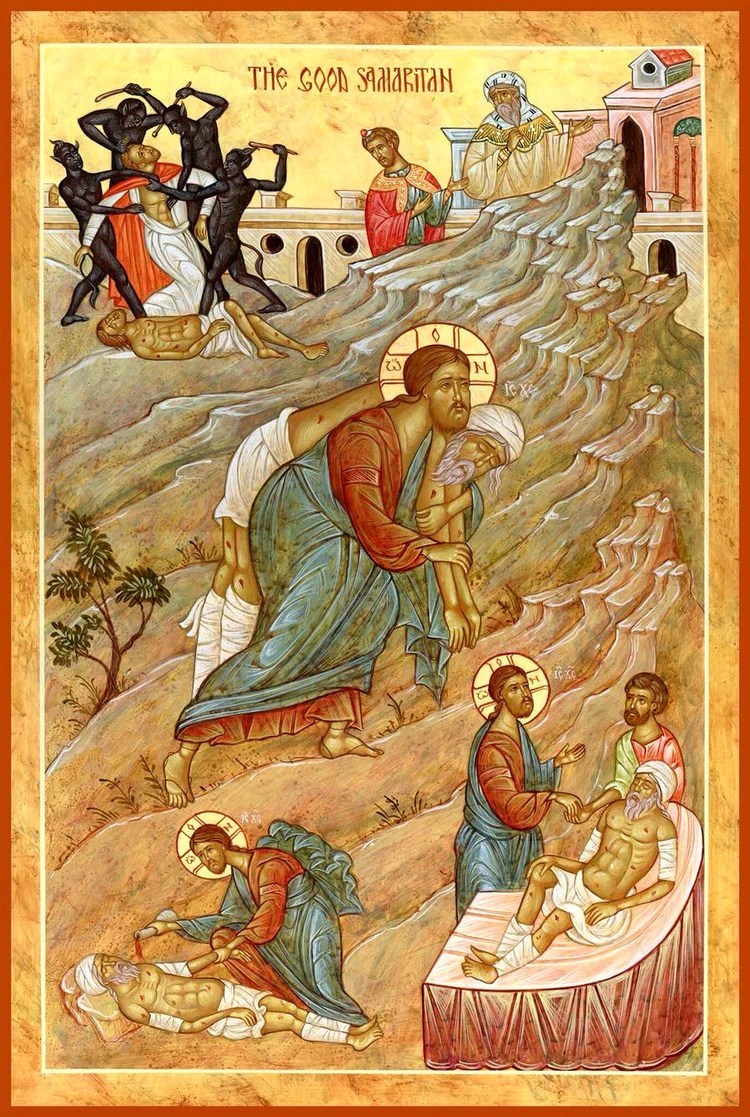
But he wanted to justify himself, so he asked Jesus, “And who is my neighbor?” In reply Jesus said: “A man was going down from Jerusalem to Jericho, when he was attacked by robbers. They stripped him of his clothes, beat him and went away, leaving him half dead. A priest happened to be going down the same road, and when he saw the man, he passed by on the other side. So too, a Levite, when he came to the place and saw him, passed by on the other side. But a Samaritan, as he traveled, came where the man was; and when he saw him, he took pity on him. He went to him and bandaged his wounds, pouring on oil and wine. Then he put the man on his own donkey, brought him to an inn and took care of him. The next day he took out two denarii and gave them to the innkeeper. ‘Look after him,’ he said, ‘and when I return, I will reimburse you for any extra expense you may have.’ “Which of these three do you think was a neighbor to the man who fell into the hands of robbers?” The expert in the law replied, “The one who had mercy on him.” Jesus told him, “Go and do likewise.”

As Jesus and his disciples were on their way, he came to a village where a woman named Martha opened her home to him. She had a sister called Mary, who sat at the Lord’s feet listening to what he said. But Martha was distracted by all the preparations that had to be made. She came to him and asked, “Lord, don’t you care that my sister has left me to do the work by myself? Tell her to help me!” “Martha, Martha,” the Lord answered, “you are worried and upset about many things, but few things are needed—or indeed only one. Mary has chosen what is better, and it will not be taken away from her.”

Luke 10:25-42, NIV

Hauerwas draws a remarkable link between these two seemingly very different stories: “This is just our task, to go and do as the Samaritan did, for it is through such doing, a doing that may appear remarkably ineffective like Mary’s inactivity, that God shows us how to serve the neighbor in a manner appropriate to his kingdom.”

This is a stunning conclusion, and just really showcases how good of a theologian Hauerwas is. Often, these two stories are disconnected, held on their own as separate tales with separate messages. But Hauerwas here maintains the integrity of the Gospel, reading them as the first readers would, without headers and verse numbers and paragraph breaks. Indeed, they are stories that feed off one another. Let us unpack the linkage a bit more, to try to more fully get at the power of the point Hauerwas is making.

Every Christian is familiar with the story of the Good Samaritan; it is a staple of church life in America. Often, it is a story presented as an example of how we are to serve our neighbors, even those we don’t know or may be inclined to dislike. In more progressive circles, it also carries the added valence of a social and ethnic criticism, as we see the “respectable” figures of the priest and the Levite turning their nose, but the foreign Samaritan filling the role of the Savior here. I don’t think there is anything wrong or bad about these readings. They are quite honorable distillations of Christ’s intent.

That said, what Hauerwas draws out is fascinating, and makes his larger point well. Remember, this series, like the chapter it draws from, is about the juxtaposition Hauerwas makes, between the politics of charity and the politics of effectiveness. So how does this dichotomy come into play here? By including the story of Mary and Martha, we can see how. Mary gets criticized by Martha for not helping Martha prepare the dinner for their guest; Jesus, however, redirects Martha’s anger, reminding her that all the trappings and duties society and the world places on her as hostess are of little import in God’s kingdom. What he needs it not her skills in preparing a meal and presenting a home. Effectiveness, Jesus says, is not the point. Discipleship is.

So, too, in the Good Samaritan. Read through the lens of the antecedent story, we see here another example of discipleship as charity, as ineffective action, over effective. In the story, while the Samaritan is good and correct to take the man to an inn, to care for his wounds and pay for expenses, wouldn’t he also be obligated in some way to address an injustice, to ask questions as to why this happened, why this stretch of road is treacherous? Where are the authorities? How can the local society address the problem of rampant crime and the attendant fear?

To my mind comes the story of the man who, working alongside a river, sees a baby floating down from upriver. He saves the baby from certain drowning, only to see another, and another. Saving the babies is good, the parable tells us, but the man must then go up river, to stop whoever is throwing babies in. Justice demands it.

And that’s right! Justice does! We would be foolish to ignore the cause of something as shocking and heinous as that! But what about in this story of the Good Samaritan? Why does the Samaritan, in all of the time taking care of the man, never ask, “how did this happen? Who is responsible?” Instead, the Samaritan pays the innkeeper and goes on with his business.

To extrapolate this story out to the dilemma of justice and injustice in the world, it becomes natural to ask the question, if we see injustice, how do we stop it? If we are called to be the Samaritan (and obviously Jesus intends that we are), then what must our actions be? Surely, saving and tending to the hurt, yes, but aren’t we also called to go further, to identify the injustice, and then set about the hard, concrete work of fixing it?

Per Hauerwas’ reading of these stories, I don’t think we always are in every situation. Instead, seemingly ineffective action can become our duty as disciples. Think back to Hauerwas’ summary statement, and specifically the last clause:

“God shows us how to serve the neighbor in a manner appropriate to his kingdom.”

Appropriate to his kingdom. That is the key. Yes, pursuing structural justice is a natural inclination. But, I think one of the things we are to learn here is that, as disciples of Christ, as members of the community called the Church, that isn’t our primary task, because God’s effectiveness is not the world’s effectiveness

God’s effectiveness looks like stopping, showing compassion, caring for the hurting, not at an abstract level, but at the most intimate and personal of levels, in the blood and dirt and muck of the world. We don’t know that that priest or that Levite, after going on their way, didn’t then think “We need safer roads; I will work to make it so.” It’s very possible one of them might have! But what neither of them did was stop, and care.

One thing that is important to remember is that our focus on large policy fixes to problems we see in the world can often serve just as effectively as ways to insulate ourselves from the really hard work of loving our neighbor, not in some abstract way, but face-to-face, in a manner that is costly to us. Worldly effectiveness can shield us from the messy relationship-building that charity would demand of us. 

What this story is telling us, as shocking and scandalous as it may seem, is that the charity we are called to as followers of Christ is the work of caring for one another, for showing our love to our fellow beings in our willingness to stop, notice, and heal when we see a hurt or a wrong.

Still, you may be asking, what about all that injustice in the world? No one can deny it, and surely we aren’t called to ignore it, right? I agree, we are not. So how do we adapt the work of charity, of stopping and loving and spending the time with another human being, into something that can address the injustices of the world? That’s where we turn next.