Democracy Is Not Always Right

My delve into Hauerwas’ Christian criticism of liberal democracy coincided very well with one of the most depressing electoral results, and everything since then, that I can imagine. What better time to contemplate the futility and utilitarianism of democracy that at the time when America is electing a woefully under-prepared proto-fascist to be the most powerful man on the planet?

elections_palestineI actually think the election of Trump reinforced the message I was getting from Trump; namely, that democracy is not inherently moral. This isn’t to say that it is immoral. Rather, democracy is a morally neutral system, a tool we humans use to order our governance of our selves. Self determination, self government: those are moral ideals. Democracy, as the tool used to achieve them, is not.

One of the ideas that so many people struggle with (and I admit I did for a long time) is that we expect democracy to produce the “right” answer. We expect, no matter our ideology or political party, that in the medium to long-term, regardless of the outcome of various immediate elections, that the democratic process will conform itself to Dr. King’s moral arc of justice. And sometimes it certainly feels that way; for me, 2008 was one of those times. It was hard for so many people to not perceive the election of Barack Obama as not just a good thing, but the morally inevitable thing that democracy promises us.

But this just simply isn’t the case. In and of itself, democracy is no more moral that any form we use to govern ourselves. Now, democracy comports itself better to the ideal of self-determination better than republicanism or oligarchy or even Plato’s rule of the elite does. But, in the end, democracy facilitates the ability of the mass of people to make a certain choice, regardless of the moral weight of that choice. Another way to say this is, we get what we vote for. And sometimes, that is a Barack Obama, or an Abraham Lincoln, or a Solon, or a Nelson Mandela. But, sometimes, it’s a Donald Trump. In democracy, the right choice isn’t always the moral choice. The right choice is just whatever we decide it is. Democracy is only as moral as we are as a people.

The equation of democracy with morality is one of the original sins of American political engagement. Because we have allowed our democratic experiment to so often be equated with the Kingdom of God – because we like to entertain the notion that American democracy is a divinely ordained institution – we accept the logical conclusion that American democracy must be a force for good in the world always. It’s not.

Democracy is another tool for ordering this world. And it is a particularly good tool, compared to so many of the others we humans have tried. Churchill’s rumination on the merits of democracy is quoted often today, but rarely taken to it’s logical conclusion. Those of us who identify ourselves as Christians have an obligation to not identify our faith with that of something as human – and thus as fallible – as democracy. Our hope is not found in such things. Democracy can be useful, and can do good things. But the redemption of our world – the coming of the Kingdom – is found in ideals beyond simply the logistics of choosing new leaders. Our hope is found in the radical love that is our God, and that was lived by the man whose example we follow.

That’s an important reminder in a world that just elected Donald Trump. His elevation to the White House is disheartening, frightening, and dangerous. We have a lot of work in front of us, in terms of standing with and for those who need our love and solidarity today. But, frankly, that would have been true, albeit on a less severe scale, even with the election of Hillary Clinton, or Bernie Sanders. This is what we would do well to remember in the heat of the next electoral cycle: the election of a candidate we favor doesn’t mean our work is needed less. On the contrary: the election of Hillary Clinton would have made our work just as important, because rather than working to hold ground (as we are going to be doing for the next four years), we would have been compelled to move justice forward – and that is just as vital and hard of work as we are facing now.

The promise of democracy is not the same as the promise of love. We shouldn’t forget that, and we should never equate the two. The right answer will never be the one supplied by democratic promises; the right answer is the hoped-for Kingdom, the one we have the power to bring here, not at the ballot box, but in loving those we meet everyday.

The Ordinary is where we meet up with Jesus

“The ordinary is where we meet up with Jesus, and he is more profoundly nowhere else.” – Romand Coles

ordinary-life1One of the most extraordinary things about Jesus, something that confounded and proved a stumbling block to even his closest disciples, was the sheer ordinariness of his existence. I don’t mean this in the sense of his teachings; clearly, he was extraordinary in the Way of Being of exemplified.

Rather, I mean the ordinary nature of the man Jesus. In him, we have a Palestinian peasant, born in a village we would not of if he had never lived, to an unwed teenage, at the very edge of empire. He was a day laborer, probably spending the majority of his life before ministry traveling to nearby Sepphoris, working long hours on Herod’s magnificent city.

But even after his entry into ministry, Jesus retained his essence of ordinary. Rather than the conquering king, rather than the over-thrower of Rome and second coming of King David, Jesus was an ordinary human, who communed with and loved other ordinary, flawed humans. He ate with sinners, loved unclean women, forgave extravagantly. He preferred the company of lepers to that of magistrates and priests. He was essentially homeless, living off the generosity and goodwill of ordinary Palestinian people. He was poor. He didn’t aspire to power or greatness. He was executed as a criminal, with no friends at his side.

Jesus was “radically ordinary,” to borrow a concept from Hauerwas and Coles. And thus, he calls us to a life of the same. Christians are not called to be purveyors of power and control. We don’t long for a seat at the table with the rich and powerful and beautiful. We don’t become insiders, and place our trust in electoral victories or temporal power. Instead, we are called to serve the “least of these.” We look for the blessings of the hungry and the meek and the forgotten. We are called to be ordinary, and thus, to be radical agents of change.

The one place where Jesus wasn’t ordinary was his extraordinary understanding of the power of relational living to change the world in a lasting and meaningful way. And so, he practiced the ordinary life of a man who meets and knows people. Simply that. And he knew that would be the key to the Kingdom.

This isn’t an ordinary that disengages. As Coles writes a bit later, “…all the arts of the ordinary that read patience as an invitation to escape from the tasks of large struggles against the gargantuan and fast-moving whirls of destruction are likewise highways of delusion.” We don’t embrace our ordinary in order to withdraw from the power of the world. Rather, we engage it as a practice oriented towards change on the macro level. The ordinary, when practiced in a way that is self-giving with no expectation of return, becomes the most powerful tool known to humanity.

So we are called to be relational beings. We make the world become the way we know it can be by changing lives, and we change lives by knowing people, talking to them, hearing them. Institutional power, political power, is important in it’s way. But the real way to change the world is to get to know the people near you, as Jesus got to know the people near him.

We meet Jesus in the ordinary. We bring the Kingdom by being ordinary.

Christian America’s Politics of Fear

Commenting on political theorist Romand Coles’ reading of John Howard Yoder, Stanley Hauerwas writes in Christianity, Democracy, and the Radical Ordinary:

 Yoder argues that the church precedes the world epistemologically, but Coles rightly argues that does not mean that Yoder thinks the church has nothing to learn from the world. Rather it means that there can be no “politics of Jesus” that could be coercive, selfish, nondialogical, or invulnerable. Therefore, Christians, from Yoder’s perspective, should welcome the diversity of peoples that Babel represents because only by engagements with different communities does the church learn what it means to be a community of truth and love.

No one can accuse Hauerwas of any partisanship, or even a affinity for American democracy (this book, after all, is a series of essays by him and Coles imagining a new sort of politics the church can pioneer over and above liberal democracy.) But I think this passage here could be applied quite aptly to the political scene in America right now, and really for the duration of this last election.

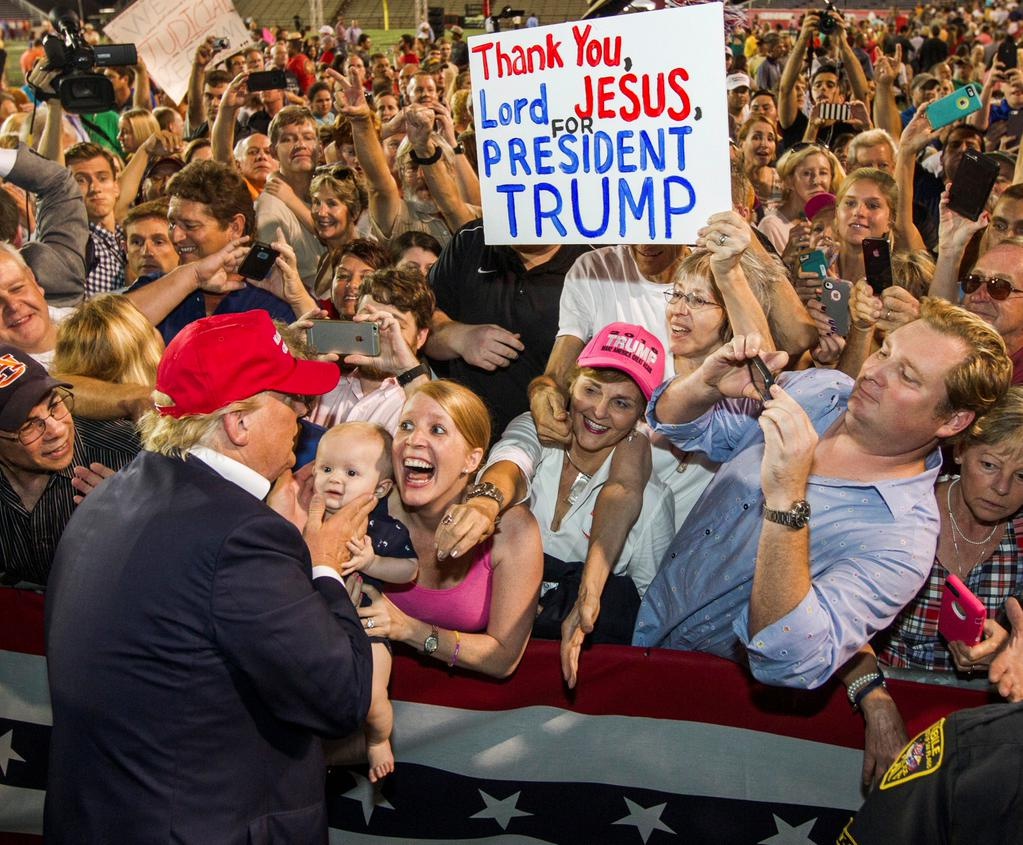
trumprallyAmerican politics has become quite dependent on what Hauerwas and Coles term the “politics of fear.” Yet, one of the central ideas of Christianity is a “love that drives out all fear,” and consequently, a way of engaging in the world that reject the structures that are dependent on fear for their own continuance. Liberal democracy, in Hauerwas’ view, is such a structure.

That fear has been especially evident this election season, as we saw Donald Trump sweep to power on a platform that largely was driven by fear of almost every “Other” one can imagine. Fear of the Other has become the primary driving factor for white Christians in America in 2016, in direct contradiction to the dictates of the Gospel message, as was made evident by the 81% of white evangelical Christians who provided the key support that delivered Trump the white house.

Indeed, Hauerwas notes here that a Christian politics is one that happily engages with the Other, because only then does the church live fully into it’s inheritance. Rather than being driven fear, Christians are called to be driven by love and self-giving. The politics of Jesus looks like the life of Jesus: compassionate, humble, just, and concerned with the “least of these” first and foremost.

American Christianity is at a point of reckoning. In a monomaniacal focus on culture war issues, most notorious of which has been abortion, the church has ceased to be a reflection of the life and example of Jesus in the world. It has cloistered itself, becoming inward-focused and obsessed with preserving a white nationalist, hyper-moralistic, us-vs-them vision of politics, rather than the life-giving, love-filled Politics of Jesus. In order to “be for the world what the world can become,” as Hauerwas writes, it must reject it’s fealty to white American exceptionalism and regain it’s vision for a future predicated on love for the Other that is all around them.