
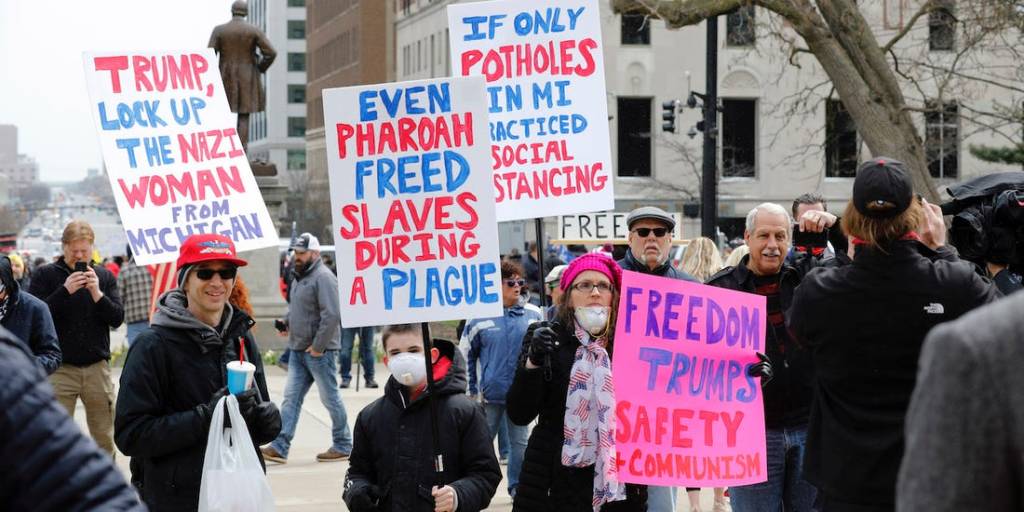
Last week brought the image of protestors across a variety of states rallying against social distancing and self quarantine guidance from local, state and federal officials. Reminiscent of the Tea Party protests of a decade ago (although noticeably smaller), protesters carried signs demanding an end to shutdowns, comparing political leaders to Nazis, and asserting their rights to shop where they want, get haircuts when they want, and spread a largely unknown, highly contagious, and potentially deadly disease as far and wide as they want.
Of course, right wing political leaders immediately latched on to these protests in a show of faux populism. President Trump himself could not resist the opportunity to take to Twitter and start all-caps tweeting things like “LIBERATE MICHIGAN”, as if the very federal government he heads up wasn’t at the same time properly encouraging shutdowns and stay-at-home guidelines. Then yesterday, Attorney General William Barr went on a radio show to declare his own opposition to shutdowns on potential legal grounds:
“Our federal constitutional rights don’t go away in an emergency. They constrain what the government can do,” Barr said in the Tuesday interview. “And in a circumstance like this, they put on the government the burden to make sure that whatever burdens it’s putting on our constitutional liberties are strictly necessary to deal with the problem…
“You know, the idea that you have to stay in your house is disturbingly close to house arrest,” Barr said in the Tuesday interview. “I’m not saying it wasn’t justified. I’m not saying in some places it might still be justified. But it’s very onerous, as is shutting down your livelihood. So these are very, very burdensome impingements on liberty, and we adopted them…”
Declarations of one’s absolute right to do as they please have been a constant refrain over the last few weeks as shutdowns and social distancing have increased. AG Barr echoes here much of the rhetoric, which is focused on rights language, and the concept of personal liberty. Speaking legally, none of what is being said is wrong, per se. You do have a right to do as you please. Granted, rights extend only as far as the closest person, and so at times, the government has the power to limit rights in order to promote a greater good, or in this case, to promote health and safety, especially among vulnerable populations.
But I don’t want to get into a legal argument here. I want to think more critically about the concept of “rights”, and the role they play in society beyond the legal arena. Because rights are, most essentially, the legal duties we have to one another. Rights are the necessary language of a society of mistrustful, anxious strangers, constantly assuming the worst in their neighbors in each encounter they have with one another. Rights are the way we ensure each one of us meets our legal obligations to one another and to society.
Rights, however, are not the way to build a community of trust and care. And in a time of crisis, that is the kind of community we desperately need.
The only way to defeat an epidemic is to trust that each of us have the well being of one another in mind, and that we will do what we can to care for those in need, whether they be sick, financially insecure, or worried about their business or endeavors in life. It requires more than the assertion that I have to right to do this or that thing, regardless of any other consequence. It requires me to see beyond my selfish rights, to see that this isn’t about me, but about all of us, together.
The automatic fallback of rights language is the language of a people who have forgotten how to care for one another beyond our mere legally coerced obligations. It is the sign of people who no longer have the moral imagination or vocabulary to create a community predicated on learning how to act with judgement and restraint, rather than with unrestrained consumption and self-fulfillment.
Stanley Hauerwas writes in The Work of Theology, “appeals to rights threaten to replace first-order moral descriptions in a manner that makes us less able to make the moral discrimination that we depend upon to be morally wise.” What he means here is that some situations require to think beyond the legal rights we are owed by the state and one another. Some situations aren’t going to be solved or made better by a deeper understanding of your personal right to do what you want whenever you want.
To put it mildly, viruses don’t give a damn about your rights. You can’t spout Constitutional truisms at coronavirus. You can’t sue Covid-19 into retreat.
Instead, we have to be able to set aside appeals to our rights to do certain things, and recognize the moral imperative of acting in a way that shows our values – namely, our concern for the vulnerable, for our neighbors, and for the good of a society that can in turn protect your rights in the proper arenas.
Because your right to do something doesn’t do you much good if we’re all dead.
The spread of coronavirus requires us to take extreme steps to protect ourselves and defeat it. Since it easily spreads through airborne particles, lays dormant for a period of time, doesn’t show symptoms in a large chunk of those infected, and is deadly to a wide range of people who get it, we must take the hard and costly step of limiting our contact with others until we know more about the virus, have widespread testing to tell who has it, and the ability to quash quickly and efficiently new outbreaks. We don’t have any of those things right now. So, social distancing is what is required. Yes, it is hard. Yes, our economy is going suffer. Yes, we are all going to be called upon to make sacrifices that seemed inconceivable as recently as two months ago. And yes, at times, you are going to feel that you are at unable to exercise your full suite of legal rights under our Constitution and our legal code.
But the alternative is so much worse.
Merely appealing to our liberty and our rights isn’t good enough. We have to think bigger than that.
 Justin DaMetz