What I’ve Been Reading (and Watching and Listening To) This Summer

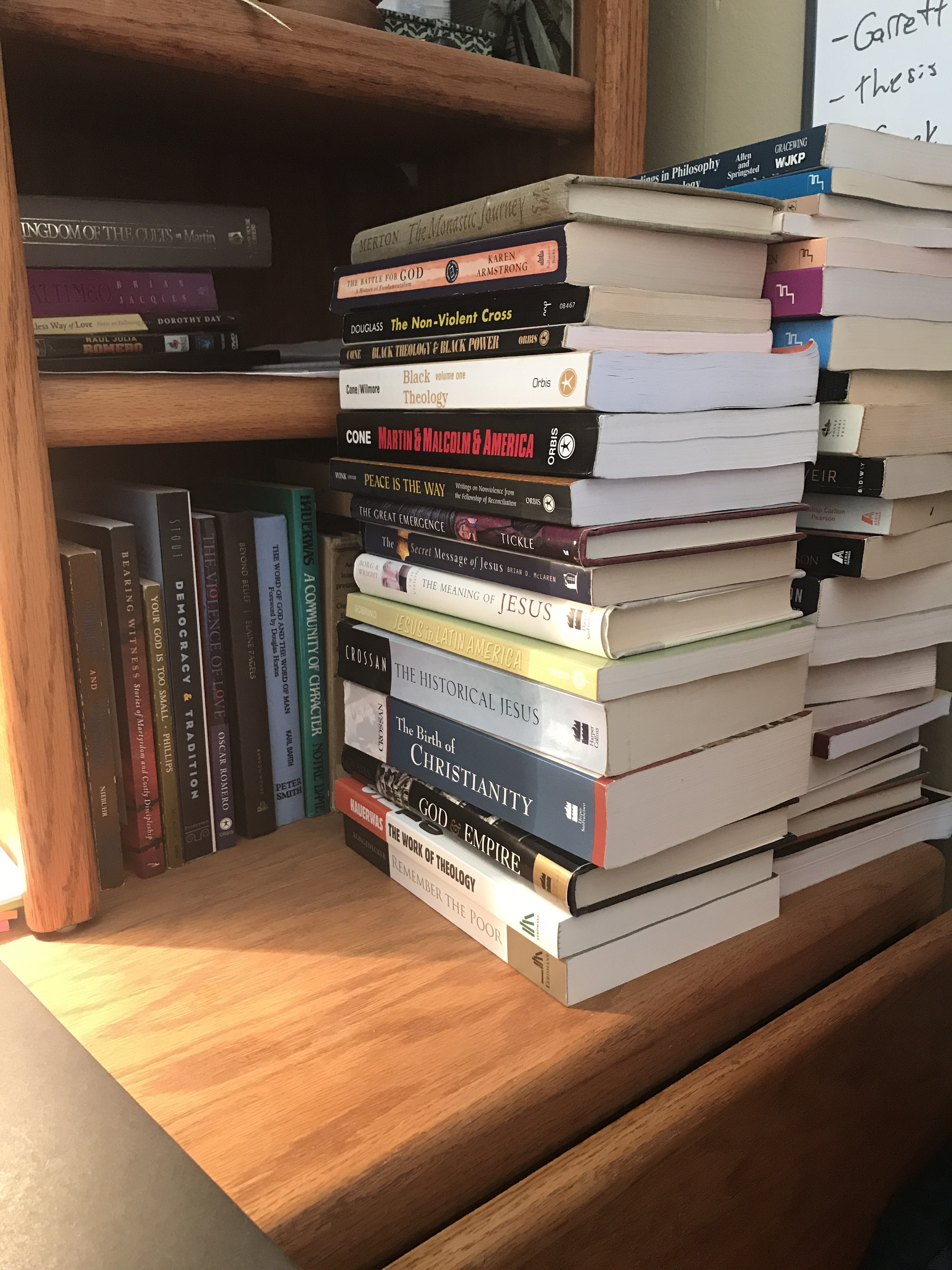
A portion of the “to-be-read” books on my desk.

One of my goals this summer has been to do a lot of reading. During the school year, any personal reading is very obviously out of the question. Being a lover of books, this means that I obtain a healthy stack of “to be read” books. This last year was especially fruitful on this front; between a pastor friend retiring and letting me raid his shelf, another friend downsizing for a cross country move and allowing the same, and just my own general buying and collecting of books, the to-be-read pile on the corner of my desk has swelled to well over 70 titles.

Obviously, getting through all of them this summer is impossible. But I’m doing my best! Here is what I have read so far this summer.

The Righteous Mind by Jonathan Haidt

Tears We Cannot Stop by Michael Eric Dyson

Sabbath as Resistance: Saying No To The Culture of Now by Walter Brueggemann

Drops Like Stars by Rob Bell

What is the Bible? by Rob Bell

The Bluest Eye by Toni Morrison

The Road to Assisi: The Essential Biography of St. Francis of Assisi by Paul Sabatier

Home: A Novel by Marilynne Robinson

The Gift of Doubt by John B. Wolf

The Divine Dance: The Trinity and Your Transformation by Richard Rohr

Sister Outsider: Essays and Speeches by Audre Lorde

Misquoting Jesus: The Story Behind Who Changed the Bible and Why by Bart D. Ehrman

How Jesus Became God by Bart D. Ehrman

At The Heart of the White Rose: Letters and Diaries of Hans and Sophie Scholl

I’m not going to get into my thoughts on each of these here, but I’m sure I will come back to them this fall. You can especially count on hearing more about What is the Bible? by Bell, the Ehrman books, Tears We Cannot Stop, and The Gift of Doubt. Also, At the Heart of the White Rose was sent to me by Plough Publishing, and I intend to write a book review very soon.

At this moment, I currently have two books I’m working on:

A Theology for the Social Gospel by Walter Rauschenbusch (which I quoted in a post last week; I imagine I’ll have much more to say going forward,)

and, We Were the Mulvaneys by Joyce Carol Oates (I’m only about a quarter of the way into it, and I highly, highly recommend you read it.)

And of course, my list is still full. If you are interested in seeing what I have on my shelf, and keeping track of what I’m reading, find me on Goodreads.

In addition to the books I am reading, I have also been working through the stacks of journals I subscribe to that I couldn’t get to during the school year. Regular readers here will be familiar with Plough, a quarterly I reference here often (they also send me books to review, as per above.) I had stacked up back issues from last summer, which I finally have caught up on.

I also took out a subscription to Jacobin, a democratic socialist quarterly, this spring, and have been reading through the back issues. Interesting stuff; I don’t always agree, but it always gets me thinking.

And, as a new student member of the American Academy of Religion, I have started receiving their journal, which I haven’t even had a chance to look at yet. (I intend to attend the Annual Meeting in November in Boston, which I’m sure I will share more about here.)

Of course, I expect to have thoughts about all three of these journals here in the future.

I don’t watch TV in the traditional way (I’m a millennial, after all) but I do engage in binge watching shows as best as I can. This last year, I worked through Mad Men finally, and got current of House of Cards. I am currently working through the Sopranos (halfway through season 4!), with intentions of moving to The Wire next.

Finally, I have been working on catching up on the Rob Bell podcast (RobCast) this summer, which is always stimulating and hilarious and wonderful in a lot of different ways. You should listen to it!

So that’s everything that’s bouncing around in my brain this summer, which is obviously going to have lots of influence here going forward. What are you reading, watching, or listening to this summer? Share with us below!

Vote For The Losers

Elections are about winning.

That’s an obvious thing to say. Of course they are. Candidates, for the most part, are running to win. And while they may see the writing on the wall, or they may know they are a long shot, or even they may understand that in the end they won’t, in fact, win, they are all out there every day trying to convince their fellow citizens that they need to win, for very real reasons.
This Election season, in particular, we have heard a lot about winning. One of our major party presidential candidates has made the idea of winning – at all costs, no matter who or what gets left behind, destroyed or dehumanized in the process – the center of his campaign. We have heard that the only real Americans are the winners; that those who are different, who are having a hard time, who speak a different religion or encounter God in a different way or hold different ideas about how to make America great, are the losers. 

And you don’t want to be a loser, do you?

Losers aren’t what make America great again. Losers are worthy of our scorn, our hate. They are the scapegoats. They only want to take, not make. Losers deserve nothing, not a vote or a voice, or the means to live a minimally-comfortable life, or even a place in OUR country. Losers should self-deport, should be cordoned off behind a wall. Losers aren’t real Americans.

This how the world works, right? Winners win. Losers lose. Be a winner. Give a little to Salvation Army bell ringers for the losers, but don’t worry too much about it. They probably got just desserts anyways.

This is not the message of God.

God is the God of the losers. The God we see experienced in the man Jesus was not a God that came to reward to winners and punish the losers.

Instead, in Jesus, we see God experienced again and again the losers of society. We see God found in lepers, in immigrants and foreigners, in unclean women, in enemies, in those society forgot and left behind.

God was experienced not in a victorious army riding into Jerusalem, destroying the Romans and the corrupt Temple priests, and establishing a conquering kingdom that never fell.

God was experienced in death and defeat. Jesus lived the Way of the Divine by failing, by being captured, tortured, humiliated, and executed.

Rob Bell writes of this in What We Talk About When We Talk About God:

…there’s a moment when Jesus first tells his followers that he’s going to be killed. They don’t get it: they push back, they resist his prediction, because they assume that he’s come to win, not lose. To prevail, not surrender. To conquer, not hang on a cross.

They say no because they’ve come to believe that he is in some way God-among-them, and what kind of God fails?

It’s all upside down,

backward,

and not how it was supposed to be.

And that, we learn, is the point.

God wins not by conquering, by getting the most votes. God wins by showing us the futility of our earthly conceptions of victory. Victory is not found in honor and glory that builds us up individually. Victory is found in self-sacrifice. Victory is found in concern for others before self, even unto death. Victory- real, God victory – is found in understanding that we win by loving others- loving radically and irrationally and against our own interests, even when that means getting poorer or ridiculed or killed.

It was, basically, just like Jesus said: “The first will be last.”

Like Rob says, that’s point. We go to the polls every two or four years with the intention of making our country, and by extension, the world a better place. And sometimes we do, in small ways. But there is only one way to make the world a truly better place, a way modeled by Jesus two thousand years ago. That way is the way of putting others first, of doing everything we can to spread unconditional love and pulling up the least and the lost so that there is no first or last, but just US.

No matter what happens tonight- no matter who “wins” and who “loses,” we will still have a lot of work to do. America won’t become a “Christian nation” by voting someone to victory. America won’t win because of strength or our military or the perfect public policy initiatives, no matter how important all that is.

America, and the whole world, will “win” when we realize that winning means looking out for one another, making the world better for all people, and especially those who are oppressed and in need of liberation. We win when we feed the hungry and quench the thirsty, when we invite in the immigrant, when we clothe the naked, heal the sick, and free the oppressed.

Go vote. Vote for the person who you think will improve people’s lives the most. Vote not just for president, but for Senate and House and state office and local officials and ballot initiatives.

And then, remember: there is much much more work to be done, work that can’t be done in the ballot box or by elected officials.

And then, go do that work. The self-sacrificial work of love.

Be a loser.

That’s winning.

The Bookshelf: How To Be Here

Yesterday, I wrote about attending Rob Bell’s How To Be Here Experience tour stop here in Tulsa on Saturday. Today, I want to take a look at the book he is promoting.

After getting the tickets for the Saturday show from Ari late on Friday afternoon, I rushed out to Barnes and Noble and bought a copy of How To Be Here. I figured, if I am going to the show, I better read the book. And so, I did. I started it at about 6:30 Friday evening. I finished it at 6:30 Saturday morning. This is a pattern for me and Rob Bell books. (I’m really glad he said his next book is measurably longer; it will be nice to spend some time with his work.)

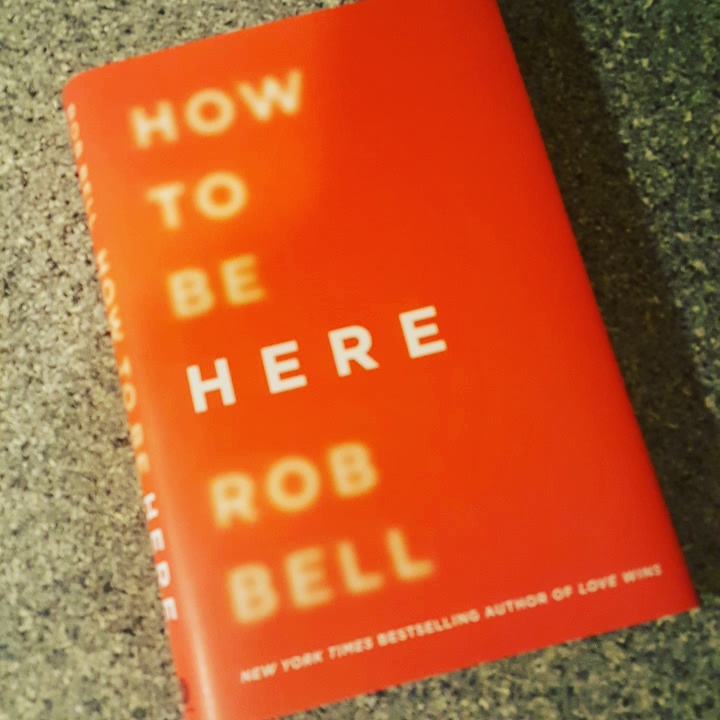
IMG_20160617_181306So, let’s get out of the way what How To Be Here isn’t. It is not a book about Christianity. It is not Biblical scholarship. It’s not theology. It’s not “Christian Living” (which is the heading it is shelved under at B&N.) So if you go into reading it expecting or hoping for any of those things, then you are going to be disappointed.

In the same vein, let’s get out of the way some things that Rob Bell isn’t, as well. Rob Bell is not a church pastor anymore. (Although I would still call him a pastor, albeit in a different way. He said the same in his talk.) He is not an evangelical Christian. He is not a theologian, or a Biblical scholar.

What is he? Well, I don’t want to speak for him too much. But I would say, he is a pastor in a wider sense, to a church, as he described it, without walls or a building. Instead, the church he leads is, in his words, “a group of people…….” He still guides people pastorally; he described that as a motivator for the more intimate nature of this tour, his hope to be able to interact with and hear from actual people, rather than lecturing from a stage. Theologically/philosophically, he is a universalist Christian. He still references the Bible often, both in the book and his talk, and he continues to describe his chief adherence to the Way of Christ.

And so, this book is a commentary on how to live in the world. It is a book that speaks about being yourself more fully. I hesitate to label it self-help, due to the baggage that comes with that term, but if you can think of the most generous categorization of that term, then you could call it self-help. The blurb describes it as a combination of “Spiritual wisdom with practical life advice.” I think that’s pretty accurate.

So, lets talk about this book. The premise is summed up pretty well in the title: Rob wants you to be here, present in this moment, in this life, in this world, in this place and time and context. We can spend a lot of time worrying about the future, and feeling guilty about the past, and those things can prevent us from experiencing life, from loving forward and fulfilling our potential and transcending  what we think we are and are capable of.

The book is split into 9 sections, each expounding on a practice geared towards maximizing your potential and experiencing life fully. It builds, starting with “The Blinking Line,” referring to the cursor in a Word document that blinks at you, waiting for you to type something into existence, seemingly pregnant with possibility and subtly mocking you, all at the same time. It moves from there to the blank page that is the future, ready to be filled, by finding your ikigai, or calling, by developing your craft, by tackling life one thing at a time, but being willing to take big risks, by being humble enough to work your way up from the bottom if necessary, and by taking everyday as a gift, culminating in a call to living fully present in this moment, unafraid, unworried, ready for whatever comes your way, optimistic and hopeful and gracious.

Like all of Rob’s books, it is full of wit and humor and short, catchy sentences and gripping stories and illustrations. He makes short reference to the Bible in several places (reminding readers at one point that he was, after all, once a pastor.)

The whole book is captivating and powerful. The arc of argument is inspiring, and for me, much needed and well timed. Specifically, his section on taking life one thing at a time really grabbed me. Rob calls it “finding your 1.”

I’ll let him set this up:

That’s where you start. With 1.

It’s too overwhelming otherwise. It’s too easy to be caught up in endless ruminations: What if Step 4 doesn’t work? or What if there isn’t money for Step 11 or What if people don’t like the results of Step 6?

You have no idea what the answers are the any of those questions. The only thing that wondering and speculating will do is seperate you from the present moment.

When you begin, the seventeenth step is sixteen steps away. You don’t have to know how to do it, or what it is, or even when it is.

Because the first number is always 1.

Not focusing on the 1 is a huge problem for me. I am all too often thinking far out into the future, planning and stressing and unsure of how I am going to bring all this together or do that thing or figure that out.

But what this section of the book instilled in me is, I don’t need to worry about that stuff right now. It’s not in front of me now. There are plenty of problems right here to solve, and then when you solve the first one, you move to the next. As Rob’s friend Eddie says in the book, “Stop thinking about shit that ain’t happenin’.”

Another good way to think about this is from the great movie The Martian(It’s a movie about outer space. Or course I think it’s great.) At the end of the movie, Matt Damon’s character Mark Watney is speaking to a class of future astronauts of the first day of class. He tells them, “You just do the math. You solve one problem, then you solve the next.”

You just do the math. You stop worrying about shit that ain’t happen’.

When it comes to writing, I am all to often way out in front of myself. What’s the next thing I’m gonna write? How do I follow this up? How am I gonna fill an entire page/post/book etc? And those questions paralyze me, and prevent me from sitting down and just writing what I know and what I have right now.

So now, I find my 1. What is that topic on my head today? What is that thought bouncing around? Write it down. It doesn’t have to be 1000 words or whatever. Just write down. More will come. Share it with the world when it seems right. And don’t worry about what comes next. Find your 1.

This extends to all areas of life for me. Work, home, family, leisure. I have problems to work today. Yes, we will plan and strategize and brainstorm and dream. But ultimately, we will work those problems when they get here. For now, we do 1.

Rob opened all that up for me in this book. Just that alone is big. But combined with everything else, I would highly recommend How to Be Here to you all.

Ok, so I said earlier, this is not a religious book. It’s not a book about Christianity. And that’s true. But I think there is a deeper spiritual point Rob is making, because, as he would tell us, everything is spiritual.

We have to be here, be present in this time and place and world, but that is where God is. God isn’t out in some cosmos. God isn’t beyond this plane. God isn’t out of this world. God is here, now, with us, in this world. But we miss God constantly, because we are constantly moving, and rushing, and worrying about the future, and not paying attention. God is here, and to experience God, we need to slow down and see God where God is. God is in people. God is in nature. God is in the little things that happen everyday that blow you away, or that you can’t explain.

And that’s Rob’s underlying point: be here, because God is here.