
Let’s talk about statistics. Cold, hard, indisputable numbers. Last year, in Germany, an unusually large number of people for that nation were killed by police: 17. In the UK, last year’s number was 3. In Australia in 2016 and 2017 total (the most recent year we have data for), it was 4. In Japan in 2018, it was 2.
Last year, in the United States, the number of people killed by the police was 1,099. Let that sink in for a moment.
Now, I know what you are thinking: the United States just has so many more people than Germany, the UK, Australia, and Japan. And you are right! So, let’s look at per capita. In Germany, .2 people in every 1 million were killed. In the UK, it was .05 in every 1 million. In Australia, it was .16. In Japan, is was .02.
In the United States, 3.4 people in every million were killed by police.
I know those numbers can be hard to gauge. That disparity between the US and those major nations is HUGE. The orders of magnitude difference is crazy. And the point is this: the number of people – of any race, age, gender, or socio-economic status – killed by police is unimaginably high. It is the kind of number you expect to see in third word authoritarian and dictatorial states. To add some perspective, think about this: in 2016, the Philippines elected an authoritarian dictator named Rodrigo Duterte. Duterte ran as a strong man, promising during this campaign that he would kill drug sellers and users across the nation, and urging his supporters to commit extrajudicial killings themselves. Upon election, Duterte in essence launched a war on his own citizens, unleashing the police to commit untold extrajudicial murders of all sorts of “undesirable people.” The country in the four years since has been a human rights disaster. From June 2016 to July 2019, over 5,000 people were killed by the police without any kind of trial or due process.
Last year alone, the United States killed a fifth of as many people. Over a similar three year period, we put 2/3 as many people to death with due process as a despotic, authoritarian dictatorship.
If you value democracy, liberty, and being a beacon for morals and values in the world, this should bother you. If you are a decent human being, this should bother you.
Let’s dig deeper. Out of those 1,099 people killed by police last year, 259 of them were black. That’s about 24%. Meanwhile, the US population is about 12% black. In the same year, 406 white people were killed by police. That’s more people! And, as a percentage, 37% of all people killed were white. Still more! The nail in the coffin for Black Lives Matter, amirite?!
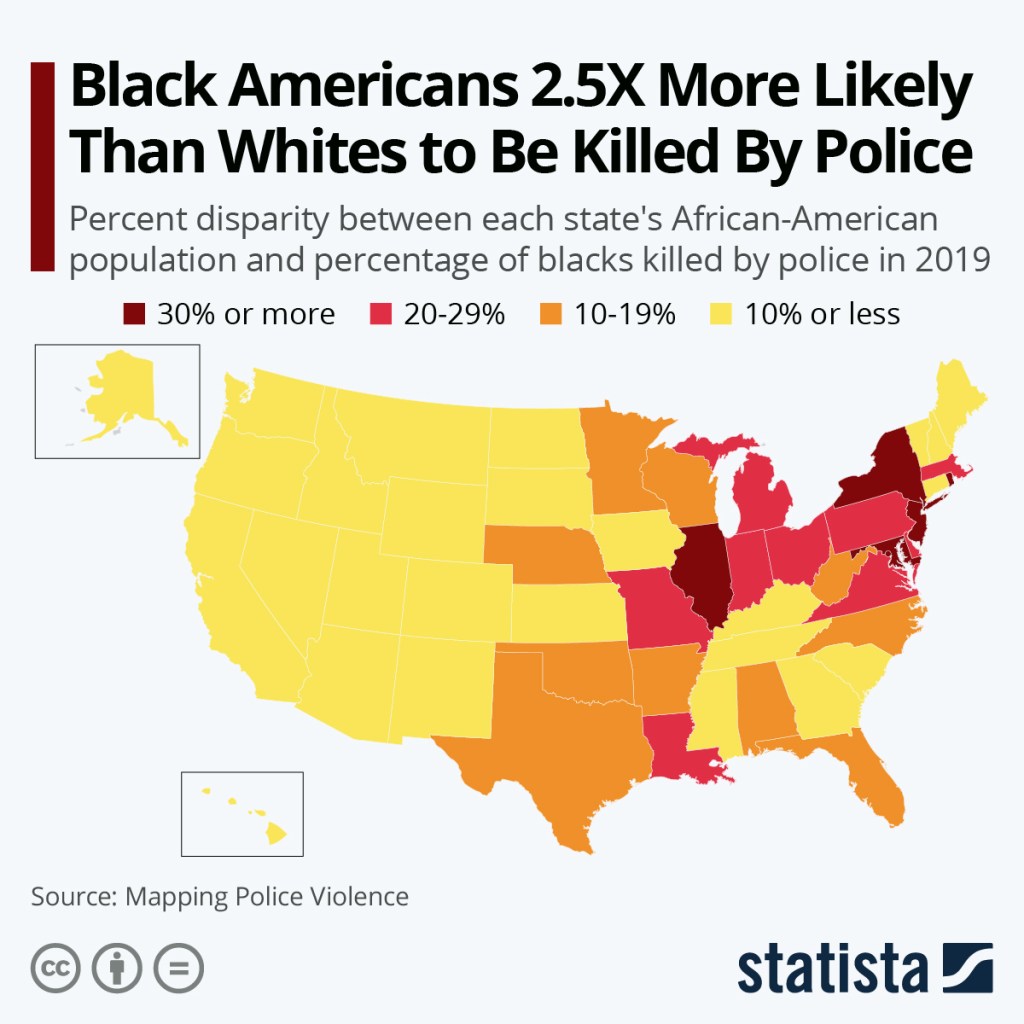
The US population is 72% white. We white folks make up ¾ of the people in this country, but only about a third of us were killed by police last year. What this means is, if you are black in the United States, you are 2.5x MORE LIKELY than a white person to be killed by the police.
Well surely, I hear you ask, this was the case because those black people were committing more dangerous crimes, right? I mean, that’s a logical assumption to make, isn’t it? But its just not the case either: blacks victims of police death were 1 ½ times more likely than whites to be unarmed. Again, think about that: black victims were more likely than whites to be unarmed, but also more likely to be killed.
All in all, whites and blacks made up a similar amount of total crimes committed in the US last year. That tells us that, in a world free from racial prejudice, victims of police brutality should also be similar among whites and blacks. But they aren’t. Blacks are, again, 2.5% MORE LIKELY to be victimized, despite not committing crimes at a similarly higher rate than whites.
Oh, and one last thing on these numbers: in 99% of cases, the police officers committing murder against those in police custody were not charged with any crime. Let me say that again: 99% OF POLICE WHO MURDERED UNARMED SUSPECTS NEVER FACED A CHARGE OF WRONGDOING.
Again, these numbers should bother you. No, wait, they shouldn’t just bother you. They should terrify you. They should devastate you. They should piss you off, send you into the streets, make you demand better from those we charge with protecting, serving and leading our nation. These numbers are simply UNACCEPTABLE.
These numbers don’t exist in a vacuum, either. To understand why people are so angry, why #BlackLivesMatter is taking off, why people are demanding real change and meaningful police reform in this country, you have to view these statistics in the context of American history. These numbers are happening in a nation that once enslaved these same black bodies. We first created professional police forces to hunt and return runaway slaves. Then, after we were forced by four years of bloody war to no longer enslave them, our country spent the next one hundred years constructing and maintaining a state-sponsored, outright system of discrimination, segregation, and terror against these same black bodies. We lynched hundreds, destroyed the livelihoods of countless others, and refused to let them exercise the full rights, responsibilities and obligations that are their birthright as American citizens. We turned the police into the tool of public repression and discrimination, using dogs and batons and water hoses and jail cells and a convenient blind eye to keep blacks in line and in their place. Then, when we were forced to dismantle that as well, we turned around and built a New Jim Crow, to quote Michele Alexander, predicated on housing and financial discrimination and the use of judicial and police power to disproportionately punish, imprison, and kill black bodies. We have elected a series of “law and order” political leaders who used the levers of legislative and executive power to twist sentencing and judicial guidelines against black bodies. We have, in short, literally done just about every imaginable thing we could come up with throughout our history to oppress and kill black people. And, in a democracy, these things have been done in YOUR name.
And you can’t figure out why black people are done with this shit? You can’t fathom why they are so damn fed up?
These appalling numbers cannot be separated from this shameful history. And that vital link is why we are marching in the streets today. Enough is enough. 400 years of history is too much. These numbers – indisputable, scientific, hard facts – are too much. Things must change. They have to change. Our future as a nation depends on it. And frankly, these numbers tell me this: if we don’t do better, maybe we don’t deserve to stick around much longer. The injustice may just be too much for our nation, already so divided, to bear.
One last note:
I wanted to take a second to break some of these numbers down by state, too. I’m going to look at six states/territories that jump out on this map: Washington D.C., New York, Illinois, New Jersey, Maryland, and my own home state, Oklahoma.In D.C., the population is 50% black, yet blacks make up 88% of those killed by police.In New York, the population is 16% black, with 37% of police deaths being black.In Illinois, those numbers are 14%, and 53%, respectively; in New Jersey, 13% and 46%; in Maryland, 30% and 50%. And finally, right here in Oklahoma, only 8% of our state’s population is black. Yet, blacks make up 40% of those killed by police in our state. FORTY PERCENT! That’s insane!
Resources
https://www.statista.com/chart/21872/map-of-police-violence-against-black-americans/
https://www.channel4.com/news/factcheck/factcheck-black-americans-commit-crime
 One only need look at the state of race relations in the ensuing decades to see the limits of respectability politics. A nice suit didn’t stop that bullet from killing Dr. King. Racial inequality and animus is still all around us. Reynolds mentions the example of Dylann Roof’s victims’ families forgiving him and the fact that “in the wake of that horrific tragedy, not a single building was burned down.” And yet, 18 months later, we elected Donald Trump as president and watched white nationalism get a new shot of energy. The respectability of Roof’s church-going victims, and of their families’ beautiful (even Christ-like) display of forgiveness did not save America’s soul. This isn’t to say they are to be dismissed, or that the work of Dr. King and others was inconsequential. Far from it. Rather, the point is that their work has been co-opted by the power of white supremacy.
 Justin DaMetz