The curious thing is that many agriculture specialists and “agribusinessmen” see themselves as conservatives. They look with contempt upon governmental “indulgence” of those who have no more “moral fiber” than to accept “handouts” from the public treasury – but they look with equal contempt upon the most traditional and appropriate means of independence. What do such conservatives wish to conserve? Evidently nothing less than the great corporate blocks of wealth and power, in whose every interest is implied the moral degeneracy and economic dependence of the people. They do not esteem the possibility of a prospering, independent class of small owners because they are, in fact, not conservatives at all, but the most doctrinaire and disruptive of revolutionaries.
Wendell Berry, “Margins” in The Unsettling of America
I’ve written in this vein before, and I’m glad to get some confirmation of this feeling from Wendell: today’s conservatives are anything but conservative, in terms of the policies and priorities they put forth. There is nothing conservative about wanting to radically tear down or alter institutions and programs. Many so-called conservatives today are instead radicals, driven by an ideological commitment to capitalism and nationalism. In fact, as I wrote recently, everyone is a radical now, on all sides. And there are a few of us, moderately inclined (tempermentally) who are taking up the task identified by William F. Buckley half a century ago of standing athwart the on-going social media fights and political games, yelling “stop!”
On a unrelated note, this is the last of my posts recently detailing the things I wanted to pull from Wendell Berry’s What Are People For? and The Unsettling of America. Onward to new obsessions!
On a subject related to yesterday’s obituary for affirmative action, I want to think about this quote from Wendell Berry, who in turn is quoting and commenting on George Orwell:
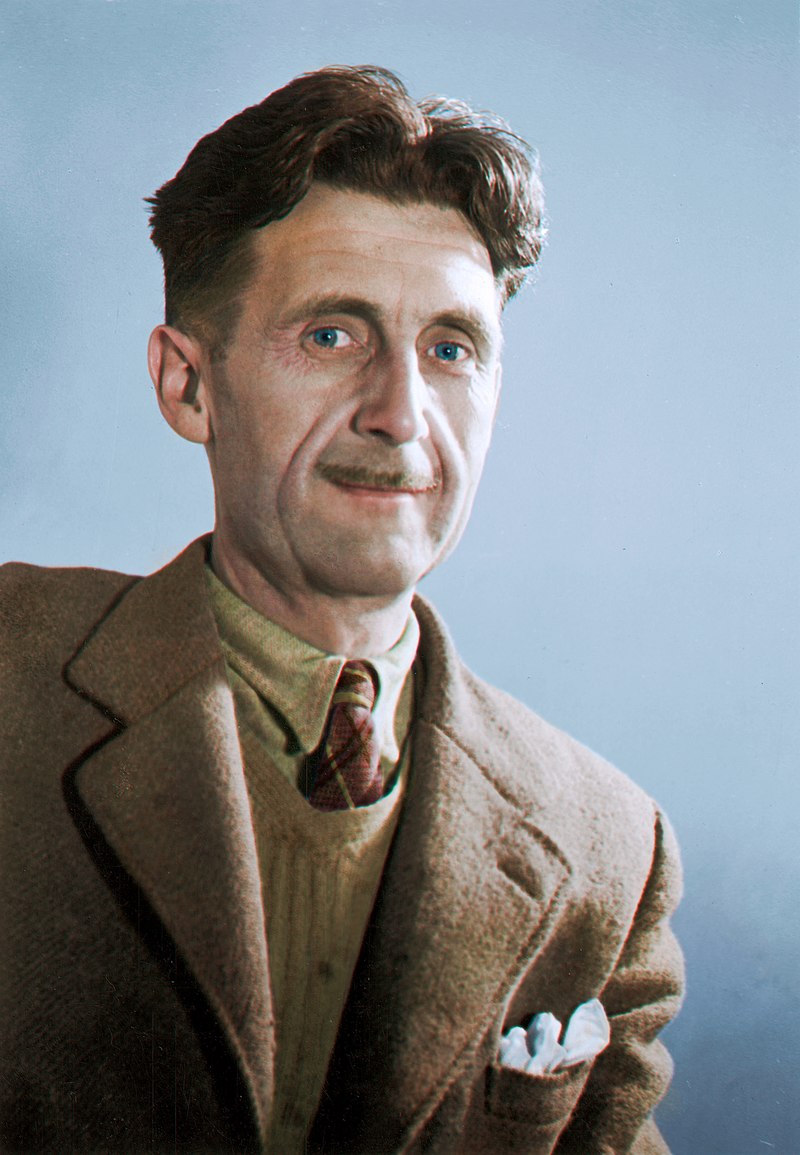
George Orwell
In his essay on Kipling, George Orwell wrote: “All left-wing parties in the highly industrialized countries are at bottom a sham, because they make it their business to fight against something which they do not really wish to destroy. They have internationalist aims, and at the same time they struggle to keep up a standard of life with which those aims are incompatible. We all live by robbing Asiatic coolies, and those of us who are ‘enlightened’ all maintain that those coolies ought to be set free; but our standard of living, and hence our ‘enlightenment,’ demands that the robbery shall continue.”
This statement of Orwell’s is clearly applicable to our situation now: all we need to do it change a few nouns. The religion and environmentalism of the highly industrialized countries are at bottom a sham, because they make it their business to fight against something they do not really wish to destroy. We all live by robbing nature, but our standard of living demands that the robbery shall continue.
Wendell Berry, “Word and Flesh” in What Are People For?
This relates as well to my post a couple of weeks ago about how the left needs to get serious about politics, and I guess is becoming a bit of a running theme for me. There are real serious issues for the left to tackle – around inequality, wealth, economic justice, corporations, capitalism, and more – that would have fantastic downstream effects on marginalized communities. But, tackling them would mean back-benching identity issues and the easy clicks and fundraising pitches they generate, not too mention the dopamine hits that a good Twitter rant conjures up. Orwell saw it nearly a century ago, Berry saw it fifty years ago, and here we are today. The left hasn’t really changed; most liberals seem to enjoy the fight more than they do results, and the people who are hurt by that decision are the ones we claim to care the most about. We’ve got to get serious. We’ve got to.
One of my pet fascinations/habits over the last year or so has been what you might call “optimistic catastrophizing.” What I mean by this oxymoron is that I have been kind of obsessed with the end of civilization1 and how that might come about and what that would mean for how people live their lives. I have a lot of thoughts around this, and I should probably write more about them.2
Anyways, I don’t necessarily view this end of things with a worried or pessimistic view, beyond my natural concern for the harm that would come to many, many people. The reason I observe things “optimistically” is because I tend to think some sort of “end” to civilization as we understand it today – and have understood it since at least the beginning of the Industrial Revolution, or perhaps even the Enlightenment – is somewhat inevitable, possibly within my lifetime, fairly probable within that of my children. Whether its environmental degradation, massive political unrest, permanent economic disruption, or hubristic and fatal technological development (or perhaps a combination of all these things), I do think big, irreversible changes are coming, after which life will look radically different for everyone. This is in terms of social interaction, economic activity, travel, consumption, entertainment: all of it will mostly go away, or at best, become extremely difficult to access and participate in.
But I stay optimistic precisely because I see it as inevitable, and thus something in need of preparation for, at least psychologically (I’m not really interested in survivalist/prepper-style hoarding and planning, mostly because I think the idea that one can plan logistically for that kind of thing is really hubristic and misguided). These shifts are coming, and we need to be ready for the day when we can’t simply hop in our car and drive to the local grocery for everything we might want to consume, or click on the television or phone for endless entertainment and distraction. Despair is not helpful, nor is it something Christians are allowed to traffic in. So, I try to stay optimistic, in the sense that tomorrow really is not promised in any way, and each day will bring us struggles and challenges and even tragedy we must confront, that giving up and curling into a ball is not really an option, especially for those of us with children and family and other human beings we love and feel a sense of responsibility for. To reference my post on friendship from yesterday, another demand of human relationship that many people shy away from is that of hope: that is, the hope that no matter how bad things may be, the love and fellowship we have with one another is not dependent on any outside product or construction or value. We can survive it all simply through our attachments to one another and our commitment to mutual care, love and interaction.
All this is a long set up for me to praise this piece by Oliver Burkeman on his fantastic newsletter “The Imperfectionist.”3Titled “It’s worse than you think”, it is a wonderful piece of writing that successfully pulls off the trick of being terribly pessimistic and oddly uplifting all at the same time. Here is a taste:
Or maybe your issue is feeling anxious about what the future holds, in your life or the world at large. You feel as though you need to engage in constant planning, or reassurance-seeking from others, or some other form of psychological self-defence, in order to cushion yourself from the worst of the uncertainty. But it’s worse than you think! In fact, anything could happen at any moment. The future is always entirely uncertain. And while planning has its uses, it will never do the slightest thing to alter what the spiritual author Robert Saltzman calls your “total vulnerability to events.”
That’s….oddly comforting. You can try to plan for every eventuality. But honestly? Everything is going to go to shit at some point, because we are limited beings and entropy is a fact of the universe and we just can’t foresee every permutation things could take. You could try to plan for it all. But chances are, you’re gonna be wrong. And in the end, we all are fatally wrong at some point.
My optimism arises here (where I think most people would turn to nihilism) because this is a pretty freeing notion, if you think about it. Stop grasping after the future. Live today. Love today. Experience today. You can’t stop the inevitable, and the end is in fact inevitable, whether you like it or not. Yeah, things are gonna hurt at some point. Everything you built may come crashing down. You never know. You can’t predict it, and trying to it a fools errand. So just be. Here is Oliver again:
In short: we can’t ever get free from the limited and vulnerable and uncertain situation in which we find ourselves. But when you grasp that you’ll never get free from it, that’s when you’re finally free in it – free to focus on the hard things, instead of the impossible ones, and to give this somewhat preposterous business of being a human everything you’ve got.
Honestly, I think this is also a radically Christian view of things. Ever heard the phrase “let go, and let God”? Yeah, that’s some cheesy and shitty cultural Christian schlock that’s often used to justify injustice. But there is a kernel of truth in there too. Part of surrendering to Christ is just that: surrendering. Jesus told us: building up a bunch of treasure here is foolishness, because its all going away eventually.
The end is coming sooner or later. Things are falling apart. It really is all probably a lot worse than we imagine it is! But you know what? It always has been. If we all just spent a little more time caring for those around us, and a little less time trying to erect unwieldy, complicated and Babel-esque structures in some Sisyphean effort to stave off the inevitable, things would probably work out for all of us a little bit better in the end.
1 Note the word civilization here, not world. I don’t think the ending of the entire world is something worth worrying over. But the ending of western civilization as we understand it today? Completely within the realm of possibility within my lifetime, I believe.
2 I have a longer piece, centered around a review of the novel Station Eleven, that has been in the works at my newsletter for a while. Perhaps I’ll wrap that up and publish it soon. In the meantime, subscribe to my newsletter!
3 credit to Alan Jacobs for first pointing the way to this piece on his “Snakes and Ladders” newsletter.

 Justin DaMetz