Intentional Christian community is a way of living that my wife and I have been interested almost as long as we have known each other. Some of our earliest experiences together were attending a talk by Shane Claiborne, one of the leaders of the New Monasticism movement, and visiting Dr. Elaine Heath’s New Spring Communities in the Dallas-Fort Worth area for three days.
As a result of these experiences, and through reading and study, we’ve always had a goal of participating in intentional, missional Christian community. During our time in Tulsa, this goal has come closer and closer, as we have gotten involved with those pursuing the same here. Recently, we have begun looking at places to live in Turley, an unincorporated town just north of Tulsa that is hit hard by poverty and blight, and where the Third Way Foundation, led by UU Rev. Ron Robinson, has begun this missional model. Intentional living is finally within reach for us, the culmination of almost seven years of searching and discerning and hoping.
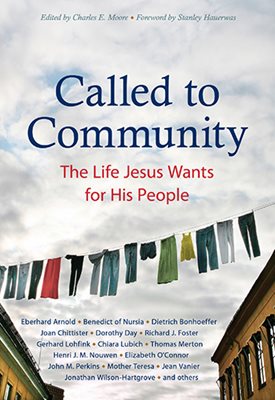
So receiving the latest book from Plough Publishing in the mail a few weeks ago was an unexpected, much appreciated surprise. Called to Community: The Life Jesus Wants for His Peopleis a compliation of essays from a variety of Christian figures across the centuries. Divided into 52 chapters focused on specific topics (for instance, “Vocation”, “Transparency”, or “Money”), the book is designed for communal reading weekly for a year.
Obviously, I didn’t go the weekly route; I read it straight through. In doing so, I came to understand that reading it slowly, topic by topic, is what I really would suggest; there is not a narrative theme, so it can start to bog down in a straight read, especially if you are running through chapters that don’t speak to you.
That said, I found Called to Community a great resource, one I intend to keep close at hand as we move into intentional community. The variety of voices represented here (ranging from Dorothy Day to John Perkins to Dietrich Bonhoeffer to Thomas Merton), writing from experience on the things any Christian community will run into are invaluable. So many new ideas and questions came to me as I read and contemplated our move.
If you are involved in a missional community, or if you are contemplating it, or if you just want to know how to maximize the sense of community in your local congregation or prayer group, Called to Community can be a priceless, and much used, resource on your shelf. Not necessarily as a single read, but as a collection you can call upon in a variety of situations as you navigate life with others. Give it a read.
I love reading about our leaders, their lives and their presidencies. I have many on my shelf – Adams, Jackson, Polk, Lincoln, Truman, both Roosevelt’s, among others.
A couple years back, I read a book called “Brothers”, by David Talbot, about the John and Robert Kennedy. One thing the book kept relaying, in the words of those who knew him, was JFK’s overwhelming sense of mortality. He had a keen awareness that life was intimately perishable, and at any moment he could be struck down.
Of course, he was, in 1963, at the hands of an assassin. And that fact about JFK, his awareness of his own mortality, has long since stuck with me.
I’ve not experienced a lot of death in my life. Both of my grandfathers have died, one of whom I was particularly close to. My mother’s older brother died in his 30’s, and he and I are much alike. My wife’s aunt died a few years ago, while we were all gathered around her hospital bed. Compared to most people in the world, I suppose my direct exposure to death has been relatively light.
Yet, I’ve always been especially aware of death. The idea of dying young has always had a morbid fascination to me. We seem to be made to live and prosper across a fairly long span of years, and yet, so many people do not. Lives are cut short everyday, by gunshots and car wrecks and natural disasters and disease. Those people never get to live out a “full” life, whatever that may be. In the view of us left, they were taken early, and we all miss out on the things they may have brought to the world.
“Six Months to Live” By Daniel Hallock 134 pages Plough Publishing House
“Six Months to Live,” by Daniel Hallock, is the story of 22-year old Matt, who is diagnosed out of the blue with terminal lymphoma. A healthy, fun-loving young man, Matt grew up in the Bruderhof community of Pennsylvania. His illness and death was a pivotal event for the small, close knit Christian community.
The book does a wonderful job of introducing you to Matt, of helping you to understand who he was, so much so that, when you get to his inevitable death near the end, it truly saddens you. You feel like you are losing a friend. Told mostly from the words of his attendant doctor, Matt’s final hours are strikingly detailed and heavy.
But throughout the book, the recurring theme is one of hope. Through faith, family and community, Matt and his wife Cynthia, whom he married a month after his diagnosis, come to grips with his fate, and help guide their friends and family through the difficult steps of letting go. It’s a beautiful illustration of grappling with mortality, of accepting a terminal diagnosis, and thriving through the end of one’s life.
It makes you grapple with your own mortality. What is to stop you from walking into the doctor later this week, and being given your own terminal diagnosis? I know that’s a rather morbid thought, but it’s one we should all think about. How would you life differently? What would you do? Who would you be with?
We live in a world that seems to treat death as an accident, as something unnatural and terrifying. Yet, death is inevitable, and even normal. Death comes to all of us. As Christians, we believe that death’s sting has been defeated. Resurrection is our comfort; death does not have the final word, but instead hope moves us forward always. No matter the final outcome, we know death is but a temporary roadblock to eternal life. All things die, but all things live on.
Matt lived on. The impact he had on his family and friends and classmates and even total strangers is readily apparent in the reading of his book. His resurrection is indisputable; he lives on in the words and memories and actions of those who knew and loved him, those who gained a sense of rebirth as a result of his death.
I quibble with the theology throughout; the constant invocation of “God’s will” and “God’s plan” in relation to Matt becoming terminally ill doesn’t sit well with me. I don’t think death and suffering is God’s plan or will for anyone, even in the light of resurrection. God wills full and healthy lives for us all, and joins us in active mourning every time a life is cut short.
But this doesn’t mean God is abandoning us to a terrible fate, a world of despair and sadness. The world works how it will; nature produces disease and illness, and our place in this ordered universe means it will strike us. But God has the final, love-filled say over that reality: Love wins in the ends, life goes on, we are resurrected.
As Matt’s friend Steve puts it in the book,
Matt’s death was actually a victory over death-over the powers of darkness, self-indulgence, and pride. It was a victory because it brought him and all of us around him back to the essentials; to the things of eternity-to the childlike spirit each of us needs in order to be part of the kingdom of God.
Amen.
Disclosure of Material Connection: I received this book free from Plough Publishing House in the hope that I would write a review. I was not required to write a positive review. The opinions I have expressed are my own. I am disclosing this in accordance with the Federal Trade Commission’s 16 CFR, Part 255: “Guides Concerning the Use of Endorsements and Testimonials in Advertising.”


 Justin DaMetz