The Bookshelf: At The Heart of The White Rose

There is a paradox constantly present in times of persistent crisis. The world around us is going to hell, seemingly. Yet, at home, life goes on almost unblemished. In our modern times, this paradox is especially present. For the last sixteen years, our nation has been at war in at least two different theaters. Scientists are unanimous in their assessment that the climate is almost at a point of no return, and in half a century vast swaths of the world will be uninhabitable. Anti-democratic forces are gaining hold more and more worldwide, and hundreds of millions of people live in a state of not knowing where their next meal is coming from. And right here at home, the most extreme, right wing administration in American history is reshaping the norms of American politics in terrifying and unreal ways. 

Yet, for so many of us, life just continues to roll on. We may know about all these crises, but we are so well-cushioned – a nice home, a readily accessible food source, good schools, decent neighbors, a consistent paycheck – that its hard to feel like we are in a moment of crisis at all. You could close your eyes, and it would almost all just fade away.

However, we don’t think of moments of historical crisis in that way. Surely, in actual moments of crisis, it must be overwhelming, the constant feeling of dread and insecurity one would feel. World War II, for instance, would seem like a time when normal life would stand still, and a daily sense of extremes would dominate. This would seem especially true in war-era Europe, and probably even more acute in war-era Germany.
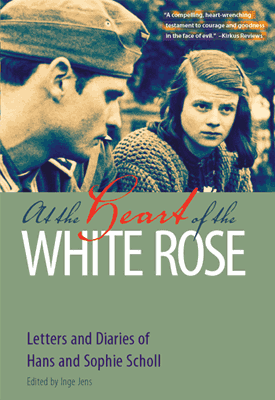
The reality, however, is almost certainly the opposite, more akin, actually, to our present reality. This feeling of detachment and normalness in the midst of earth-shattering crisis is present throughout At The Heart of the White Rose: Letters and Diaries of Hans and Sophie Scholl.

Hans and Sophie were brother and sister, alternately the oldest and youngest of a larger brood of children, growing up in the first half of the 20th century in Nazi Germany. In their early 20s at the outbreak of war on the continent, both are conscripted into national service for the Reich, Hans as a military doctor, and Sophie in the compulsory Nazi youth organizations.

Yet, neither are Nazi supporters. Hailing from a highly educated, well-to-do family, they are well-read and intellectual, and both write obliquely of their horror at the rampant nationalism and violence going on around them. Eventually, along with a substantial group of friends and acquaintances their age, they begin writing and distributing anti-Nazi leaflets in Munich. Their group is dubbed “The White Rose.” After six subversive pamphlets, Hans and Sophie are caught distributing leaflets at the university in Munich, and subsequently executed. Hans was 24; Sophie just 21.

At The Heart of the White Rose is a collection of excerpts from their letters and personal diaries, kept between 1937 and their deaths in February of 1943. And despite the wartime setting, the sense one gets of reading the letters is normalness. Without the editorial inserts between letters and chapters, one would hardly know the circumstances they were facing. Hans, being in the military, obviously speaks often of his deployment first in France, then in Russia. But these references all come admidst rumination on philosophy and religion, vivid descriptions of nature, and mundane topics such as the need for clean laundry and money from home.

Sophie, who we meet when she is just 15, is a normal teenager of time, fond of biking and boys and nature. As the war continues, you watch her become a bit harder, at times forlorn. In her diary, she struggles both with her burgeoning religious beliefs, and also with self doubt. Yet, she maintains deep friendships with far-flung friends via letter, and her inherent optimism is always there.

This is a heartbreaking book, precisely because of the mundanity of the letters and diaries. Obviously, Hans and Sophie could have never imagined all this would be compiled and read nearly a century later. But, because we know where this story is going -not just the deaths of Hans and Sophie, but also the concentration camps, the ghettos, the atrocities of war – you read these letters with the feeling you are watching the moments just before a devastating car crash in slow motion.

In the second half the book, Hans and Sophie both begin to grapple with Christianity, which seems to have become a topic of interest among the White Rose members. Hans is ever the philosopher, writing academically of theological notions, grappling with them intellectually. Sophie, on the other hand, in her diary, is much more visceral, wrestling mightily with the existence of God, and her relation to such a being. I was astounded at just how articulate and brilliant both of these amazing people were, and acutely aware of the grand tragedy of their deaths.

Both Hans and Sophie’s last letters were written the day before they were arrested, and just five days before they are sent to the guillotine. Hans writes to his girlfriend, Rose; they appear to be going through a difficult moment in their relationship, exacerbated by their distance. Hans last words on paper are a wish for another letter from her quickly. 

Sophie writes to her best friend, Lisa, that she had been playing a piece by Schubert on her sonograph, and beautifully describes the piece. “You can positively feel and smell the breezes and scents and hear the birds and the whole of creation cry out for joy. And when the piano repeats the theme like cool, clear, sparkling water – oh, it’s sheer enchantment,” she ends the letter. Less than 24 hours later, she would be in the custody of the Gestapo. The enchantment in this amazing collection of personal writings is found in the privilege of being privy to the everyday lives of these normal, ordinary heroes, and seeing that they aren’t all that different from us, that the world they were living in was not so different from ours.

Disclosure of Material Connection: I received this book free from Plough Publishers. I was not required to write a positive review. The opinions I have expressed are my own. I am disclosing this in accordance with the Federal Trade Commissions’ 16 CFR, Part 255: “Guides Concerning the Use of Endorsements and Testimonials in Advertising.”
What I’ve Been Reading (and Watching and Listening To) This Summer

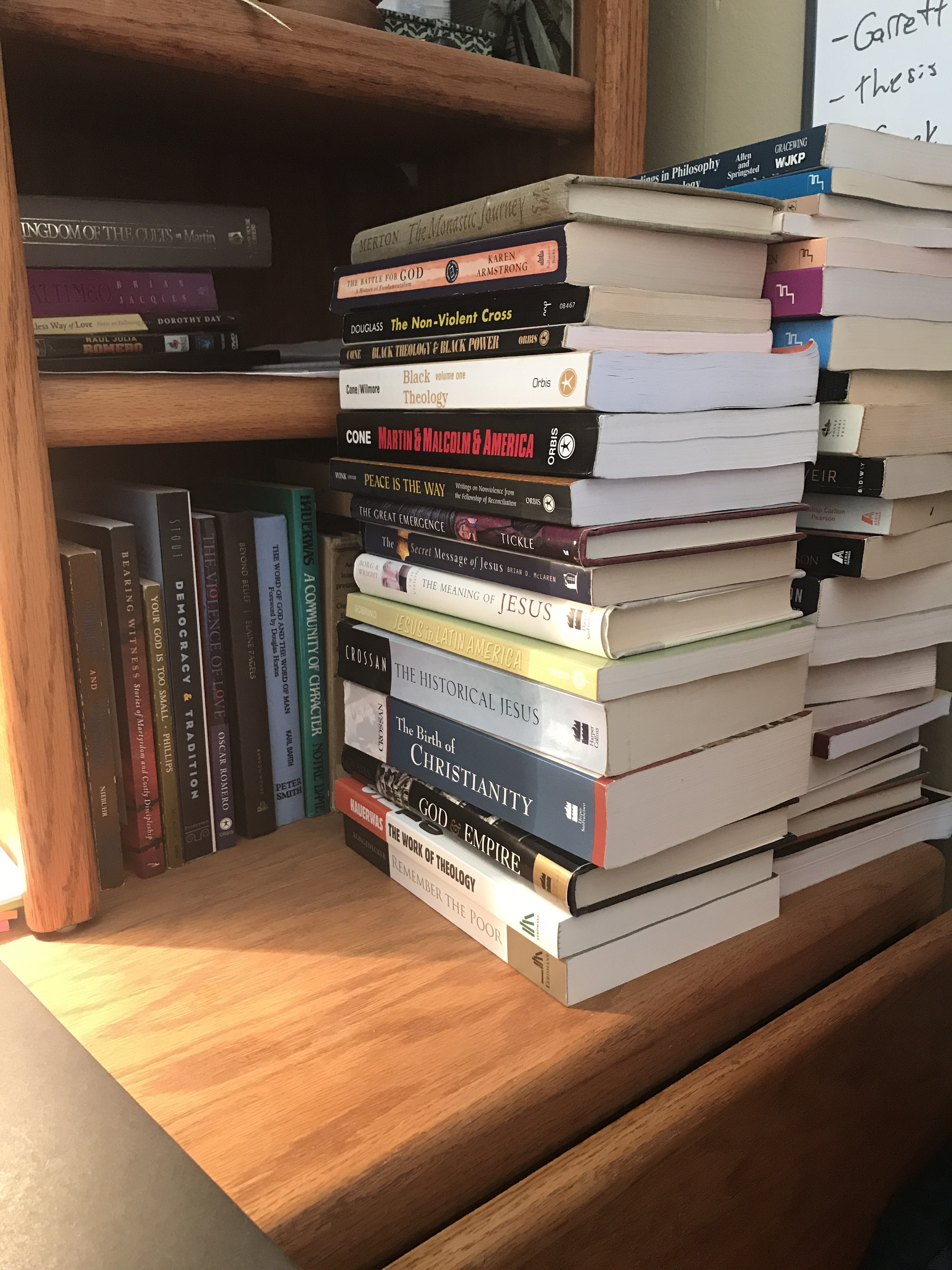
A portion of the “to-be-read” books on my desk.

One of my goals this summer has been to do a lot of reading. During the school year, any personal reading is very obviously out of the question. Being a lover of books, this means that I obtain a healthy stack of “to be read” books. This last year was especially fruitful on this front; between a pastor friend retiring and letting me raid his shelf, another friend downsizing for a cross country move and allowing the same, and just my own general buying and collecting of books, the to-be-read pile on the corner of my desk has swelled to well over 70 titles.

Obviously, getting through all of them this summer is impossible. But I’m doing my best! Here is what I have read so far this summer.

The Righteous Mind by Jonathan Haidt

Tears We Cannot Stop by Michael Eric Dyson

Sabbath as Resistance: Saying No To The Culture of Now by Walter Brueggemann

Drops Like Stars by Rob Bell

What is the Bible? by Rob Bell

The Bluest Eye by Toni Morrison

The Road to Assisi: The Essential Biography of St. Francis of Assisi by Paul Sabatier

Home: A Novel by Marilynne Robinson

The Gift of Doubt by John B. Wolf

The Divine Dance: The Trinity and Your Transformation by Richard Rohr

Sister Outsider: Essays and Speeches by Audre Lorde

Misquoting Jesus: The Story Behind Who Changed the Bible and Why by Bart D. Ehrman

How Jesus Became God by Bart D. Ehrman

At The Heart of the White Rose: Letters and Diaries of Hans and Sophie Scholl

I’m not going to get into my thoughts on each of these here, but I’m sure I will come back to them this fall. You can especially count on hearing more about What is the Bible? by Bell, the Ehrman books, Tears We Cannot Stop, and The Gift of Doubt. Also, At the Heart of the White Rose was sent to me by Plough Publishing, and I intend to write a book review very soon.

At this moment, I currently have two books I’m working on:

A Theology for the Social Gospel by Walter Rauschenbusch (which I quoted in a post last week; I imagine I’ll have much more to say going forward,)

and, We Were the Mulvaneys by Joyce Carol Oates (I’m only about a quarter of the way into it, and I highly, highly recommend you read it.)

And of course, my list is still full. If you are interested in seeing what I have on my shelf, and keeping track of what I’m reading, find me on Goodreads.

In addition to the books I am reading, I have also been working through the stacks of journals I subscribe to that I couldn’t get to during the school year. Regular readers here will be familiar with Plough, a quarterly I reference here often (they also send me books to review, as per above.) I had stacked up back issues from last summer, which I finally have caught up on.

I also took out a subscription to Jacobin, a democratic socialist quarterly, this spring, and have been reading through the back issues. Interesting stuff; I don’t always agree, but it always gets me thinking.

And, as a new student member of the American Academy of Religion, I have started receiving their journal, which I haven’t even had a chance to look at yet. (I intend to attend the Annual Meeting in November in Boston, which I’m sure I will share more about here.)

Of course, I expect to have thoughts about all three of these journals here in the future.

I don’t watch TV in the traditional way (I’m a millennial, after all) but I do engage in binge watching shows as best as I can. This last year, I worked through Mad Men finally, and got current of House of Cards. I am currently working through the Sopranos (halfway through season 4!), with intentions of moving to The Wire next.

Finally, I have been working on catching up on the Rob Bell podcast (RobCast) this summer, which is always stimulating and hilarious and wonderful in a lot of different ways. You should listen to it!

So that’s everything that’s bouncing around in my brain this summer, which is obviously going to have lots of influence here going forward. What are you reading, watching, or listening to this summer? Share with us below!

The Bookshelf: Escape Routes

Christianity provides an extensive theological framework for a variety of important topics. Perhaps the most important subject it gives a lens to is that of human suffering. The Christian faith centers itself around the suffering act of God, experienced in the person of Jesus Christ. The Suffering Servant is a widely popular image of Christ, and the stories of the martyrs feature prominently in church tradition.

In this light, Johann Christoph Arnold’s little book, Escape Routes: For People Who Feel Trapper in Life’s Little Hells, is a vitally important read on how to apply real-life theological understandings to the suffering nature of human existence.

Any regular reader here knows I am not a fan of the “self help” model of religion that 21st century American Christianity so often falls into. Yet, over the past month, I have begun to become intensely interested in a “theology of suffering,” chiefly as a result of reading Moltmann’s The Crucified God. While I certainly don’t want to narrow the life and message of Jesus down to a simple how-to guide of dealing with the hard parts of life, I do think the faith, at it’s core, should be oriented towards better lives for all human being. And a crucial part of that work is addressing and putting into perspective the suffering every person experiences in their lives.

Arnold, through the use of stories about people’s life’s, addresses the various aspects of suffering. Running through lonlieness, despair, difficult pasts, the struggle of success, and (interestingly) sex, he shows the universality of suffering in the human experience, and thus is able to effectively address the loneliness someone struggling though any of these areas surely feels. This arc culminates in the highlight of the book, Chapter 7, entitled, simply, “Suffering.” Arnold tells several stories again, culminating in the life of Bishop Oscar Romero.

The book ends on more positive notes. One of the most noteworthy, and surprising, moments of the book, is in the chapter entitled “Travel Guides.” Arnold illustrates the lives of three people who endured much suffering, and yet persisted, carrying through to significant and lasting impacts on the world. Surprisingly, one of the people he highlights at this point is Che Guevara, the Communist revolutionary who fought in Cuba and Angola. 

To encounter words of praise towards the leftist icon from someone within traditional Christianity is, well, rare, to say the least. And Arnold certainly doesn’t gloss over the most unsavory aspects of Guevara’s life and legacy. But crucially, he is able to draw out Guevara’s love for the regular people of Latin America, a love that drove him to fight against oppression and imperialism around the globe.  As a young left-leaning person, I obviously grew up around images of Che. I have always been intrigued by the man and the passion he exemplified, but was troubled, as a pacifist, by the violent methods he employed at times. Arnold, in this section of the book, is able to put my mind at ease.

He does all this in service to his broader goal, of normalizing the act of suffering and reassuring those who suffer that they aren’t alone, that even great men and women in history suffered greatly on their way to the things they did in the world. I found this little book an easy and enlightening read. Indeed, as Arnold shows, suffering is a key component to the Christian experience. For every Prosperity Gospel success story of big houses and helicopters, there are a thousand suffering campesinos, toiling everyday for pennies. Their experience is the dominant experience of the Christian movement. Their lives provide the primary paradigm for understanding Christian theology. And it is their suffering that Jesus took on and identified with, and called us all to recognize. The Suffering Servant isn’t an unobtainable ideal; the Suffering Servant is each of us.

As always with the books I receive from Plough, I of course was bothered by the allusions to traditional views on sexuality and reproductive issues, but they are few and far between here. Escape Routes is a lovely little book, and can be a highly useful resource for those enduring suffering (that is to say, all of us), and those who are called to be shepherds to those who suffer.

Disclosure of Material Connection: I received this book free from Plough Publishers. I was not required to write a positive review. The opinions I have expressed are my own. I am disclosing this in accordance with the Federal Trade Commission’s 16 CFR, Part 255: “Guides Concerning the Use of Endorsements and Testimonials in Advertising.”