The following is a reflection post from my Vocation Matters class at Phillips this spring. We were prompted to think about holding the authority to bless, and how that felt.
The idea of “blessing” someone is somewhat unsettling to me. I think this is for several reasons. First, I’m not entirely sure what it means to “bless” someone. The dictionary defines it as to “pronounce words in a religious rite, to confer or invoke divine favor upon; ask God to look favorably on.” In the Christian context, I suppose that means to lay hands on or pray for somebody in their presence.
But this brings means to my second reason for being unsettled. My personal theology balks at this idea of asking God to “Favor” someone or something in a particular instance. I don’t see God as a being that picks out certain people for “Special” favor. I think God looks with favor on all people at all times, but that bad things happen, not because of God, but because of the nature of an ordered, rational universe and our own imperfect knowledge.
So what can I do with this idea of blessing? Obviously, as clergy, I am going to be entrusted with the authority to pronounce blessing, and expected by my congregants to exercise that authority in some way. Perhaps what I said above can be a starting place: God looks with favor on all people at all times. I think we forget that, especially when times are hard, or we are anticipating something hard, or new, or scary. As a clergy, as someone ordained to be God’s representative to the church, a blessing can be a reminder of this ever-present blessing and love of God to people who need to be reminded. And I don’t think we can hear enough that God does love us, that we have purpose and favor in our lives. In this sense, being an agent of blessing really speaks to me.
It’s the midway break of my first semester at Phillips Theological Seminary, and I am currently enjoying a break from class and discussion boards and writing and reading. (Ok, so I’m not actually able to take a break from reading. More on that in a sec.)
We’ve been on break from weekly classes for two weeks now, and we have next week off for Holy Week celebrations. Last week, I had an intensive course all week called Theological Issues in Film, taught by Brandon Scott. The class was really great, and Dr. Scott is basically a celebrity in the theological world (Google him: Bernard Brandon Scott.) It was a long, exhausting week though, with class everyday from 9am to 4:30pm. I thoroughly enjoyed it, but I am grateful for this week of rest. (TU is on spring break this week too, so there is little Blue House work to do.)
But, as I am finding is the norm in seminary life, the work is never really done. I have spent all week reading and taking notes for my big paper in Context Matters, which I am writing about Archbishop Oscar Romero. I’m so excited to do this paper, and more importantly the research, because I consider Romero my personal patron saint, and probably the key figure in my return to Christianity 7 years ago. The paper is a look the Archbishop, the context he lived and worked in, the forces that shaped him, and the way in which his memory and martyrdom continue to shape the world. I am centering it around Romero, Pope Paul VI, and Pope Francis, as kind of a line of continuity centered on an embodied faith that has that “preferential option for the poor” so central to liberation theology.
Besides this paper, I have a paper for the film class that I am beginning to contemplate, which requires us to take a film of our choosing and explain how it tells a version of the Gospel. I’m not sure what film I am going to do yet. I also have a series of essays for my midterm in Vocation Matters, as well as a paper on a spiritual practice for Context. For that last paper, we are to take a practice we observe in our research paper (Romero) and reflect on it. I am strongly considering looking at the practice of martyrdom for this paper.
Needless to say, all of this constant reading, writing, and reflecting hasn’t left me much time or energy to write blog posts, obviously. But in order to make up for my silence, and atone for the future prospect of silence between now and May, I want to share some of my papers and reflections from class from this first half of the semester. These were all written as assignments, and I’ll try to share their context and some links to some of the referenced pieces. I hope you enjoy them, and I would love feedback on my work so far.
Thanks for all who have stuck around here despite the quiet, and I hope you will keep coming back. Wish me luck!
Yesterday, I enrolled in my classes for my first semester at Phillips. I have just three this semester, as most classes this spring semester have prerequisites.
New students at Phillips have to take four introductory classes known as “portal classes.” This semester, I’ll be taking two of those, titled “Context Matters” and “Vocation Matters.”
Context Matters is described as such in the course catalog:
Combining the disciplines of Practical Theology and Church History, the Context Matters course introduces students to the careful analysis of historical and cultural/situational contexts as a fundamental aspect of researching the past and exploring contemporary practical settings. This course functions as a prerequisite for all practical theology courses, upper level church history courses, and all immersion courses. Instructors: Ellen Blue, Mouzon Biggs, Jr. Professor of the History of Christianity and United Methodist Studies, and Mindy McGarrah Sharp, Assistant Professor of Pastoral Theology and Ethics.
Context has an extensive book list:
The Invention of Wings by Sue Monk Kidd
The Acts of the Apostles
The Story of Christianity, Vol. 2, The Reformation to the Present Day by Justo L. González, revised and updated.
Practicing our Faith: A Way of Life for a Searching People, 2nd edition, by Dorothy C. Bass. Jossey-Bass
St. Mark’s and the Social Gospel: Methodist Women and Civil Rights in New Orleans, 1895-1965 by Ellen Blue.
We are also required to view the films Romero (one of my favorites)and The Mission.
Vocation Matters, the other portal course, is an online course this semester. Here is the class description:
This course provides an introduction to the practices of developing and sustaining vocation, including issues of ministerial identity and professional ethics. Attention will be given to historical and contemporary models for ministry, ordination and leadership, spiritual practices, and ethical theories that will enable students to develop their own image for ministry and a professional code of ethics, both of which can serve as a continuing guide for responsible practices of ministerial leadership. This course functions as a prerequisite for all upper level practical theology courses. Instructors, Kathleen D. McCallie, Assistant Professor of Ministerial Leadership and Ethics, and Richard F. Ward, the Fred B. Craddock Professor of Homiletics and Worship.
And the booklist:
Blodgett, Barbara J. Lives Entrusted: An Ethic of Trust for Ministry. Minneapolis: Fortress Press, 2008.
Cahalan, Kathleen A. Introducing the Practice of Ministry. Collegeville, Minnesota: Liturgical Press, 2010.
Daniel, Lillian and Martin B. Copenhaver. This Odd and Wondrous Calling. Grand Rapids, Michigan: William B. Eerdmans Publishing Company, 2009.
Fluker, Walter Earl. Ethical Leadership: The Quest for Character, Civility, and Community. Minneapolis: Fortress Press, 2009.
Robinson, Marilynne. Gilead: A Novel. New York: Farrar, Straus and Giroux, 2004.
Svennungsen, Ann M. and Melissa Wiginton. Awakened to a Calling: Reflections on the Vocation of Ministry. Nashville: Abingdon Press, 2005.
Taylor, Barbara Brown. The Preaching Life. Boston: Cowley Publications, 1993.
Finally, my final class is called Theological Issues in Film. It is described as:
A study of how films represent and create an American mythology. Students will learn how to view films critically and interpret their theological and religious significance. They will explore models for understanding the place of electronic media in our culture and theological responses to related issues. Satisfies Cultures and Contexts requirement. No prerequisites. Meets during the Concentrated Course Week, March 7-11, Mon-Fri, 8:30am–5:00pm. Instructor: Brandon Scott, Darbeth Distinguished Professor of New Testament Emeritus.
As it says, this is a concentrated course that just takes place for a week in March.
Bernard Brandon Scott. Hollywood Dreams and Biblical Stories. Minneapolis: Fortress Press, 1994.
I’m excited about these classes. It’s a good easy entry into my first semester as seminary.
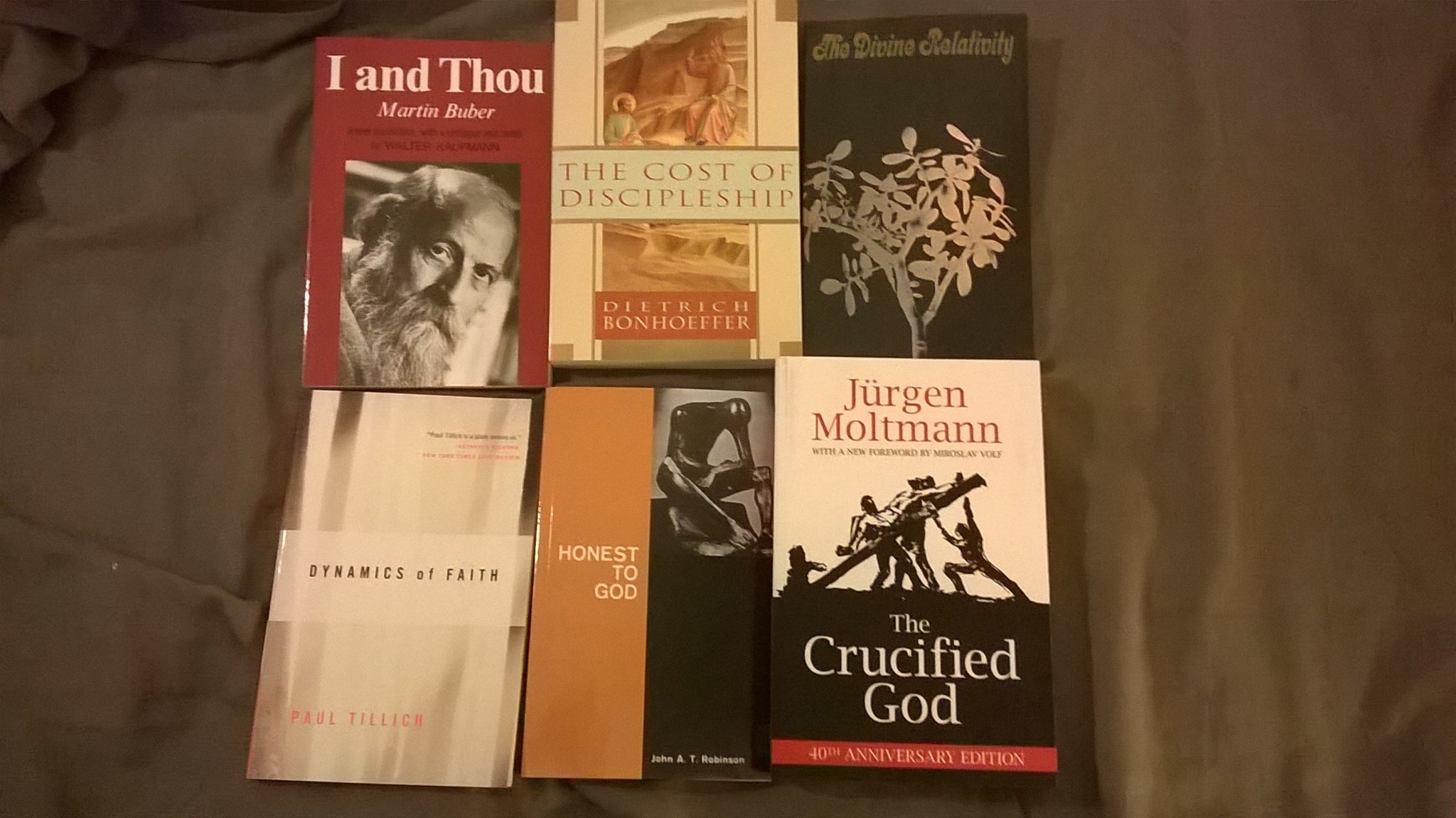
So, in addition to all this, I also was given the gift of a selection of books of my choice. I picked out six titles that are foundational texts in 20th century theology. I hope to read these along side my assigned texts, to get a better grasp on theological thought as I enter this new phase of life. My new list of books is:
I and Thou by Martin Buber
The Cost of Discipleship by Dietrich Bonhoeffer
The Divine Relativity: A Social Conception of God by Charles Hartshorne
Dynamics of Faith by Paul Tillich
Honest to God by John A.T. Robinson
The Crucified God by Jurgen Moltmann
I’m looking forward very much to all of this, and I can’t wait to share and engage here on my new learnings! Let me know what you think of my classes and reading materials.

 Justin DaMetz