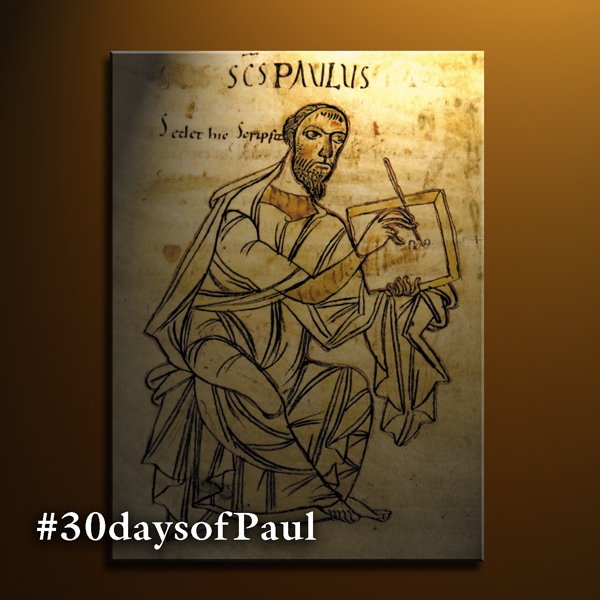
1 Corinthians 5-6: Love Begins at Home #30daysofPaul

This is where Paul starts to lose me. It’s passages like these from his Epistles that have long defined the Apostle for me. When his letters start reading like Leviticus and Deuteronomy, I just want to check out. When he starts saying things like, “But now I am writing to you not to associate with anyone who bears the name of brother or sister, who is sexual immoral or greedy, or is an idolater, reviler, drunkard, or robber. Do not even eat with such a one.

Yuck.

As a progressive Christian, I get accused quite a bit of “picking and choosing” which Bible verses I follow. To which I respond, “Amen, absolutely I do. And so does every other Christian ever in existence.” All too often, the verses Christians pick out to live by are verses like the ones contained in 1 Corinthians 5, those talking sexual immorality and listing various sins.

Why?

Because these verses are just so darn easy! You don’t have to think, you just have to obey!

Remember what we learned about faith and obedience?

I have a tendency to reject these parts of Paul, because I just have such a hard time integrating it with what I believe Jesus taught us. But let me try to provide some integration here. First, a couple of working assumptions for this exercise.

First, Paul isn’t infallible. Paul was a human being, with very obvious strengths and weaknesses that shine forth in his writing. Thus, he probably got things wrong.

Two, the entire Bible, and more specifically the New Testament, is not absolutely consistent and coherent in the instructions, teachings and theology therein. Paul contradicts Jesus, James contradicts Paul, John contradicts Matthew-you get the idea. So reading a book like 1 Corinthians as a natural, coherent outflow of the Gospels is the wrong way to read. Remember this very important fact: when Paul wrote these letters, the Gospels weren’t even written yet! All they had was a free-flowing, word-of-mouth, always evolving and changing story of the life and teachings of Jesus.

So, back to Paul’s ruminations on sexual immorality. Paul tells his congregants in Corinth, don’t even have communion with those among you who are sinners! Shun them, leave them behind, don’t make them a part of your community.

Again, yuck.

But then, one verse after the one I quoted above, Paul says something I think is very, very telling:

“For what I have to do with judging those outside? Is it not those who are inside that you are to judge?”

Are you with me here? This totally changes everything Paul says in these two chapters! Let’s unpack this a bit. Paul is writing to his church in Corinth, and he says to them, “Some of your members, those you call brothers and sisters in Christ, are living lives inconsistent with the example of Christ. and while you guys are busy on one hand dividing yourselves in this camp and that camp, and the other hand judging the pagans and Gentiles who live around you, your very own are running wild.


Now this is good stuff.

Paul is telling the Corinthians, you are trying to be followers of Christ, but you are doing it all wrong! In chapter 6, he turns on Sarcastic Paul again, and mocks their quotes of his teachings. He taught them, “all things are lawful for me,” but he amends that by saying “but not all things are beneficial.”

The Corinthians have basically been saying, “Paul, you told us it’s not our deeds but our faith that brings is into God’s kingdom. All we are doing is trying to relate to the people of Corinth by living like them so they might trust us!”

And Paul says, nope. That’s not how this works. The Corinthians thought they had found a loophole in Paul’s teachings, in which they could join in all the pagan reveling with the excuse that they are just “relating” to the people, and then come back to their church and judge others for their sins while excusing their own under Paul’s doctrine of justification by faith. Look at us, we know what sin is, and we know how to love our neighbors! We’re awesome!

But Paul tells them, you are accountable first and foremost to yourselves. Judgment of the world is not the Christian’s job; you bring no one to Christ by condemning their lives. You bring them in by being a living example of Christ in the world. That’s why he tells them to shun their brothers and sisters; the only ones you are able to pass judgement on are those with who you are on the journey, those who are accountable to you and who you are accountable to.

A lot of Christians today could learn a lesson here. We are quick to jump on Facebook and lay down the holy hellfire on those we think are “sinners,” especially when those folks are celebrities, politicians or other public figures. But I think Paul would chastise us pretty severely for doing this. We don’t know those people, we aren’t close friends or family or confidants of those people. Judging them from afar does more harm than good; it pushes away rather than draws in.

Instead, start with yourself. And then, hold those closest to you accountable for their actions, not by condemning, but by helping to guide in a spirit of love. Be the example of Christ in the world by living the example, and helping those you love live it as well. Then all will be drawn in, and we will be one step closer to that Christian unity we strive for.

You don’t need to show the world that you have this all figured out by pointing fingers at the easy targets, by making it clear loudly that you know who the sinners are. You only repel people that way. Instead, live a life of immense, overflowing love for all people. Get yourself on track, show the world the great life you have to offer by following Christ, and others will begin to want that too.

It’s like Mother Teresa said: “Love begins at home.”

Amen to that.

Next: 1 Corinthians 7-8

For a PDF of the 30 Days of Paul reading plan, click here.

1 Corinthians 3-4: One God, One Church #30daysofPaul

Today’s passage from 1 Corinthians lacks the punch the first two chapters had, or that much of Galatians had. There is a lot of bridge material here, to get us from Paul’s discussion of unity and the upside down nature of God, onto specific addresses to the Corinthians concerning the things dividing them. So for today, I just want to shortly highlight the idea of Christian unity that underpins so much of 1 Corinthians.

Through these two chapters, Paul ties up the loose ends of the arguments made in chapters 1 and 2, reminding the church at Corinth of the importance of being a united church in Christ. No matter who founded the church, or built up the church, or who leads the church now; all are under God, all receive God’s grace through faith equally.

Paul throughout his ministry has a vision of an authentic, unified Christian community, united behind the idea of One God, One Church. This isn’t to say there won’t be disagreements. But disagreements don’t need to lead to disunity.

We still have this problem today. I don’t mean this to be a screed against denominationalism; I think denominations can serve a good purpose, in that we all experience and find God in different ways, and diverse communities can help people find an authentic church home.

But too often, we let our disagreements stand in the way of being One Church under One God. In the end, as Paul reminds us, we all follow the same Christ, and we all worship the same God. In the end, that is all that really matters. We don’t need further division and disunity, a disunity characterized by character attacks and a lack of fellowship and a general attitude of hatred. We need to recognize that we are all of us, all of humanity, in this together, and try to identify among our common bonds of being children of God, and specifically for us, followers of Jesus Christ.

Next: 1 Corinthians 5-6

For a PDF of the 30 Days of Paul reading plan, click here.

1 Corinthians 1-2: The Foolishness of God #30daysofPaul

There are few things more institutionalized in America today than Christianity. It’s a practical requirement in large swathes of the country to be a loud and proud, “born again” Christian to obtain elected office. While it’s true that our nation is in no way an officially “Christian nation,” there is no doubt that Christianity has had a profound effect on America, for good, and more often, for bad. And the way so many people like to equate America and Christianity makes it clear that our faith has become a part of the “establishment”, that part of society that makes and enforces societal norms, rules and prejudices.

So one would be forgiven for thinking that Paul’s identification of the Christian faith as a sort of worldly “foolishness” is sort of, well, foolish. We take the cultural context of the beginning of 1 Corinthians for granted at this point, understanding that Paul was writing within and to a church that oppressed and unacceptable within the Roman world. Paul’s juxtaposition of Christianity and “wisdom” makes perfect sense in the first century world. But today, two thousand years later, Christianity has become the “Wisdom” and the allegiance of rulers and kings has turned to Jesus.

Or perhaps more accurately, the allegiance of the Jesus’ followers has been turned to the rulers and kings.

Yet, Paul’s message here is still very relevant, regardless of the “Christian” nature of the worldly powers. True Christianity is still a tradition rooted in foolishness, in opposition to the prevailing wisdom and common sense of the world and those who rule it.

Perhaps the most central idea to liberation theology is the idea of God’s “preferential option for poor.” The man who coined the name “liberation theology,” Peruvian theologian Gustavo Gutierrez, also is responsible for this term, from his seminal 1971 text “A Theology of Liberation.” Proponents of this world view are deeply indebted to the first two chapters of Paul’s first letter to the church at Corinth.

Writing to one of the most successful centers of first century Christianity in this bustling Greek metropolis, Paul is providing much needed shepherding and pastoral care to one of his most successful church plants. In light of various divisions and splits, he writes to implore them to find Christian unity, reminding them that they all follow one God.

In making this argument, he seeks to bind them together around their common shared knowledge and experience of Jesus. Hoping to make them feel like “insiders”, he reminds them that they understand something the wider world doesn’t, namely, that Jesus gave them a new way of living in and looking at the world. He reminds them that as Christians, they are viewed as foolish, but they should embrace it, and remember that Christ turned the world upside-down for all who follow him.

Paul elaborates on the upside-down nature of Christianity by ruminating on the foolishness of the Gospel in the eyes of the world. As Paul explains it, Christianity is not the way of the world, but a way opposed to how the world views success. In 1:20-25, he writes:

“Where is the one who is wise? Where is the scribe? Where is debater of this age? Has not God made foolish the wisdom of the world? For since, in the wisdom of God, the world did not know God through wisdom, God decided, through the foolishness of our proclamation, to save those who believe. For Jews demand signs and Greeks desire wisdom, but we proclaim Christ crucified, a stumbling block to Jews and foolishness to Gentiles, but to those who are called, both Jews and Greeks, Christ the power of God and the wisdom of God. For God’s foolishness is wiser than human wisdom, and God’s weakness is stronger than human strength.”

He continues the theme in 2:6-8:

“Yet among the mature we do speak wisdom, though it is not a wisdom of this age or of the rulers of this age, who are doomed to perish. But we speak God’s wisdom, secret and hidden, which God decreed before the ages of our glory. None of the rulers of this age understood that; for if they had, they would not have crucified the Lord of glory.”

In today’s world, especially here in America, we are quick to equate Christianity with our nation, and with worldly success. The popularity of prosperity gospel preachers like Joel Osteen and Creflo Dollar shows what the world thinks Christianity it all about: namely, personal success and wealth accumulation, due to the favor of God.

But Jesus truly showed a preferential option for the lowly. In 1:26-28, Paul powerfully affirms this:

“Consider your own call, brothers and sisters; no many of you were wise by human standards, not many were powerful, not many of noble birth. But God chose what is foolish in the world to shame the wise; God chose what is weak in the world to shame the strong; God chose what is low and despised of the world, things that are not, to reduce to nothing things that are.”

Our faith is one predicated on identification with the “least of these,” and success is not measured in dollars and followers. A lot of Christians mouth this as a meaningless platitude, without understanding the nature of this way of life. We are called to be in solidarity and at one with the poor and the forgotten. The only way we can serve others is through truly walking in their shoes, not just sympathizing with their struggles, but joining them in it as fully as possible. We can’t just do that by sending money overseas, or by donating food to a pantry. We must join their struggle for liberation, we must work to dismantle those institutions and structures that keep people in chains, even if that institution is the church itself, or America itself.

At it’s core, Christianity is a worldview centered on the poor, the mourning, the meek, the hungry, the thirsty, the merciful, the peacemakers, the persecuted, the least. It is a worldview with the homeless, the prisoner, the drug abuser, the prostitute as it’s cherished class. It is a religion of takers and welfare recipients and moochers and illegal immigrants and the unemployed. Everything we are called to do is to be centered on those the world rejects. We are to identify and work in harmony with the losers and rejects and outcasts, to liberate the world from social class and stigma and inequality. Such is the foolishness of the Christian faith. Such is the foolishness of God.

Next: 1 Corinthians 3-4

For a PDF of the 30 Days of Paul reading plan, click here.