1 Corinthians 11-12: This Table is Open to All #30daysofPaul

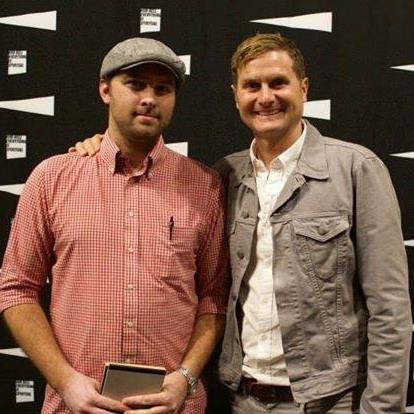
Rob Bell and your humble blogger

I had the incredible opportunity to attend Rob Bell’s “Everything is Spiritual” show when it was here in Tulsa last week. I’ve been a Rob Bell for a while, ever since I read his paradigm-shifting book “Love Wins,” and his stage show is absolutely mind-blowing. If you get a chance, go. Cancel everything and go and take a notepad and just listen to him talk. It’s really mind-blowing.

The stuff he talked about fits right in with what we are experiencing here in Paul’s first letter to the Corinthians. Today’s chapters move us back into Paul’s overarching theme in this letter of Christian unity.

In the talk, Rob described the fundamental progress of the universe towards greater complexity, depth and unity. He spoke of how evolutionary processes have caused all living things, including humans, to defy all expectations by becoming more complex by coming together to create something bigger. Particles combine to become atoms, atoms combine to become molecules, molecules combine to become cells, cells combine to become planets and rocks and plants and animals and us.

He asked, near the end, “what is the thing we are being invited to create together?” What is that thing in the future that humans are to come together and make, that thing that may be inconceivable and unimaginable to us now, but is nevertheless real and desirable and damn near inevitable?

One of the most moving statements he made was about racism and the way it works against the progress of nature. “Racism,” he said, “defies the essential unity of the universe.” Things like racism and bigotry and hate tear us apart, instead of building community. 13.8 billion years of history show an undeniable story of progress, one that some humans work so hard to push back against.

We Christians have a long, rich history of unity, interwoven with a tendency to build walls and tear apart communities and segregate ourselves. Paul, in chapters 11 and 12, ties the essential unity of Christianity, how it is like a body made up of many parts working towards a common goal, to the practice of communion, that brings all Christians together around one table, equally valued and equally important.
Communion is at the center of the Christian tradition. The earliest Christian believers gathered not for worship services and praise bands and prayers of the people, but to share meals, to be a community gathered around the most universal of human needs, the need to be nourished and fed. Communion is at  it’s best when all are welcome, when it reflects the example of the Jesus who ate with everyone – tax collectors, prostitutes, thieves, everyone.

Too many denominations and Christians place conditions around the common table. They have requirements to join in communion, to be a part of the community gathering together. I’ve long rejected these traditions and found my home in the denominations that practice an open, inclusive table. My church homes- the United Methodist Church and the Disciples of Christ-place no restrictions to who can join our communion tradition. This creates a beautiful practice whenever communion is had, as all identifiers and categories are left behind like one’s coat and hat as all are given the bread and the cup. No matter the struggles and sins and suffering in one’s life, everyone is welcomed in and loved in this most basic of Christian traditions.

Through the Lord’s Table, we are able to serve one another every time we are together, making a habit of the art of service. Rob described serving as “when you intentionally decide to align yourself beyond yourself.” What a beautiful way of reminding ourselves why we live with ultimate regard for the Other. he also said, “suffering is not an intellectual exercise,” meaning that suffering is one of the most intense of human experiences and only by identifying and unifying ourselves with others can we join in their suffering, understand, and then work to liberate them from it.

The last Rob Bell quote I want to share: “Line yourself up with the fundamental direction of the universe.” He repeated this mantra over and over. The universe for 13.8 billion years has been moving inevitably towards complexity, depth, and unity. In a word, it has been making constant progress. As Christians, may we always line our selves up with that progress, by practicing the unity of One Church, One Body, One faith.

Next: 1 Corinthians 13-14

For a PDF of the 30 Days of Paul reading plan, click here.

1 Corinthians 9-10: We Meet People Where They Are #30daysofPaul

“We are in the world, but not of the world.”

That’s a phrase you hear pretty often from Christians.

Usually it’s from those asserting some kind of cultural purity or holiness they posses, in opposition to the rest of the world, which is made up of a bunch of identical drones parroting the party line as given this week by some Hollywood celebrity or godless politician.

This saying is often accompanied with a life that is exemplified by “separateness,” with as little interaction with “outsiders” as possible, especially for their children’s sake. Loving neighbors is important, yes, but at a distance, with one’s purity intact and ability to recognize (vocally) the faults in others preserved.

And yet, we find in Paul today, a set of verses that seems to contradict this way of life, this “not conformed to the world” viewpoint.

“For though I am free with respect to all, I have made myself a slave to all, so that I might win more of them. To the Jews I became as a Jew, in order to win Jews. To those under the law, I became as one under the law (though I myself am not under the law) so that I might win those under the law. To those outside the law I become as one outside the law (though I am not free from God’s law but an under Christ’s law) so that I might win those outside the law. To the weak I become weak, so that I might win the weak. I have become all things to all people, that I might by all means save some.”

Paul tells us we are called to anything but a life of separateness. What Paul is saying is, as Christians, we meet people where they are. We don’t hold back, we don’t cloister ourselves and win people by being separate from them. We join with them in their lives, in their struggles and their successes. In short, we are to join in solidarity with the people of the world, that we might play a part in their liberation.

Only when we identify with those we love and serve can we show them the authentic message of Jesus. That is the other point Paul makes in these chapters: through the freedom that comes we grace, we shed our fear of the world, our fear of living under the law and thus failing to achieve God’s standards. Paul says, don’t refuse those who invite you to dinner, even if they are unbelievers. Don’t shut them out. Join them, love them, serve them, identify with them, become as they are so that they might become as you are!

Yes, as Christians, we have a separateness, a discernible difference between us and the world. But it is not a separateness outside of the world, but very much in it. We can only show the love of God by being with the people we wish to love. We can only serve others by living with others. We are One Body, One Church, One Human Race. Our unity with all people is our strength and our blessing. Be in the world and of the world. Show your oneness with all other people.

Next: 1 Corinthians 11-12

For a PDF of the 30 Days of Paul reading plan, click here.

1 Corinthians 7-8: Don’t Get Distracted #30daysofPaul

Chapters 7 and 8 move us into the part of 1 Corinthians where Paul begins answering specific questions the Corinthians asked in a previous letter to Paul, mentioned in 7:1. Chapter 7 is concerned exclusively with marriage, and chapter 8 with meat offered to idols.

Paul has a very particular and, for the time he was writing, unique view on marriage. The first thing that shines through is Paul’s view of marriage as an equal partnership between husband and wife. Over and over, he makes sure that all the instructions he gives are understood as applying to both members of a marriage, going so far as to write the same sentence twice in a row in several places, with the words “wife” and “husband” simply switched the second time.

The other thing you get is that Paul really wasn’t a fan of marriage. Throughout the whole chapter, he keeps coming back to his instruction to not get married if you really don’t have to. He makes a point to say that marriage isn’t a sin, and people aren’t wrong to get married if they want to, but that he doesn’t encourage it. He says,

“Those who marry will experience distress in this life, and I would spare you that.”

Not exactly a ringing endorsement for holy matrimony.

There is also a short section in this chapter where Paul tells his readers that they should stay in their station in life, because the grace of God doesn’t discriminate against social class, gender, or any other defining mark. You definitely get the point Paul is making, while also seeing how easy it was for slaveholders to justify the continuation of the practice by quoting him.

Finally, chapter 8 deals with a question about food offered sacrificially to idols. There seems to have been some question about whether it was right to eat this food, or if it was forbidden because of it’s link to false gods. Paul’s answer is rather simple and practical: it’s just food, because those idols are just wood and stone. He tells them not to make a habit of going to idolatrous feasts or anything, but if someone brings them food from one, it’s just food. His one caution: if the eating of the food causes backsliding amongst fellow Christians who think that idol worship has been endorsed because of this food, then put a stop to it.

So the question for us, after reading all these specific instructions to very specific questions is: how do we apply this pastoral guidance to our modern lives? And is it even appropriate to do so?

We are beginning to pick up on a general theme Paul carries from here on in his letters, showcased most obviously in Romans: the chief sin of idolatry. And I don’t just mean the bowing to golden calves and statues of Zeus, but the more pernicious kind of idolatry that makes an idol of whatever it is you are most attached to in the world.

Paul, in these two chapters, has a basic, universal message woven into the specifics he gets in to. It’s an message that springs from his essential eschatology of imminence, his ardent belief that Christ was coming back within his and his followers life times. You see that message here in his talk about social station, and marriage, and eating food offered to idols, and elsewhere, in his directions concerning sexual immorality, his calls to Christian unity, everywhere. It’s a message that weaves perfectly into his concern for idolatry.

That message? Don’t do things that compromise your commitment to God, your ability to follow Jesus, and your place in the Christian community. Don’t waver, don’t get distracted, don’t get bored, don’t find something else, don’t cut yourself off or fall out with your brothers and sisters. Be patient in waiting for that impending day when Jesus comes back and ushers in the Kingdom of God.

To Paul, idolatry is so bad because anything that distracts us from this attitude of eager watchfulness is potentially fatal. He wants his readers to be focused, to be aware and undistracted by this world, in anticipation of a new and better world. He wants them working to make the little changes that bring aspects of that coming world here and now, so that they might be prepared when Jesus brings all those changes at once. That is why he says, over and over, live your life, do the things you want to do, be happy and loving and joy-filled, but avoid getting distracted by all of it.

Obviously, Paul misread the coming of Jesus. There was no second coming in Paul’s life, or in anyone’s since. But these words can offer direction to us still. We are called to a life of bringing the Kingdom here on Earth. We are called to love one another, serve one another, and in so doing, to love and serve God. There are many great things here on earth, things that are so interesting and cool and are for us to enjoy.

But don’t get distracted. Don’t lose sight of your calling. Don’t forget why you are here, what you are a part of. Love and serve, seek justice, practice mercy. Enjoy life, do awesome stuff. But stay focused on the bigger picture. Don’t neglect the Kingdom that we are called to bring, on Earth as it is in heaven.

Next: 1 Corinthians 9-10

For a PDF of the 30 Days of Paul reading plan, click here.