Philippians 1-2:18: Paul’s Unquenchable Joy #30daysofPaul

If there is one thing I think we can understand about Paul, it is the fact that he had a perpetually sunny outlook. Despite numerous imprisonments, shipwrecks, trials, betrayals and tests, Paul consistently exudes a spirit of joy in his writings.
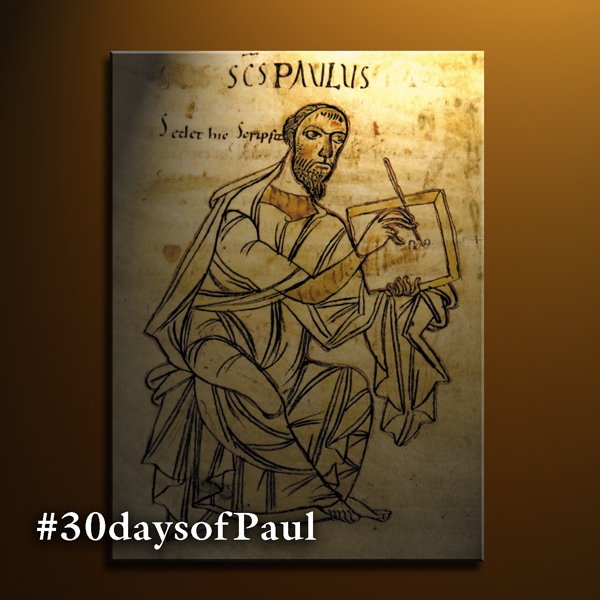
That spirit is abundant in Philippians. Five times in this short letter he uses the word “joy,” and eleven times he says “Rejoice” and “be glad.” His tone overall is one of rejoicing and positivity towards the church at Philippi, despite the fact that he was in prison at the time of his writing.

This section of Paul’s letter is basically one of continued praise and thanks and joy for the Philippians. He exhorts them to “live in humility”, and “be a light to the world”, but the Paul we see here is a happy, positive Paul we haven’t seen since probably 1 Corinthians.

Paul seems most joyous here because of the spread of the Christian faith that he has seen. In 1:15-18, he recounts how this spread has been both from sincerity and from those who are insincere, but it is a spread nonetheless in his eyes, and he is almost ecstatic to see that. It seems to ease the ache of being imprisoned, and he displays an indifference to his ultimate fate, an attitude that would be impossible for Paul if he felt there was still substantial amounts of work for him to do. Instead, he seems content with the growth of the church, and assured of it’s continuance.

It’s easy to imagine the pre-Christian Saul as a dour kind of person, considering his mission in life. But the apostle Paul is a man continually filled with the joy of God, embodying a spirit of love and compassion consistent with his assurance in the Message he was spreading. I think the common perception of Paul in the popular mind is a dry, academic, boring personality. But through out this study of his works, I have found an engaging, relatable, intensely human Paul, a man who is happy and driven and sometimes defensive or a braggart, but always compassionate.

Paul suffered persecution and hardship many of us can never imagine, yet never wavered in his positive outlook or caring attitude towards his churches. His is an example to emulate in our comfortable Christian lives in 2015 America. A persecution complex is an unseemly thing to carry about, considering the place of the Christian as that of the dominant cultural, social and political mindset in the modern world. Instead, we should be joyous, humble and compassionate at all times. We have no excuse to live otherwise.

I want to end by highlighting one section, verses 6-11 from chapter 2. This section is likely an early Christian hymn, and Paul recites it in full in the section about humility. This is another wonderful window into the early church, one we are lucky to have. I want to quote it in full here; as you read, just think about the fact that the earliest Christians, those who lived two thousand years ago, those who got direct personal guidance from the apostle Paul, also read and sang these very words of worship. It’s an exercise in the ultimate form of Christian communion, a chance to be in community with those who pioneered our faith.

who, though he was in the form of God,

did not regard equality with God

as something to be exploited,

but emptied himself,

taking the form of a slave,

being born in human likeness.

And being found in human form,

he humbled himself

and became obedient to the point of death—

even death on a cross.

Therefore God also highly exalted him

and gave him the name

that is above every name,

so that at the name of Jesus

every knee should bend,

in heaven and on earth and under the earth,

and every tongue should confess

that Jesus Christ is Lord,

to the glory of God the Father.

Next: Philippians 2:19-3:1a, 4:4-9, 4:21-23

For a PDF of the 30 Days of Paul reading plan, click here.

Philippians 4:10-20: The Interconnected Church #30daysofPaul

We are on to a new letter here, the last one before Paul’s surviving “magnum opus”, the Epitstle to the Romans. Writing to the church at Philippi from prison, we hear Paul tonight writing in thanks to one of the few churches he accepts financial support from.

It’s widely shared that Paul comes from a family of tent-makers, and that he was also part of the Jewish religious authorities, so the assumption is often made that he was probably wealthy at best, or well-off at worst. But we forget that for at least the last twenty years of his life, Paul worked full time traveling to plant and support churches.

Needless to say, that is not a highly profitable field.

So, Paul was surely dependent upon the generosity of others to sustain himself and his fellow workers (such as Titus and Barnabas and Timothy) and his ministry. He makes a point in some letters to acknowledge that he has never accepted compensation from them (specifically in 2 Corinthians, where he makes a point in his polemic to highlight this fact.)

Paul wants to highlight here that he certainly doesn’t expect or require the Philippians to support him, but that he greatly appreciates it. He also points out that they were one of the first and only to do so.

We get a good picture into the interconnected, generous nature of the early church. Early traveling apostles could not exist without support from the congregations they planted and nurtured. Additionally, as we saw in 2 Corinthians as well, it was crucial that the better-endowed churches supported the less fortunate churches to assure their continued survival, and thus the continued spread of the Gospel.

It’s still true today: all the established churches are a web, interconnected and interdependent, as are all of us. We cannot survive without the touch and support of others, whether we find agreement with them on most things or not. All people, and all churches, are interrelated and propped up on all sides by one another. It is the only way to be, and the only way to continue to be. As much as some of us may try to pull away, may try to assert their individuality, their independence and ability to exist on their own, in the end, we are all drawn together, inevitably and assuredly.

In community we find support and strength and love.

Next: Philippians 1-2:18

For a PDF of the 30 Days of Paul reading plan, click here.

Philemon: A Window Into Paul’s World #30daysofPaul

The Epistle to Philemon is one book that makes you think, “What in the world was the early church thinking when they put this in the Bible?”

Philemon is very short -25 verses, 445 words, one chapter- and very, very light on theology. And by light, I mean there is none at all. Philemon is simply a letter from Paul to his acquaintance Philemon, asking for the slave Onesimus to be welcomed back with love and care, after an apparent falling out between the slave and his master.

And that’s it. It’s basically a note.

So what can we pull from it?

Well, it;s another good example of the personal Paul we’ve been encountering over the last couple of days. If you want to know Paul, if you want to get a feel for who he was and what he like and how he communicated to friends and loved ones on a personal level, then this is a great book for that.

In Philemon, we see Paul as we very rarely see him: humble, deferential, brown-nosing a bit, trying to praise and flatter Philemon as much as possible, so he will do what Paul is asking.

Martin Luther very accurately called this letter “holy flattery.”

We don’t know why Onesimus left Philemon-or if perhaps he was cast out. We don’t know where they were from. We can infer from verse 2 that Philemon was highly regarded enough to host a church in home. We don’t know the outcome of this letter, whether Philemon accepted Onesimus, whether he freed him or not, whether he punished him and sold him or what. All we know is what we read here, which is not much.

We can infer a bit of Paul’s theology tangentially here, since we have a good idea of his ideas overall. Paul was always interested in reconciliation. Here, he writes specifically to implore Philemon to practice reconciliation, and forgiveness, to live the Christian example in relation to Onesimus.

We also know Paul had an eschatology of immanence, so he likely believed it wouldn’t be long before the return of Christ and the breaking down of social barriers, meaning soon Onesimus and Philemon would truly be brothers and equals, thus Philemon should practice that Kingdom outlook here.

We know Paul was a product of his times, and something like slavery was so commonplace that if never occurred to Paul to advocate for abolition or manumission of slaves. It was just the natural order of things. As one commentary notes, for Paul to be an “abolitionist would have been at the same time an insurrectionist, and the political effects of such a movement would have been unthinkable.”

Paul’s eschatology prevented him from being one to rock the boat much, as he believed all this world was passing away soon anyways. He wasn’t out for political and social revolution; he was working to reconcile people and to make followers of Christ. Those who once used Philemon as justification for the continuance of slavery were not only morally and ethically compromised, but also dismissive of historical context for Scripture.

There isn’t much to work with in Philemon, but that doesn’t meaning there’s nothing. Getting to know Paul, getting a glimpse into his world and live and relationships-what a great opportunity from such a short work.

Next: Philippians 4:10-20

For a PDF of the 30 Days of Paul reading plan, click here.