The Cheap Grace of Donald Trump


ct-trump-evangelicals-support-20171006
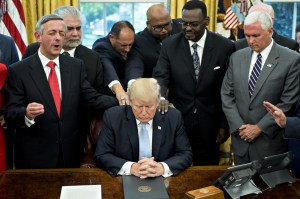
Trump and his court evangelicals

One of the Christian right’s favorite ways to excuse Donald Trump’s moral failings as a human being is to say that “God uses imperfect people.” You can read examples here, and here, and here. 

And I get it! God does use broken and imperfect people! I truly believe this; as a process thinker, I think God, in conjunction with each and every one of us, uses every moment of our lives – good, bad and in between – to create new possibilities and realities all the time.

But here’s the thing. I also believe that we are imbued with a sense of right and wrong. We have notions of human dignity and worth, and love for others, embedded within us, as part of the Imago Dei we all carry.

Because of these carried notions, and because humans are amazing, dynamic beings, we have the ability to react to situations, to learn, and the change. In fact, we have a divine mandate to do so. We must learn from our mistakes and shortcomings; it’s bred into our make-up. Human beings would have died out long ago if we didn’t learn and adapt.

In the Christian realm, the leeway we give ourselves and one another to learn and grow and have second chances is called grace. What sets Christianity apart is that grace is unearned, that we get it just because we are.

But, as St. Paul explained, just because grace is unearned doesn’t mean it is free of responsibility. Richard Beck writes, “Grace has been given to us...Therefore. And what follows Paul’s Therefore is a list of obligations and expectations. Like his contemporaries, Paul assumes that grace implies a return. Grace obligates us. Gifts–even God’s gifts–have strings attached.”

Grace without an imperative to change is Bonhoeffer’s cheap grace, “the preaching of forgiveness without requiring repentance….Cheap grace is grace without discipleship, grace without the cross, grace without Jesus Christ, living and incarnate.”

God may use broken people, but when God does, it is incumbent on us to acknowledge the grace that that is, and do better next time to not keep perpetuating our own brokenness. The excusing of Donald Trumps’s moral failings without requiring him to show any progress is cheap grace. It is an affront to the God who has shown us grace, but who also expects us to react to that grace, not just keep on what we were doing. The brand of American Christianity that keeps excusing Trump is a brand of Christianity built on a foundation of cheap grace; this foundation is like Jesus’ house built on sand.

I’m not saying Donald Trump can never make mistakes. Obviously, we all do and will. But if he keeps refusing to acknowledge those mistakes or make any changes, then it is the Christian duty of his court evangelicals to call him on it. And if they won’t do it, they are abdicating their Christian responsibility, and choosing power over Christ.
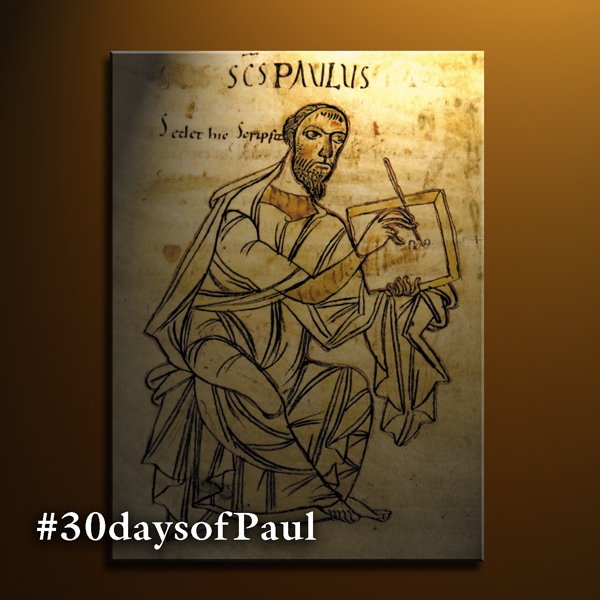
Romans 16: Gender Equality and Paul #30daysofPaul

Well, we’ve made it to the end.

30 days of Paul turned into something more like 41 days of Paul, thanks to illness and work and birthdays and just life in general.

But this is it. The last piece.

I’ve learned a lot about Paul and his writings over the course of this series. I’ve found him to be funny, intelligent, moving; his personality really shows through in his letters. I’ve also been able to dispel myths about him that I had before, and that I think a lot of progressive Christians carry around.

In wrapping up, I want to address one of those misconceptions one more time. This is the big one, the one that really trips folks up when they read the Apostle: Paul’s views on women.

Now, Romans 16 is, I think, a really good place to tackle this subject. This chapter is really just the postscript and signature line for a long, important letter. He greets a bunch of people, sends some greetings from his compatriots, and signs off. But look more closely at those greetings.

27 names are listed.

10 of those names,

are the names of women.

The stereotype of Paul is that he held a decidedly anti-woman view of the world, and of how the church should be organized. This is based on several verses from his letters, or letters attributed to him. The most commonly cited are 1 Corinthians 14:34-35, Colossians 3:18, Ephesians 5:22-24, 1 Timothy 2:11-15.

Now those last three verses cited, from Colossians, Ephesians, and 1 Timothy, are relatively easy to dismiss from this argument, because if you haven’t noticed, they aren’t included in this study and thus are not considered to be authentic writings of Paul. So they are not indicative of his views on the sbject.

The 1 Corinthians verse is a little trickier. That letter was most assuredly written by Paul. But many Biblical scholars no longer think those verses, and a whole raft of others in the letter, were actually written by Paul.

I didn’t touch on this much when were going through 1 Corinthians, but this scholarly consensus on this stuff is almost unanimous. And for 14:34-35, the view is that this was inserted by a later editor to advance an agenda that prioritized the leadership of men in early churches. This assumption is made because these two verses break up a flow of commands about keeping order and peace within the church, related most likely to the subject we tackled yesterday, Paul’s desire for the church to not stir the waters too much in light of the imminent return of Jesus.

So, we’ve determined that the texts justifying Paul’s exclusion of women are no such thing. How do we get from there to seeing Paul not just as a typical mysoginistic first century male, to a radical believer in gender equality?

Back to those 27 names in Romans 16.

Like I said, 10 are women.

Prisca (or Priscilla).

Mary.

Junia.

Tryphaena.

Tryphosa.

Persis.

The mother of Rufus.

Julia.

The sister of Nereus.

Phoebe.

All are prominent enough to get called out by name.

Some get special attention.

Prisca is a well-known associate of Paul, along with her husband Aquila, and is said to work with Paul.

Mary, Tryphaena, Tryphosa and Persis also get a shout-out for their work. In fact, the Greek word used here for work, “kopaio”, is a word Paul uses to describe himself in Galatians and Corinthians, and indicates specifically apostolic work.

Junia is noted for being “prominent among the apostles.”

And finally, Phoebe is called “a deacon of the church at Cenchreae” and a “benefactor” of Paul’s, indicating she was a patron of sorts to him. It is Phoebe who is entrusted to deliver this letter for Paul to Rome.

I think in light of Romans 16, it is hard to paint Paul as someone who doesn’t value women, or doesn’t see a place for them in active church leadership. Paul saw women as key actors in the early Christian movement, and was never afraid to associate with them, commission them or place them in leadership.;

This really helps highlight what I feel is the key takeaway from this study. Throughout these seven letters, the impression I have gotten of Paul is of a universalist, a radical, an egalitarian. Paul sees all people as equal in the eyes of God. He wants all people brought into the church, to be made whole in the ever present love of God. Paul didn’t care if you were “Jew or Gentile, slave or free, male or female; for all of you are one in Christ Jesus.”

What a great summary of Paul the Apostle.

Next: There is no next! This is it. Thanks for sticking with me through this study; it’s been a lot of fun and very informative. I have some exciting plans for the next few months going forward here on the blog, which I will lay out in more detail in the next couple of days, so keep checking in to see what’s in store!

For a PDF of the 30 Days of Paul reading plan, click here.

Romans 13-15: Dangerous Misreadings of Paul #30daysofPaul

Ah, Romans 13. One of the most-misused and misunderstood sections of the Bible. Also, historically speaking, probably one of the most damaging.

For two thousand years, every power-tripping tyrant has justified his authority by invoking the Apostle here, quieting the protesting masses by simply pointing out that he was appointed by God, because Paul said so, very explicitly.

Very often, the Church has backed up such claims and reasoning’s.

In modern usage, it is more often used as a clobber verse against those who don’t like whatever government is in power, telling them that they better get in line, because God said so.

In their combined work “The First Paul,” (which I just started reading and now wish I would have started before this study) John Dominic Crossan and Marcus Borg call Romans 13 “one of the most imprudent passages in all of Paul’s letters. Looking back on how it has been used throughout Christian history, Paul might surely wish he had never written it.

Can I sign on to that sentiment?

But there has to be some utility here, right? There has to be something constructive we can use in today’s world of democracy and dissent, something that isn’t along the lines of “you’ll take it and you’ll like it. Or else.”

Let’s put things in context here, both Biblical and historicals.

First, imagine the Bible didn’t have the chapter and verse divisions. This makes us look at it like it was written, as one part of an unbroken letter. Romans 13 falls in amongst a whole string of instructions for the church at Rome. Remember how chapter 12 ended?

“Bless those who persecute you; bless and do not curse them. Rejoice with those who rejoice, weep with those who weep. Live in harmony with one another; do not be haughty, but associate with the lowly; do not claim to be wiser than you are. Do not repay anyone evil for evil, but take thought for what is noble in the sight of all. If it is possible, so far as it depends on you, live peaceably with all. Beloved, never avenge yourselves, but leave room for the wrath of God; for it is written, “Vengeance is mine, I will repay, says the Lord.” No, “if your enemies are hungry, feed them; if they are thirsty, give them something to drink; for by doing this you will heap burning coals on their heads.” Do not be overcome by evil, but overcome evil with good.

So, in light of that, verse 13:1 – “Let every person be subject to the governing authorities; for there is no authority except from God, and those authorities that exist have been instituted by God” – seems to make sense as the next in a line of instructions.

And then, it seems, Paul feels the need to expound upon this thought. That makes sense; this verse by itself would seem confusing to the early church, who was dealing daily with a governing authority who wanted to put them to death. Why in the world should they submit?

So, Paul explains, if you live right and keep quiet and stay out of sight, you shouldn’t have much problem. And then he tells them, pay your taxes. Don’t refuse to do something as simple as that.

I think this gets at the heart of Paul’s intentions. The church at Rome, the individuals who made it up, probably felt like sending a portion of their hard-earned and meager earnings back to Caesar was not only a terrible hardship on them and the church they supported, but probably unnecessary, as they believed Jesus was coming back soon. They may have even felt like violent resistance would be a smart tactic!

And so, Paul invokes the imminent return of Jesus in verses 11-14 to make the exact opposite point the Romans were making. Instead of refusing to pay taxes because of Jesus’ coming return, they should instead pay their taxes, because at his return, that money would be of no use anyway!

So, in this total light, this all makes sense. Nothing overly objectionable here; Paul, in a bit of a rhetorical panic, may have overstated this case he was trying to make here, but he was concerned with keeping the church and Christians in Rome safe. So we can forgive him.

Another reason to forgive: Paul probably didn’t have any inkling that his words would be passed down for 2,000 or more years and read in a way that misconstrues them as the Directly-Dictated Word of God Never To Be Disputed Or Questioned. Remember, this was a letter written to the church at Rome. He had the reasonable expectation that it would be shared among Christians in Rome, and possibly beyond into Italy, during his lifetime. He may have even expected it to be circulated in some circles after his death by his churches to stake his claim.

But 2000 years of infallibility? I’m sure he never expected such a thing.

Paul had, as I’ve described before, an overwhelming Eschatology of Immanence. I mean, he thought Jesus was coming back to judge within his and his follower’s lives. All instructions he gave must be read in this light.

Paul didn’t want his churches trying to overthrow the Roman government. In fact, he didn’t even want them drawing undue attention to themselves. Go with the flow, he said, because Jesus is coming soon, and really, none of this matters at that point.

Now, Paul was wrong about the imminent return. And Christians for 2000 years have been wrong to forget this context. It is crucial to reading and understanding Paul.

Paul wasn’t justifying corrupt, tyrannical, unjust worldly governments. Paul was concerned with mercy and love and justice and a universal church of equality. None of that would lead him to prop up any worldly government, much less an unjust one. Paul I think would have been quite on board with attempts to defy and overthrow them, if he had lived for two millennium and shed his eschatology.

But he didn’t.

And we need to remember that.

And we owe it to him to do so.

Next: Romans 16

For a PDF of the 30 Days of Paul reading plan, click here.