I originally wrote the following on Facebook, in response to this post by Jim Palmer that has been making the rounds in progressive Christian circles recently.
I’ve seen this post going around the last few days, and as your local reliable stan for Paul, boy do I have thoughts. I don’t know that I’ll hit every point he makes, because there is a lot going on here, but this is a pretty extreme misreading of Paul, albeit one that is common in progressive Christian circles today. I’ve written elsewhere about Paul’s tendency to get tarred as a bigot, as a misogynist, as a manipulator of historic fact, as someone driven by ego to twist the growing Christian movement in his own image. All of these do disservice to one of the most important voices in the faith, simultaneously failing to acknowledge our collective indebtedness to the work he did in spreading the church and expounding Christian theology. (It’s also one of my biggest theological obsessions, reframing Paul for my fellow progressive Christians.) There is a reason his work has inspired many later great voices, from Augustine to Aquinas, Luther to Barth. Christ is the centerpoint of the faith, but Paul did the legwork of building the church after Christ was gone.
There’s always been this idea that there is some pure, pristine form of Christianity out there, unmarred by time and culture and later adornments, if only we dig far enough back. It’s the impulse that drove the rise of historical-criticism in the 19th and 20th centuries, and the holiness and pietism movements before that, and even Anabaptism and Protestantism before that. While this impulse can be a good one, and can bring us a lot of needed reform and rethinking, it is ultimately a fool’s errand if pushed too far. And, if applied to our reading of Paul, it does a major disservice to the growth of Christianity throughout history and to the importance of Paul to that growth beyond the Levant.
A little background on Paul, and what exactly he was up to, as told to us by Paul himself in his letter to the Galatians, and in Acts: after his conversion at Damascus, Paul spent a few years quietly becoming a Christian (three years, he says) and also visited Peter and James (the brother of Jesus) in Jerusalem. He then spent 14 years, by his reckoning, living life before embarking on the church planting missions and letter writing he is famous for. Once he began evangelizing, he focused on what he calls “the uncircumcised ” or “the Gentiles”. If Peter and James largely viewed their ministry as to the Jews, it was Paul who had the vision of universalizing it beyond Palestine, to people across the Mediterranean world. This is the root of his later conflict with Peter and James, and at the center of much of his writing: his assertion (a controversial one) that Christians didn’t need to first become Jews through circumcision and the works of the law, but could simply become Christians through faith.
I want to focus on this move by Paul, because it’s essential to understanding the man himself, and why this post I’ve shared below is so off base: this universalizing move is really radical. It’s what caused me to fall in love with Paul when I first did a “30 Days of Paul” writing project almost a decade ago with the Westar Institute. Paul, far from being small minded or dogmatic, was in fact, in the story of the earliest church, the progressive, the radical, the revolutionary! Paul saw a small and insular movement stagnating in Palestine, and revitalized it by taking the message out, into the world, and telling people that anyone could be a Christian: all they had to do was declare faith in Christ, be catechized and baptized, and become active members in their local church, which was characterized by communal meals and charity and care for the sick and nonviolence. No circumcision needed, no adherence to the Jewish law code as it was understood. This was a really big deal. And a really radical one. Go read in Acts and in Galatians the accounts of Paul’s conflict with the Jerusalem church. You have a debate between those who want to impose legalistic restrictions on new church members, and a man who wants to open the doors of the church.
And this arose from how Paul understood the work of Christ on the cross: as Richard Beck has written about recently on his blog, Paul understood the atoning work of Christ as not so much about making penance for sin as it was about an ontological change in our reality as human beings. Fulfilling the Law was something humanity had proven it could not do, and so on the Cross, Jesus fulfilled the Law for us. In the words of Dr. Beck, “I mean that our reality is changed. The furniture of our existence is rearranged. The cosmos is fundamentally altered.” Death has no power over us; we are free to live in love. But don’t take my word for it; it was Paul, after all, who said: “Christ had set us free for freedom.” Want a positive view of atonement? Google “Christus Victor.” The Cross means something; it wasn’t nihilistic, a defeat, simply another small death in an empire of them. The Cross, as Barth reminds us, is “the meaning of history.”
What Paul understood – what was in fact at the root of his conflict with Peter and James and the Jerusalem church – was that Christianity cannot stand still. In order to spread the Good News, its adherents had to communicate it across time and space and language barriers and cultural differences. This is what Paul did. He didn’t distort or co opt Christianity. He communicated it, in a way that made it speak to the lives of people in places as disparate at Rome, Ephesus, Damascus, and Spain. He displays this in Acts, when he preaches in the Agora of Athens to the Greeks, identifying the God of Jesus with the unknown god worshiped by the Greeks. He wasn’t watering down the message here; he was making it comprehensible. And that’s what he did through his theology of the cross.
Paul didn’t invent atonement. He didn’t invent the fact that Jesus died, or that his followers believed he then rose from the dead. He’s not responsible for the fact that Jesus’ followers were left looking for answers to the question of why: why did this happen? Why did Jesus die? Why did he rise again? What does it mean? Read Paul’s own testimony of what he claims was passed on to him as the gospel message, from 1st Corinthians: ” I passed on to you as most important what I also received: Christ died for our sins in line with the scriptures, he was buried, and he rose on the third day in line with the scriptures. He appeared to Cephas, then to the Twelve, and then he appeared to more than five hundred brothers and sisters at once—most of them are still alive to this day, though some have died. Then he appeared to James, then to all the apostles, and last of all he appeared to me, as if I were born at the wrong time. I’m the least important of the apostles. I don’t deserve to be called an apostle, because I harassed God’s church.” That is the Gospel he received. Now, did he expound upon and build up a theology of the cross throughout his ministry? He sure did, and the fact that he did it in letters, as the OP below notes, is crucial: he was answering questions and guiding his churches. They were asking him for meaning, and he was providing those answers through the work of theology. This wasn’t some alien message overlaid onto the pure gospel to distort it; this is the Gospel. Paul isn’t distorting the Gospel message he recevied; he’s putting meat on the bones and explaining to people from all walks of life why Jesus – and Jesus’ death – is important for their lives.
And to think we can escape this message is foolish. As Jim notes in his very first paragraph, ” Paul wrote his letters before the gospels were written, and likely influenced the synoptic gospel writers.” This is right, and very important, and also undermines the case he makes the rest of the way here. Our understanding of who Jesus was and what Jesus did is inevitably and inescapably colored by the influence of Paul on the church, just as it was colored by the events of Pentecost, or Peter’s vision of the sheet, or the witness of Stephen. We don’t have the earliest impressions of who Christ was or what he taught; we only have these Gospels, written between 30 and 90 years later, and well after Paul died and his letters were spread. Once again: the idea that we can get back to some pure and pristine Gospel is beyond our actual ability or the evidence we have before us. Paul didn’t impose the Cross on the rest of us; Jim’s charge that Paul was somehow responsible for the revitalization of crucifix images in the 7th century is nonsensical (Paul had been dead for 700 years!), not to mention ignores the centrality of the Cross in Eastern iconography going back to at least the 3rd century. Hell, the earliest known image of the Cross is the Alexamenos graffiti, mocking artwork from a 2nd century Roman street making fun of those who worshiped a man on a cross. Clearly, Christians had a thing for the cross, Paul notwithstanding. The Cross was always there; what Paul did was help lay the foundation for what it means.
Now, none of this is to say that Paul’s writings are always right all of the time. There are genuine issues in his writings about homosexuality, and about the role of women in the church, or about slavery. But, those things shouldn’t define Paul for us, for a couple of different reasons. First, if we dismiss Paul for those attitudes, then we dismiss every NT writer, and we are left with nothing. And maybe that’s the path you choose to take! That’s your choice. But, Paul was a product of his time, and to hold him to modern standards on social issues is a wild stance to take. Second, a lot of really good Pauline scholars have cast some serious doubt on the provenance of those passages, especially the household codes, in Paul’s letters. Reevaluating these sections in light of literary criticism, and in light of Paul’s elsewhere-stated high regard for women leading in the church (see Romans chapter 16) casts a lot of doubt as to whether Paul actually wrote those things, or if later editors and compilers inserted them. (Go see my series on Paul’s letters on my blog, where I get into the details of this argument.) Either way, the first point stands: Paul was a first century Jewish man; to be shocked and scandalized that he had first century attitudes to social issues is a bit naive.
What good can be found in those household codes and others sections of his letters that specifically address local and contextual situations? As Jim notes, these letters provide a blueprint, not for specific legal rules about this or that topic, but for what leadership in the church should look like. Paul is a person these early Christians’ turn to, and trust, and listen to. He is a leader who is funny, inspiring, and sharp, sometimes prickly, sometimes prideful, always compassionate. Paul’s pastoral leadership is on display in these letters, these personal thoughts to people he knew and loved and broke bread with. What a treasure that we have them available to us today.
Here’s my point of agreement with Jim: he’s right, we shouldn’t deify the writings of Paul. But, if we had first person accounts of Jesus’ life that all of the sudden came to light, we shouldn’t be tempted to deify those either. The Word of God is not the Bible, nor any human text; it is Jesus Christ, through the Holy Spirit. The words of Paul, and of Matthew and Mark and Luke and John and any other author in the NT, are reflections of God’s revelation; they aren’t to be identified with God. We shouldn’t deify them. But we shouldn’t demean or dismiss them either. What it means to be Christian is to follow Christ, but what it means to know what that following looks like is inevitably influenced by Paul. This is our tradition, and we don’t get to throw it away. Nor should we want to. Because, I can’t imagine a better advertisement for what it means to be a Christian than Paul when he starts spitting stuff like this:
“There is neither Jew nor Greek; there is neither slave nor free; nor is there male and female, for you are all one in Christ Jesus.”
Tear down those walls, Paul. Amen.

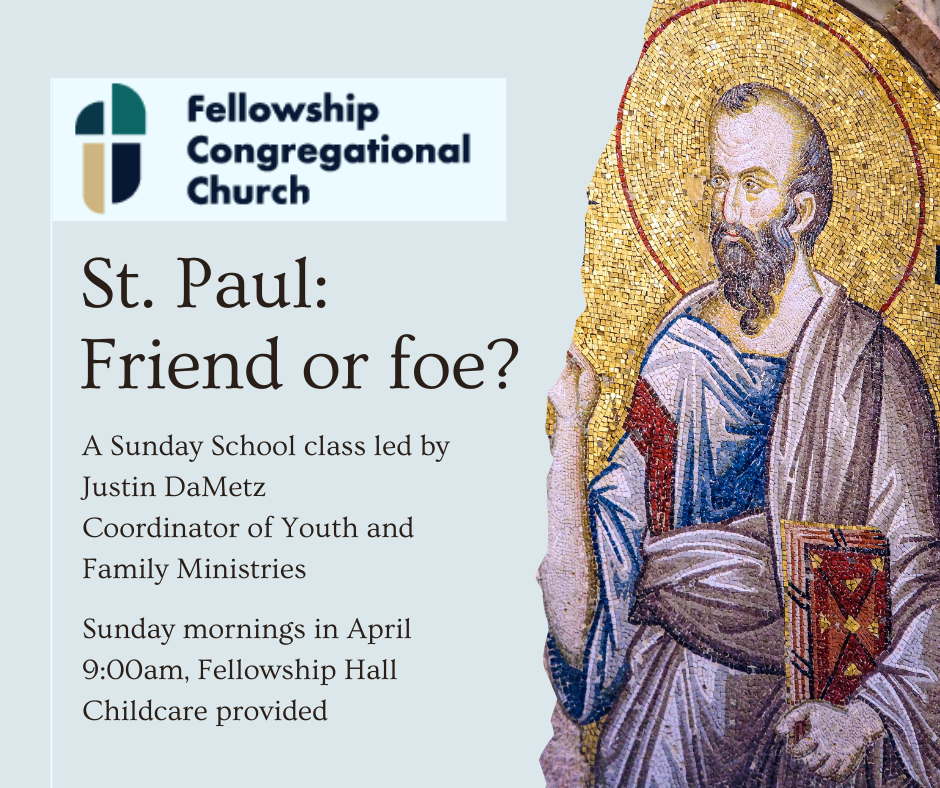
 Justin DaMetz