It seems these days as if the right to bear arms is considered by some a suitable remedy for the tendency of others to act on their freedoms of speech, press, and assembly, and especially of religion, in ways and degrees these arms-bearing folk find irksome. Reverence for the sacred integrity of every pilgrim’s progress through earthly life seems to be eroding. The generosity to the generality of people that gave us most of our best institutions would be considered by many pious people now to be socialistic, though the motives behind the creation of many of them, for example, these fine colleges, was utterly and explicitly Christian. If I seem to have strayed from my subject, it is only to make the point that forgetting the character of the Reformation, that is, the passion for disseminating as broadly as possible the best of civilization as the humanist tradition understood it, and at the same time honoring and embracing the beauty of the shared culture of everyday life, has allowed us to come near to forgetting why we developed excellent public libraries, schools, and museums. 1
Marilynne Robinson, The Givenness of Things, page 27 ↩︎
I’m reading Marilynne Robinson’s book of theological essays, The Givenness of Things, which I will likely be commenting on several times over the coming days (as is my habit when reading a book; just see my series of Wendell Berry posts from last year.) This line caught me today. from an essay titled “Limitation”:
This dialogue between the Devil and the Son of God might be thought of, so soon after the spectacle of his baptism, as a cosmic rather than a historic moment in which Jesus assumes, so to speak, the full panoply of the mortal condition.
I find this observation about the Temptation of Christ from the Gospels by Robinson a really fascinating one, in light of Paul’s quote of the Christ hymn in Philippians 2:
Though he was in the form of God
he did not consider being equal with God something to exploit.
But he emptied himself
by taking the form of a slave
and by becoming like human beings.
When he found himself
in the form of a human,
he humbled himself by becoming obedient…
Robinson’s aside here paints an interesting way to interpret Christ’s kenosis, or self-emptying, and specifically when it happened. Perhaps, early in his ministry, Jesus grappled with what it meant to be the Christ. This grappling is made evident in the story of the Temptation, where Jesus is presented with three visions of what it could mean to take that role, before he makes the decision to take a fourth path: that of the Suffering Servant, of the Son of Man, of the Crucified One. As Robinson notes here, perhaps this was the moment, too, that Jesus decided that the Christ was fully human, rather than a superhero or epic character. The Christ was to be a human being, with all that comes with that – much of which is what the second half of Robinson’s book is pondering.
Anyways, just an interesting perspective on this story that struck me as I was reading.
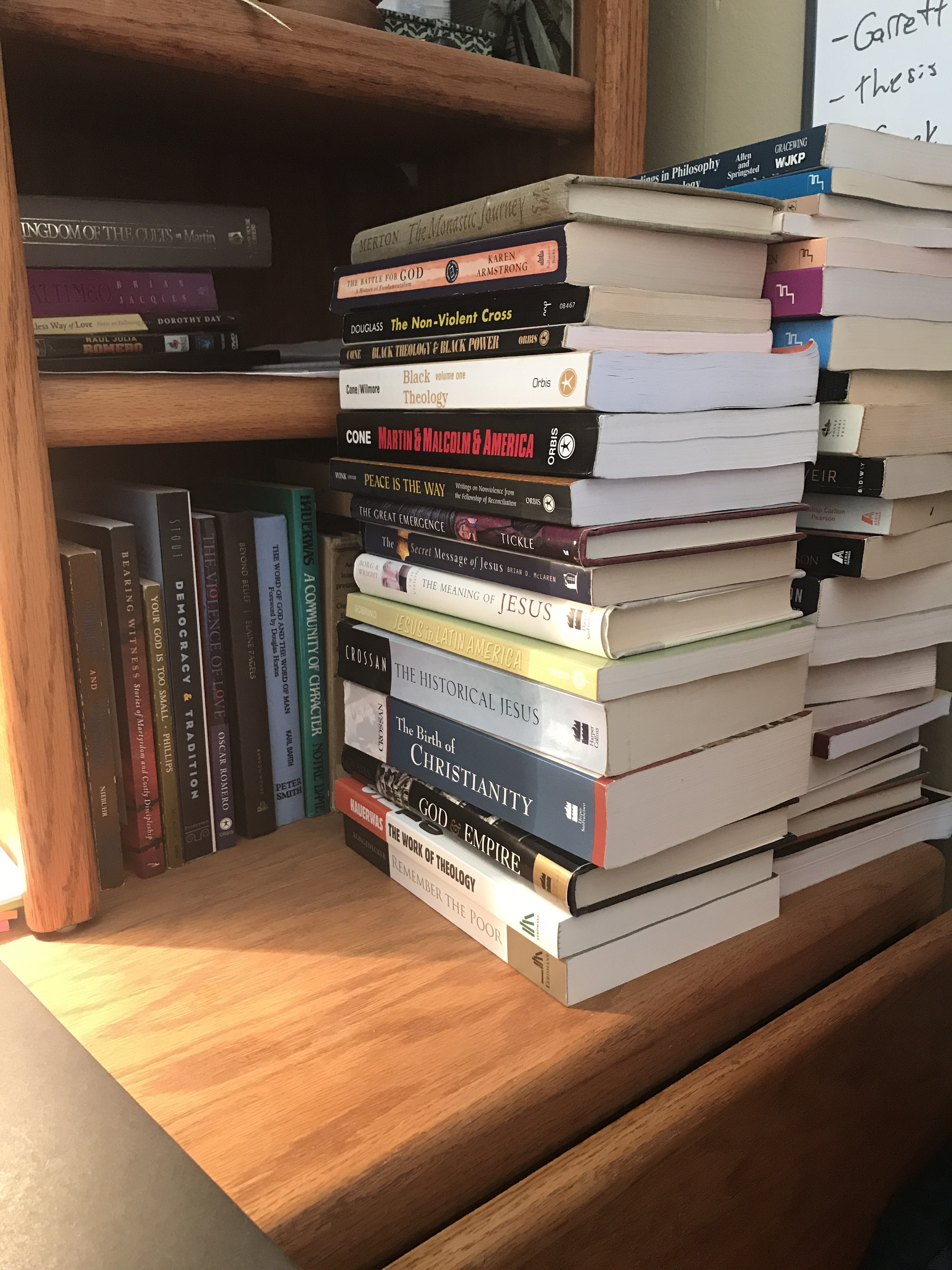
One of my goals this summer has been to do a lot of reading. During the school year, any personal reading is very obviously out of the question. Being a lover of books, this means that I obtain a healthy stack of “to be read” books. This last year was especially fruitful on this front; between a pastor friend retiring and letting me raid his shelf, another friend downsizing for a cross country move and allowing the same, and just my own general buying and collecting of books, the to-be-read pile on the corner of my desk has swelled to well over 70 titles.
Obviously, getting through all of them this summer is impossible. But I’m doing my best! Here is what I have read so far this summer.
I’m not going to get into my thoughts on each of these here, but I’m sure I will come back to them this fall. You can especially count on hearing more about What is the Bible? by Bell, the Ehrman books, Tears We Cannot Stop, and The Gift of Doubt. Also, At the Heart of the White Rose was sent to me by Plough Publishing, and I intend to write a book review very soon.
At this moment, I currently have two books I’m working on:
A Theology for the Social Gospel by Walter Rauschenbusch (which I quoted in a post last week; I imagine I’ll have much more to say going forward,)
and, We Were the Mulvaneys by Joyce Carol Oates (I’m only about a quarter of the way into it, and I highly, highly recommend you read it.)
And of course, my list is still full. If you are interested in seeing what I have on my shelf, and keeping track of what I’m reading, find me on Goodreads.
In addition to the books I am reading, I have also been working through the stacks of journals I subscribe to that I couldn’t get to during the school year. Regular readers here will be familiar with Plough, a quarterly I reference here often (they also send me books to review, as per above.) I had stacked up back issues from last summer, which I finally have caught up on.
I also took out a subscription to Jacobin, a democratic socialist quarterly, this spring, and have been reading through the back issues. Interesting stuff; I don’t always agree, but it always gets me thinking.
And, as a new student member of the American Academy of Religion, I have started receiving their journal, which I haven’t even had a chance to look at yet. (I intend to attend the Annual Meeting in November in Boston, which I’m sure I will share more about here.)
Of course, I expect to have thoughts about all three of these journals here in the future.
I don’t watch TV in the traditional way (I’m a millennial, after all) but I do engage in binge watching shows as best as I can. This last year, I worked through Mad Men finally, and got current of House of Cards. I am currently working through the Sopranos (halfway through season 4!), with intentions of moving to The Wire next.
Finally, I have been working on catching up on the Rob Bell podcast (RobCast) this summer, which is always stimulating and hilarious and wonderful in a lot of different ways. You should listen to it!
So that’s everything that’s bouncing around in my brain this summer, which is obviously going to have lots of influence here going forward. What are you reading, watching, or listening to this summer? Share with us below!

 Justin DaMetz