
I’m blogging my way through all four Gospels, in the order they appear in Scripture. Click here to read my introduction to this project.
1An account of the genealogy[a] of Jesus the Messiah,[b] the son of David, the son of Abraham.
New Revised Standard Version
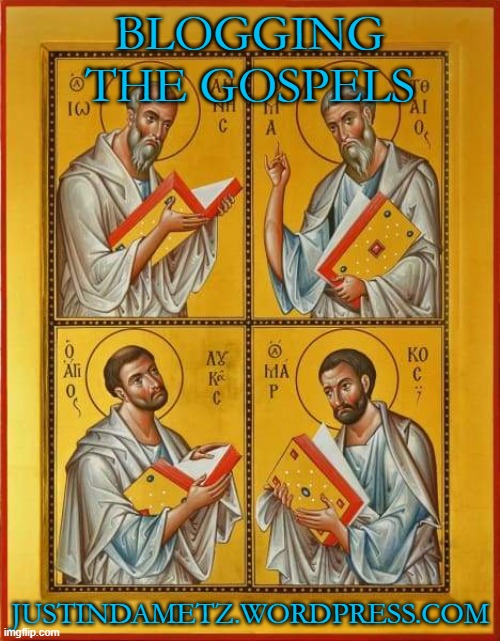
The Four Gospels, as they are ordered in the Christian New Testament, start where any good story does: with the beginning.
This may seem like an obvious statement. Of course it begins at the beginning; that’s literally how things work. On second glance, it may also seem ridiculous. What kind of beginning, at least in the sense of how we understand the beginnings of stories, is this one, which seems more suited to be a section heading.
But, when I point at Matthew 1:1 and say, this is the beginning, what I mean is, this is The Beginning. You know what I mean, right? Not, the beginning, but, The Beginning.
Yeah, exactly.
And that’s a weighty statement! One full of religious hubris, even, and one that can make any good Christian living in our religiously pluralistic world uncomfortable. To say that Jesus the Messiah, the son of David, the son of Abraham, is The Beginning, is to make a claim on history, even the parts of history held to be outside the scope of the Christian tradition.
But, that kind of weighty, uncomfortable, overreaching statement is exactly the one that the Gospel is trying to make. Matthew doesn’t begin with a scene-setting image of Nazareth or Bethlehem, or with Joseph and Mary, or even with “Once upon a time….”. Instead, Matthew kicks things off by making a declaration, that this is the story of Jesus, who is Messiah, the Anointed One of the God of Israel, the rightful inheritor of the throne in Jerusalem, descended from the first and most beloved of Kings, David, and from the progenitor of the Jews and the first carrier of God’s covenantal promise, Abraham. Jesus inherits the cultural, social, and religious burdens of these two men in this statement, taking into himself in these first seventeen words the entire weight of the people of God, and as a result, the weight of God’s own plan for humanity and the universe. Jesus enters into Israel’s story, which is God’s story, which is humanity’s story. Thus, by being the starting point of the Gospel story, Jesus becomes The Beginning for our story. It is no longer a dry header or precursor to the real narrative, but instead, is a statement that does in seventeen simple, declarative words the same thing the writer of the Gospel of John spends 18 long and poetic verses doing.
In an essay on Reinhold Niebuhr, Stanley Hauerwas writes:
For Christians history is not a realm of human endeavor or progress. Rather, it is a realm where sin and death reign and thus it is in need of redemption. The eschatological character of Christian conviction challenges any assumption that history can be construed as a continuous, or even progressive, process. Jesus is not a world-historical link in the chain of historical happenings, but the unique redeemer.
Stanley Hauerwas, “History as Fate: How Justification by Faith Became Anthropology (and History) in America” in Wilderness Wanderings: Westview Press, Boulder, Colorado (1997), 33.
Reading this in 2020, as a Protestant Christian in the cultural West, is uncomfortable. It’s borderline heretical, according to the dogmas and truisms of modern culture. Nevertheless, it is the Truth, one that transcends history, one that makes an unshakeable claim on the world and on all people in all places and all times. Jesus is not just another story in history, like Caesar or the Plague or the Peloponnesian War. Rather, Jesus is the start of a new age, the point on which all of human history turns. Jesus is The Beginning of The Story, not all the way back at some mythical starting point, but in all moments and all instances, inside and outside of time.
So, when the writer of Matthew begins by saying that this is the account of “Jesus the Messiah, the son of David, the son of Abraham”, they are saying “This is The Beginning of all that is and all that was and all that will be; that is, this is the story of Jesus the Christ. Amen.”
 Justin DaMetz