Matthew 1:1-17: Genealogy of Christ #BloggingtheGospels

I’m blogging my way through all four Gospels, in the order they appear in Scripture. Click here to read my introduction to this project.
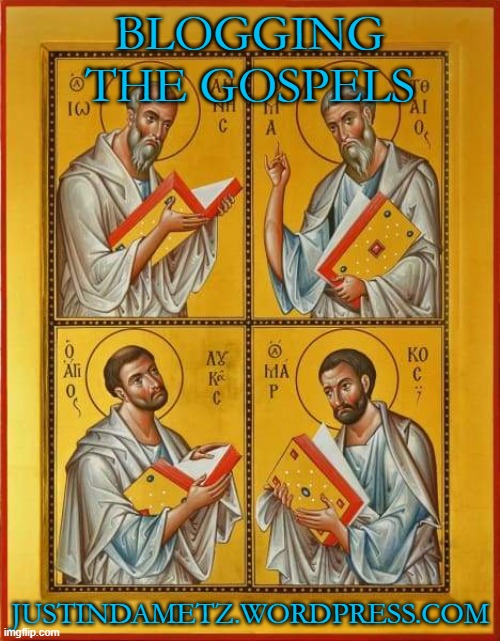
An account of the genealogy[a] of Jesus the Messiah,[b] the son of David, the son of Abraham.

Abraham was the father of Isaac, and Isaac the father of Jacob, and Jacob the father of Judah and his brothers, and Judah the father of Perez and Zerah by Tamar, and Perez the father of Hezron, and Hezron the father of Aram, and Aram the father of Aminadab, and Aminadab the father of Nahshon, and Nahshon the father of Salmon, and Salmon the father of Boaz by Rahab, and Boaz the father of Obed by Ruth, and Obed the father of Jesse, and Jesse the father of King David.

And David was the father of Solomon by the wife of Uriah, and Solomon the father of Rehoboam, and Rehoboam the father of Abijah, and Abijah the father of Asaph,[c] and Asaph[d] the father of Jehoshaphat, and Jehoshaphat the father of Joram, and Joram the father of Uzziah, and Uzziah the father of Jotham, and Jotham the father of Ahaz, and Ahaz the father of Hezekiah, 10 and Hezekiah the father of Manasseh, and Manasseh the father of Amos,[e] and Amos[f] the father of Josiah, 11 and Josiah the father of Jechoniah and his brothers, at the time of the deportation to Babylon.

12 And after the deportation to Babylon: Jechoniah was the father of Salathiel, and Salathiel the father of Zerubbabel, 13 and Zerubbabel the father of Abiud, and Abiud the father of Eliakim, and Eliakim the father of Azor, 14 and Azor the father of Zadok, and Zadok the father of Achim, and Achim the father of Eliud, 15 and Eliud the father of Eleazar, and Eleazar the father of Matthan, and Matthan the father of Jacob, 16 and Jacob the father of Joseph the husband of Mary, of whom Jesus was born, who is called the Messiah.[g]

17 So all the generations from Abraham to David are fourteen generations; and from David to the deportation to Babylon, fourteen generations; and from the deportation to Babylon to the Messiah,[h] fourteen generations.

New Revised Standard Version

The Gospels begin with the story of a people, told in the form of names, divided into three groups of fourteen names each. The three groups are all distinctive their own ways. The first, from Abraham to David, is the classic story of the Jewish people, and is notable for including women who are prostitutes and foreigners. The second group is made up of kings of Israel. In order to get to fourteen generations, the author leaves out four kings we know of from the books of Chronicles, and a queen as well. The final group is mostly unknown people, common names from this era, marking the time from the exile to the birth of Christ as a time of anonymity and far from the centers of power. This is no dry history; it is not a literal genealogical record we are reading here. Matthew 1 is not Ancestry.com.

Matthew has manipulated and reshaped the story of the Jews, leaving out names, changing others, moving folks around, in order to get us to these three groups of fourteen generations each. Three is obviously an important number to Christians, invoking the Trinity. Fourteen is as well. Besides being the first multiple of seven (a holy number in Judaism), it is also the number you get when you add the numerical values assigned to the letters that make up the name “David” (Jesus’ most illustrious and kingly ancestor.) David in Hebrew is three letters: dalet, vav, and dalet. Dalet – ד‎ – is also a stand in for the number four, while vav – ו – is 6. Add those up, and you get 14. Matthew is intentional choice of three groupings of fourteen generations. He is telling a story, of three eras, each of which point to the Messiah, the Son of David. He is willing to exclude names, and include otherwise unsavory characters, in order to get there.

All in all, the genealogy of Christ offered by Matthew is, as the footnotes in The Jewish Annotated New Testament point out, “unusual in citing women, non-Jews, and morally questionable characters” in the recounting the pedigree of the Messiah. This may seem a rather innocuous observation, but it is important to stop here and recognize that it is anything but. In ancient literature, genealogies are a tool of establishing importance via a link to a glorious past, through the image of heroes and exemplars of virtue. But the Jewish tradition that culminates here in Christ rejects that kind of mythologizing. Instead, the genealogy of the Messiah is made up of those who are rejected from society – sinners, women, immigrants, the unclean, the morally suspect. It’s not a very good way to make the case for a powerful, conquering king. But it’s a really good way to be introduced to Jesus Christ.

Christ made a career out of accepting and loving those who were otherwise unacceptable and unlovable to polite society. The story this genealogy prefaces is one where the outcast, the oppressed, the forgotten, the poor and the weak are placed before the powerful, the rich, the strong. It is a story where those who the religious establishment of the day would have regarded as unworthy of glory are given the keys to the Kingdom, are called on to lead the Church that rises up in Christ’s memory. By including such unorthodox names in Christ’s pedigree, Matthew is laying the groundwork for a Messiah who isn’t coming to confirm everyone in their comfortable, exclusionary way of being; instead, we are to understand right off the back that this story is one of inclusion and acceptance for all. If Christ can descend from the line of Tamar, of Ruth, of Bathsheba, then the Body of Christ can welcome immigrants and homeless people and trans folks with open arms.

The manipulation and twisting of the members of Christ’s genealogy in order to get it to fit into the three groups of fourteen is important as well for how we approach Jesus’ story. The story of Christ is one that always makes room for us to see God in Christ. It’s a reminder: this is God’s world, and we are living in it. God can make God’s self known in the way God needs to, even if it upends the rules and orders we are comfortable or familiar with. In fact, God at times seems to relish upending things in order to bring about the Kingdom, just like Matthew didn’t see a problem fudging the names and the numbers a little to invoke King David.

One last note I want to make about this genealogy: it is also a specifically Jewish story Jesus is taking part in. That’s important to remember, even as we emphasize the universality of God’s Kingdom. Jesus was a Jew. The Gospel of Matthew was a story written to remind readers of Jesus’ Jewishness. That will be an important note to keep in mind as we dig further into this Gospel.
Matthew 1:1: The Beginning

I’m blogging my way through all four Gospels, in the order they appear in Scripture. Click here to read my introduction to this project.

1An account of the genealogy[a] of Jesus the Messiah,[b] the son of David, the son of Abraham.

New Revised Standard Version

The Four Gospels, as they are ordered in the Christian New Testament, start where any good story does: with the beginning.

This may seem like an obvious statement. Of course it begins at the beginning; that’s literally how things work. On second glance, it may also seem ridiculous. What kind of beginning, at least in the sense of how we understand the beginnings of stories, is this one, which seems more suited to be a section heading.

But, when I point at Matthew 1:1 and say, this is the beginning, what I mean is, this is The Beginning. You know what I mean, right? Not, the beginning, but, The Beginning.

Yeah, exactly.

And that’s a weighty statement! One full of religious hubris, even, and one that can make any good Christian living in our religiously pluralistic world uncomfortable. To say that Jesus the Messiah, the son of David, the son of Abraham, is The Beginning, is to make a claim on history, even the parts of history held to be outside the scope of the Christian tradition.

But, that kind of weighty, uncomfortable, overreaching statement is exactly the one that the Gospel is trying to make. Matthew doesn’t begin with a scene-setting image of Nazareth or Bethlehem, or with Joseph and Mary, or even with “Once upon a time….”. Instead, Matthew kicks things off by making a declaration, that this is the story of Jesus, who is Messiah, the Anointed One of the God of Israel, the rightful inheritor of the throne in Jerusalem, descended from the first and most beloved of Kings, David, and from the progenitor of the Jews and the first carrier of God’s covenantal promise, Abraham. Jesus inherits the cultural, social, and religious burdens of these two men in this statement, taking into himself in these first seventeen words the entire weight of the people of God, and as a result, the weight of God’s own plan for humanity and the universe. Jesus enters into Israel’s story, which is God’s story, which is humanity’s story. Thus, by being the starting point of the Gospel story, Jesus becomes The Beginning for our story. It is no longer a dry header or precursor to the real narrative, but instead, is a statement that does in seventeen simple, declarative words the same thing the writer of the Gospel of John spends 18 long and poetic verses doing.

In an essay on Reinhold Niebuhr, Stanley Hauerwas writes:

For Christians history is not a realm of human endeavor or progress. Rather, it is a realm where sin and death reign and thus it is in need of redemption. The eschatological character of Christian conviction challenges any assumption that history can be construed as a continuous, or even progressive, process. Jesus is not a world-historical link in the chain of historical happenings, but the unique redeemer.

Stanley Hauerwas, “History as Fate: How Justification by Faith Became Anthropology (and History) in America” in Wilderness Wanderings: Westview Press, Boulder, Colorado (1997), 33.

Reading this in 2020, as a Protestant Christian in the cultural West, is uncomfortable. It’s borderline heretical, according to the dogmas and truisms of modern culture. Nevertheless, it is the Truth, one that transcends history, one that makes an unshakeable claim on the world and on all people in all places and all times. Jesus is not just another story in history, like Caesar or the Plague or the Peloponnesian War. Rather, Jesus is the start of a new age, the point on which all of human history turns. Jesus is The Beginning of The Story, not all the way back at some mythical starting point, but in all moments and all instances, inside and outside of time.

So, when the writer of Matthew begins by saying that this is the account of “Jesus the Messiah, the son of David, the son of Abraham”, they are saying “This is The Beginning of all that is and all that was and all that will be; that is, this is the story of Jesus the Christ. Amen.”

And He Healed Them All

In the news today:

Health care workers who want to refuse to treat patients because of religious or moral beliefs will have a new defender in the Trump administration.

This, of course, is straight out of the religious right’s anti-LGBT playbook, right along with protecting bakers and photographers and other businesses who want to discriminate. This case, however, stands out for me, because of the direct Biblical implications.

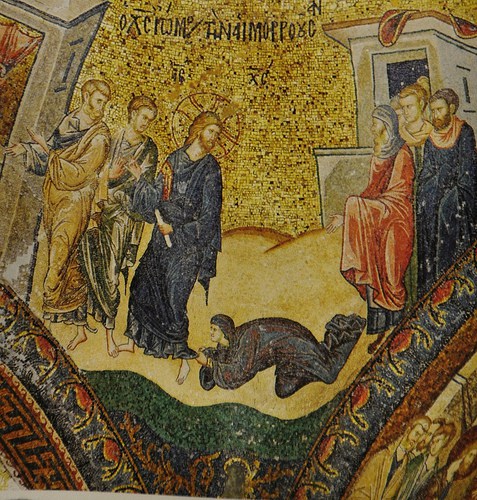
Jesus, among many other things, was a healer. Throughout the Gospels, he heals numerous people, of a variety of ailments: blindness, leprosy, a withered hand, bleeding, even death. He heals people, by touch, who were deemed unclean and unacceptable by the culture of the time. Where other healers wouldn’t go, Jesus went. He loved the unlovable, not in word, but in deed.

thehealericonMost importantly, Jesus never refused to heal anyone.

To take just one example, flip to Matthew 9:20-22. In this story, found in all three Synoptic Gospels, Jesus heals a woman who had “been suffering from hemorrhages for twelve years,” via her touching his cloak. By Levitical law, she is unclean, and he is made unclean at her touch. In the time of Jesus, this would have been unthinkable and dangerous. Being unclean was the worst thing a Jew could be, according to the Law of Moses, and the rituals required to become clean again, not to mention the massive inconvenience to a person’s life in the meantime, were onerous.

Yet, Jesus never hesitated to heal her. He did not get angry at the women, call her unclean, worry about his own cleanliness, and by extension, his own soul or salvation under the law. Rather, he simply healed, and by healing, loved unconditionally. In fact, he went so far as to tell the woman that her faith had healed her. That is, the courage and trust that she showed in coming to him, was greatly rewarded.

Those who are sick today, who might be considered unclean or unwanted, because of their gender identity or who they love, also come to health care providers in trust, and with courage, believing they, too, are worthy of their humanity, and thus of being made well and whole. I would hope that any health care provider, and especially those who heal under the name of “Christian,” would emulate the unconditional nature of Jesus, and heal all in need. No conditions, no consequences, no caveats.

This attempt by the Trump administration, and the politicized religious right, to divide and dehumanize, to make “us and them” relevant categories again, to try to institute the same kind of blind dogmatism and legalism that Jesus stood so forcefully against, can not be allowed to take hold. If someone in need comes into their operating room, someone the preacher and the politician on their cable news show told them is “untouchable,” and they go looking for a verse of Scripture for guidance, I hope the only one they find is Matthew 15:30:

“Great crowds came to him, bringing with them the lame, the maimed, the blind, the mute, and many others, and laid them at his feet,

and he healed them all.”