
I am fascinated with Michael Wear’s piece at Christianity Today on the relationship between President Barack Obama and American evangelicals. Drawing on his new book Reclaiming Faith: Lessons Learned in the Obama White House About the Future of Faith in America, Wear tries to answer the question of why evangelicals hated Obama so much, but love Donald Trump.
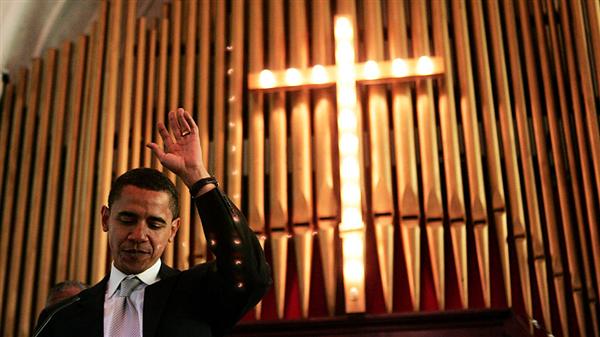 I’ll admit, this question has been central in my mind since Trump burst onto the political main-stage three years ago. The deep hatred and disdain evangelicals have for Obama baffles me. There is no doubt in my mind that President Obama governed in a Christian manner like few others before him have. I don’t mean he participated in the cheap, public displays of devotion that a George W. Bush or Ted Cruz engage in. Rather, Obama was always thoughtful, humble, and driven by deep convictions of morality and regard for human dignity. He never stood on a stage and declared himself “born again,” but he did showcase a deep knowledge and regard of the Christian faith, and clearly let himself be driven by it. He was committed to his family, and to American families as a goal of American policy. When speaking of faith, he spoke with great knowledge and reverence for God and Scripture.
As a Christian with a background in politics and policy, I can’t see many areas where I would have made choices much different that Obama with regards to faith (drone strikes overseas and other foreign policy choices are the chief areas that come to mind.) The public expression of faith exhibited by Barack Obama is something I would hope to emulate if I were again pursuing a career in public service.
Beyond personality, Obama’s Administration was much more faith friendly that it gets credit for, something Wear points out:
President Obama came into Office with plans to deliver on the promise of his campaign outreach to people of faith, including evangelicals. He kept and expanded the White House faith-based initiative, creating an advisory council (which, unlike the current president’s council, was official, established by executive order for the purpose of providing recommendations to the president and the federal government) that included robust evangelical participation. Four months into his Administration, he delivered a passionate case to heal national divides around abortion by seeking to ‘reduce the number of women seeking abortions’ while maintaining his commitment to Roe v. Wade. This speech was followed-up by years of staff work, overseen by the president, to pursue this common ground. Evangelicals were central to many of President Obama’s signature achievements: the Affordable Care Act, New START, the Paris Agreement, the expansion of America’s effort to combat human trafficking, and the rejection of deep social safety net cuts proposed by the Republican Congress.
Yet none of this is taken into account in the narrative that prevails about Obama and faith. And with good reason. The Religious Right made the decision early on, mirroring Mitch McConnell and the Republican Party, to blindly oppose everything the President did. Wear goes on:
In addition to discussing these partnerships, my recent book, Reclaiming Hope: Lessons Learned in the Obama White House About the Future of Faith in America, also describes why the president’s olive branch withered. On the right, political Religious Right groups made it their mission to sow distrust of and animosity toward the president. This went far beyond opposing specific policies or values of the Obama Administration. They did this through spreading half-truths, tolerating or promoting conspiracy theories, and insisting that Obama was an existential threat to their faith and the nation, among other things. There were notable exceptions to this fearmongering, but they were, sadly, in the minority and suffered under accusations of being closet liberals by their fellow evangelicals.
Evangelicals doubled down on abortion, same-sex marriage, and religious freedom issues, elevating these three areas over everything else. Where Obama looked for areas of cooperation and shared values, evangelicals made the decision to focus only on differences.
Wear points out that this attitude, driven by fear and loathing of someone they only saw as an “other,” led directly to President Donald Trump:
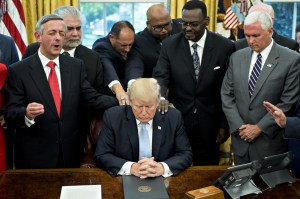
Fear was the primary basis of Donald Trump’s appeals to evangelicals. He did not pretend he was one of them. He told them they were alone, that Democrats were out to get them, that ISIS was ‘drowning Christians in steel cages,’ and only he could protect them. He offered himself as a bully. Yes, he had flaws. Yes, his pagan approach to sex, money and power was evident and unseemly, inconveniently brought to the surface repeatedly during his campaign. But he would be their bully.
Evangelicals, driven by eight years of hate, began to believe their own propaganda, that the various disagreements they held with Barack Obama not only outweighed their numerous agreements, but in fact signaled a coming apocalypse for American Christianity. Minor disagreements could not be tolerated, because they indicated, to them at least, the cracks showing deep seated liberal hatred for all things Christian. So they took a bet on a strongman to save them from a non-existent boogeyman. In return for his “protection,” they get to carry his baggage forward for decades to come, tarnishing their own reputations and making themselves culturally irrelevant.
Wear eloquently discusses the consequences of this choice:
Evangelicals may find such attention as they received from Barack Obama more hard to come by after the Trump era takes its full toll. In years to come, I believe evangelicals will view Barack Obama’s disappointment toward them in a different light. They will see that it reflected much higher esteem than either Hillary Clinton’s cold disregard or Donald Trump’s toxic embrace. As they acclimate to the cultural changes that drove them to Trump, and understand just what their support of Trump cost them and our country, they will look back and see that Obama’s disappointment was a compliment.
President Obama was indeed a liberal, and a supporter of women’s choice, equal rights for LGBTQ+ people, and an expansive view of the separation of church and state that makes room for all faiths and non-faiths. He also was passionate about reinvigorating American families, combating poverty and declining standards of living, pursuing broader economic equality, and presenting a more humble, more humane, and more compassionate America to the world. American evangelicals let their own fear and hate deprive them of a great opportunity, one they may not get again in the future.
H/T to John Fea for bringing this article to my attention.

 Justin DaMetz