Being the Church in the Time of Coronavirus

Christians have no greater task in the world than to be the church. This is a rather innocuous sounding claim that is actually rather radical when the implications are thought through completely. For what it means is that the task of Christians in the face of world events is not to analyze the best political or social action strategy, and then pursue that with technocratic efficiency. Instead, it is to see what is happening in the world, and then ask themselves, “what should I do about this in light of the death and resurrection of Christ?”
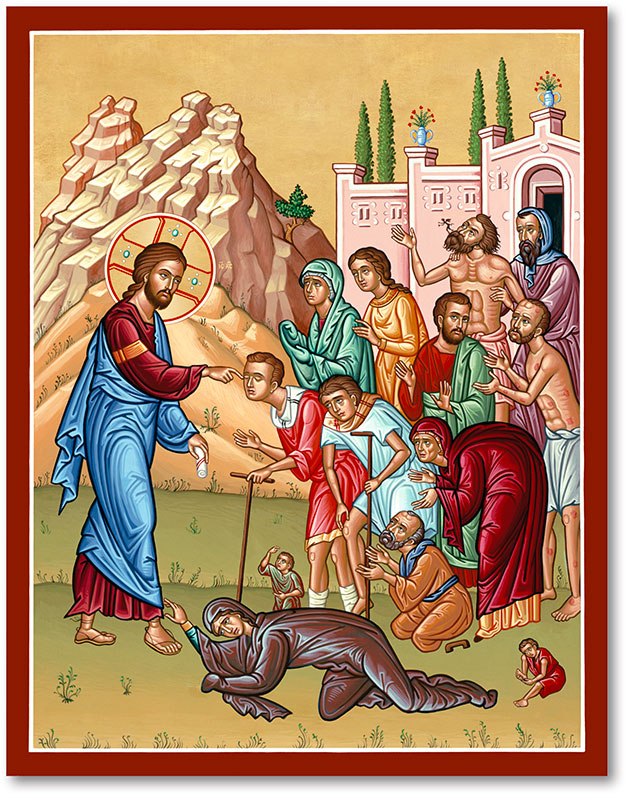
This is as true now, in the face of the coronavirus pandemic, as it ever was. So, what does the work of the church look like right now? How can we Christians be the church during a pandemic? Over at The American Conservative, Rod Dreher draws our attention to how Christians of the past were the church during a time of pandemic. He quotes at length the historian Tom Holland, who writes:

First, at the end of the second century, and then again in the middle of the third, bowls of wrath were poured out on the Roman empire. Of the second pandemic, a historian would subsequently record that “there was almost no province of Rome, no city, no house, which was not attacked and emptied by this general pestilence”.

Did it mark, then, the breaking of the cities of the world foretold by St John? Many Christians believed so. Fatefully, however, it was not as worshippers of a God of wrath that they would come to be viewed by many of their fellow citizens, but as worshippers of a God of love: for it was observed by many in plague-ravaged cities how, “heedless of the danger, they took charge of the sick, attending to their every need and ministering to them in Christ”. Obedient to the commands of their Saviour, who had told them that to care for the least of their brothers and sisters was to care for him, and confident in the promise of eternal life, large numbers of them were able to stand firm against dread of the plague, and tend to those afflicted by it.

The compassion they showed to the sick – and not just to the Christian sick – was widely noted, and would have enduring consequences. Emerging from the terrible years of plague, the Church found itself steeled in its sense of mission. For the first time in history, an institution existed that believed itself called to provide compassion and medical care to every level of society.

The revolutionary implications of this, in a world where it had always been taken for granted that doctors were yet another perk of the rich, could hardly be overstated. The sick, rather than disgusting and repelling Christians, provided them with something they saw as infinitely precious: an opportunity to demonstrate their love of Christ.

Jesus himself, asked by a centurion to heal his servant of a mortal illness, had marvelled that a Roman should place such confidence in him – and duly healed the officer’s servant. By the beginning of the fourth century, not even their bitterest enemies could deny Christians success when it came to tending the sick. In Armenia, the Zoroastrian priests who marked down the Krestayne as purveyors of witchcraft were at the same time paying them a compliment. When the Armenian king became the first ruler to proclaim his realm a Christian land in 301, his conversion followed the success of a Christian holy man in curing him of insanity – and specifically of the conviction that he was a wild boar.

Then, just over a decade later, an even greater ruler was brought to Christ. Constantine embraced Christianity, not out of any concern for the unfortunate, but out of the far more traditional desire for a divine patron who would bring him victory in battle; but this did not mean, once the successful establishment of his regime had served to legitimate Christianity, that Christians among the ranks of the Roman elite turned a blind eye to their responsibility towards the sick.

Quite the opposite: “Do not despise these people in their abjection; do not think they merit no respect.” So urged Gregory, an aristocrat from Cappadocia who in 372, 60 years after Constantine’s conversion, became the bishop of a small town named Nyssa. “Reflect on who they are, and you will understand their dignity; they have taken upon them the person of our Saviour. For he, the compassionate, has given them his own person.”

This is a wonderful example of what being the church looks like in the world. Christians in the first centuries were different from the world, in that they did the kind of work (like healing all during the plague) that made the world take notice and look on in wonder. And in doing so, they exemplified the moral character of Christ, exhibiting love, mercy, kindness, compassion, and joy.

Which is really the point. Christians, as the church, are different from the world not for the sake of being different, but for the sake of living into the character of Christ. Some Christians today take pride in “not being of the world” in a showy sense, in that it is in obvious in a very deliberate and manufactured way. But, what they fail to realize is that if they aren’t acting from love, from a concern for the needy and the poor, from a place of humility and regard for the Other, then they are just loud people doing weird, not very impactful things.

That is especially true right now, during this pandemic. As I wrote about yesterday, a very loud group of people, many of whom (based on their political persuasion) would almost certainly claim the title “Christian”, think they are being the “Church” just by being contrary, for the sake of contrarianism, not for the sake of Christ. But right now, being the church doesn’t look like defying science and public health guidelines. Right now, being the church looks like it always does: a community of faith, built on love for our neighbors, concern for the weak, a desire for righteousness, and practices of mercy and compassion.

Now, does that necessarily mean we all run out and throw ourselves on the frontlines of the outbreak, a la the second century Christians Holland describes? I don’t think so. We have medical professionals in today’s world, who don’t need us getting in the way of doing the work they have trained their whole lives to do. So what does it look like?

I don’t have the answers to that question. Perhaps it looks like, if you are young and healthy, going to the grocery store for your elderly neighbors, so they can stay in and stay safe. Perhaps it means sitting on the front lawn of the lonely old man down the street and chatting with him. I know it definitely looks like doing everything we can to keep people safe and healthy, even at the expense of our own comfort or routines. Its like the old church camp song says: “And they will know we are Christians by our love.”
Coronavirus Doesn’t Care About Your Rights

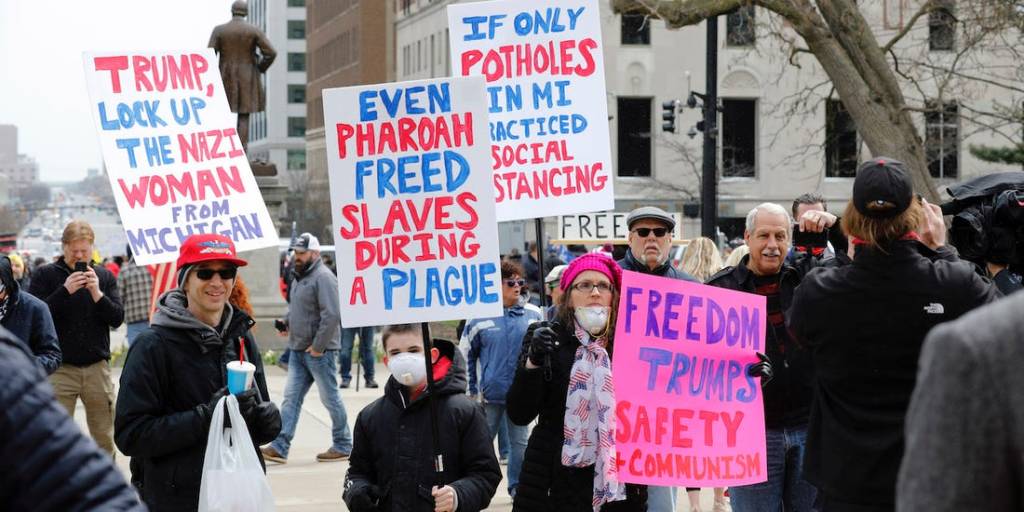
Last week brought the image of protestors across a variety of states rallying against social distancing and self quarantine guidance from local, state and federal officials. Reminiscent of the Tea Party protests of a decade ago (although noticeably smaller), protesters carried signs demanding an end to shutdowns, comparing political leaders to Nazis, and asserting their rights to shop where they want, get haircuts when they want, and spread a largely unknown, highly contagious, and potentially deadly disease as far and wide as they want.

Of course, right wing political leaders immediately latched on to these protests in a show of faux populism. President Trump himself could not resist the opportunity to take to Twitter and start all-caps tweeting things like “LIBERATE MICHIGAN”, as if the very federal government he heads up wasn’t at the same time properly encouraging shutdowns and stay-at-home guidelines. Then yesterday, Attorney General William Barr went on a radio show to declare his own opposition to shutdowns on potential legal grounds:

“Our federal constitutional rights don’t go away in an emergency. They constrain what the government can do,” Barr said in the Tuesday interview. “And in a circumstance like this, they put on the government the burden to make sure that whatever burdens it’s putting on our constitutional liberties are strictly necessary to deal with the problem…

“You know, the idea that you have to stay in your house is disturbingly close to house arrest,” Barr said in the Tuesday interview. “I’m not saying it wasn’t justified. I’m not saying in some places it might still be justified. But it’s very onerous, as is shutting down your livelihood. So these are very, very burdensome impingements on liberty, and we adopted them…”

Declarations of one’s absolute right to do as they please have been a constant refrain over the last few weeks as shutdowns and social distancing have increased. AG Barr echoes here much of the rhetoric, which is focused on rights language, and the concept of personal liberty. Speaking legally, none of what is being said is wrong, per se. You do have a right to do as you please. Granted, rights extend only as far as the closest person, and so at times, the government has the power to limit rights in order to promote a greater good, or in this case, to promote health and safety, especially among vulnerable populations.

But I don’t want to get into a legal argument here. I want to think more critically about the concept of “rights”, and the role they play in society beyond the legal arena. Because rights are, most essentially, the legal duties we have to one another. Rights are the necessary language of a society of mistrustful, anxious strangers, constantly assuming the worst in their neighbors in each encounter they have with one another. Rights are the way we ensure each one of us meets our legal obligations to one another and to society.

Rights, however, are not the way to build a community of trust and care. And in a time of crisis, that is the kind of community we desperately need.

The only way to defeat an epidemic is to trust that each of us have the well being of one another in mind, and that we will do what we can to care for those in need, whether they be sick, financially insecure, or worried about their business or endeavors in life. It requires more than the assertion that I have to right to do this or that thing, regardless of any other consequence. It requires me to see beyond my selfish rights, to see that this isn’t about me, but about all of us, together.

The automatic fallback of rights language is the language of a people who have forgotten how to care for one another beyond our mere legally coerced obligations. It is the sign of people who no longer have the moral imagination or vocabulary to create a community predicated on learning how to act with judgement and restraint, rather than with unrestrained consumption and self-fulfillment.

Stanley Hauerwas writes in The Work of Theology, “appeals to rights threaten to replace first-order moral descriptions in a manner that makes us less able to make the moral discrimination that we depend upon to be morally wise.” What he means here is that some situations require to think beyond the legal rights we are owed by the state and one another. Some situations aren’t going to be solved or made better by a deeper understanding of your personal right to do what you want whenever you want.

To put it mildly, viruses don’t give a damn about your rights. You can’t spout Constitutional truisms at coronavirus. You can’t sue Covid-19 into retreat.

Instead, we have to be able to set aside appeals to our rights to do certain things, and recognize the moral imperative of acting in a way that shows our values – namely, our concern for the vulnerable, for our neighbors, and for the good of a society that can in turn protect your rights in the proper arenas.

Because your right to do something doesn’t do you much good if we’re all dead.

The spread of coronavirus requires us to take extreme steps to protect ourselves and defeat it. Since it easily spreads through airborne particles, lays dormant for a period of time, doesn’t show symptoms in a large chunk of those infected, and is deadly to a wide range of people who get it, we must take the hard and costly step of limiting our contact with others until we know more about the virus, have widespread testing to tell who has it, and the ability to quash quickly and efficiently new outbreaks. We don’t have any of those things right now. So, social distancing is what is required. Yes, it is hard. Yes, our economy is going suffer. Yes, we are all going to be called upon to make sacrifices that seemed inconceivable as recently as two months ago. And yes, at times, you are going to feel that you are at unable to exercise your full suite of legal rights under our Constitution and our legal code.

But the alternative is so much worse.

Merely appealing to our liberty and our rights isn’t good enough. We have to think bigger than that.

Social Distancing from the Body of Christ

What does the coronavirus, “social distancing”, and self-quarantining mean for the Body of Christ? Scripture is clear about the communal nature of the Church; no single person can embody the Church. Such is idolatry or the beginnings of a cult. We find meaning and redemption in community with one another, through communal worship, through sharing lives, through working together on our tasks and vocations. The most sacred time of the week for a Christian is Sunday mornings, not just because we go to worship God, but because we go to worship God in the presence of one another.

Yet, coronavirus, and our response it, disrupts this. The most prudent step is distance oneself from others, in order to slow the spread of a sickness that requires literal human touch to propagate. How ironic this is. That which makes us human – our ability to work together with others, to love intentionally and communally – is that which this virus targets and disrupts most clearly. Coronavirus forces us to be apart from one another, to stay in our homes, and hoard what we have, and to survive, just barely. It forces us to consider that which the sick and alone need most – human touch – as something dirty, something we must avoid. It disrupts the work of being close to someone who needs proximity to be reminded of their worth and being.

Some commentators over the last couple of days have declared that this is the new normal for humanity going forward, that this incident will realign the nature of human connectedness, and make us all the more individualized, and distant, and unwilling to be close to others. Some have made this declaration as if this is the right thing to do. Social distancing is how to be a human being entering the second decade of the 21st century. It is right and good that we should pull back a little further from one another, in order to preserve our good health, and our individualism, and our own personal choices and ways of being. This, then, is the logical and desirable endpoint of the Enlightenment project. “I‌ think, therefore I am,”‌ declared Rousseau almost 500 years ago, setting every Ego apart from every other one. We distance, and therefore we are: distinct, and, singular, and fully actualized, and small, and sick, and alone.

What is the Church to do?‌ How are Christians to be in this world? We have a duty to live responsibly, to not endanger those who this virus puts at risk, and that means to stay away from large crowds, to sanitize, to avoid contact with those we can harm through our touch. The critics are correct; to continue to go on as if nothing has changed is not just reckless or irresponsible; it is selfish and immoral. It is to refuse to do that most Christian of things, to think of others before ourselves. Our actions must consider the impact they have on the lives and well-being of others.

But locking our doors, and worshiping via live stream, and staying away from those who are still in need today, despite the coronavirus, that doesn’t seem very Christian either. Hunger still exists. The naked still need clothed, those in prison are still there, the stranger approaches, injustice still reigns, and perhaps even more so, as pandemic breeds fear, and xenophobia, and racism. The world still needs the Body of Christ to be what it is called to be. But how?

This is the question the Church should be grappling with, this First Sunday after Coronavirus. I‌ wish I‌ had answers this morning. I‌, too, sit at home, wishing to be out, wandering what horrors the next few days and weeks hold, wanting to do my part. But what is my part?‌ I‌ am young, and healthy, and seemingly unaffected at this point, and thus, a risk to those around me, who don’t have my age or immune system. My prayer of lament this day is, what is my duty? Where am I‌ called, and how?

I‌ am worried about the Church, even more so that I‌ usually am. Any gathering of people is under suspicion right now, and rightfully so. And, beautifully, on this Sunday, pastors and leaders across the globe are still carrying on worship via the digital means we have to do so, a blessed gift to those who still need the Word today. But what about next week?‌‌ What about next month? How long does this go on?‌ And what about those who realize that staying home on a Sunday morning, laying in bed, worshiping at the altar of the IPhone screen, even after coronavirus, is easier, and less messy, and less awkward, and more desirable?

Human connection spreads more than viruses and disease. It requires vulnerability, it inevitably leads to conflict and uncomfortable conversations, and awkward moments. Staying home – social distancing – does more than stop the spread of disease. It makes it easy to pick and chose the form of our human contact, who we are in touch with, how, when. It makes it easy to avoid the the sick and the vulnerable, yes, but also the social awkward, the frustrating, the disagreeable, the old, the infirm, those who ask something of us. Social distancing, outside the context of disease prevention, is comfortable and appealing, and also a denial of the communal nature of God’s people, of the Body of Christ, which, as St. Paul reminds us, “has many members, and all the members of the body, though many, are one body.”

My prayer today is two-fold:‌ that coronavirus will pass, that we will do what we need as a people to fight it and defeat it, and be well; and also, that once we do, that we don’t use its lingering specter to retreat further into our individuality and distance ourselves from one another, but that instead, it reminds us of the limits of our own bodies, and the eternity embodied in the Body. Amen.