The Difference Between Doctrine and Dogma

The following is a essay written last semester, for my Introduction to Theology class.

Dogma and doctrine are words heard often in a Christian context. Accusations of “dogmatism” are thrown at theological opponents, and various “doctrines” are expounded upon. Yet, discerning a real difference between the two terms can be a difficult task. The terms are not interchangeable, but enumerate important separate concepts that are crucial for the task of theology. This paper will explore the difference between the two terms, how they are related, and their importance in Christian theology.
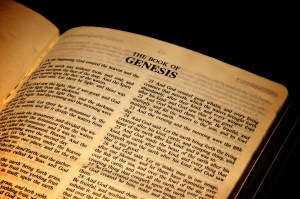
The book of GenesisDogma is defined by Merriam-Webster as “a doctrine or body of doctrines concerning faith or morals formally stated and authoritatively proclaimed by a church.” Within a Christian setting, this is partially right. Dogma is not in fact doctrine, but could be defined as “a body of doctrines.” Most importantly, dogma is made up of assertions “formally stated and authoritatively proclaimed by a church.” For Christianity, the proclaiming body is not a church, but the Church, universal. Thus, dogma can be understood those truths that have broad agreement among Christian communities throughout time. Clearly, there are broad disagreements amongst the various communities that make up Christianity; nevertheless, there are a set of agreed-upon truths – the primacy of Christ, the importance of baptism, to name two – that can be called Christian dogma. Dogma can be understood as “timeless truths,” so to speak. Within the Christian context, dogma is specifically salvific knowledge. These are things that comment upon or increase human knowledge about the nature of God.

Doctrine, on the other hand, is defined in Merriam-Webster as “something that is taught,” or “a principle or position or the body of principles in a branch of knowledge or system of belief.” More specifically, doctrine are the specific appropriations of dogma that mark the boundaries of difference amongst Christian communities. Doctrines are the specific positions churches take on different issues of practice, tradition, and theology.

The differences that arise over disagreements about doctrine create and shape various Christian traditions. As a result, these traditions serve to make visible the shape of doctrines. These traditions arise as Christians respond to specific historical circumstances that shape their experience of God. Thus doctrine, rather than being knowledge about God, is rather the response of humanity to that knowledge. Doctrine arises as a result of response to dogma.

Oftentimes, doctrine gets mistaken for dogma. This is problematic because disagreements on these doctrinal issues that harden into dogmatic statements become the hard edges that serve to fracture communities. Understanding and preserving the difference between the two is important for maintaining the shape of the Christian tradition. Whereas dogma is constituted of pieces that are not up for debate, but which are understood to be timeless and unchanging, doctrine is in fact changeable and up for debate.

In The Faith of the Christian Church, Tyron Inbody describes a helpful difference between the two concepts in his glossary of terms. Doctrine, he writes, is “an agreed-upon teaching of the church which has been declared to be an official teaching in some kind of assembly.” (Inbody, 341) Dogma, on the other hand, he defines as “an official teaching of the catholic church set forth in creedal for through a church council.” (Inbody, 341) In other words, statements of dogma can be found in church creeds, such as the Apostles Creed, held to be authoritative and unchanging. Doctrine, on the other hand, is other statements about Christian worship, practice, and life that are agreed-upon and important, but which can be reinterpreted, disagreed about and even dismissed, by those in other traditions.

Despite the differences between the two, there is important interplay between doctrine and dogma. Both concepts are essential pieces of Christian theology, serving as counterbalances of competing instincts. On one hand, the existence of dogma gives shape to Christianity, establishing the borders of acceptable discourse within faith, and establishing it a religion of universal truths, unchanging and unchangeable. On the other hand, doctrine allows Christianity to retain flexibility, to be a faith that can be responsive to the needs of specific people in specific places and times. The presence of doctrine that can be debated and changed means that the border of the faith, while real and important, is also permeable, allowing in a variety of voices and ideas.

Doctrine and dogma are two sides of a single coin. Both are crucial components of Christian theology. However, it is imperative that Christianity works to educate believers on the differences between the two, and why those differences matter.


America First, God Second?

Last Friday, I wrote a post about the book of Jonah, asserting that America plays the role of Nineveh in that story, not the role of Jonah (as we like to tell ourselves.) Today, I want to follow that up with a little theological grounding for that idea.

I’m doing this because I can hear folks asking, how can I equate us with Assyria and people from places like Iran or Syria with Jonah, when those people aren’t Christians, or even Jewish? Why would God side with Muslims over us, even if, as a nation, we haven’t always acted very Christian in our foreign relations?

The answer is found in thinking about the relation of humanity to God, and specifically, the fundamental orientation of that relationship. In the telling where America plays the good guy role here, the assumption is made of a Divine-Human relationship where we get to set the terms. From us emanates truth, and all else swirls around us and is described in relation to us. America is good, not on God’s terms, but on our own terms. In this telling, the great fundamentalist fear comes to fruition: truth is made relative, in this case, to the needs of American imperialistic aims. The way of God is made unimportant; instead, the way of America is the guiding lodestar. America First becomes not just a quasi-racist catchphrase, but a theological assertion of primacy.

But this gets the human-Divine relationship backwards. When speaking of God – the Divine, the Ground of All Being, Ultimate Truth – one exists in relation to God, is defined by one’s relationship to the Divine. Paul Tillich writes of the “subject-object distinction,” asserting that God can never be an object in an object-subject relation, but is always the subject.

This argument can be problematic at times, especially when the subjective God is conceived of by human beings as a capricious, angry and self-obsessed God. This subject God, around whom all else orbits, becomes “Anti-humanistic,” a God with little if any concern for humanity, but instead completely caught up in God’s own whims and desires. Humanity’s actions and existence become by-products of God, rather than objects. The subject-object relation breaks down in this case.

God as subject works, though, when we understand God as concerned with humanity, and especially, as Jesus posited, with the “least of these.” This is one of the primary and most important contributions of liberation theology to the conception of God: a God concerned primarily with the oppressed, who stands on the side of those not in positions of power.

That’s what powers my assertion that America is playing the role of Nineveh, and persons in places like Iran or Iraq or Afghanistan are playing the role of Jonah. Because God takes the side of the oppressed. And in the case of American imperialism in the Middle East, the oppressed are the people in those places who are being bombed and terrorized and killed. God sides with them, no matter their religion, no matter their creed, and no matter their nationality. In cases where unjust power in being brought to bear, God could really care less about any temporal identifiers. God cares about the flourishing of human life, in its many varied forms. God takes the side of the indigent peasant farmer before he takes the side of well-fed suburbanites in conflict between the two.

Too often, America plays  the role of oppressor to peoples in the global south and east, especially poor people of color. We do it for well-reasoned “good” ideas, like democracy or liberty. But always, these are justifications that benefit not in solidarity with others, but at the expense of them. This is where I get my grounding the say: in Jonah, we are Nineveh. I have very little doubt about that.

Looking for Jonah

I saw this headline the other day, while scrolling through Facebook. Like so, so, so many things having to do with our President, it made me angry, it offended my sensibilities as an American, a Christian, and a human being, and most of all, it just made me sad.

But it also made me think about the story of Jonah.

Anyone who grew up in Sunday school knows the broad contours of the story. God tells Jonah to do something, Jonah disobeys and runs away from God, a big fish (maybe a whale?) swallows Jonah for three days, during which time Jonah decides he’s sorry for disobeying God, the fish spits him out and Jonah goes and does what we he was told.

In this version of Jonah, the story is all about obedience and disobedience, not just of God, but also of our parents, our teachers, or really, any authority figure. Obedience to authority is a pretty important value for most parents, and this seems like a tailor made tale for teaching such a lesson.

But, this is a really shallow way to read the story of Jonah. There is a lot more going on here. There are a lot of different lessons to learn from this little book, and a lot better contemporary issues to apply those lessons to than whether or not Johnny is listening when Mom tells him no cookies before dinner.

Like, for instance, American imperial hegemony in the Middle East.

Stick with me here.

Jonah is a story that is obliquely about imperial hegemony in the ancient Middle East; in this case, Assyria is the hegemon. God asks Jonah to go to Nineveh, Assyria’s capital, to deliver a message of impending judgement and possible redemption to the Assyrians. And Jonah really, really doesn’t want to. Why is that? Because if you imagine Jonah being an American (and that’s a really problematic assumption we’ll return to), then the ancient Assyrians were like Iran, ISIS, or maybe more accurately, like imperial Japan. They had a mission of global conquest, and they were constantly attacking and invading ancient Israel. Over the course of a century, they invaded Israel at least three times, capturing the northern capital of Samaria, carrying it’s people off to captivity, and besieging Jerusalem.

So the Israelites really, really didn’t like the Assyrians. You can open to just about any pre-exilic prophet in the Old Testament and find some condemnation and judgement from God for Assyria.

So, imagine one day, you are chilling on your front porch with your dog and a some really good red wine, and then God goes:

“Hey, you, I want you to go to Tehran, and I want you to tell the Ayatollahs that I’m gonna destroy them.”

I imagine you’d be simultaneously like,

“Hey, great idea, God! Way to show those Iranians who is boss!”

and also “Wait, I can’t go to Tehran and do that, I’ll most definitely be arrested and thrown in an Iranian prison and I really don’t think that sounds great.”

And then God says, “Also, tell them if they repent of their violence, I’ll bless them and make a great nation of them,”

and now I imagine you aren’t thinking this sounds like a good idea at all.

You’d run away too, I imagine. Bless the Iranians? Or ISIS? Or imperial Japan? Make them a great nation? Not cool. They’ve all done some pretty terrible things, invaded places and beheaded people and made life pretty difficult for us. The destruction part sounds good, but the blessing, not so much.

But that’s the point. This story isn’t about obedience and disobedience (at least, not primarily.) Rather, this is a story about the universality of God’s redeeming love. As much as we want to think God’s love is mostly reserved for us good, church-going, tithe-paying Christians, it is simply not. God’s love, as we find in so many places in the Bible, cannot be contained or rationed. It extends to any and all people, no matter their transgressions, no matter their background or creed or problems. God showed love to tax collectors, to persecutors, to murderers, and even to Nineveh. So, chances are good that God also loves ayatollahs and jihadis and kamikaze bombers, just as much as he loves Presbyterians and Baptists and Methodists.

And that’s some really good news for us Americans, too. Because we need it.

Remember above, when we imagined Jonah as an American and I said that was a problem and we’d come back to it? Well, we are coming back to it.

Because, as much as we want to read a story like Jonah and imagine ourselves the hero, the fact is, we really aren’t.

In fact, in this case, America is more like Assyria.

Jonah isn’t getting sent from Akron to Aleppo. Most likely, Jonah is getting sent from Jalalabad to Washington, to deliver a warning of destruction and opportunity for repentance to us. In America, we are the ones in need of God’s love and grace. 

And that brings me back to that headline. It’s really gross and disgusting to see an arena full of self-proclaimed followers of the Prince of Peace cheering wildly at the idea of bombing the very part of the world that Prince hailed from. It’s also nothing new; America Christians were the biggest, most fervent supporters of an unprovoked war in Iraq, for death-dealing forays into Central America in the 80s, for the ill-fated effort to combat communism in Vietnam. This news item is only the most recent, and most blatant, example of the American-Christian war machine. And it is so blatant this time because we’ve been taught and conditioned for so long to associate the glory of Christianity with the success of American imperial power.

News flash: that’s not the Gospel. That’s kind of the anti-Gospel.

So, in the book of Jonah, we don’t get to play the part of Jonah. Instead, we are imperial Assyria, conquering Israel and carrying the people off and besieging their capital. We are the ones God’s anger is kindled against, the ones in danger of destruction, the ones in need of redemption.

In the book of Jonah, the Assyrians hear Jonah’s message. They repent. They wear sackcloth and cry out to God and are saved. They shelf their imperial arrogance and hubris, admit that being the biggest, most powerful country on earth, with the biggest, baddest military and the most money and the biggest egos hasn’t served them very well.

Let’s hope our Jonah shows up soon. Let’s hope we pay attention.