
On Saturday, one of the Scripture readings from my Sacred Ordinary Days planner was Genesis 18:1-16, the story of Abraham welcoming the three angelic messengers to his tent, and their speaking of the promise of God that nearly-100 year old Sarah would soon bear a child.
The Lord appeared to Abraham[a] by the oaks[b] of Mamre, as he sat at the entrance of his tent in the heat of the day. 2 He looked up and saw three men standing near him. When he saw them, he ran from the tent entrance to meet them, and bowed down to the ground. 3 He said, “My lord, if I find favor with you, do not pass by your servant. 4 Let a little water be brought, and wash your feet, and rest yourselves under the tree. 5 Let me bring a little bread, that you may refresh yourselves, and after that you may pass on—since you have come to your servant.” So they said, “Do as you have said.” 6 And Abraham hastened into the tent to Sarah, and said, “Make ready quickly three measures[c] of choice flour, knead it, and make cakes.” 7 Abraham ran to the herd, and took a calf, tender and good, and gave it to the servant, who hastened to prepare it. 8 Then he took curds and milk and the calf that he had prepared, and set it before them; and he stood by them under the tree while they ate.
9 They said to him, “Where is your wife Sarah?” And he said, “There, in the tent.” 10 Then one said, “I will surely return to you in due season, and your wife Sarah shall have a son.” And Sarah was listening at the tent entrance behind him. 11 Now Abraham and Sarah were old, advanced in age; it had ceased to be with Sarah after the manner of women. 12 So Sarah laughed to herself, saying, “After I have grown old, and my husband is old, shall I have pleasure?” 13 The Lord said to Abraham, “Why did Sarah laugh, and say, ‘Shall I indeed bear a child, now that I am old?’ 14 Is anything too wonderful for the Lord? At the set time I will return to you, in due season, and Sarah shall have a son.” 15 But Sarah denied, saying, “I did not laugh”; for she was afraid. He said, “Oh yes, you did laugh.”
Then the men set out from there, and they looked toward Sodom; and Abraham went with them to set them on their way.
Genesis 18:1-16, NRSV
This story is featured in the world’s most famous, and most intriguing, sacred icon, Andrei Rublev’s Trinity, also known as The Hospitality of Abraham.
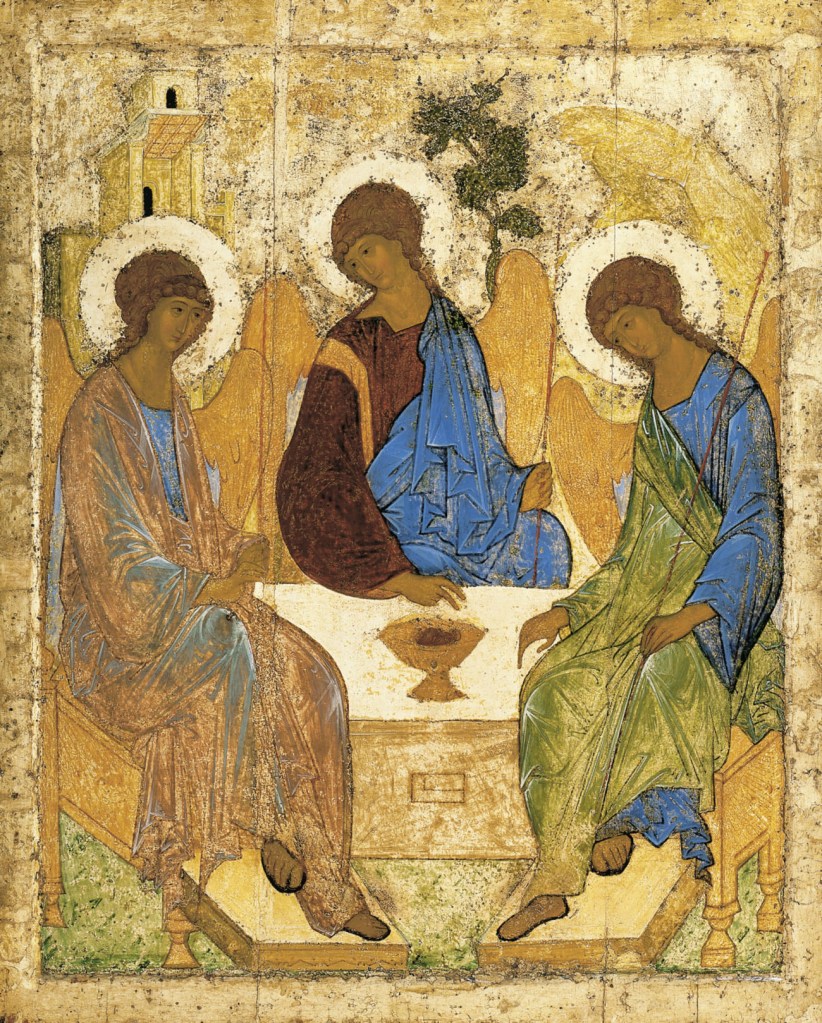
Rublev originally painted the icon to depict the story from Genesis 18. However, interpreters and worshippers have long interpreted the image as also depicting the Holy Trinity, as well as an invitation to the Communion Table.
There are entire books written about The Trinity, not to mention countless articles, papers and sermons. For a quick devotional-style primer from the perspective of relational theology, read this piece by Fr. Richard Rohr. He writes,
If we take the depiction of God in The Trinity seriously, we have to say, “In the beginning was the Relationship.” The gaze between the Three shows the deep respect between them as they all share from a common bowl.
Richard Rohr, “Take Your Place at the Table”, Center for Action and Contemplation
In relational theology, the Holy Trinity is depicted as, first and foremost, a relationship, self-giving and freely receiving, showing that God desires nothing more than non-coerced relationship with each of us. To contemplate Rublev’s Trinity is to contemplate our own place in relationship with God, offered (like the empty seat in the image) without condition or judgment, but simply because we are here.
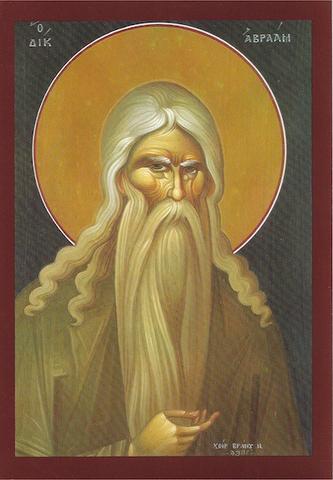 As a process theologian, I don’t see God that way. Rather, this story from Genesis illustrates my view of God much better. In this story, we see Abraham bargaining with God, reminding God of God’s promises of mercy and justice, and eventually even changing God’s mind.
 Justin DaMetz