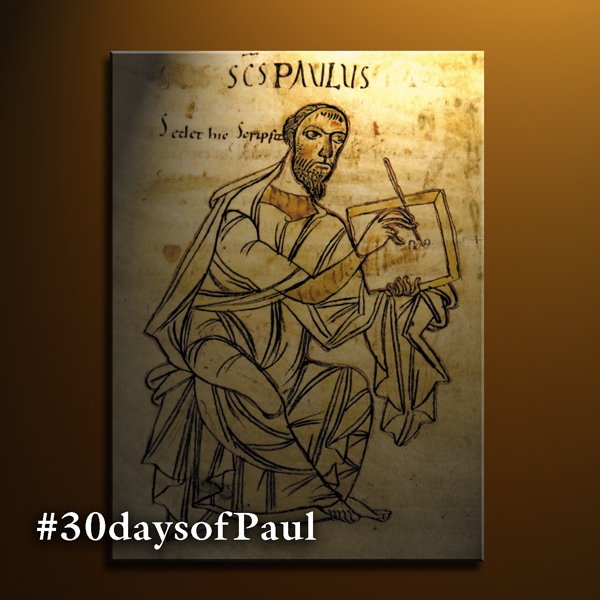
2 Corinthians 4-6:13; 7:2-4: Everything Has Become New! #30daysofPaul

I want to refocus. I want to get this #30daysofPaul series back on track. I’ve fallen behind, shirked my duties, lost focus. So let’s take a deep breath, center ourselves and realign.

When I started this, I said I wanted to read Paul with a focus on liberation theology. I’ve hit that bits and pieces throughout, but not in any consistent or meaningful meaner.

But this passage is the perfect one to jump back in on.

Why do we liberate?

What is the purpose of working towards liberation for all of humanity?

What is the utility of viewing the Gospel from the perspective of those who labor?

Those who are shackled?

Those who are oppressed?

Those held in bondage?

We liberate because our faith has made us free from the hold of sin, as embodied by the law. Because we find ourselves free from these spiritual bonds, we must also work to make ourselves free of all bonds that hold us back from living in relationship with God. We must break all the chains that hold us back from truly living into our imago dei.

And not just our chains. We must work to break all chains, for all people, especially those who cannot do for themselves.

The only way to do this work of liberation is to live into the existence of those who need liberation the most. We can only identify their bonds, and participate in their liberation, by becoming as they are, by seeing the world through their eyes. We must live to serve the other.

Only then can we open the shackles, and break their chains.

Here is 2 Corinthians, in the second part of his letter defending his ministry, Paul describes the life of faith, achieved through reconciliation with God. In 5:17, he says:

“So if anyone is in Christ, there is a new creation; everything old has passed away; see, everything has become new!”

Here, we can see the final step of liberation. The work towards freedom is the work of shedding our old selves, and becoming new, becoming whole and healthy and liberated and holy.

Why do we liberate?

Because we are compelled by our relationship with God to make all things new.

Paul warns that the fruits of our work for liberation may not always be apparent to the world. “We are treated as impostors, and yet are true; as unknown, and yet are well known; as dying, and see – we are alive; as punished, and yet not killed; as sorrowful, yet always rejoicing; as poor, yet making many rich; as having nothing, and yet possessing everything.”

The burdens we carry will be enough to crush us; nothing will be given easily. But it is the only way. Only by working to liberate, to make all things new, are we doing the will of God. This is what bringing the Kingdom of God looks like.

The Kingdom is a place where all are freed from the burdens they carry.

But the Kingdom doesn’t just come about on it’s own. Only by our hard work:

feeding

clothing

freeing

serving

dying to ourselves to become new again.

Only then will we see the Kingdom on Earth.

Next: 2 Corinthians 10-13

For a PDF of the 30 Days of Paul reading plan, click here.

2 Corinthians 2:14-3:18: Removing the Veil #30daysofPaul

We move on to 2 Corinthians now, and things are going to get jumbled. In case you didn’t notice, we aren’t starting “in the beginning” here.

Why? Because Paul’s second letter to the Corinthians isn’t just one letter. In fact, scholars now think it more probable that 2 Corinthians is a composite of four separate letters and parts of letters that Paul wrote in continued with correspondence with the church at Corinth.

In fact, the book we refer to as 1 Corinthians isn’t even Paul’s first correspondence with the church in Corinth; at best, it’s the second letter he wrote them, based on the cues in gives.

So, over the next 5 posts, we’ll be bouncing around the book of 2 Corinthians. The splits we are using are those explained in The Authentic Letters of Paul, from the Westar Institute, as laid out by our fearless leader, Cassandra Farrin, who explains more here.

Ok. 2 Corinthians 2:14-3:18. Let’s dig in.

So, in 1 Corinthians, Paul addressed some specific questions the church had posed to him, and provided some pastoral guidance around the idea of unity. Now, Paul is writing back to them here to defend his ministry and his status as an apostle.

Remember, all the way back in Galatians, when we talked about Paul’s tendency to get defensive very easily? This is one of the best examples of this character trait.

He writes about Moses, and how he brought the law, the first covenant, to the people of Israel. Moses was the original messenger of God, but as the law had shortcomings and was unable to fully justify the people of Israel, they could not be shown the full glory of God revealed through Moses.

Paul contrasts that to his own ministry, and the ministry of his fellow apostles, who bring the full glory of God to the people who have been justified to God by faith in Christ. Paul describes this in striking terms in 2:15-16, saying.

For we are the aroma of Christ to God among those who are being saved and among those who are perishing; to the one a fragrance death to death, to the other a fragrance of life from life.”

Paul is describing the Christians as a “light to the world,” as the shining example of God’s kingdom on earth. Much as Moses carried the light of God following his personal encounter with God at Sinai, all followers of Christ, all those who emulate his liberating example in the world through their faith, shine with God’s unquenchable light. Paul describes this beautifully in chapter 3. (I’m quoting from Eugene Peterson’s Message translation here):

“Whenever, though, the turn to face God as Moses did, God removes the veil and there they are-face to face! They suddenly recognize that God is a living, personal presence, not a piece of chiseled stone. And when God is personally present, a living Spirit, that old, constricting legislation is recognized as obsolete. We’re free of it! All of us! Nothing between us and God, our faces shining with the brightness of his face. And so we are transfigured much like the Messiah, our lives gradually becoming brighter and more beautiful as God enters our lives and we become like him.”

I love that. Throughout this passage, in the Message translation, Peterson describes the old covenant and the new covenant as the “Government of Death” and the “Government of the Living Spirit,” the “Government of Condemnation” and the “Government of Affirmation.” I think those perfectly reflect the image Paul was trying to convey through all his letters when talking about the Law and Faith.

So what is Paul trying to achieve with this writing? He is pushing back against claims that somehow his ministry is invalid, that he isn’t a legitimate apostle. Instead, he describes how everyone that follows Jesus is commissioned to spread the Gospel, and how he is carrying that out, the proof being the vitality of the church at Corinth. He is reminding them of their own commission, that they shouldn’t be cowed by those who try to hold them back.

Through the grace given by our faith, we are all made like Moses, with the light of God shining from our very faces. Don’t veil it, but let it illuminate all the world, driving out darkness to be replaced with the light of God reflected in each of us.

Next: 2 Corinthians 4-6:13; 7:2-4

For a PDF of the 30 Days of Paul reading plan, click here.

1 Corinthians 15-16: What Is the Resurrection? #30daysofPaul

I have a difficult relationship with the Resurrection.

I know that’s a strange statement to make, considering centrality of the Resurrection of Christ to the Christian faith. Ask any Christian you know, and they likely will tell you that the bodily resurrection of Christ is a non-negotiable tenant of the faith.
Let me be straight with you: I don’t believe in a bodily resurrection. I don’t believe Jesus rose physically from the grave on the third day after he died. In fact, I don’t even think he was buried in a tomb. I certainly don’t think his physical body appeared to Mary, or Peter, or the disciples, or the travelers on the road to Emmaus, or Paul.

I know this probably brands me as a heretic, or some such other outcast from the Christian faith. Just consider tonight’s passage from Paul: 1 Corinthians 15 is exclusively focused on the Resurrection, it’s centrality to the Christian faith, and the common bond it engenders among all believers. Paul uses the Resurrection to hammer home his point of Christian unity in this letter, saying: “If Christ has not been raised, your faith is futile.”

So that basically seems to seal the deal, right? Maybe I should be reconsidering my religious affiliation here.

But let me restate what I believe: I don’t believe in the bodily resurrection of Christ.

But is there a resurrection outside of the bodily type that exemplifies what the early church described when it spoke of a “Living Christ” and “Resurrected Lord?”

Not long after I began my ordination process with the UMC in Kansas, I met with my pastor at the time to discuss some of my questions and concerns in the process. I asked my pastor (a progressive leader of a Reconciling Ministries congregation) about my unorthodox theological beliefs, including this very subject. I told him I was concerned about taking the ordination vows of Methodist church, considering I didn’t necessarily believe the same thing as the church on Resurrection, among other things. I didn’t want to have to take vows while crossing my fingers. I want to be true to myself, my church, my faith and my future congregations.

My pastor told me something that has stuck with me ever since: “Everybody believes in the Resurrection; but that Resurrection takes different forms for different people.”

This seemingly obvious idea has stuck with me, and has allowed me to evolve theologically in an open and free way. It’s allowed me to get to the place I am on the Resurrection, which is being open and honest about my disbelief, and on the flip side, about what I in fact do believe.

So, if not a bodily resurrection, then what?

The movement Christ led seems extraordinary to us, two thousand years after the fact, considering it led to the formation of the largest, most influential religion in world history. But in first century Palestine, Messianic movements centered around a charismatic personality were fairly common and anodyne.

Yet, the Christian movement persisted, unlike to many other. Why is this? What made the Christian movement more special than any other?

Many Christians would, I think, answer that the answer is obvious: because the God-given message of Jesus is irresistible and divinely ordained. In this view, the spread of Christianity was inevitable. But I don’t think so. Yes, Jesus’ message was counter cultural, revolutionary and world changing in a way none of the others was. But after his death, something had to have perpetuated this message. Something carried that message for forty years, until it was written down by the author or Mark, beginning the synoptic traditions and the worldwide spread of written Christianity.

I contend that the thing that caused the Christian cause to live on, to not die out following the devastating and especially cruel death of it’s progenitor was a single person: Peter. I believe we Protestants overlook the outsize influence and role of Peter in the perpetuation of our faith.

Now, I know this is a series on Paul and the importance of writings, but let’s show some love to Peter. I’ve come to this appreciation of Peter very recently. Bishop John Shelby Spong’s book “Resurrection” helped me get there, and since finishing it recently, I’ve been giving a lot of thought to the Rock of the church.

Following Jesus’ death, it would have been very easy for the Christian movement to fold up, to disappear in a cloud of despair and grief. And maybe it did for a while. Maybe after the death of Jesus, the disciples scattered for a time, and things quieted down, and it seemed that the movement was good and dead.

But I think at some point soon after Jesus’ death, after the shock of his death have begun to fade, Peter decided to pick up the pieces, to carry on the life-changing message of Jesus. Through his force of personality and will, Peter reassembled those who followed Jesus, began the theological development of Christianity, and built a church community based in Jerusalem.

And at that point, Christianity distinguished itself from all the other Messianic movements, and took on the narrative of Resurrection. Jesus’ resurrection took the form of the continuance of the movement he started. Jesus’ resurrection was, and is, the success and life of the Church initiated in his name. Jesus’ resurrection is the message he preached being taught in all the world, and embraced by billions over the last two thousand years.

And who led this early movement? Peter. I think Peter almost singe-handedly willed the Christian movement into existence. I think Peter embodied the Resurrection of Jesus. I think Peter, by being the foundation of our faith, deserves to be recognized for the out sized influence he had on the Christian faith.

I don’t really know what this means for the message Paul is recounting here. Twenty years after the death of Jesus, the story of Resurrection has already become central to the Christian community spreading across the Mediterranean world. It’s easy to read this chapter in light of either of these views of Resurrection-the bodily variety, or the living church variety- and feel it validates your particular view. And that is probably why Resurrection has gone from an understanding of the extraordinary nature of the Jesus movement’s continuance, to meaning the literal, physical bodily Resurrection of Jesus.

I could write a book about the subject of Resurrection, and another one about what I think of Peter. Maybe I will one day. But for tonight, here is my takeaway from 1 Corinthians 15: the idea of Resurrection, of rebirth, of a return to life after the seeming inevitability of death, is indeed central to Christianity, no matter what form that Resurrection takes for different people. My pastor was right: everybody has their own view of Resurrection. And really, that’s perfectly fine. It’s the idea of rebirth that’s important in the end, not the literal truth of any one story.

Let’s embody that Resurrection by carrying forward a message of peace, of love, of forgiveness, of God’s authentic justice and desire for liberation of all people, as taught and lived by Jesus before his terrible death. Let’s not let the Good News be buried, but be reborn everyday in our actions, in our lives as Christians. Amen.

Next: 2 Corinthians 2:14-3:18

For a PDF of the 30 Days of Paul reading plan, click here.