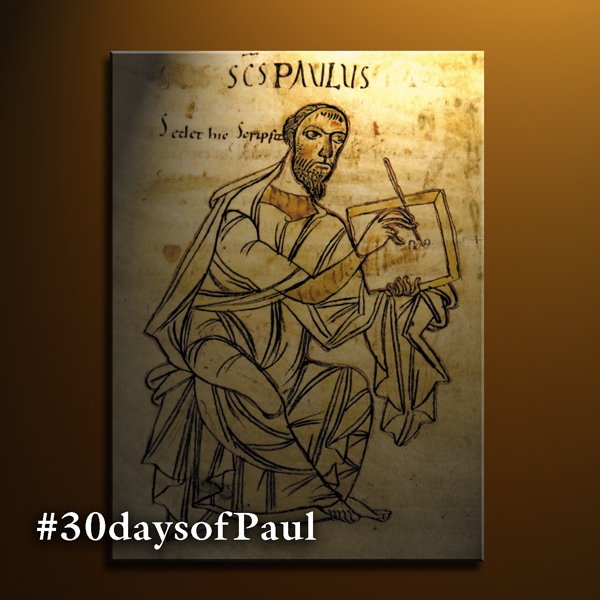
Philippians 2:19-3:1a, 4:4-9, 4:21-23: The Big Picture #30daysofPaul

I’ve almost been defeated. 

I’ve been plugging away over the last ten days or so at this #30daysofPaul reading challenge, writing about these little note-like missives from Paul. Sections of 2 Corinthians, the letter to Philemon, the Epistle to the Philippians: all these have been light on the theology, and heavy on  personal notes and minutiae and specific instructions and answers to questions.

There is only so much one person can say about this stuff.

And today was almost the day it got me.

I’ve been thinking and thinking on this passage since yesterday afternoon, and after 18 hours of fruitless reflection, I was ready move on to Romans.

And then I pulled out my handy, dandy Interpreters Bible set.

Thank goodness for fifty year-old scholarship.

So, let’s think about the big picture here.

Paul’s seven+ authentic epistles weren’t written in a vacuum. They did not spring forth fully formed, free of any context and or personality traits. Paul wrote these in a specific time, to a specific audience, with a specific purpose in mind. His writings have very little to do with guiding the faith of American Christians in the 21st century, and very much to do with addressing the needs of his congregations and friends.

I know, you’re saying “duh, we’ve already been over this.” But I think it’s important to point out again. We get into the weeds of these Epistles sometimes, and we lose sight of the purpose Paul was writing with. We start pulling out individual phrases and verses to back up an argument or make a point, and we lose sight of the big picture.

So Philippians: what was Paul’s purpose in writing this letter?

According to my Interpreters Bible, it is widely held that Paul was writing a letter of thanks in response to a large monetary gift from the church at Philippi, as referenced near the end of the letter. It seems the church raised a large sum of money, something that took a lot of work, to send to support Paul.

Now, we have seen elsewhere that Paul wasn’t much of one for accepting money for churches. It appears he made an exception for Philippi, at least in this case, perhaps because he saw how much work and pride they put into their fundraising. But there is still a note of embarrassment from Paul, a hint of the uncomfortable feeling he had in accepting money. This has been Paul’s consistent attitude throughout his ministry, and in fact, in previous letters, he had always had a point of pride in acknowledging his refusal of funds from the churches he supported.

(A quick side note here: I know that for the purposes of this #30daysofPaul study, Philippians has been split up, and 4:10-20 was actually the first thing we read from this letter. I don’t have a copy of The Authentic Letters of Paul, the book this study comes from, so I have no idea why this decision was made. I trust the authors and their reasonings in reconstructing the chronology of Paul’s letters, but I’m going to ask us to focus on the original composition of this letter, as handed down to us in the Bible. Maybe they got it wrong, and this is how the original letter flowed, or maybe an ancient compiler thought it would work better if that was the last bit included from Philippi: whatever the reason, for the purposes of my point, we are going to view the letter as an uninterrupted whole.)

Back to my point: this is supposedly a letter of thanks from Paul to his benefactors in Philippi. But go read the letter as a whole, or at least skim the headers. I’ll wait while you do.

We don’t see much reference to that gift, do we?

In fact, it’s not really mentioned until the end, in chapter 4. The rest of the letter is a status report on Paul’s situation, and exhortations to live humbly and be a light to the world, and some information about Timothy and Epaphroditus.

If this is a letter of thanks for a gift,

it’s kind of an odd one.

I think this emphasis is deliberate. Something we can discern about Paul is that he took the words of Jesus on money and wealth very seriously. Paul agreed that money is the “root of all evil,” and I think he always wanted churches to keep the focus off finances and on serving one another. If he asked them to send money to another church, or to support the leaders in Jerusalem, it was about spreading and nurturing the Christian faith.

Paul is shifting the emphasis of his church at Philippi with his letter. They have sent him a large sum of money, and while they probably wouldn’t come out and say they expect it, they surely believed that Paul would write a gushing thank you letter, talking about how generous they are.

But Paul doesn’t want them becoming about the money; he doesn’t want them to make their fundraising prowess their chief gift to the world. Instead, he moves the focus to the things that are important for the church.

Thinking of others, especially those in distress.

Living with the humility that Christ showed.

Becoming a light to the world.

Keeping their eyes on the cross.

In 4:8 he makes this point most explicitly,

“Finally, beloved,

whatever is true,

whatever is honorable,

whatever is just,

whatever is pure,

whatever is pleasing,

whatever is commendable,

if there is any excellence and if there is anything worthy of praise,

think about these things.”


That’s what Paul wants their focus to be.

Live in the example of Christ.

Be humble.

Love justice.

Find purity.

Serve, and be served.

Be generous, not for the praise it engenders, but because it brings the Kingdom a little

bit

closer

everytime.

Don’t lose sight of the big picture.


Paul had a purpose in writing to Philippians. But I don’t think it was the purpose they expected.

Next: Philippians 3:1b-4:3

For a PDF of the 30 Days of Paul reading plan, click here.

Philippians 1-2:18: Paul’s Unquenchable Joy #30daysofPaul

If there is one thing I think we can understand about Paul, it is the fact that he had a perpetually sunny outlook. Despite numerous imprisonments, shipwrecks, trials, betrayals and tests, Paul consistently exudes a spirit of joy in his writings.

That spirit is abundant in Philippians. Five times in this short letter he uses the word “joy,” and eleven times he says “Rejoice” and “be glad.” His tone overall is one of rejoicing and positivity towards the church at Philippi, despite the fact that he was in prison at the time of his writing.

This section of Paul’s letter is basically one of continued praise and thanks and joy for the Philippians. He exhorts them to “live in humility”, and “be a light to the world”, but the Paul we see here is a happy, positive Paul we haven’t seen since probably 1 Corinthians.

Paul seems most joyous here because of the spread of the Christian faith that he has seen. In 1:15-18, he recounts how this spread has been both from sincerity and from those who are insincere, but it is a spread nonetheless in his eyes, and he is almost ecstatic to see that. It seems to ease the ache of being imprisoned, and he displays an indifference to his ultimate fate, an attitude that would be impossible for Paul if he felt there was still substantial amounts of work for him to do. Instead, he seems content with the growth of the church, and assured of it’s continuance.

It’s easy to imagine the pre-Christian Saul as a dour kind of person, considering his mission in life. But the apostle Paul is a man continually filled with the joy of God, embodying a spirit of love and compassion consistent with his assurance in the Message he was spreading. I think the common perception of Paul in the popular mind is a dry, academic, boring personality. But through out this study of his works, I have found an engaging, relatable, intensely human Paul, a man who is happy and driven and sometimes defensive or a braggart, but always compassionate.

Paul suffered persecution and hardship many of us can never imagine, yet never wavered in his positive outlook or caring attitude towards his churches. His is an example to emulate in our comfortable Christian lives in 2015 America. A persecution complex is an unseemly thing to carry about, considering the place of the Christian as that of the dominant cultural, social and political mindset in the modern world. Instead, we should be joyous, humble and compassionate at all times. We have no excuse to live otherwise.

I want to end by highlighting one section, verses 6-11 from chapter 2. This section is likely an early Christian hymn, and Paul recites it in full in the section about humility. This is another wonderful window into the early church, one we are lucky to have. I want to quote it in full here; as you read, just think about the fact that the earliest Christians, those who lived two thousand years ago, those who got direct personal guidance from the apostle Paul, also read and sang these very words of worship. It’s an exercise in the ultimate form of Christian communion, a chance to be in community with those who pioneered our faith.

who, though he was in the form of God,

did not regard equality with God

as something to be exploited,

but emptied himself,

taking the form of a slave,

being born in human likeness.

And being found in human form,

he humbled himself

and became obedient to the point of death—

even death on a cross.

Therefore God also highly exalted him

and gave him the name

that is above every name,

so that at the name of Jesus

every knee should bend,

in heaven and on earth and under the earth,

and every tongue should confess

that Jesus Christ is Lord,

to the glory of God the Father.

Next: Philippians 2:19-3:1a, 4:4-9, 4:21-23

For a PDF of the 30 Days of Paul reading plan, click here.

Philippians 4:10-20: The Interconnected Church #30daysofPaul

We are on to a new letter here, the last one before Paul’s surviving “magnum opus”, the Epitstle to the Romans. Writing to the church at Philippi from prison, we hear Paul tonight writing in thanks to one of the few churches he accepts financial support from.

It’s widely shared that Paul comes from a family of tent-makers, and that he was also part of the Jewish religious authorities, so the assumption is often made that he was probably wealthy at best, or well-off at worst. But we forget that for at least the last twenty years of his life, Paul worked full time traveling to plant and support churches.

Needless to say, that is not a highly profitable field.

So, Paul was surely dependent upon the generosity of others to sustain himself and his fellow workers (such as Titus and Barnabas and Timothy) and his ministry. He makes a point in some letters to acknowledge that he has never accepted compensation from them (specifically in 2 Corinthians, where he makes a point in his polemic to highlight this fact.)

Paul wants to highlight here that he certainly doesn’t expect or require the Philippians to support him, but that he greatly appreciates it. He also points out that they were one of the first and only to do so.

We get a good picture into the interconnected, generous nature of the early church. Early traveling apostles could not exist without support from the congregations they planted and nurtured. Additionally, as we saw in 2 Corinthians as well, it was crucial that the better-endowed churches supported the less fortunate churches to assure their continued survival, and thus the continued spread of the Gospel.

It’s still true today: all the established churches are a web, interconnected and interdependent, as are all of us. We cannot survive without the touch and support of others, whether we find agreement with them on most things or not. All people, and all churches, are interrelated and propped up on all sides by one another. It is the only way to be, and the only way to continue to be. As much as some of us may try to pull away, may try to assert their individuality, their independence and ability to exist on their own, in the end, we are all drawn together, inevitably and assuredly.

In community we find support and strength and love.

Next: Philippians 1-2:18

For a PDF of the 30 Days of Paul reading plan, click here.