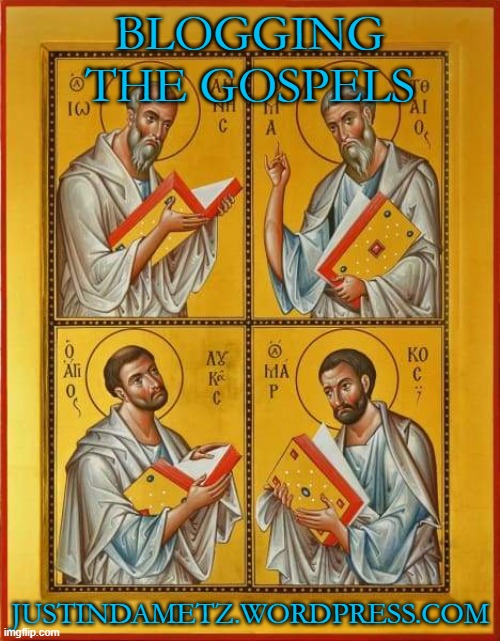
Blogging the Gospels: Introduction

I write about a lot of things on this blog. Theology, politics, culture, books, policy, religion, America. As intended, this blog definitely functions as a reflection of my own interests and obsessions.

But one thing I don’t spend much time on here that I enjoy and that I think I should is reading and commenting on Scripture. I love reading Scripture, and finding new meanings and interpretations and understandings and nuances. I don’t write about that nearly enough here. I’ve played with the idea of doing a Daily Office series, but committing to writing on a daily basis is not realistic for me.

However, I think I have found something I can do, that I know I will enjoy, and that would hopefully spark some good conversation: reading the Gospels. I want to do it along the lines of the Paul series I did five years ago, reading through the texts in their entirety, and finding something to say about each.

The question arises: why the Gospels? I believe Scripture is the leading teaching tool in our faith, and within Scripture, the Gospels are the center from which we read and interpret the rest of our faith. The story of Christ is the story we are baptized into, and Christ should be where we look first when trying to understand how to be a Christian, or more accurately, how to be a disciple of Christ. Thus, doing a close reading of the Gospel stories is an important task for any Christian. I love the example my home denomination, the Episcopal Church, sets in this respect: the Gospel reading is one of the central moments of Worship, where all stop and stand and turn their faces towards what they are hearing. I hope this endeavor plays a similar role for me, and for you as well, as together we take a moment to stop and remember the story of Christ.

So, starting soon, I will be reading the Four Gospels in order – Matthew, Mark, Luke, and John – and providing commentary on each passage. Some days, I’ll probably focus on just a couple verses. And other days, I may tackle a whole chapter at once. I’ll never settle on a single method of commentary: some days it may be historical critical, the next devotional style, and the next applying it as cultural commentary. Sometimes, I may even spend multiple days on a single verse, looking at it more than one way. I’ll go wherever the Spirit leads, as they say. I’m also not promising to write everyday. Some weeks, I may post three or four time; other weeks, not at all.

You’ll be able to find this series through the tag #BloggingtheGospels. I’ll be sure each time to indicate which verses will be coming next, so you can read along if you like. Let’s read!

Pro-Life Evangelicals for Biden

A group of pro-life evangelicals has issued a statement this week, and is soliciting signatures to add to it, titled “Pro-Life Evangelicals for Biden.” Headed up by evangelical leaders Richard Mouw, John Perkins, and Ron Sider, and including among the signatories former Trump voters and members of the late Rev. Billy Graham’s family, the group has issued a strong, Biblically-based called for pro-life voters to think more holistically and critically about their voting habits and choices this November. Here is the statement in full:

As pro-life evangelicals, we disagree with Vice President Biden and the Democratic platform on the issue of abortion. But we believe that a biblically shaped commitment to the sanctity of human life compels us to a consistent ethic of life that affirms the sanctity of human life from beginning to end.

Many things that good political decisions could change destroy persons created in the image of God and violate the sanctity of human life. Poverty kills millions every year. So does lack of healthcare and smoking. Racism kills. Unless we quickly make major changes, devastating climate change will kill tens of millions. Poverty, lack of accessible health care services, smoking, racism and climate change are all pro-life issues. As the National Association of Evangelicals’ official public policy document (FOR THE HEALTH OF THE NATION) insists, “Faithful evangelical civic engagement and witness must champion a biblically balanced agenda.“  Therefore we oppose “one issue” political thinking because it lacks biblical balance.

Knowing that the most common reason women give for abortion is the financial difficulty of another child, we appreciate a number of Democratic proposals that would significantly alleviate that financial burden: accessible health services for all citizens, affordable childcare, a minimum wage that lifts workers out of poverty.

For these reasons, we believe that on balance, Joe Biden’s policies are more consistent with the biblically shaped ethic of life than those of Donald Trump. Therefore, even as we continue to urge different policies on abortion, we urge evangelicals to elect Joe Biden as president.”

In an op-ed at the Christian Post introducing the group, Sider and Mouw explain the driving forces behind the group, and expand upon the ideas in the statement. In particular, they dig into the idea of a consistent pro-life ethic, and what it means for other areas of political engagement beyond abortion:

The statement points out that many problems that better politics could correct violate the sanctity of human life. Poverty, lack of health care, racism and climate change all kill persons created in the image of God. They are all pro-life issues.

Poverty and diseases we know how to prevent kill millions every year. The World Food Program estimates that by the end of 2020, 265 million people around the world could be pushed to the brink of starvation. PEPFAR (President George W. Bush’s President’s Emergency Plan for Aids Relief) has saved the lives of 17 million people around the world. But in repeated budget proposals, Donald Trump has proposed cutting this effective program. Other effective US funded foreign aid programs have saved the lives of millions.  But Donald Trump has also repeatedly tried to cut that help for starving people. Poverty is a pro-life issue.

Lack of health care kills people. Studies have shown that people without health insurance are less likely to visit a doctor, are more likely to have poor health, and die younger than persons with health insurance. The Affordable Care Act provided health insurance to an additional 20 million Americans – and prohibited insurance companies from refusing to cover persons with pre-existing conditions. Donald Trump has repeatedly tried to abolish the Affordable Care Act and has not offered any genuine  alternative. Health care for all is a pro-life issue.

Racism kills. We know that racism killed African-Americans in slavery and then later in thousands of lynchings. But even today, African-Americans are several times more likely than white Americans to be killed by the police. And the death rate for African-Americans because of COVID-19 is 3.6 times that of white Americans. Tragically Donald Trump refuses to condemn racist groups and continues to stoke racism rather than uniting the country to struggle against racism.  Racism is a pro-life issue – and it is on the ballot in 2020 in an unusually significant way.

Climate change already kills untold thousands and will soon kill tens of millions unless we change. The overwhelming scientific consensus is that unless we quickly reduce the amount of greenhouse gases causing global warming that we send into the atmosphere, many millions will die. The poor will suffer the most. But Donald Trump denies the near scientific consensus on climate change and has made numerous policy decisions that make things much worse. Climate change is a pro-life issue.

I am not an pro-life evangelical, and so I cannot affix my signature to this statement. That said, as a fellow Christian who thinks hard about the consequences of my faith on my political engagement, I heartily endorse everything these leaders have written. The issue of abortion is one that vexes me, as I believe the single-minded focus so many Christians have on it when it comes to politics ends up damaging the Gospel witness by reducing it and stripping away everything that makes the message of Christ so unique and powerful in the world. When we let the Gospel become held hostage to one issue – no matter the issue – then the Gospel becomes secondary to that issue.

Christian political engagement requires difficult decisions, a robust process of discernment, and a holistic view of the message of Christ and the historic example of the Church and its members in their engagement with the world. The evangelicals who have issued this statement have embodied that tradition well, using their faith to inform their whole selves, and applying that ethic consistently to the issues we face as a nation.

Neither political candidate is a “Christian” candidate. This means, in making a choice, voters must consider all the facets of their vote, and the consequences of that vote for a whole host of issues and people. It cannot simply be a rubber stamp for specific interest groups, political parties, or individual personalities. Kudos to this self-described group of pro-life evangelicals for engaging this debate seriously and thoughtfully. May we all do so.

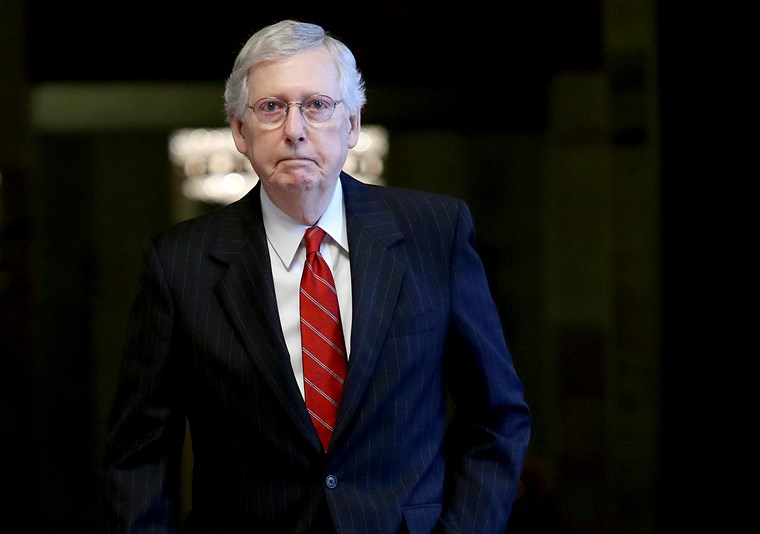
Mitch McConnell is a Political Terrorist

Mitch McConnell is a political terrorist.

The FBI has this to say about the definition of the term terrorist:

There is no single, universally accepted, definition of terrorism. Terrorism is defined in the Code of Federal Regulations as “the unlawful use of force and violence against persons or property to intimidate or coerce a government, the civilian population, or any segment thereof, in furtherance of political or social objectives.”

What we have seen Senator McConnell do in the United States Senate over the last decade and a half is nothing short of the “use of force to coerce a government in furtherance of political or social objective.” Ever since his declaration on the eve of the inauguration of Barack Obama that his primary political goal was to make Obama a one-term president, McConnell has used his power as the leader of the Republican Senate caucus to twist and subvert democratic governance and to tear apart any of the norms need to sustain such a government.

McConnell’s particular brand of terrorism isn’t the use of violence to subvert and undermine governments. My use of the term isn’t to say McConnell has joined some fringe group using physical violence to achieve their ends. Rather, I use the term “terrorist” to indicate that, like the commonly understood subjects of the epithet, McConnell places ideology and a thirst for power above the good of civilian populations or electoral majorities, and is willing to tear down any structure, institution or society in order to achieve his ends. His is a pure consequentialist, in that the ultimate goal of seizing and maintaining power for himself and his capitalist allies supersedes any question of tactics. No tradition or institution is too important to dismantle in his single minded pursuit.

His latest push to complete a Supreme Court nomination mere weeks before an election in which his party is increasingly projected to lose across the board – against his own former declarations of what is and is not permissible in an election year – is just the latest example of the terrorism he perpetuates. For decades, the process of selecting and confirming a Supreme Court nomination has been a slow and deliberate one, purposely so, in order that the United States Senate has the full amount of time and attention needed to carry out their Constitutional duty in such a way that they are able to assure the public that whoever assumes the lifetime appointment to the most powerful judicial body in the world is indeed fully capable, qualified and vetted. At the same time, the right of the sitting president to nominate and have their candidate voted on by the Senate was never challenged, no matter what other events were happening in the nation at the time.

These norms are essential to our Constitutional democracy. The Supreme Court wields enormous power over judicial proceedings and legal theory in our nation. As an unelected body, it is the most undemocratic of our major governing institutions. Thus, the role of the President in nominating, and the Senate in conducting a confirmation in good faith, is crucial to maintaining trust in the Court and ensuring that the decisions it hands down are respected and followed. Without an above-board process, the legitimacy of the Court breaks down, along with that of the rest of the federal judiciary, which leads to a undermining of the idea of rule of law, something crucial to our democratic society.

McConnell has shown, over the course of the last five years, that preserving the rule of law, maintaining trust in the nomination process, and carrying out the duties of the Senate in the interests of maintaining our form of government are not priorities to him and his caucus. It is clear from his actions that he would rather burn it all down, as long as the benefits of that burning trickle upwards to him and his allies.

This burning began early in 2016, when Supreme Court justice Antonin Scalia died in February, a full 9 months before the presidential election, and almost an entire year before the next president would take office. As has been the case since the founding of our country, President Obama nominated qualified jurist and sent that nomination to the Senate. McConnell at this point made the decision that he had no duty to follow the Constitution and bring the President’s nominee before the Senate for consideration, on the weak and baldly political grounds that it was “too close” to an election, that “the American people should decide who selects the next nominee to the Court.” McConnell was able to maintain this blockade for over a year, destroying norms the whole while and allowing President Trump to begin his presidential term (achieved without winning an electoral majority) with a lifetime appointment to the Court. This was shocking at the time, a clear attack on the democratic character of the United States government.

All the while, McConnell and his allies made pious claims about preserving democracy and the rights of the people, about how allowing a “lame duck” President to influence the Court was an affront to the Constitution, about how a President should never make an appointment in an election year.

This year, the narrative coming from McConnell has flipped dramatically. Following the death of Ruth Bader Ginsberg just 6 short weeks before an election, now the rhetoric coming from the Majority Leader is that a President has an absolute right to fill a Supreme Court seat, and that the Senate should confirm that nominee quickly and with little oversight provided, in order to get it in before the election.

The hypocrisy is breathtaking, but not unexpected. McConnell and his Republican allies long ago made it clear that none of this was ever about principle; rather, power is at the heart of their calculations. Whatever seizes the most power is the right play, ideals be damned. Again, no principle, institution or tradition is too valuable to smash in this immoral pursuit. The democratic will must never be heeded.

This unyielding pursuit of power and destruction of the Constitutional norms American governance was supposed to be built upon is political terrorism. The idea behind McConnell’s moves are not driven by the desire to govern widely or compassionately. Instead, every move is motivated by the ideology of power. Every obstacle must be destroyed. Every check must be broken. Every appeal to higher principles must be ignored at best, and more often than not, mocked as unrealistic or weak. This is not a partisan issue; this disregard for our basic norms of governance damages all of us, as it makes government even less accountable to those it is supposed to represent and serve. Through his actions, McConnell continues to actively work to make government work only for those with power, money, and elite status. Through weakening democratic institutions, he serves to make our Constitutional form of government much more of a oligarchy than a democracy.

Mitch McConnell is a political terrorist. His trampling of a whole host of democratic norms over the last decade and a half will have a terrible impact far beyond the expiration of his time in power. Things have been broken that can never be fixed. The traditions he has subverted or undone will not return after he and Donald Trump leave office. I fear for the future of our democratic experiment, because I do not believe there is a lot of optimistic signs about its future. And when the story is written about its downfall, Mitch McConnell’s blatant willingness to shred it all in pursuit of power will be the central story. Trump may be the loud and shocking voice at the center of this terrible moment in our national story; but his is an aimless, blundering destruction, one that while terrible, could be papered over after his ouster from office, written off as an aberration, a temporary insanity on the part of American democracy. But the legacy of McConnell’s terrorism will live on much, much longer.

Like what you read here? Then go subscribe to my free email newsletter today.