Matthew 1:1-17: Genealogy of Christ #BloggingtheGospels

I’m blogging my way through all four Gospels, in the order they appear in Scripture. Click here to read my introduction to this project.
An account of the genealogy[a] of Jesus the Messiah,[b] the son of David, the son of Abraham.

Abraham was the father of Isaac, and Isaac the father of Jacob, and Jacob the father of Judah and his brothers, and Judah the father of Perez and Zerah by Tamar, and Perez the father of Hezron, and Hezron the father of Aram, and Aram the father of Aminadab, and Aminadab the father of Nahshon, and Nahshon the father of Salmon, and Salmon the father of Boaz by Rahab, and Boaz the father of Obed by Ruth, and Obed the father of Jesse, and Jesse the father of King David.

And David was the father of Solomon by the wife of Uriah, and Solomon the father of Rehoboam, and Rehoboam the father of Abijah, and Abijah the father of Asaph,[c] and Asaph[d] the father of Jehoshaphat, and Jehoshaphat the father of Joram, and Joram the father of Uzziah, and Uzziah the father of Jotham, and Jotham the father of Ahaz, and Ahaz the father of Hezekiah, 10 and Hezekiah the father of Manasseh, and Manasseh the father of Amos,[e] and Amos[f] the father of Josiah, 11 and Josiah the father of Jechoniah and his brothers, at the time of the deportation to Babylon.

12 And after the deportation to Babylon: Jechoniah was the father of Salathiel, and Salathiel the father of Zerubbabel, 13 and Zerubbabel the father of Abiud, and Abiud the father of Eliakim, and Eliakim the father of Azor, 14 and Azor the father of Zadok, and Zadok the father of Achim, and Achim the father of Eliud, 15 and Eliud the father of Eleazar, and Eleazar the father of Matthan, and Matthan the father of Jacob, 16 and Jacob the father of Joseph the husband of Mary, of whom Jesus was born, who is called the Messiah.[g]

17 So all the generations from Abraham to David are fourteen generations; and from David to the deportation to Babylon, fourteen generations; and from the deportation to Babylon to the Messiah,[h] fourteen generations.

New Revised Standard Version

The Gospels begin with the story of a people, told in the form of names, divided into three groups of fourteen names each. The three groups are all distinctive their own ways. The first, from Abraham to David, is the classic story of the Jewish people, and is notable for including women who are prostitutes and foreigners. The second group is made up of kings of Israel. In order to get to fourteen generations, the author leaves out four kings we know of from the books of Chronicles, and a queen as well. The final group is mostly unknown people, common names from this era, marking the time from the exile to the birth of Christ as a time of anonymity and far from the centers of power. This is no dry history; it is not a literal genealogical record we are reading here. Matthew 1 is not Ancestry.com.

Matthew has manipulated and reshaped the story of the Jews, leaving out names, changing others, moving folks around, in order to get us to these three groups of fourteen generations each. Three is obviously an important number to Christians, invoking the Trinity. Fourteen is as well. Besides being the first multiple of seven (a holy number in Judaism), it is also the number you get when you add the numerical values assigned to the letters that make up the name “David” (Jesus’ most illustrious and kingly ancestor.) David in Hebrew is three letters: dalet, vav, and dalet. Dalet – ד‎ – is also a stand in for the number four, while vav – ו – is 6. Add those up, and you get 14. Matthew is intentional choice of three groupings of fourteen generations. He is telling a story, of three eras, each of which point to the Messiah, the Son of David. He is willing to exclude names, and include otherwise unsavory characters, in order to get there.

All in all, the genealogy of Christ offered by Matthew is, as the footnotes in The Jewish Annotated New Testament point out, “unusual in citing women, non-Jews, and morally questionable characters” in the recounting the pedigree of the Messiah. This may seem a rather innocuous observation, but it is important to stop here and recognize that it is anything but. In ancient literature, genealogies are a tool of establishing importance via a link to a glorious past, through the image of heroes and exemplars of virtue. But the Jewish tradition that culminates here in Christ rejects that kind of mythologizing. Instead, the genealogy of the Messiah is made up of those who are rejected from society – sinners, women, immigrants, the unclean, the morally suspect. It’s not a very good way to make the case for a powerful, conquering king. But it’s a really good way to be introduced to Jesus Christ.

Christ made a career out of accepting and loving those who were otherwise unacceptable and unlovable to polite society. The story this genealogy prefaces is one where the outcast, the oppressed, the forgotten, the poor and the weak are placed before the powerful, the rich, the strong. It is a story where those who the religious establishment of the day would have regarded as unworthy of glory are given the keys to the Kingdom, are called on to lead the Church that rises up in Christ’s memory. By including such unorthodox names in Christ’s pedigree, Matthew is laying the groundwork for a Messiah who isn’t coming to confirm everyone in their comfortable, exclusionary way of being; instead, we are to understand right off the back that this story is one of inclusion and acceptance for all. If Christ can descend from the line of Tamar, of Ruth, of Bathsheba, then the Body of Christ can welcome immigrants and homeless people and trans folks with open arms.

The manipulation and twisting of the members of Christ’s genealogy in order to get it to fit into the three groups of fourteen is important as well for how we approach Jesus’ story. The story of Christ is one that always makes room for us to see God in Christ. It’s a reminder: this is God’s world, and we are living in it. God can make God’s self known in the way God needs to, even if it upends the rules and orders we are comfortable or familiar with. In fact, God at times seems to relish upending things in order to bring about the Kingdom, just like Matthew didn’t see a problem fudging the names and the numbers a little to invoke King David.

One last note I want to make about this genealogy: it is also a specifically Jewish story Jesus is taking part in. That’s important to remember, even as we emphasize the universality of God’s Kingdom. Jesus was a Jew. The Gospel of Matthew was a story written to remind readers of Jesus’ Jewishness. That will be an important note to keep in mind as we dig further into this Gospel.
Matthew 1:1: The Beginning

I’m blogging my way through all four Gospels, in the order they appear in Scripture. Click here to read my introduction to this project.

1An account of the genealogy[a] of Jesus the Messiah,[b] the son of David, the son of Abraham.

New Revised Standard Version

The Four Gospels, as they are ordered in the Christian New Testament, start where any good story does: with the beginning.

This may seem like an obvious statement. Of course it begins at the beginning; that’s literally how things work. On second glance, it may also seem ridiculous. What kind of beginning, at least in the sense of how we understand the beginnings of stories, is this one, which seems more suited to be a section heading.

But, when I point at Matthew 1:1 and say, this is the beginning, what I mean is, this is The Beginning. You know what I mean, right? Not, the beginning, but, The Beginning.

Yeah, exactly.

And that’s a weighty statement! One full of religious hubris, even, and one that can make any good Christian living in our religiously pluralistic world uncomfortable. To say that Jesus the Messiah, the son of David, the son of Abraham, is The Beginning, is to make a claim on history, even the parts of history held to be outside the scope of the Christian tradition.

But, that kind of weighty, uncomfortable, overreaching statement is exactly the one that the Gospel is trying to make. Matthew doesn’t begin with a scene-setting image of Nazareth or Bethlehem, or with Joseph and Mary, or even with “Once upon a time….”. Instead, Matthew kicks things off by making a declaration, that this is the story of Jesus, who is Messiah, the Anointed One of the God of Israel, the rightful inheritor of the throne in Jerusalem, descended from the first and most beloved of Kings, David, and from the progenitor of the Jews and the first carrier of God’s covenantal promise, Abraham. Jesus inherits the cultural, social, and religious burdens of these two men in this statement, taking into himself in these first seventeen words the entire weight of the people of God, and as a result, the weight of God’s own plan for humanity and the universe. Jesus enters into Israel’s story, which is God’s story, which is humanity’s story. Thus, by being the starting point of the Gospel story, Jesus becomes The Beginning for our story. It is no longer a dry header or precursor to the real narrative, but instead, is a statement that does in seventeen simple, declarative words the same thing the writer of the Gospel of John spends 18 long and poetic verses doing.

In an essay on Reinhold Niebuhr, Stanley Hauerwas writes:

For Christians history is not a realm of human endeavor or progress. Rather, it is a realm where sin and death reign and thus it is in need of redemption. The eschatological character of Christian conviction challenges any assumption that history can be construed as a continuous, or even progressive, process. Jesus is not a world-historical link in the chain of historical happenings, but the unique redeemer.

Stanley Hauerwas, “History as Fate: How Justification by Faith Became Anthropology (and History) in America” in Wilderness Wanderings: Westview Press, Boulder, Colorado (1997), 33.

Reading this in 2020, as a Protestant Christian in the cultural West, is uncomfortable. It’s borderline heretical, according to the dogmas and truisms of modern culture. Nevertheless, it is the Truth, one that transcends history, one that makes an unshakeable claim on the world and on all people in all places and all times. Jesus is not just another story in history, like Caesar or the Plague or the Peloponnesian War. Rather, Jesus is the start of a new age, the point on which all of human history turns. Jesus is The Beginning of The Story, not all the way back at some mythical starting point, but in all moments and all instances, inside and outside of time.

So, when the writer of Matthew begins by saying that this is the account of “Jesus the Messiah, the son of David, the son of Abraham”, they are saying “This is The Beginning of all that is and all that was and all that will be; that is, this is the story of Jesus the Christ. Amen.”

The Moral Debt of 284,000 Deaths

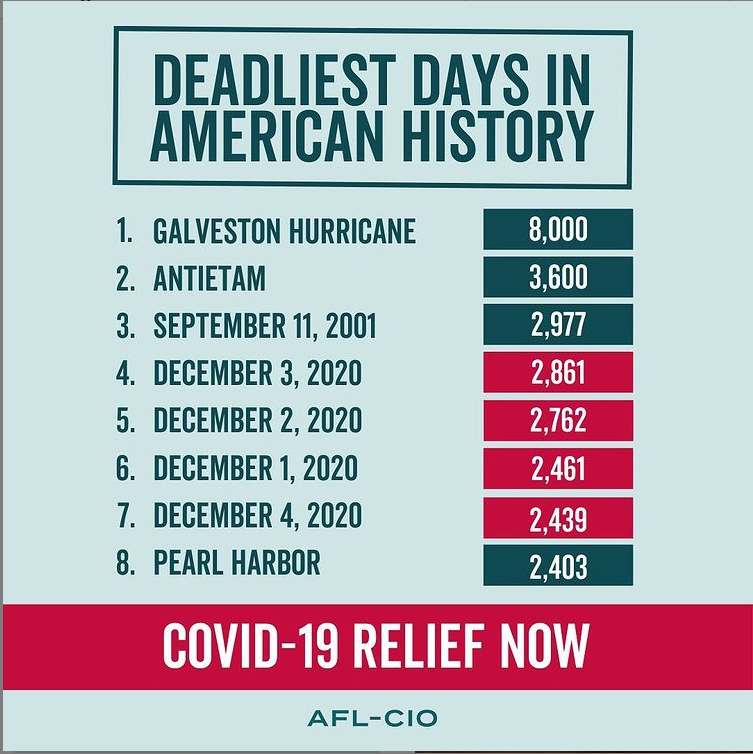
As of this morning, according to data compiled by the Washington Post, the Covid-19 death toll in the United States stands at 284,005 deaths. Overall, there have been about 15 million documented cases of Covid-19 in the US. Both of these numbers, as shockingly high as they are, probably undersell the actual impact, considering the sorry state of testing, contact tracing, and medical reporting in large swathes of the country.

On Wednesday of last week, the single day death total was 2,861 deaths. For some context, 2,977 people died in the September 11th terrorist attacks. 2,403 people died during the attack on Pearl Harbor.

In total, 620,000 soldiers died during the US Civil War, the bloodiest conflict American forces have been involved with. We are a third of the way to that total in less than one year. The Civil War lasted almost five.

These numbers should be shocking and grief-inducing. We should look at the news that 284,005 Americans have died over the last year from a pandemic, and feel….something. The fact that many of us don’t – myself included – is a really sad commentary on how numb we have become as a nation to those things that are outside of what we would have considered normal or acceptable in the past. Our civic conversations have degraded to a point where millions of Americans have suffered from a terrible disease, and hundreds of thousands of them have been killed, and we can’t hardly muster up a collective tear. Half of us have become inured to the insanity of the world. The other half refuse to acknowledge reality or believe anything anyone tells them.

None of this is a natural occurrence, or a regular progression of rational events. The abnormality of our present moment and our collective obsessions is astounding, if you take a moment to step back and look at it. And, the worst part is, it did not have to happen. The fact that we are at this point is the result of choices and actions taken by people. We have to acknowledge that, and respond to it, if we are going to begin any kind of healing process.

Most importantly, these 284,005 deaths weren’t natural and inevitable. They did not have to happen. Someone bears the blame, and not just the blame, but the moral debt incurred by hundreds of thousands of unnecessary deaths. And that someone is anyone in a leadership role or position of responsibility who downplayed, dismissed or in any other way disregarded the very real threat of Covid-19, and the advice and direction of public health experts who told them what we needed to do as a society to weather this storm.

This goes against much of the conversation around who bears the blame for the Covid situation in the United States. Even from the most dedicated critic on the left, the narrative is often construed as one where our political leaders should only be held responsible for maybe half of Covid deaths; the rest are considered inevitable ones that would have happened even with a more responsible and effective leader. And, at one level, this is probably correct. No matter who was leading our nation over the course of the last year – Donald Trump or Hillary Clinton, Mitt Romney or Barack Obama, Joe Biden or George W. Bush – many people would likely have contracted Covid-19 and died. Such is the nature of highly infectious disease.

Nevertheless, I still contend that the total blame here, and the accompanying moral debt that follows the unforeseen deaths of so many people, should be shouldered by our nation’s leaders. The actions and words of these people matter for how we account for these situations. And, from the beginning, President Trump and his most ardent defenders – in the federal government, in Congress, in media, and in various states – have downplayed the crisis, deflected their responsibility, and denigrated those who have worked, suffered, and died. Their failure to do the right thing – the things that experts and health officials and other politicians and even millions of regular, rational people were calling for them to do – means that they must carry the full weight of guilt for those 284,005 deaths. Not only did they cause thousands of unnecessary deaths and untold suffering through their poor policy choices and irresponsible rhetoric, but they also dishonor the deaths of even those who would died anyways. In short, these people bear the weight of all these deaths through dint of simply not trying to mitigate or respond to them in a rational way.

The Covid pandemic in America is a true travesty, and in a more sane world – in a fairer version of history – those who are responsible would go down with the reputation they deserve: that of some of the most morally reprehensible people who ever lived, people who turned a blind eye to massive and largely preventable human suffering, all for short term political gain, and who as a result are remembered primarily for justifying and facilitating hundreds of thousands of deaths. They would be remembered as the cowards they are, scared to stand up to widespread ignorance and fear and push back by presenting a fact-based discourse in the interest of helping people, even if it meant they got dragged on Twitter or bashed on Fox News in the near term.

There are countless people who make up this group of people, and they are led first and foremost by Donald Trump. In 2016, he ascended to a elected position who has as one of its primary functions the moral leadership of the nation. Throughout American history, the President has led by example and word as much as he has by policy and plan. In times of great struggle and crisis, the President’s moral leadership is crucial to maintaining order and directing public will towards the good. While this intention is not always cared through well, this President in particular has failed in this most important task, as he decided from early on to not respond to the pandemic in a way that would help people, but instead selfishly attempted to shift any and all blame and responsibility away from himself. Since February 2019, this has been the primary purpose of his entire public persona, and from all accounts, his private ones as well. Not once has he taken responsibility and tried to address the crisis and save lives; instead, he has consistently shown that his priority is trying to deflect any blame and to win cheap political fights. In the face of a pandemic, his actions have been particularly morally reprehensible.

This shouldn’t be a surprise. Those of use who were critical of Trump to politician from the start saw this coming, and have watched his failure to lead – morally, politically, ethically – from day one of his administration. No one can hide behind claims of ignorance about Trump, because there were myriad early indicators, and a plethora of voices trying desperately to call attention to it, and to the dangers this man posed to the nation and the world.

It did not have to be this way. His failures could have been circumvented and nullified. Such is the decentralized nature of our Constitutional form of government. But instead, members of his political party decided that defending and parroting the President took precedence over doing the right thing and helping the people who had entrusted them with the responsibility of leading. For instance, here in my home state of Oklahoma, our Governor Kevin Stitt, a Tulsa area businessman who rode the tried and true playbook of “we need a businessman to show all those politicians how to really govern” to office in 2018, has shaped himself as Trump-lite during the pandemic. Instead of following the lead of other governors in this part of the country, imposing a statewide mask mandate alongside responsible distancing recommendations, Governor Stitt has instead continually pushed the rhetoric of “personal responsibility” as the antidote to the virus, even as numbers spiked in the spring and never really came down. Of course, Governor Stitt was counting on Oklahomans to view his call for personal responsibility as a “do as I say, not as I do” thing, as early on in the pandemic, he was still posting pictures to his Instagram of he and his family at Oklahoma City-area restaurants, unmasked and in close quarters with hundreds of others. He subsequently contracted Covid-19 this summer, but was lucky enough to escape relatively unharmed, a fate that 1,900 of his late fellow citizens wish they could have shared.

Recently, Governor Stitt dipped into the bucket of typical neo-Trumpian Covid responses, calling for a statewide Day of Prayer and Fasting, in order to “continue to ask God to heal those who are sick, comfort those who are hurting and provide renewed strength and wisdom to all who are managing the effects of COVID-19.” Never mind that he himself is one of those who could be managing those effects; perhaps all those prayers and all that fasting will make an impression on his own soul, and spur him to action. Us Okies aren’t going to hold our collective breaths, however. His false piety, far from being spiritually comforting, is instead deeply insulting to those of us who as people of faith take the idea of communal prayer seriously, not as an offering in hope of divine intervention, but instead as preparation for human action guided by the Holy Spirit. Additionally, it is a slap in the face to those who have suffered from the disease, as it becomes apparent that Governor Stitt, like the President he so obviously models himself on, just doesn’t give enough of a damn to actually do anything about the effects of Covid-19 on Oklahoma and its people.

People like Governor Stitt have enabled Donald Trump, and continued to clear the ground for the inaction and irresponsibility of our civic forces in the face of a worldwide pandemic. It it these very people who bear the burden of guilt for the deaths and the suffering. I repeat myself: it did not have to be this way. We could have, like much of the rest of the world, reacted quickly and intelligently, limiting the spread and saving lives and doing the things we need to do to get to the safety of an effective vaccine. We entrusted these people with the responsibility of leadership, and they have failed spectacularly. They will bear that failure on their souls for the remainder of their lives. We must not let them forget it. Not because revenge is going to somehow atone for those 284,005 deaths. No, instead we must publicly recognize these moral failures, and identify those responsible and the actions they failed to take, in order to properly face the next disaster. Only through future commitment to responsible leadership and collective action can we make the deaths of all those have died from Covid-19, and all those who still will in future, not be in vain.