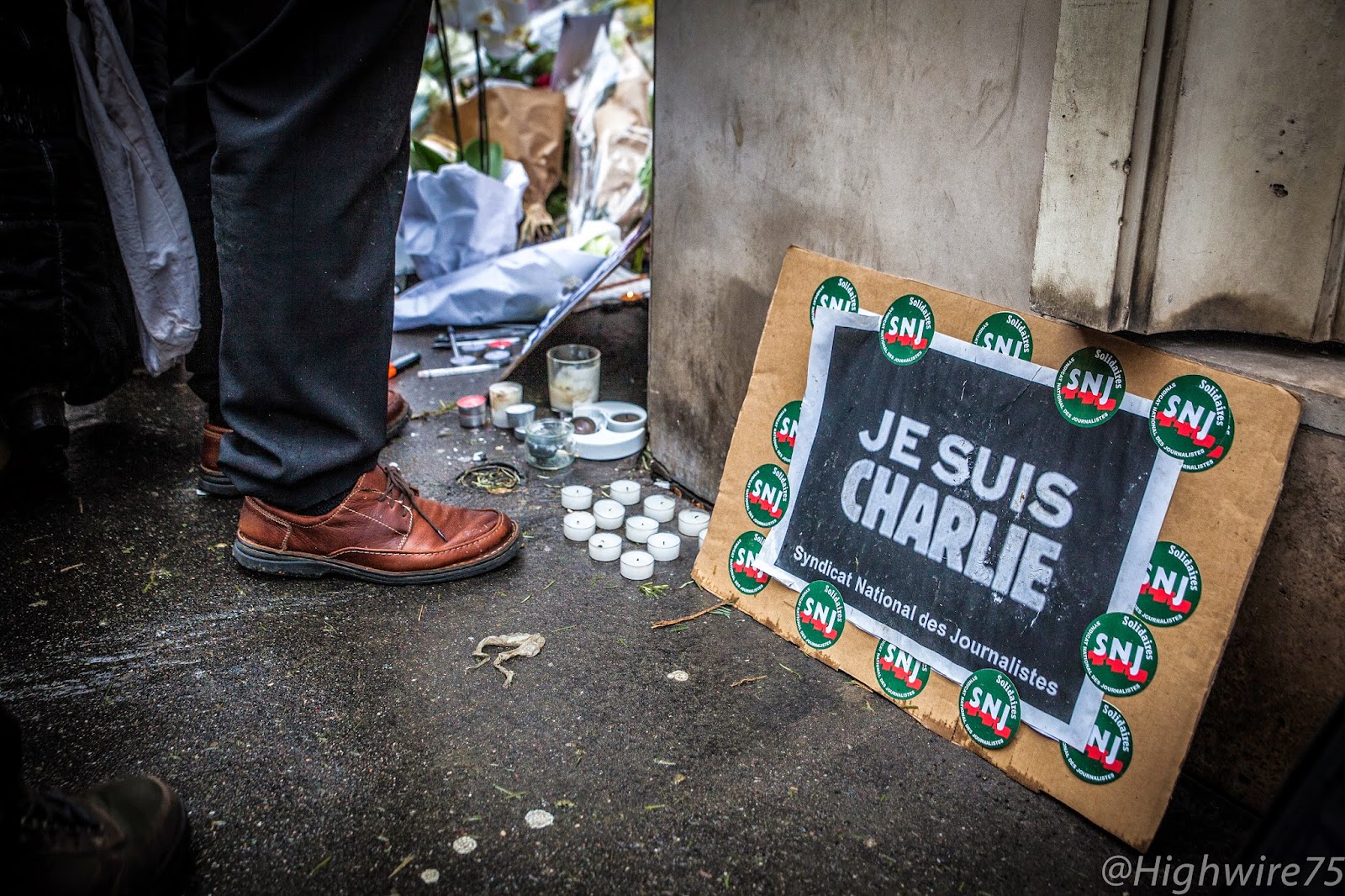
The Responsibility of Free Speech: Thoughts on the Charlie Hebdo Shooting

The tragic happenings in Paris came to a sort of end today, with the death of three of the Charlie Hebdo shooters at the hands of French police just outside of the city. The deaths of twelve people at the satirical magazine earlier this week has sparked an online debate of sorts about the balance of free speech and respect for religious beliefs.

By Guillaume from Paris, France (#JeSuisCharlie) [CC BY 2.0 (http://creativecommons.org/licenses/by/2.0)%5D, via Wikimedia Commons

The believed cause for the shootings was the numerous cartoons that have run in Charlie Hebdo showing the Prophet Mohammed. In the Islamic tradition, it is forbidden to show images of any prophet, especially of the Prophet, not because they are considered especially holy, but because there was always a worry that images of Mohammed would lead to his worship. Of course, the enforcement of this rule, as is the case with many such religious rules, has been taken to the extreme in some cases, causing death threats to be lodged against non-religious European cartoonists who illustrate Mohammed in the same satirical light they cartoon Jesus or the Pope. It’s not about falling into a worshipful trap, it’s more the blasphemous nature of the images that has driven the enforcement of the No Graven Images rule.

(On a related note, isn’t it interesting that many of the American Christian conservatives who have sprung to the defense of the free speech rights of the magazine would shudder in any other situation to be allied with such an irreligious publication?)

Nevertheless, warranted or not, the outrage felt by many in the Islamic world is very real, and deserves the attention of the civilized world. One way we can give that attention is by discussing that dichotomy of free speech and respectful discourse. No one denies Charlie Hebdo the right to run cartoons of the Prophet at this point. But should they be running them?

This question has caused a lot of angst over the last couple of days. Those arguing on the side of free speech have implored publications across the world to reproduce images of the cartoons that set this all off. There has even been some discussion that such blasphemous conduct is essential to the practice of free speech, that if speech that offends and infuriates doesn’t occur, then somehow we aren’t living up to the gift we have been given in the First Amendment.

Another permutation of this argument  holds that failing to run the offending cartoons far and wide hands a de facto victory to Islamic extremists, that quivering, hand-wringing liberal weaklings are giving into the radical demands of terrorists by refusing to publish the very material that so offended them.

This argument quite gratuitously ignores the value of prudence, of evaluating our actions in light of how it treats others. Such sentimental musing is dismissed as the worst of that great sin, political correctness. Exploring the responsibility of our stewardship of free speech, of the bounds which we choose to police upon ourselves, is categorized into the same class as reading Bin Laden’s declaration of jihad in wake of the 9/11; the horrific nature of the acts disclaims any possibility of understanding what provoked such a response. Never mind that we could learn how to prevent future tragedies by learning what causes such acts; so many would rather ignore all rational cause and effect in favor of keeping our own hands clean and just telling ourselves they hate our freedoms, our shopping malls, our tolerance. And so we invade their countries and mock their religious icons, and we disaffect an entire generation, and then we wonder why they lash out.

This isn’t an argument that lays the attacks on the Charlie Hebdo at the feet of said magazine; but it also doesn’t make them innocent martyrs. It’s an argument that asks that same question as above: just because we can run those cartoons, does that mean we should?

Freedom of speech in a civilized nation means more than acknowledging the limitless bounds of our rights to say things. It means speaking with a self-imposed sense of propriety or respect. It means understanding that just because we can say something doesn’t mean we should, not because a government tells us not to, but because we know that with great privilege comes great responsibility. It means that we know that tact and restraint, respect for others and their beliefs, is not a weakness or capitulation, but the ultimate example of civilization. It is the hope for a peaceful and tolerant future.

As Christians, we are called to a life full of respect and love for others. Every Christian who felt deep offense and anger at something like Piss Christ should innately understand the anger Muslims feel over depictions of the Prophet. We can acknowledge the right of persons to display these images while also calling on them to show the restraint to not do so, in the name of tolerance and respect. This isn’t giving in to terrorists; it’s coexisting with others in a diverse world. It’s self-governance in it’s highest and more virtuous form.

My prayers go out to the families who lost loved ones this week, that they might find peace and comfort. They also go out to humanity, in the hope that we can coexist peacefully and respectfully. Amen.

Sermon on The Fullness of Time

I had the opportunity to preach at my home church, College Hill United Methodist in Wichita, this last Sunday. The following is the text of my sermon. The scripture reading for the day was Galatians 4:4-7.

Let me preface today’s message with a request. Now, I know as a progressive, rational Christian, I can get tied down in the details of Biblical accounts like that of the Nativity. My brain knows that Jesus wasn’t born in December, he probably wasn’t visited by shepherds and Magi, it’s doubtful his birth was any less ordinary than any other, and that the idea of a Virgin Birth wasn’t earth shattering, but is in fact a common tool used by ancient writers to set a part a person regarded a special or supernatural. But sometimes, all that can get in way of a good story, of the meaning and truth conveyed in a tale like that of the Nativity. So I ask you this morning, be aware that I am thinking about the story of the birth of Christ as written in the Gospels, manger and Magi and star and all, to carry the message I want to pass along today, and I ask you to also immerse yourself in the truth and beauty of the Nativity Story.

We have just come through Advent, through the long four week lead-in to the birth of Christ. Advent is a time of waiting, of thinking, of pondering. It is a time pregnant with hope.

For Mary and Joseph, it was a hope-filled time of anticipating the arrival of a child heralded by angels. A child conceived beyond reason, sent for a purpose they could barely understand. Joseph had been told to name him Emmanuel, “God with us.” They knew this baby meant a change in everything they had ever experienced, that he would usher in a new life for them. Mary references this in her great song, when she says “From now on, everyone will consider me highly favored.” All in all, it was a pregnancy full of hope, excitement, expectations beyond what could be imagined, the promise of a life that would change human history like nothing before and after.

And yet, it was still a pregnancy. For all the fanfare and angels and songs, Mary was still charged with carrying a baby for ten months at a very young age. And at the end of those long, nauseous, sleep-deprived, pickle-and-ice cream-filled months, Mary would go through intense labor, without the modern convenience of epidurals and pain relievers, not to mention air conditioners and ice cold water. All the prophecy in the world could never quench the nervousness that Mary surely felt. Undoubtedly, in her very own village, she had seen multiple pregnancies and births, and very likely several unsuccessful ones. It had to be scary.

Ari and I have been through two pregnancies over the last three years, as well as two births with no medication, no epidurals, and no artificial induction. Granted, we had ac and cold drinks, not too mention steak dinners waiting for us on the other side. But nevertheless, for as wonderful as the experiences were, they were also scary. Especially the second time, after the massive hemorrhaging we experienced with Julian, knowing it could happen again. And it did, and it was quite scary. But we had the best medical care any one could ask for. We were well taken care of, and saw the wonderful benefits of 21st century science and medicine. I can’t imagine going through all of that without the safety net of well trained midwifes and doctors, and state of the art hospitals and birth centers.

All of this is to say, Mary had to feel fear and apprehension. Giving birth to a child was no sure thing in first century Palestine. And then showing up in Bethlehem, finding no where to stay, and facing the prospect of giving birth in a stable. A stinky, unsanitary, animal-filled stable. Terrifying is probably to mild a word to attach to the teenage Mary and her husband. And we haven’t even mentioned the shame her and Joseph must have felt. At the time of the pregnancy, they were not married. To have conceived a child before marriage was something that would have brought mountains of shame not just on them, but on their families. With that would come anger, and perhaps even exclusion from their families and home.

And yet, clearly, the birth went well. A happy, healthy, beautiful little boy was born. And to welcome him into the world were shepherds there to worship God, and Magi from the east, bearing priceless treasures. Out in the fields, a host of angels sang the new baby into the world with their heavenly voices, and high above, a shining star marked the birth of this remarkable child. An awe-inducing scene, a fitting majestic entrance for the one who is destined to change the world in unknown ways.

But again, reality surely intruded. The next day dawned for an exhausted Mary, sore and weak and cold and hungry. Joseph was tired, worried about his wife, anxious that this child, whom so many were counting on, show all the signs of health. And, for all the pictures we see of a haloed, smiling, reassuring little baby Jesus, the fact is, he was a newborn baby. Which means he probably didn’t allow mom and dad much sleep that night, or for several night after. He cried. He had spit up. He had dirty and wet diapers. And those weren’t nice, snug Huggies from the local Dillon’s.

In the face of all these ordinary baby events and habits, surely Mary and Joseph felt a little let down. They had this child built up to mythical proportions before he was born, and yet, he was still a baby, and life for this small, poor, rural family was undoubtedly HARD. The disappointment they had to feel at the normalness of their life’s in those first months and years had to be almost devastating at times.

Advent and Christmas can make us feel the same way. We spend four weeks anticipating, building up to this most important of Christian holidays. We celebrate joy and peace and hope and love. We are encouraged to pray and meditate and practice new spiritual disciplines. Here at CHUM, we contemplate the coming of Christ and the hope of a justice filled world that he showed us was possible. We think about how we can roll forward into a new year, emboldened by the holiest time of year to live our lives with Christ in pursuit of the Kingdom he described to us. Hope is truly the best word to describe the feelings we experience during Advent.

And yet here we are. Three days since Christmas. And its still the same old world we find on the other side of the holiday. It’s still a world filled with injustice. And it still will be going forward. In 2015, we will see more Eric Garners and Mike Browns, more shutdowns and budget cuts, more Ebola and ISIS, more “religious liberty” fights and roll backs of the gains made over the last fifty years in civil rights and voting rights and equal rights.

What was all that hope about? We go through Advent every year. We dream of new world, ushered in by the birth of a baby, sent to make justice roll down like waters, and righteousness like an every-flowing stream. And yet it doesn’t seem like things are getting significantly better.

Disappointment is a good word. We can commiserate with Mary and Joseph a bit.

We see the same theme in the Old Testament Scripture from today’s lectionary. Isaiah 61:10 through 62:3 was written as the Israelites were returning to Jerusalem from exile in Babylon. It was without a doubt a hopeful a time, to see the kingdom and Temple restored. And yet, arriving back in the Holy City, they find the remnants of destruction: scattered, weed-covered old building stones, and empty Temple mount, very few people. It must have been a sad sight, one made all the more overwhelming by all the work needed to be done to restore their home.

And yet the author of Isaiah finds words of reassurance and hope to give them strength. From the ruins of Jerusalem, he finds the words they Israelites need. “As the earth brings forth its shoots,” he says, “and as a garden causes what is sown in it to spring up, so the Lord God will cause righteousness and praise to spring up before all nations….You shall be a crown of beauty in the hand of the Lord, and a royal diadem in the hand of you God.”

Amidst the ruins and destruction, Isaiah sees hope still alive. He sees the potential, and finds the words Israel needed to restore itself, to plant itself once again as God’s people, doing justice, loving kindness and walking humbly. Most of all, he senses the presence of God in Jerusalem. Despite the terrible things Israel has been through, he knows God is still at work among them, that God has not once abandoned them.

Mary and Joseph needed this same kind of reassurance. And they found it in Jerusalem as well, on the seventh day of Jesus’ life, when they brought him to the Temple to present him to the Lord as first born child. In the temple, the priest Simeon attended to them, and took Jesus from them, and said “This child is destined.” And the Gospels also describes a prophet named Anna who began praising God and to tell everyone who was looking for the redemption of Jerusalem about the child Jesus.

Imagine the reassurance of hope Mary and Joseph must have felt upon hearing this from the religious leaders of the Temple! To be told again of the great things awaiting this child must have renewed for them the feeling that they were in the presence of God, that God was now dwelling with them, not just in the Temple, but right in their very arms, in the form of this beautiful baby.

And so we look for reassurance as well. We look to have our hope restored, to see God present in our world amidst the injustice and suffering and cynicism. We long for the Kingdom described to us by the man this child grew up to be. And we can find it in the verse from Galatians we just heard. When I first read this verse in preparation for this Sermon, that first line really jumped out at me. “But when the fullness of time had come, God sent his son.”

That’s our hope. That’s our reassurance. In the fullness of God’s time, when God choose, the Son was sent to us. Jesus showed us the kingdom, he lived the example of a life immersed in the presence of God, a life embodying justice and mercy and love.

Paul goes on, writing to the Galatians, “So that we might receive adoption as children…So you are no longer a slave but a child.” To unpack this a little back, I look back at the verses leading up the selected reading. Paul writes about how children who are heirs are yet given about as much privilege and freedom slaves were given, which is to say, not a whole lot. He then says, “in the same way, when we were minors, were enslaved by this world’ system.” So when he tells us we are no longer slaves but instead are children, Paul is saying our status has changed in light of Christ’s time on earth. We are no longer the wards of God, entitled to much but asked of little. Instead, we take up the responsibility of heirs. We are given the task of, not just hoping and waiting, but instead of inheriting our birth right, of being the hope we dream of during Advent. It’s our duty, as children of God, to work with every ounce of our passion and talent and will to bring about the Kingdom here on earth.

When we look around post-Advent, when we feel that let down from the high of Christmas, from the ecstatic feeling we get amidst the singing of hymns and lighting of candles and the hope the birth of a child brings, we can remember that we are all named Emmanuel, “God with us.” We all are stamped with the enduring and everlasting image of God, and with that stamp comes great responsibility, to show the world that the fullness of time is NOW, that we are the hope of the Christ child in the world.

Amen.

Sermon on the Kingdom Among Us

As I move through the ordination process, I have been given the opportunity to preach a few times at some local churches, including my home church, College Hill UMC (CHUM) in Wichita. I’ll be sharing the text of my sermons here. I am scheduled to preach December 28th, and I will share that sermon here afterwards.


Today’s sermon was preached July 27, at Burden UMC, in Burden KS. 
Last year, I worked for a time in the Oklahoma Legislature, in the House of Representatives. And in the House, there is a Representative named Richard Morissette. He represented south OKC, and he is term-limited out after this year. His office was two doors down from mine. Richard is from New Hampshire, and has a real strong New England accent, a booming voice, and being a lawyer and politician, he uses that booming New England voice of his loudly and often.

And colorfully. When he stood up to debate in the legislature, it was worth it to stop and watch. No matter this issue, Rep. Morissette would get fired up and pretty soon would be hollering and yelling and putting on quite a good show in the chamber.

And nothing got Rep. Morissette riled up like the Eastern Red Cedar.

How many here know what the Eastern Red Cedar is?

Well, the ERC is a tree that is not native to Oklahoma. It’s invasive, pushing out other, resident trees, and it is also a big time allergen. It’s pollen is terrible and I don’t know whether Rep. Morissette was actually allergic to it or just knew people that were or what, but he hated ERC and it was his driving goal during his twelve years in the legislature to eradicate it from Oklahoma.

Every session, you could count on numerous bills concerning ERC, and news conferences about it, and photo ops out looking at the creeping infestation.

So imagine if I walked up to Rep. Morissette, and said to him one day, “Sir, the kingdom of heaven is like the Eastern Red Cedar.”

I imagine he wouldn’t have liked that too much.

He probably would have looked at me like I was nuts for comparing something so longed for and great to something he considers so foul and obnoxious. He probably would have used that booming New England voice of his to colorfully inform me what he thought of my statement.

I imagine this is kind of the same reaction Jesus got when one day he declared, “The kingdom of heaven is like a mustard seed,” and “The kingdom of heaven is like yeast.”

Now obviously, in the world we live in, mustard seeds and yeast aren’t bad things. In fact, there are few things I enjoy more than a sandwich on big yeasty bread with some mustard. I don’t think anyone would think I’m crazy for eating that.

But in his typical fashion, Jesus found some things that were considered dirty and bad and forbidden in first century Palestine, and used them to describe God’s plan for the world in a thought provoking way.

And then, just a few verses later, he turns around and describes the kingdom of heaven like a pearl, or a great treasure, or a net full of fish.

Always keeping us on our toes, isn’t he?

In today’s Gospel, we see five parables of Jesus that describe the varied nature of the kingdom of heaven. And in these five stories, Jesus tells us the kingdom is something small, and precious, and secretive and contaminating and beautiful and just. And this is a just a small sampling of the kingdom. Time and again in his ministry, Jesus attempts to describe the kingdom to his followers. He uses numerous parables and sayings and examples to get them to understand, to see. And he tells us these things not to fill us with longing. He leaves us these examples with the intention that we make this world like that world, the one he tells us about. Like he taught us to pray: “The kingdom come on earth as it is in heaven,” right?

So the first parable we read today is the parable of the mustard seed. In ancient Israel, the mustard plant  was not something you grew in your backyard vegetable garden. Jewish law forbade the domesticated growing of mustard, because it was so invasive. From just one little bitty tiny seed, a huge bush would grow, and this bush would take over entire garden plots, choking out the good vegetables and herbs growing there. And since yellow mustard wasn’t invented until the Enlightenment period in France, mustard plants had very little use for the Jewish people. About the only thing it was good for was crushing and rubbing on a sick person’s chest like Vicks vapor rub.

Traditionally, if the kingdom of God was going to be compared to a plant, it was usually compared to the Cedars of Lebanon. Undoubtedly Jesus knew the passage from Ezekiel 17:22-24, where the coming kingdom is described to the exiled Jews:

“Says the Lord God: ‘I myself will take a sprig from the lofty top of the cedar and will set it out….On the mountain height of Israel I will plant it, that it may bear branches and produce fruit and become a noble cedar. And under it will dwell every kind of bird…And all the trees of the field shall know that I am the Lord.’”

A great towering, majestic cedar, looming above all the other trees and bushes, where all the birds can come nest. Sounds much more kingdom-like.

But Jesus turns that all on its head. Instead, he tells us that the kingdom is like a bush, a weed even. And in this bush will all the birds make their nest.

Next, Jesus tells us the kingdom of heaven is like yeast. As if it isn’t bad enough that he just invoked mustard, now he is comparing it to something that Jewish law forbade from even being present in a home during the holiest time of the year: Passover.

We all know about Passover and the story of unleavened bread: the Jewish people fled Egypt so quickly they didn’t even have time to let the yeast in their bread rise, but instead ate unleavened bread. And from then on, according to Jewish law, yeast was forbidden from use during the holy week.

And we’ve all seen yeast. It’s tiny, nearly invisible. And when it is used in bread, it’s hidden in the dough. And yet it pervades the entire loaf. It contaminates the dough, and although impossible to see, it’s results in the end are undeniable.

From these two examples, we can see the nature of the kingdom that Jesus is beginning to illustrate. Though at first small, unassuming, secretive, unnoticeable even, the kingdom is pervasive and unstoppable. It spreads and invades and grows and chokes out all other desires and priorities and wants.

So next, Jesus moves on and tells us the kingdom is like a treasure hidden in a field, which someone found and then hid again. Then that person goes and sells all that he has and uses the proceeds to buy that field, and with it, the treasure hidden inside.

The fourth parable is almost identical, and identifies that kingdom as like someone who finds a pearl of great value, and so sells everything he owns and buys this priceless pearl.

So we begin to see the second nature of the kingdom. We have moved from the cosmic nature of the kingdom described by the parables of the mustard seed and the yeast to a more personal nature, where we encounter the kingdom in our lives. After secretly and quietly growing into something pervasive, the kingdom becomes irresistible. And as we encounter the kingdom personally, after searching and finding it, or maybe encountering it without knowing, we discover it to be joyous. We discover that we are willing to sacrifice all else to possess it, that we feel a wholehearted commitment and are completely wiling to disrupt our daily lives and priorities in service to the kingdom.

We become like the disciples Jesus called early in the book of Matthew, who drop everything they are doing, who give up their friends and families and livelihoods, to simply follow Jesus and experience the kingdom.

And also, we find that we are called to be like the rich young man, who asks Jesus what he should do to inherit the kingdom. And just like the subjects of these parables, Jesus tells him to sell all he owns, give away the proceeds, and then he will experience the kingdom. The rich young man is unwilling. But the protagonists of these two parables follow through, and experience the joy of the kingdom. They illustrate the key point here: no cost is too great for the kingdom of heaven. It is priceless beyond all else, and should be willing to give up all else for it.

So now, after building the nature of the kingdom of heaven, Jesus uses a final parable to illustrate just what this priceless kingdom looks like, what it is exactly we are searching for.

He says the kingdom is like a net thrown into the sea that catches fish of all kind; and after it is hauled up, the fish are sorted and the bad are thrown back and the good are kept.

The story, and the message here, are almost identical to the parable immediately preceding these five, the parable of the weeds and the wheat. In each, the kingdom is compared to the sorting of the good from the bad from a single source. What Jesus is describing here is God’s justice. The kingdom of heaven is inseparable from the idea of God’s justice.

And the key here is that it is in fact God’s justice. Not out own. The justice we practice can only begin to scratch the surface of the justice God practices. Because our perspective is limited. In the parable of the weeds and the wheat, the servants offer to sort the weeds out from the wheat, but the landowner tells them no.

It is the same with us. We want to pass judgment, to speculate about what is and isn’t welcome in God’s kingdom, about who will and won’t be there. But that isn’t our place. We don’t know the hearts of others, we don’t know their place and situation. We are only subject to God’s justice, not the deliverers of it. We don’t know which are weeds, and which are wheat. We can’t tell the bad fish from the good. We can only do our best to bring along all of the fish, all of the weeds and the wheat, with love and mercy and compassion and open arms.

So from something small and invisible yet powerful, the kingdom is built into something irresistible and priceless, something we would do anything to possess, because God’s vision of the kingdom, God’s justice, is something we long for and feel deep within us. We know it when we experience it, and we want all to experience it with us. And, like mustard seeds or yeast, it’s not always what we expect it to be, or even what we think it is right for it to be.

Here’s another good one for us, one I wrote: the kingdom of heaven is like skunk spray. Once you get hit with it, you just can’t seem to get it off.

When we listen to the teachings of Jesus, when we do something that invokes the kingdom, when we experience that irresistible pull to the example that Jesus lived, we can’t get it off anymore. We can’t shake it. And we want it even more. We want to share it. We want to make it happen. We want to come here on Sundays and help our church to facilitate the kingdom on earth.

I regularly read the blog of Christian writer Zach Hoag, and one of his signature ideas to think about is “kingdom business and empire business.” He means the two as in opposition to one another, and says that churches can engage in one or the other, but not both. And there is only one that is identified with the teachings of Jesus.

We as a church, as a denomination, as Christians all over the world, are called to kingdom business, to reject empire business. We are to keep Jesus in our sights and follow his example. We are to, as the prophet Micah said, “do justice, love kindness and walk humbly,” in all that we do. We are to bless the poor, and those who mourn, and the meek, and the hungry, and the merciful and the peacemakers. That’s kingdom business. We are to reject the business of empire, the focus on bottom lines and and dogma and rigidity at the expense of justice and mercy and love. We are to help sow that mustard seed, to kneed in that yeast, so that the kingdom will become pervasive through us and become irresistible to all who experience and God’s justice will “Roll down like waters, and righteousness like an everlasting stream.”

It’s not the easy, comfortable path the world wants the church to stay on. It will put us at odds with the systems and governments of the world, and set us apart from all others. But Jesus calls us to it, calls us to bring the kingdom on earth, as it is in heaven. He calls us to bring the kingdom among us, not to wait, but to do it now! May we all feel the call to give up all and seize the kingdom. May it be so. Amen.