So Black Lives Matter has taken over my newsfeed of Facebook again this week.
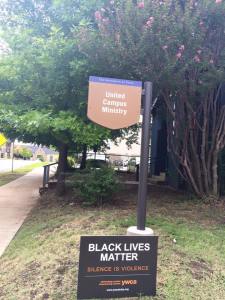 It all started with this picture, posted on the page for my employer, United Campus Ministries at TU, after we put a BLM sign out front of our building, and it was subsequently stolen Tuesday night or Wednesday morning. We promptly got another one to put out front.
I shared the picture to my personal Facebook page, and all hell broke lose. Immediately, the All Lives Matter and White Lives Matter crowd jumped all over this. So I posted an article by Leonard Pitts that addressed why All Lives Matter is insensitive and unnecessary.
And that set off a whole other can of worms.
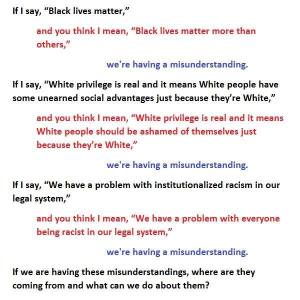 So then, in my great wisdom, I posted this wonderful graphic.
And the whole thing happened over again.
And in the midst of this, I keep seeing patterns of thought from the ALM/WLM crowd that I find disturbing and very, very frustrating. So I want to try to address some of that, to try to get people to understand, as my title states, why BLM is so important, ALM is unnecessary, and WLM is just flat-out racist. And, in sticking with the theme around here, why as Christians we have a duty to stand with BLM in combating racial injustice in America today.
First, what exactly is Black Lives Matter? It’s more than just a slogan, or a chant, or a catchphrase. BLM is a movement, organized after the unjust death of teenager Michael Brown in Ferguson, MO. But it is a movement responding to the hundreds of deaths before and after Brown, including Trayvon Martin, Jordan Davis, Tamir Rice, Sandra Bland, Walter Scott, Eric Garner, Freddie Gray and many many more young black men and women who died at the hands of white police officers. Please understand that: it is an organized movement, with leaders and decision-makers and a policy platform. And it is centered around one of the largest on-going injustices in America today.
There is a legitimate problem centered around black men and women being gunned down by police officers prior to any opportunity for due process and the judicial system to do its work, and then those police officers walking away with no consequences. Read that last sentence again; it is the crux of what people are upset about. Far too many times have we seen stories about a black human being who may or may not have broken a law being killed by the officer they come in contact with, and then no consequences being handed down. Far too often, the death penalty has been meted out at the whim of a single, white police officer, for alleged “crimes” that in a court of law would merit a fine.
This is a real problem in a country that purports to believe in the principle of the presumption of innocence, and trial by jury. When we dispense with real justice, when we defend those who take it into their own hands to do the work of the courts and dispense “justice” without due process, we inevitably say that the victimized person was undeserving of the rights guaranteed to us in the America. That person just didn’t matter enough.
This is what is meant by the phrase “Black Lives Matter.” Too often, black lives don’t seem to matter. Black lives seem expendable, like they are merely the normal leftovers of creating a society that is supposedly “just” and “free” and “safe.” Every time a black man or woman is gunned down by a state actor, and no one is held responsible, it sends the message that Black Lives Don’t Matter.
BLM works to make this simple idea a reality: the lives of black people do matter.
It isn’t an assertion that no other lives matter. Stop reading Black Lives Matter as a zero-sum statement. It isn’t. Acknowledging the existence of one injustice does not the negate the importance of others. Acknowledging the humanity of another person, or of a specific oppressed group, does not deny the humanity of everyone else. These are the words of Mana Tahaie, who designed and distributed these signs here in Tulsa, on Facebook that I found particularly striking:
A critical part of my worldview is that I believe that more for you does not mean less for me. I believe in abundance. I don’t think that pulling up one community necessitates tearing down another. I don’t feel that your success comes at my expense. Quite the opposite: I believe that a rising tide lifts all boats, and that my liberation is bound up in yours. So standing in solidarity with someone else’s struggle doesn’t threaten me, it actually strengthens me. I think we’re in a historic moment, when a community is crying out for justice, and in those moments I choose to stand with the oppressed. I also fight against transphobia, and ableism, and homophobia, even though I’m not directly impacted by those. I hope that in doing so, I inspire others to fight against sexism and ageism and Islamophobia and xenophobia and other things that oppress me.
I truly believe that the world will be more just, and beautiful, when we share one another’s struggles.
We only achieve justice in this world by working together, and by acknowledging and helping those who are oppressed, not by denigrating them because we have a problem with the words they use. BLM does not negate other issues in the world; it strengthens them by it’s very existence.
A good metaphor I keep seeing is the man who goes to the doctor for a broken arm, and the doctor starts examining the rest of the man’s body. The injured man says, “Doc, it’s my arm that’s broken; everything else is fine,” and the doctor responds, “All bones matter.” Of course they do! But they aren’t the ones that are hurting right now!
As a follower of Jesus, I like this little illustration, courtesy of my wonderful wife: when Jesus said, “Blessed are the poor,” no one stood up and yelled “Blessed is everyone!”
All Lives Matter seems to only ever be said in reaction to someone saying Black Lives Matter. That is a problem. It is a phrase being thrown around in opposition to BLM, no complementary to it.
And frankly, ALM is just unnecessary. No one in BLM has ever made the assertion that all lives don’t matter. They clearly do. That’s not issue here. What is the issue is that it is black people who are the target of discrimination, hatred and violence.
I’ve also seen some views that Black Lives Matter is the wrong phrase to use, or it is divisive or non-inclusive. Usually, this sentiment comes from white people, who seem to have a knee jerk reaction to BLM. But here’s the thing: as white people, we don’t get to dictate to an oppressed minority how they go about achieving their liberation. For too long, we have been the one’s standing in their way, the ones telling them what they can or cannot do. So for us to stand up now and say, “hey, we get what you are doing, but can you just say it a little nicer?” is the epitome of racial arrogance and lack of self awareness.
Our job as white people isn’t to direct BLM, or tell it how to work or what strategy to use. Our job is to acknowledge the depth of the hurt and anger, and the injustice that is happening every single day, and then ask, “how can we help?” That’s it. We need to stop trying to make this about us, and take the back seat for once in our lives. “How can we help?” That’s our role.
This is why White Lives Matter is such a racist and hate-filled statement. We white people are not at risk in this country, nor have we ever been.
It isn’t white people being gunned down without due process.
It isn’t white people who were enslaved for 350 years.
It wasn’t white people who have suffered under Jim Crow and state sponsored discrimination and racism for 150 years since.
Just as white people didn’t need to be emancipated, we don’t need to assert that our lives matter. We were never enslaved, and we were never the victims of terrorism and hatred supported by the state based on the color of our skin.
To say White Lives Matter in response of Black Lives Matter is to again assert our own assumed “superiority” and denigrate the humanity of African Americans. In light of the racial history of our nation, of the fact that it is exclusively white Americans who for so long have held down black people so that they might not challenge our place in the world, to use oxygen and air time to drown out BLM is to stand on the side of segregationists and the KKK and Jim Crow. It’s time we white people realized, it’s not all about us. We are not victims, we are not in need of protection or saving or fighting back. We are the perpetrator, not the victim.
Black people make up about 12% of the American population. They make up almost 40% of the prison population(1). Black men are incarcerated at over 6 times the rate of white men(2). Studies show that black men receive considerably longer sentences for petty crimes than white men do, as much as 10% longer, even when factoring in past records(3). This despite the fact that, in total, black people do not commit crimes at higher rates than whites, and certainly not at a rate that matches the incarceration gap(4). In fact, the number one reason for incarceration among black men, drug use, is actually more of a statistical problem among white men(5). This is injustice. This is institutionalized racism. We are responsible for this.
Racism is not the acknowledgment of race. Racism is not being aware of race. Racism is the active or passive discrimination against a group of people based on their ethnicity or skin color, especially by a majority identifier against a minority. It is not racist to say Black Lives Matter. It is racist to say White Lives Matter. You have to be aware of culture, of society, of history. We don’t live in a vacuum. We don’t live free from the past, from those around us, from cultural trends. That is why WLM is such a big, racist problem.
As Christians, we are called to follow the example of a man who made his life among the poor and oppressed and downtrodden. Jesus’ example calls us to work for injustice, to identify with the least among us. As Christians, we must work to liberate those who are shackled.
Jesus’ primary concern for the least of these is the earthly embodiment of God’s preferential option for poor. God always sides with the oppressed and downtrodden and lowly. We are obligated to do the same, even if it makes us uncomfortable or burdened.
White, middle class Americans are not the oppressed.
I have no doubt that, were Jesus alive today, he would be saying Black Lives Matter and marching in the streets of Ferguson and Baltimore. And really, he already is, in the form of every human who says these words and marches for justice. I want to be on the side of Jesus, and the side of justice and truth. That’s why I support Black Lives Matter.
Click here for my follow-up post, which answers most of the criticism and objections raised in comments below.
ed.: Updated to reflect the fact that victims of police brutality are not just men, bu also women and trans- or cis-gendered people of color. Thanks to commenter Faith Eden-Barre for pointing out this oversight in my original writing.
(1) http://www.bjs.gov/index.cfm?ty=pbdetail&iid=2200
(2) http://papers.ssrn.com/sol3/papers.cfm?abstract_id=1985377
(3) http://jrc.sagepub.com/content/49/1/56.short
(4) Let me clarify this with something I said in comments: “In looking at total murders in the United States, blacks and whites both commit close to 50% of murders, with the small difference accounted for by Asians, Native Americans, Hispanics, etc. My general point stands: blacks do not commit crimes at a considerably higher rate than whites, especially not at a rate that matches the incarceration disparity.”
(5) http://healthland.time.com/2011/11/07/study-whites-more-likely-to-abuse-drugs-than-blacks/


