
Myths of the Nativity: How Jesus’ Birthday Ended Up on December 25th

December 25I know this series has been pretty heavy so far, with a lot of Biblical analysis and deep dives into scholarship and language and theology. So, I want to finish with a couple of posts on “lighter” topics: the date of December 25th, and St. Nick (or Santa Claus.)

Obviously, we celebrate Christmas, and thus the birth of Christ, on December 25th. But why? There is no Biblical tradition of Jesus being born on this day. In fact, to judge from the stories of the Nativity, if you just look at what is recounted, it makes no sense for the story to be taking place in deep winter. First, if shepherds were out in the field, this indicates pasturing season, March to September. Second, it is highly unlikely that if Joseph were going to take his very pregnant wife on a long journey to Bethlehem, that he would do it in the deepest, darkest part of winter. Not exactly the best weather for travel by foot or donkey.

But, that is all speculation, as we have now by this point in the series determined those details to be highly symbolic myth. So we are left with our original question: Why December 25th?

There are two main competing theories, one of which I’m sure you’re familiar with, the other not so much.

The most common theory is that December 25th was chosen to supersede pagan holidays. Late December was the time of year for two major Roman holidays: Saturnalia, which had been practiced since ancient times, and the Feast of Sol Invictus (the Unconquered Sun), instituted in 274 CE by Emperor Aurelian. The Germanic holiday of Yule was also fairly well known.

The idea is that Christians of the time (3rd-4th century CE) wanted to use the popularity of these pagan festivals to “piggy back” their celebration of the birth of the Messiah. And there is some truth here, in that early Christian’s writing around the time of the inauguration of Sol Invictus answered the Emperor’s new holiday by proclaiming Jesus to be the true “Unconquered Sun.” An anonymous tract from around that time states,

“But Our Lord, too, is born in the month of December … the eight before the calends of January [25 December] …, But they call it the ‘Birthday of the Unconquered’. Who indeed is so unconquered as Our Lord…?”

There was clearly some effort by contemporary Christians to try to undercut the new holiday by proclaiming Jesus as the one worthy of celebration and reverence.

Beyond that, however, it seems unlikely that the identification with pagan festivals was primary consideration. Christians of the time, working in a very pluralistic religious atmosphere, were eager to distance their religion from the many, many others. It seems highly unlikely that Christians looking to highlight the exceptional nature of their faith would deliberately go about making decisions that obscured it in the face of other, more popular occurrences.

Further, the first mention of Christmas being a response specifically to pagan holidays wasn’t recorded until the 12th century. Surely, if this was the prime motivating factor, one of the many Christian literary sources we have available to us from this time would make some mention or allusion to such an act.

The second major theory is that of a divine connection between Jesus’ conception and death. Early Christian theorists deduced that Jesus’ death took place on March 25. This just so happens to be exactly nine months before December 25th.

Now, while that seems a lucky coincidence, it is actually an intentional connection being made by early writers. In Jewish tradition, the confluence of important dates was a common literary practice. For instance, rabbinic scholars of around the same time posited that the Jewish date of 14 Nisan was the date of the completion of creation, the beginning of the Exodus, and the birth of various Patriarchs. The idea that many important events happened across the years on a common day was an indication of God at work in the world.

Thus, Jesus being conceived on the same day he died was a way for early Christian writers to indicate Jesus’ ultimate fate as the Savior of mankind by his death was preordained from birth, and before even that. The connection was deliberately made between these two events to establish the role of Jesus in God’s divine plan. And so, by logical deduction, they were able to assert his birth as exactly nine months later: December 25.

Neither of these theories wholly explains to choice of this specific date. Rather, both probably played a small contributing role in a process that spanned centuries, and was fairly organic in it’s evolution.

For instance, December 25th wasn’t even a consensus choice. There was much early debate about January 6th being the correct date. Eventually, the Orthodox Church in the East selected the January date as their Christmas, a tradition that carries down to today. The Western church went with December 25, and picked January 6 as Epiphany (the Adoration of the Magi from the East) instead. (Early writers in the Orthodox tradition even went so far as to repudiate the conception date of March 25 by asserting that April 6 was the correct day.)

Up until the early Middle Ages, Epiphany held much more importance than Christmas did. As the conflict between east and west began to intensify, the west began to emphasize instead the importance of Advent, and the 12 days of Christmastide that followed (December 25-January 5.) The importance of the date of Christmas seems to have had a secular spur as well, with the Holy Roman Emperor Charlemagne choosing it as his coronation date in 800 CE, and King William I of England following suit in 1066. With these celebrations of the anniversaries of the coronations, Christmas became more and more popular.

The supposed roots of Christmas in pagan festivals was bolstered by splinter religious groups like the Puritans, who refused to celebrate it because of it’s supposed pagan links and influences. Modern day 7th Day Adventists picked up this stream of thought from their founding in the mid-19th century. The modern celebration of a more secular Christmas on December 25th, with presents and Santa Claus, gained steam in the 19th century, carrying on to a more Enlightened and secular world to today’s highly commercialized holiday.

The choice of December 25 is far from a conscious decision of the church. It is instead the product of 2000 years of tradition and wrangling and just plain dumb luck.
Myths of the Nativity: Herod’s Decree and The Flight to Egypt

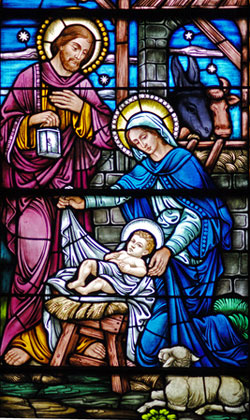
stained glass nativityThere is no more central figure to Judaism than Moses. He is originator of the nation of Israel, God’s chosen who led the people out of slavery in Egypt, gave them God’s law, and brought them to the Promised Land. If Jesus is the key figure in Christianity, and Muhammad the key in the Islam, Moses is the key to the Jewish faith.

Today’s segment of the Nativity has one purpose: to tie Jesus, who in Matthew’s eyes was the perfector of the Jewish faith, to Moses, the originator. With the slaughter of all the boy children, and the flight to and from Jesus, Matthew is clearly trying with these stories to firmly establish Jesus in his readers’ minds as the new Moses.

As we discussed at the beginning of this series, Matthew was writing to a specifically Jewish audience. Throughout his Gospel, we find fulfillments of Jewish prophecy, and references to the Hebrew Bible, and a focus on Jesus as the culmination of the Jewish faith. Matthew’s nativity is no different. We have already seen him tie Jesus to that other crucial Jewish figure, King David, by way of a genealogy and a purported birth in Bethlehem. Now, he is evoking the very formation of the Jewish nation, as he establishes where Jesus came from.

There are two elements to this story: Herod’s decree that all the male children in Israel be put to death, and Jesus’ family’s flight into Egypt as a result. Considering the situation we have established over the course of the last few blog posts, it is clear this is not a historical story again, and is instead a story meant to identify Jesus with the Jewish people.

If in fact Herod had ordered something as despicable and horrifying as the murder of all male children, we surely would have heard of it in contemporary writings. Yet neither Josephus, the premier Jewish historian of the time, nor the Romans, who sanctioned Herod’s rule and this were quite interested in his actions, ever mention such a thing. It is hard to imagine that if it had happened that no one would have mentioned it in any way.

So why did Matthew create such a story? He is clearly evoking the similar order by Pharaoh in Exodus to kill all the male Hebrew children.  Again, Matthew’s readers would have been well aware that no such thing really happened. Such an event would be burned into the collective consciousness of the Jewish community. The point is to reference Jesus as taking up Moses’ mantle as the guide and savior of the Jewish nation.

The flight to Egypt does the same, by giving Jesus a link to the land that Israel came up out of, while also providing an explanation for Jesus’ escape from the decree. At God’s prompting, through an angelic messenger, Joseph is warned to flee to Egypt to save his son. With his return, again at the command of an angel of God, Matthew is able to fulfill another Hebrew prophecy, recounted in verse 2:15: “Out of Egypt I have called my son.” Just as God called Israel out of Egypt and into God’s protection, so Jesus was called. Jesus becomes a stand in for the entire nation.

The birth of a peasant boy in rural Galilee was an event of no special occasion. In a community that was largely illiterate, there would have been no time or energy wasted in remembering such details. The Nativity stories instead serve to orient Jesus as Matthew and Luke want him understood: as the Jewish messiah, as the bringer of a peaceful rule to God’s world. This was not history being written; it was myth pointing us towards Truth. As Tillich describes it,

Symbols of faith cannot be replaced by other symbols, such as artistic ones, and they cannot be removed by scientific criticism. They have a genuine standing in the human mind, just as science and art have. Their symbolic character is their truth and their power. Nothing less than symbols and myths can express our ultimate concern.

Myths of the Nativity: The Adoration

By now, I think it’s clear that I regard most of the details of the Nativity story as told in Matthew and Luke to be chiefly “myth.” But today, I want to dive deeper into what I mean when I use that word.

For instance, let’s look at the story of the Adoration. Here is Luke:

 In that region there were shepherds living in the fields, keeping watch over their flock by night. Then an angel of the Lord stood before them, and the glory of the Lord shone around them, and they were terrified. 10 But the angel said to them, “Do not be afraid; for see—I am bringing you good news of great joy for all the people: 11 to you is born this day in the city of David a Savior, who is the Messiah,[a] the Lord. 12 This will be a sign for you: you will find a child wrapped in bands of cloth and lying in a manger.” 13 And suddenly there was with the angel a multitude of the heavenly host,[b] praising God and saying,

14 “Glory to God in the highest heaven,
    and on earth peace among those whom he favors!”[c]

15 When the angels had left them and gone into heaven, the shepherds said to one another, “Let us go now to Bethlehem and see this thing that has taken place, which the Lord has made known to us.” 16 So they went with haste and found Mary and Joseph, and the child lying in the manger. 17 When they saw this, they made known what had been told them about this child; 18 and all who heard it were amazed at what the shepherds told them. 19 But Mary treasured all these words and pondered them in her heart. 20 The shepherds returned, glorifying and praising God for all they had heard and seen, as it had been told them.

And Matthew:

In the time of King Herod, after Jesus was born in Bethlehem of Judea, wise men[a] from the East came to Jerusalem, asking, “Where is the child who has been born king of the Jews? For we observed his star at its rising,[b] and have come to pay him homage.” When King Herod heard this, he was frightened, and all Jerusalem with him; and calling together all the chief priests and scribes of the people, he inquired of them where the Messiah[c] was to be born. They told him, “In Bethlehem of Judea; for so it has been written by the prophet:

‘And you, Bethlehem, in the land of Judah,
    are by no means least among the rulers of Judah;
for from you shall come a ruler
    who is to shepherd[d] my people Israel.’”

Then Herod secretly called for the wise men[e] and learned from them the exact time when the star had appeared. Then he sent them to Bethlehem, saying, “Go and search diligently for the child; and when you have found him, bring me word so that I may also go and pay him homage.” When they had heard the king, they set out; and there, ahead of them, went the star that they had seen at its rising,[f] until it stopped over the place where the child was. 10 When they saw that the star had stopped,[g] they were overwhelmed with joy. 11 On entering the house, they saw the child with Mary his mother; and they knelt down and paid him homage. Then, opening their treasure chests, they offered him gifts of gold, frankincense, and myrrh. 12 And having been warned in a dream not to return to Herod, they left for their own country by another road.

Now, obviously, I don’t think this is a factual retelling of a historical story. What I mean is, if you were writing a sort of “Witness statement” of what happened at the birth of Jesus, these things wouldn’t be in there.

Now, there are a lot of reasons I think that, many of which can be deduced from the last two posts in this series. In short, if Mary wasn’t married, and thus didn’t travel to Bethlehem and stay in a stable to give birth, then consequently, the tales of wise men and shepherds visiting her there wouldn’t have happened either.

But, none of that means that these stories aren’t important, or that they don’t mean something crucial to Christians, or even that they shouldn’t be recounted or included in the canon. Quite the opposite. I think they are absolutely crucial to understanding the nature of Christ as the Gospel writers are recounting it. It all comes back to that word, “myth.” What do I mean there?

The grandest explanation of myth within the Christian paradigm was provided by the incomparable Paul Tillich in his book Dynamics of Faith. In the chapter “Symbols of Faith,” Tillich first explains the nature of symbols vs. signs this way:

Sometimes such signs are called symbols; but this is unfortunate because it makes the distinction between signs and symbols more difficult. Decisive is the fact that signs do not participate in the reality of that to which they point, while symbols do. Therefore, signs can be replaced for reasons of expediency or convention, while symbols cannot.

This leads to the second characteristic of the symbol: It participates in that to which it points.

This important because, as he says:

The language of faith is the language of symbols.

Faith can only be described by symbol. Finite human beings cannot adequately comprehend or describe the majesty and ultimacy of God. We can only point at the nature of God through something as powerful as symbols. For instance, the idea of God as the Father has meaning not because God is a literal father, but because of what the symbol father says about the relation of one being towards another. In this case, “father” indicates the nurturing, protecting, strong figure of a classic father in patriarchal structures.

Now, naturally, many of us (myself included) reject the misogynistic view of God operating chiefly (or solely) as a father. We prefer to also refer to God equally as mother, because of the things the symbol mother conveys. Nevertheless, God is described in these symbolic ways because these are the only ways we can begin to comprehend of the nature of God.

This expands into myth, as Tillich continues:

Myths are symbols of faith combined in stories about divine-human encounters.

Myths are always present in every act of faith, because the language of faith is the symbol…

…It puts the stories of the gods into the framework of time and space although it belongs to the nature of the ultimate to be id beyond time and space. Above all, it divides the divine into several figures, removing ultimacy from each of them without removing their claim to ultimacy.

This is where I’m coming from when I say “myth.” Did these things “really” happen? No. Do the stories have crucial meaning about who God is and what God’s nature is? Absolutely. These myths-the Virgin Birth, the Adoration-reveal the nature of God through Christ by telling a story with scenes that have meaning to the larger picture. The authors draw on real life situations (for instance, a Roman census) with small changes that fit them into this story to help tell the story in a way readers will comprehend and understand.

The Bible as a whole is full of myths. But this doesn’t mean the Bible is only myth. The Bible is a collection of many different works, written by men thousands of years ago trying to recount the nature of God as they and their people were experiencing it. To do this, they used history and song and lamentation and geneaology and court records and letters and apocalypses and yes, sometimes, good old fashioned myths to do so. To reduce scripture to nothing but myth is as blasphemous as reducing it all to science book or literal history of the physical world, as some fundamentalists aim to do. Tillich explains:

All mythological elements in the Bible, and doctrine and liturgy should be recognized as mythological, but they should be maintained in their symbolic form and not be replaced by scientific substitutes . For there is no substitute for the use of symbols and myths: they are the language of faith.

To make the stories in the Bible “science” is to demythologize them, as Tillich describes, “the removal of symbols and myths altogether.” The attempt to resist the identification and interpretation of myth in favor of the myth being reality leads to command and control structures of faith, in which the goal becomes not reading to become better understand the human relationship to God, but instead reading to affirm the power structure that claims a monopoly on interpreting the Bible (even if they don’t recognize what they are doing as such.)

Reducing Scripture to nothing but the “infallible, inerrant Word of God” negates the power of it’s variability. To give full respect and deference to the Bible and it’s writers, we must grapple with the multiplicity of form and intent we find therein. To make the Bible unquestionable and infallible is to make the Bible God, is to practice that most deadly of sins according to Paul, idolatory, in the form on Biblolatory.

Recognizing the stories of the Nativity as “myth” isn’t to reduce them in importance or power or meaning. Instead, it is to recognize and acknowledge their true forms, and thus to recognize and acknowledge the kernel of Truth trying to be described. Analyzing these myths and the symbols that make them up is to give them their proper due. It is the work of better understanding the Divine.