A Open Letter to Donald Trump, On the Occasion Of Your Salvation

Dear Donald Trump,

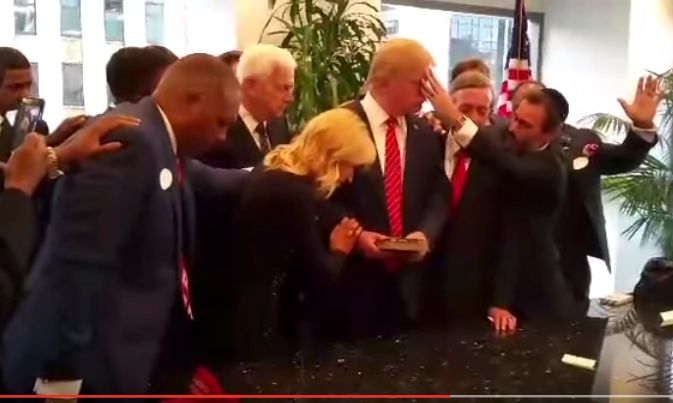
Screen-Shot-2015-10-03-at-11-compressedCongratulations! I just heard that Dr. James Dobson, who was at your little get together with evangelical leaders last week, has confirmed for us that you have indeed been saved and are now a born-again Christian. Great news!

We in the DaMetz household are ecstatic that you, like us, have decided that following the life and teachings of Jesus of Nazareth is the best way of going about life. It’s something really important to us, and to millions of others, and because of that, I just know you wouldn’t be claiming the name Christian as a political tool to win votes. You must be very sincere! So, welcome to the family, brother Trump!

And because we know being a Christian is really hard, as we are still figuring it out ourselves, I just wanted to drop you a note on what we have been learning, because, as the esteemed Dr. Dobson said, you are just a “baby Christian.”

So, here we go.

First of all, that whole thing a while back about your favorite Bible verse. You see, it sounded like you said “An eye for an eye” was your favorite. Which is great! That’s actually in the Bible, way back in Leviticus, so kudos to you. But, see, now you are a Christian, and Jesus did have something to say about “an eye for an eye.” It was something like this:

You have heard that it was said, “An eye for an eye and a tooth for a tooth.” But I say to you, Do not resist an evildoer. But if anyone strikes you on the right cheek, turn the other also. — Matthew 5:38-39

Yeah, geez, ok, so maybe you should find a new favorite verse, since Jesus kind of slapped that one down. But that’s ok! There are lots of other good ones to choose from!

(And really, this should be easy for you, right? I mean, you are the man with a warehouse full of Bibles in the middle of Manhattan, right?)

So anyways, let’s move on. Jesus was pretty explicit about what it takes to follow him as a Christian, and since you seem like the kind of guy who really appreciates easy-to-follow instructions, this whole Christian thing should come pretty easy to you, with just a little Bible study.

I mean, for instance, there is the one above: “turn the other cheek.” Basically, what that means is, if somebody does you wrong, you don’t try to get even or strike back. The Christian thing to do is submit, in love, knowing that breaking the cycle of violence is a lot more important that getting even. You can do that, right?

Then there is Luke 6:37-38: “Do not judge, and you will not be judged; do not condemn, and you will not be condemned. Forgive, and you will be forgiven; give, and it will be given to you.” So that’s all pretty cut-and-dry: Don’t judge, don’t condemn, forgive, give. Check, check, check, check.

How about some more from Matthew 5; these are some of my favorites, so I’m sure you’ll love them too. See, in this part of the Bible (called Jesus’ “Sermon on the Mount”; it’s a really big, like, rally speech he gave. Just like you do!!), Jesus gives us a list of people to bless. Now, you always tell us how much you love all the people (especially winners, right?), so you should really like this part. Here are the people Jesus thinks we should exalt:

  • the poor
  • the mournful
  • the meek
  • the hungry and thirsty
  • the merciful
  • the pure
  • peacemakers
  • the persecuted

So, yeah, I know that, technically speaking, none of those seem on the surface like “Winners” or the rich and powerful or influential or anything. But, hey, this is what Jesus said it takes to follow him, and you are now a born-again Christian now, so I guess you can get on board, right?

So, jumping ahead a bit in Matthew 5, Jesus says that if you are angry, then that’s really bad. So, yeah, no more anger towards other people.

Jesus also says we need to love our enemies. Now, I know this is hard. Because there are a lot of enemies out there. And it would be really great to just bomb them back to the stone age, and move one, right? Or at least, build a really big wall so that we don’t have to see them anymore. But, see, that’s just the thing. Jesus said we can’t do that. Like, he’s very adamant and everything. So make a note, we are going to have to revisit that part of your campaign platform.

Oh, and right after that, he says this:

“Whenever you give alms, do not sound a trumpet before you, as the hypocrites do in the synagogues and in the streets, so that they may be praised by others.”

Now, I know you made a big deal about giving $1 million to a veterans group a few weeks ago (except you actually didn’t give them the money, and then lied about it. Oops!) Donald, you can’t do that. Just donate the money and move on, because it’s not about you, right? It’s about them, and your reward is in heaven and blah blah blah. Ok.

Along those same lines, Jesus says “Do not store up for yourselves treasures on earth.” So we are going to have to talk about you giving away a lot of stuff. Like, a lot. Start picking a few things to keep. This is really important, because just a few verses later Jesus says, “You cannot serve God and wealth,” and then “It will be hard for a rich person to enter the kingdom of heaven.” (He said that last thing after telling the rich man to go sell all he had and give the money to the poor. Yeah, I know.)

Now, I know you’ve been told your whole life that the fact that you are rich and powerful and well-known means that you are obviously blessed and favored by God. But, well, see, Jesus actually says that’s not true. Jesus’ overarching theme is that favor rests on the meek and oppressed and poor and lowly. I know, that kind of turns this whole world upside down, and reverses everything we’ve been told about how the world works. But that’s the point! Jesus turns it all upside down! Crazy!

Because, here in America, we like to tell ourselves that Jesus is found in the boardroom, in victory lane, on Wall Street, in success and riches and power. But, again, that’s just not what the Bible actually says. And, I mean, if you are a Christian now (and James Dobson says you are and who am I to doubt that ringing endorsement?) then you have to start following what Jesus actually said. And later on in Matthew, in chapter 25, he says this: “Just as you did it to one of the least of these, you did it to me,” and by least of these, he means the hungry, the thirsty, the stranger, the naked, the sick and the imprisoned. What he is saying is, he (Jesus) is found with people like that.

I know, this whole Christian thing is starting to seem really hard and uncomfortable. I get it, ok? But, I also know that you have “Really great stamina” and that you are really strong and smart and powerful. I know all this because you told me this. Over and over and over again. So, I know you can do this. I believe in you Donald.

Anyways, I know this is a long letter, and it’s hard to focus for this long, so I’m gonna wrap things up. Again, I’m so excited you are a Christian now. And I know how sincere you are, and so I can’t wait to see you start living out the Way of Christ in your life. What better way to spread the message of Jesus, then by having someone of your stature living it everyday in the public eye!

Your brother in Christ,

Justin DaMetz

The Way of Jesus is the Way of Peace

If you think safety and security will be brought about by more guns, then you clearly are missing the point of Jesus’ life and death.

In the days since the tragedy in Orlando, we’ve seen the pro-gun crowd double down on their call for more guns in society, led by presidential candidate Donald Trump, who expressed support for the idea that what when wrong in the Pulse nightclub was that there weren’t enough guns in the building.

(Because more guns always means less killing, right?)

FB_IMG_1466694781406For decades, the NRA has led a push on behalf of the gun makers they represent to normalize the idea of a gun in every hand, all in an effort to make more money for the aforementioned companies. They’ve certainly succeeded in polarizing the debate, but more importantly, the gun lobby has managed to completely transform the culture of American society.

The culture of America is now one of fear and distrust of others, and a willingness to commit violence at the slightest provocation. It is a culture that says the way to relate to others is with bluster and anger and hate, in an effort to cover up the infantile fear of so many.

And it’s understandable that fear is the prevailing mood in 21st century America, when an entire ideological movement has paired with the gun lobby to terrorize Americans by making them think that everyone different from them, and everything strange, is a mortal danger. When you constantly hear that you and your family are in danger from terrorists and black teens and trans people and Mexicans and a hundred other things, then of course you are going to be fearful. And if you are fearful – like really, life-and-death fearful – day and night, then of course you are going to listen to the NRA when they tell you that the only thing between you and danger is the barrel of a gun.

And to think, we have the gall in the midst of this to claim the mantle of a “Christian nation.”

Fear and distrust and anger and violence are all the antithesis of the Way of Christ.

The message of Jesus was one of strength through peace. It was a way of power found in love and submissiveness, not force and coercion.

Jesus found a way to deal with enemies: you love them. You serve them. You go the extra mile. You lay down your life, if that’s what it takes.

When Jesus was confronted with violence and his own death, he did not pull a sword and lead an armed resistance. He implored his followers to put away their swords, reminding them that “Those who live by the sword, die by the sword.” He recognized that his nonviolent resistance is what would break the cycle of violence. It would warm the cold hearts of the world, by showing them that real power and liberation is found by refusing to submit to the violent ways of the world.

You turn the cheek. Because, if we are going to live in a less violent world, we have to break the cycle of violence.

More guns and more fear and more distrust will not make us a safer society. Walking through Kroger with your AR-15 does not make anyone feel safer or secure. Putting guns in the hands of more people does not make for less violence. Weapons of war and destruction do not build a more just, peaceful and merciful society.

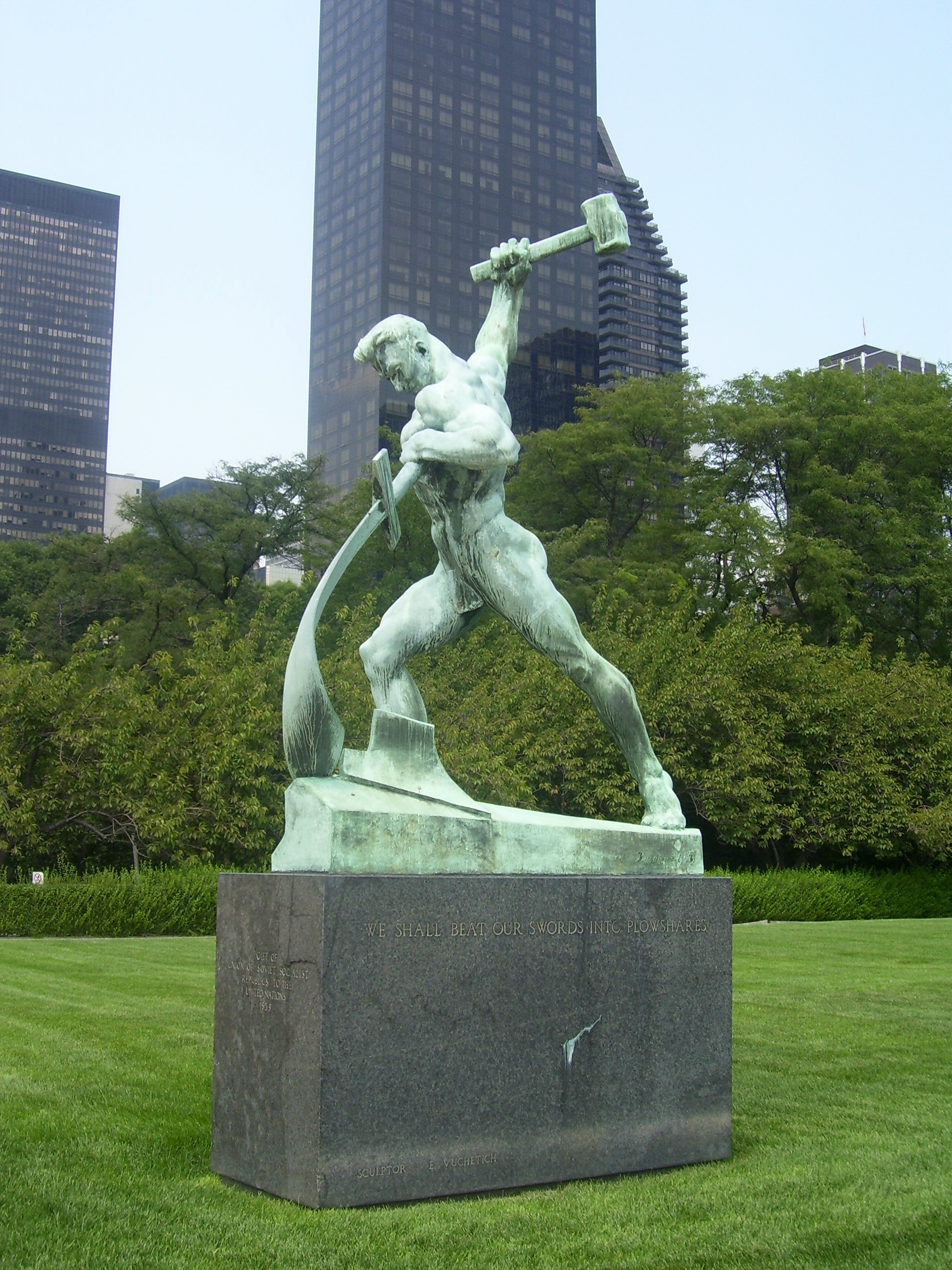
Image-UN_Swords_into_Plowshares_StatueWe must beat our swords into plowshares. We must learn to love others. We must begin to be peacemakers.

Does the mean we don’t protect our loved ones and the vulnerable of the world? Does that mean we become doormats for injustice and power to walk all over?

Of course not.

But it does mean we have to re-imagine our conceptions of power. We have to find that prophetic imagination that animated Isaiah and Jesus and Gandhi and King and Mandela. We need to be able to imagine a gun-free world, a world where mutual distrust and cynicism is replaced with love for our brothers and sisters. Only by imagining a new way of being in the world will we begin to transform this world.

Because nothing screams “lack of imagination” like a gun.

We have to be willing to endure the taunts of those who tell us the way of Christ is unrealistic, utopian, or naive. We have to ignore those who would distort the Gospel by telling us it’s “metaphorical.” We have to face up to those that tell us that this is the “real world” and we have to be “practical” and be willing to say “Get behind me, Satan!”

The only way we replace the fear that has permeated our culture is through love. It’s biblical: “Perfect love casts out all fear.”

We have to be willing to take our call as Christians seriously, and realize that peace and nonviolence begins with us. We have to be the example, just like Jesus was the example. We have to practice love for all people, especially those we term our enemies. We have the live into the role that Jesus blessed: that of peacemaker, of the meek, of mercy, of the oppressed.

Don’t like the idea of that? Take it up with Jesus.

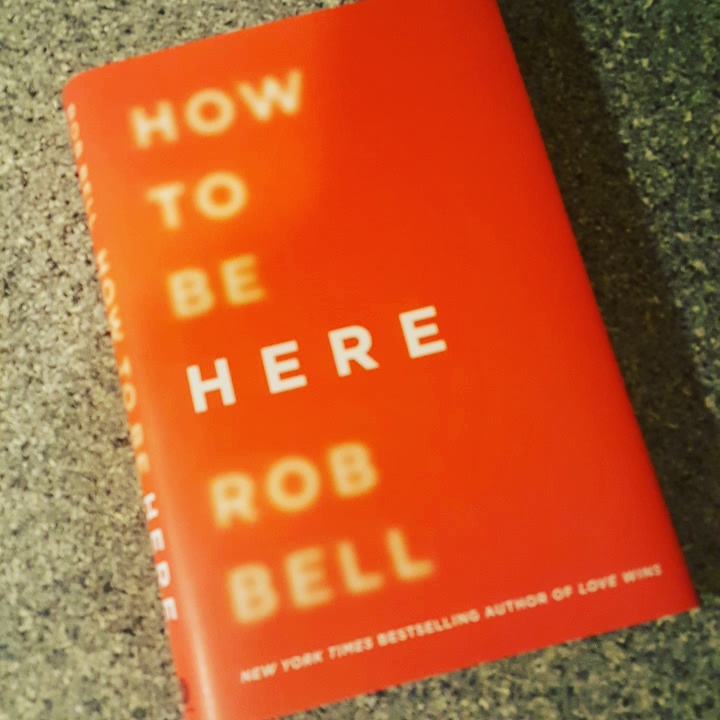
The Bookshelf: How To Be Here

Yesterday, I wrote about attending Rob Bell’s How To Be Here Experience tour stop here in Tulsa on Saturday. Today, I want to take a look at the book he is promoting.

After getting the tickets for the Saturday show from Ari late on Friday afternoon, I rushed out to Barnes and Noble and bought a copy of How To Be Here. I figured, if I am going to the show, I better read the book. And so, I did. I started it at about 6:30 Friday evening. I finished it at 6:30 Saturday morning. This is a pattern for me and Rob Bell books. (I’m really glad he said his next book is measurably longer; it will be nice to spend some time with his work.)

IMG_20160617_181306So, let’s get out of the way what How To Be Here isn’t. It is not a book about Christianity. It is not Biblical scholarship. It’s not theology. It’s not “Christian Living” (which is the heading it is shelved under at B&N.) So if you go into reading it expecting or hoping for any of those things, then you are going to be disappointed.

In the same vein, let’s get out of the way some things that Rob Bell isn’t, as well. Rob Bell is not a church pastor anymore. (Although I would still call him a pastor, albeit in a different way. He said the same in his talk.) He is not an evangelical Christian. He is not a theologian, or a Biblical scholar.

What is he? Well, I don’t want to speak for him too much. But I would say, he is a pastor in a wider sense, to a church, as he described it, without walls or a building. Instead, the church he leads is, in his words, “a group of people…….” He still guides people pastorally; he described that as a motivator for the more intimate nature of this tour, his hope to be able to interact with and hear from actual people, rather than lecturing from a stage. Theologically/philosophically, he is a universalist Christian. He still references the Bible often, both in the book and his talk, and he continues to describe his chief adherence to the Way of Christ.

And so, this book is a commentary on how to live in the world. It is a book that speaks about being yourself more fully. I hesitate to label it self-help, due to the baggage that comes with that term, but if you can think of the most generous categorization of that term, then you could call it self-help. The blurb describes it as a combination of “Spiritual wisdom with practical life advice.” I think that’s pretty accurate.

So, lets talk about this book. The premise is summed up pretty well in the title: Rob wants you to be here, present in this moment, in this life, in this world, in this place and time and context. We can spend a lot of time worrying about the future, and feeling guilty about the past, and those things can prevent us from experiencing life, from loving forward and fulfilling our potential and transcending  what we think we are and are capable of.

The book is split into 9 sections, each expounding on a practice geared towards maximizing your potential and experiencing life fully. It builds, starting with “The Blinking Line,” referring to the cursor in a Word document that blinks at you, waiting for you to type something into existence, seemingly pregnant with possibility and subtly mocking you, all at the same time. It moves from there to the blank page that is the future, ready to be filled, by finding your ikigai, or calling, by developing your craft, by tackling life one thing at a time, but being willing to take big risks, by being humble enough to work your way up from the bottom if necessary, and by taking everyday as a gift, culminating in a call to living fully present in this moment, unafraid, unworried, ready for whatever comes your way, optimistic and hopeful and gracious.

Like all of Rob’s books, it is full of wit and humor and short, catchy sentences and gripping stories and illustrations. He makes short reference to the Bible in several places (reminding readers at one point that he was, after all, once a pastor.)

The whole book is captivating and powerful. The arc of argument is inspiring, and for me, much needed and well timed. Specifically, his section on taking life one thing at a time really grabbed me. Rob calls it “finding your 1.”

I’ll let him set this up:

That’s where you start. With 1.

It’s too overwhelming otherwise. It’s too easy to be caught up in endless ruminations: What if Step 4 doesn’t work? or What if there isn’t money for Step 11 or What if people don’t like the results of Step 6?

You have no idea what the answers are the any of those questions. The only thing that wondering and speculating will do is seperate you from the present moment.

When you begin, the seventeenth step is sixteen steps away. You don’t have to know how to do it, or what it is, or even when it is.

Because the first number is always 1.

Not focusing on the 1 is a huge problem for me. I am all too often thinking far out into the future, planning and stressing and unsure of how I am going to bring all this together or do that thing or figure that out.

But what this section of the book instilled in me is, I don’t need to worry about that stuff right now. It’s not in front of me now. There are plenty of problems right here to solve, and then when you solve the first one, you move to the next. As Rob’s friend Eddie says in the book, “Stop thinking about shit that ain’t happenin’.”

Another good way to think about this is from the great movie The Martian(It’s a movie about outer space. Or course I think it’s great.) At the end of the movie, Matt Damon’s character Mark Watney is speaking to a class of future astronauts of the first day of class. He tells them, “You just do the math. You solve one problem, then you solve the next.”

You just do the math. You stop worrying about shit that ain’t happen’.

When it comes to writing, I am all to often way out in front of myself. What’s the next thing I’m gonna write? How do I follow this up? How am I gonna fill an entire page/post/book etc? And those questions paralyze me, and prevent me from sitting down and just writing what I know and what I have right now.

So now, I find my 1. What is that topic on my head today? What is that thought bouncing around? Write it down. It doesn’t have to be 1000 words or whatever. Just write down. More will come. Share it with the world when it seems right. And don’t worry about what comes next. Find your 1.

This extends to all areas of life for me. Work, home, family, leisure. I have problems to work today. Yes, we will plan and strategize and brainstorm and dream. But ultimately, we will work those problems when they get here. For now, we do 1.

Rob opened all that up for me in this book. Just that alone is big. But combined with everything else, I would highly recommend How to Be Here to you all.

Ok, so I said earlier, this is not a religious book. It’s not a book about Christianity. And that’s true. But I think there is a deeper spiritual point Rob is making, because, as he would tell us, everything is spiritual.

We have to be here, be present in this time and place and world, but that is where God is. God isn’t out in some cosmos. God isn’t beyond this plane. God isn’t out of this world. God is here, now, with us, in this world. But we miss God constantly, because we are constantly moving, and rushing, and worrying about the future, and not paying attention. God is here, and to experience God, we need to slow down and see God where God is. God is in people. God is in nature. God is in the little things that happen everyday that blow you away, or that you can’t explain.

And that’s Rob’s underlying point: be here, because God is here.