“Let Obamacare Fail” Is Immoral

Health care has been at the center of the news recently. President Trump and Congressional Republicans are determined to do….something, mainly centered around repealing the Affordable Care Act, or Obamacare, as it’s known.

These guys have your future in their hands. Yikes.

Yet, they keep failing to do so, lacking the necessary votes to get it done in Congress. So, after last week’s debacle, Trump decided he had enough, declaring that he would just “let Obamacare fail” and that he wasn’t going to own it.

The concept of “letting Obamacare fail” is highly immoral. It strikes against the oath at the very heart of the medical field, which states “First, do no harm.”

Obamacare has real problems with the way it is built and the way it has worked in the real world. But these problems are all fixable. The mandate needs to have better enforcement. Subsidies could be more generous. CSR (cost-sharing reduction) payments to insurers need to be assured and generous as well. Medicaid expansion needs to take hold in all fifty states.

The three-legged stool of Obamacare – universal coverage, subsidies, and the individual mandate – is a proven model. It’s not perfect; we would be better off with Medicare-for-all, with the eventual goal of single payer. But Obamacare, when it is funded and not sabotaged, works. No one can deny it: more people are insured under Obamacare than were before, and that is a unqualified good. No matter what your opinions on health policy, no one can deny that more people (24 million more people, to be exact) having access to affordable, decent health coverage is a good thing for this country, politically and morally.

That’s what makes the attitude of Trump, and the all-out drive of the Republican Party to repeal Obamacare no matter what, so morally problematic. The talking points about rising subsidies and infringements on liberty and massive tax hikes and death panels are wrong and disingenuous. Subsidies are rising no more than they were before Obamacare. Taxes were raised modestly on a few of the richest Americans. Death panels are just a stupid lie perpetuated by national joke Sarah Palin. And the only liberty Obamacare repeal promotes is the liberty of millions of Americans to die without health care access.

As much as they want to talk about Obamacare failing, the facts are just not with them. It’s not failing; the only way it fails is if they continue to undermine it (i.e. by refusing to pay CSRs, or to enforce the mandate.) And in their drive to undermine and repeal it, they are ensuring that those 24 million Americans who got health insurance will now lose it, and put their lives at risk in the process. All so they can cut the very modest taxes Obamacare imposed on the rich.

In essence, the GOP policy outcome is that millions will lose their health insurance so that a handful of the richest people in America can pocket more money. This is highly immoral, and terribly un-Christian. The GOP is choosing mammon over human beings. It’s callous, and history will judge them harshly.

There are those who will accuse me of being partisan, who will try to posit a moral equivalence between both political parties in this health care debate. That argument is wrong. The Democratic Party is far, far from perfect. I have my gripes with it, trust me. But, in the case of health care, there is only one party trying to take health care away from millions of working families, and it ain’t the Democrats*.

Health care is a basic human right. The fact that America is still the only major industrialized nation that doesn’t guarantee coverage for all it’s citizens puts us as a moral disadvantage on the world stage. Obamacare was a small step in correcting that shortcoming. The fact that a sizable portion of Americans thinks that providing health care to everyone – something the richest country in the history of the world can easily do, if we have the will – is wrong and undesirable is a sad commentary on the state of the American soul.

Here’s hoping Trump and the GOP fails, and we continue on the path towards a better future.

*And don’t try to talk to me about abortion. I have a really hard time believing you are “pro-life” if you support and vote for a party that wants to take away life saving health care for millions of people, including millions of children. You can’t be pro-life if you care more about future hypothetical fetuses than you do human beings alive right now.
 

Big Changes Ahead!

As I’ve shared here before, this last year has been one of much change. And in a few weeks, one of the biggest changes of all will be happening in my life.

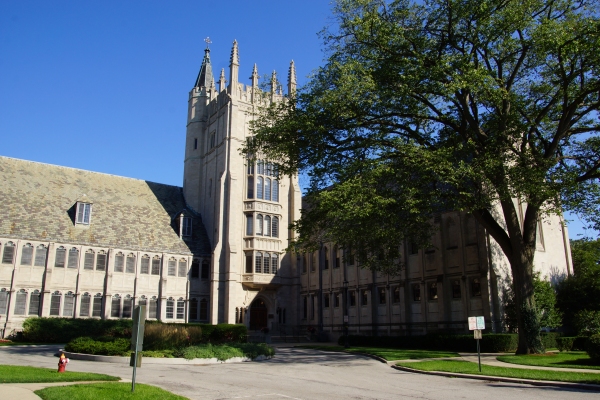
I have been accepted into the Master of Theological Studies program at Garrett-Evangelical Theological Seminary, in Evanston, Illinois, beginning this fall semester. Obviously, this means I am leaving Phillips Theological Seminary here in Tulsa, where I have been enrolled for the last two years. A variety of factors have played into this decision, and I am excited to get up to Chicago and finish my Masters work so I can begin working on my Ph.D! I will miss Phillips and all the wonderful colleagues I had there, but I am also excited for a whole new cohort of peers and teachers at GETS!

At Garrett, I will be doing my thesis work in Constructive Theology, with specific areas of focus on suffering, death and dying, liberation theology, and the work of Moltmann. (Or at least that’s the plan for now.) I  look forward to sharing here how my thoughts are being shaped and growing, and some of my work as well. And of course, I look forward to your feedback on that work!

Leaving Tulsa is not an easy choice, especially because my kids will still be there. I am making this choice fully knowing I am going to have to be a long-distance parent for a while. It’s hard and really sad to be away from them, but I still intend to be an active presence in their lives, and to be in Tulsa as often as I can to be with them.

This also means I am leaving the wonderful community at All Souls Unitarian Church, where I have been employed for the last year and a half, and the campus ministry at the University of Tulsa where I also worked. I hate to leave both of these places, and all the wonderful people I have met there.

I look forward to sharing my Chicago/Garrett adventures here, especially all the exciting/interesting/challenging things I will come upon in my studies. Classes start September 5th, and I am relocating in just three short weeks. Thanks to you all for your support, and if you are in Chicago, give me a shout!

Doubting Our Faith Like Jesus and the Disciples

Doubt is viewed by many American Christians as one of the worst of all sins. To doubt a tenant of the faith, or something found in the Bible, or something one has been told growing up in church, is to reject God’s trust, or at least so it seems to the doubter.

This is a sad state of being. Doubt is one of the most beautiful – and most crucial! – elements of any vibrant faith. Doubt is the critical attitude taken towards any asserted system of belief or knowledge that works to refine and strengthen that system by cutting away the fat.

Yet, that is the problem for many Christians. Their faith is built on shaky moral and intellectual foundations, and the distrust of doubt is a subconscious acknowledgement of that fact. To know that doubting even one small tenant of faith would bring your entire worldview crashing down is to admit the weakness of that worldview; if it can’t stand up to scrutiny, it must be a faith “built on sand and shifting stones.”

The fear of doubt, for many Christians, is the fear that God will cast them out for doubting God’s truth. It is a fear preyed upon by those who tell them “The End is Near,” and those who want to use that fear to get in their wallets. What is Jesus came back just in that moment of doubt, and I miss my chance to be taken into heaven forever, because right at that moment I wasn’t so sure about something? Leaving aside the inherent problematic, and non-Biblical nature of such an apocalyptic worldview, the use of fear to coerce people into faith is surely one of the greatest sins one can engage in. “Fear not,” Jesus commanded. “There is no fear in love,” the author of 1 John writes. To cause others to fear, intentionally, is to go against God. To strike fear into the hearts of good people because they might have doubts is spiritual malpractice.

Especially because, doubt is Biblical!

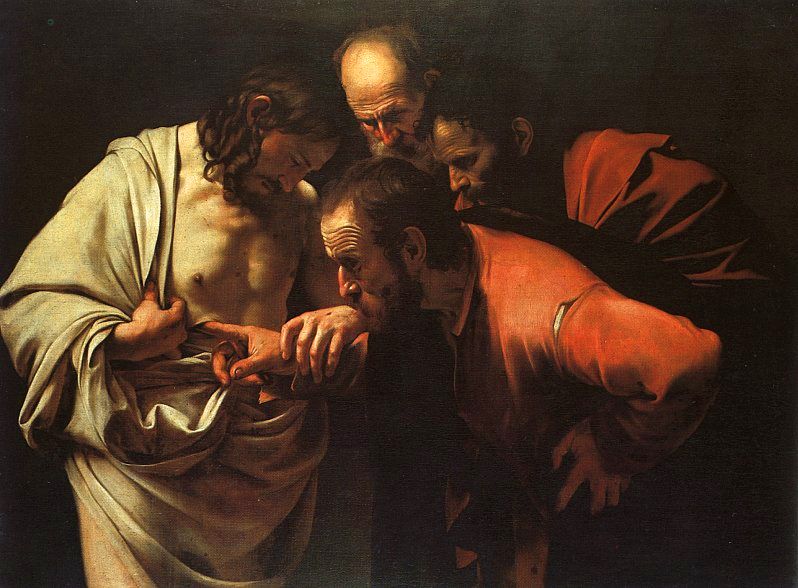
For instance, in the very last chapter of the Gospel of Matthew, we find the resurrected Jesus issuing his Great Commission to the gathered disciples, exhorting them to “Go therefore, and make disciples of all nations.” Yet, just one verse before this, we read that, upon seeing the Risen Christ, some disciples worshipped, “but some doubted.”

“The Incredulity of St. Thomas” by Carvaggio

And that’s it. That’s all it says. It doesn’t say that that doubt was resolved. Jesus doesn’t preach a sermon, or rebuke them, or tell them they have to get it together before they can make disciples.

No, all it says is “they doubted” and then they are commissioned and then they head out. Think about that: even with their doubts, Jesus still sends them out to make disciples. He doesn’t see doubt as an impediment to their ability to carry the Gospel. In being followers of the Way, those who doubt are just as valid as those who don’t.

(But, really, who doesn’t feel doubt, right? Even those who worshipped probably held some doubts.)

But really, think about it this way: those who doubted were probably better evangelizers than those who claimed not to! Remember, doubt is a refining fire. Questioning strengthens one’s beliefs in the long term. They person who engages in self-criticism, questioning and self-doubt can more clearly and firmly answer the questions – and speak to the doubts – of others. The disciple who speaks honestly of their own doubts and questions can more fully relate to other doubters, whereas the person who claims to have all the answers and none of the doubts is often off-putting and demoralizing by comparison.

And really, what was Jesus doing other than doubting the religious assertions and dogmas of his times. Asking questions, challenging, doubting that the religious really did have all the answers to peoples questions. The Way of Jesus is a way of doubts and questions and skepticism.

Don’t be afraid of your doubts. Don’t reject questions. Don’t be afraid to reformulate and reject and rethink. Bring your faith through the fires of doubt, and know you are standing in the tradition of Christ. Know you are participating in the great creating and animating spirit we call God.