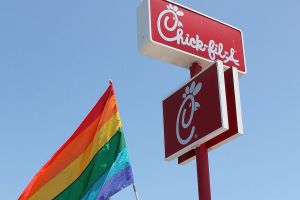
Chick Fil A’s LGBTQ+ decision really doesn’t matter much at all

chick_fil_a_rainbow_flag.0Some quick thoughts in the Chick Fil A brouhaha that has blown up (again) over the last few days as the news that the fast food chain will no longer be donating to the Salvation Army and FCA, organizations that have historically been unfriendly towards LGBTQ+ people:

Chick Fil A refraining from putting funds towards these organizations in favor of instead diverting that money towards organizations focused on homelessness, education and hunger awareness initiatives is not the equivalent of putting that money towards organizations that support LGBTQ+ people (especially LGBTQ+ youth, since homelessness is a priority for them and 40% of homless youth in America identify as LGBTQ+.) Its not like Chick Fil A has all the sudden pledged its bottom line to Planned Parenthood, GLAAD, or PFLAG, and religious conservatives need to stop acting like they have. To do so is to make clear that, first, ones abiding hatred of/disregard for LGBT people in the our country, all of whom are just regular people worthy of all the love and respect one can give. Second, the palpable anger over this decision makes it clear that many Christians continue to shove any and all other social concerns far down the list behind anything related to sex and/or LGBTQ+ people, thus confirming many of the stereotypes and assumptions people make about Christians.

Additionally, the idea that this is in some way about “leftists” or “cancel culture” or some part of some mythical war on Christianity is pretty wild. What this is is something conservatives are usually pretty defensive of: pure capitalism. Chick Fil A saw the writing on the wall, recognizing as they expand further and further across the nation that support for the LGBTQ+ community is very high across the board. If there is some underlying motive at work here, it is the profit motive: Chick Fil A wants to continue making boatloads of cash off of its food, and apparently, they recognized that continuing to stand as the premier anti-LGBTQ+ business entity in the United States was going to begin cutting into the bottom line. So they made a change. And that’s not the fault of some magical leftist-secularist cabal intent on destroying all Christians in America or something; instead, its the power of positive social change meeting the hard realities of modern capitalism.

The last point I want to make is this: I don’t think this decision moves the needle morally in any way, either positively or negatively. I think its a pretty morally neutral action; it’s not some huge moral or ethical victory for the LGBTQ+ community. Chick Fil A still continues to be associated with conservative Christianity. The wheels of capitalism continue to churn. This all plays into the same strains that drive my own personal refusal to participate in boycotts of businesses for various political or social stances. Making moral choices the driver of purchasing decisions is a fool’s errand; there are really no “good” choices when it comes to deciding with who to spend your money, outside of choosing to solely spend money locally with businesses you know and are intimately acquainted with, a choice that is largely unavailable for most people today, due to the structure of modern global capitalism. Unless you choose to completely disengage, you might as well spend money in a way that is economically and logistically viable for your family, and focus your moral energies elsewhere.

Anyways, Chick Fil A not giving money to FCA and the Salvation Army is good thing, as far as any thing good can come from modern capitalism, but really, its a mostly empty gesture that none of us should care much about. Its not worth the elation of the left, or the panicked overreaction of the right. Just like so many things our social media feeds want us to think matter.

From My Thesis: Self-Interest and Voting

For progressives who are especially attuned to situations of oppression and injustice, the plight of rural white working-class people should be a concern. Instead, they are dismissed because of their repugnant political beliefs, with no understanding of how or why they arrived at those beliefs. White progressives still advocate for and stand alongside black Americans, Muslims, or Hispanic people, despite the existence of some poll numbers showing, for instance, the level of antipathy among these groups for the rights of LGBT people.[1] Why is the same consideration not extended to the rural white working class?  Hochschild calls this the ”empathy wall,” that which inhibits the understanding of another’s deep story, and the resultant inability to have empathy or understanding for those very different from us.[2]

Finally, this is a group that is largely disdained and derided by other populations. As noted above, Nancy Isenberg has traced this history of cultural alienation in her book. This has resulted in the determination by advocacy and political groups that rural white working-class people aren’t worth the time. One particularly pernicious narrative applied to them is the idea that they, politically, they vote and support candidates who go against their own interests. This infantilizing narrative robs rural white working-class people of their own agency. To reduce the interests of white working class people to merely economic considerations is to reduce the humanity of these people, and to disparage their ability to make rational choices about their own lives. Additionally, it is a narrative firmly entrenched in a neo-liberal, market oriented world, one where the only legitimate choices to be made (at least by those we look down our noses at) are strictly economic in nature. Christians especially should eschew such essentializing narratives about human beings.

Instead, we need to understand that people make decisions – rational decisions – for a variety of reasons that are ultimately personal for each person. If any economically distressed person chooses to vote for and support candidates or policies that are not directly beneficial to their financial well-being, but instead picks a candidate that speaks to their cultural, social or identity priorities, then it is important to view that as a legitimate and reasonable choice to make, even if we abhor the positions and policies endorsed by such a vote. Even more importantly, if Christians claim to care about these people, then we must understand the real reasons behind these actions, and take real, concrete steps to address them, rather than dismissing them as irrational and self-destructive actors undeserving of our attention. The electoral results of 2016 demand such a response, not to mention the inherent dignity of each person.

[1] Pew Research Center, ”Support for Same-Sex Marriage at Record High, but Key Segments Remain Opposed,” June 2015, accessed March 25, 2019, https://www.pewresearch.org/wp-content/uploads/sites/4/2015/06/6-8-15-Same-sex-marriage-release1.pdf.

[2] Hochschild, Strangers In Their Own Land, 5.

The death penalty is wrong

I’ve gotten to the point where I don’t post political stuff on Facebook anymore, because I just don’t think it does much good in the world. In the case of the news about the Department of Justice reinstating the death penalty for federal inmates, however, I felt this week compelled to speak out as a Christian and a theologian.

One of the most basic ethical positions of the Church has long been an opposition to capital punishment. Catholics, Protestants, Anabaptists, Orthodox: across the board, with few exceptions, all these churches take an official stance opposing the taking of life as a form of punishment. The few strands of Christianity that do express religious support for the death penalty (many of which are politically active in the United States) are well outside the mainstream of 2000 years of the Christian tradition, and are often beholden to and inseparable from the secular state.

The death penalty is wrong, it is immoral, and it flies in the face of God’s good order for the world, an order that includes God’s prerogative to give and take life, not ours. To decide that we can rightly determine when someone deserves to live or die is to usurp the authority of God. It is even worse that this is being done by an Administration that claims to be the “most Christian” administration in history. This action, combined with so many others they have taken over the last few years, make that claim laughable, and reveal them as actually one of the most anti-Christian regimes this country is seen.

I’ll give the last word here to John Howard Yoder, from his essay on the death penalty entitled “The End of Sacrifice”: “Forgiveness is the response to evil dictated by God’s own nature and by Jesus’ example and command. We should seek to save the life even of the murderer fully culpable for the act which society wants to kill him. The death penalty is wrong, not because it is not merited by some, but because merit is not the basis on which, since Jesus, we should decide who has a right to belong to the human race.”