The Struggle for Justice is Also the Struggle for the Kingdom of God

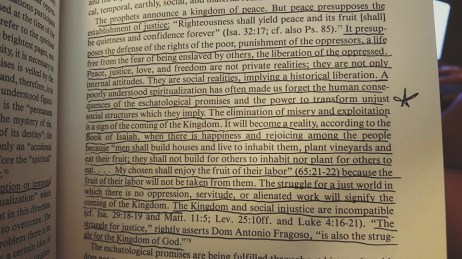
I’m currently reading “A Theology of Liberation,” by Gustavo Gutierrez, and I came across 13631512_566337586879887_1216705277669166885_nan extraordinary passage today. Gutierrez is discussing the tendency of those opposed to the work of social justice by the Church to argue that temporal justice is not a prerequisite for God’s Kingdom, and thus eschatologically unnecessary. Gutierrez disagrees, and writes
the following:

The prophets announce a kingdom of peace. But peace presupposes the establishment of justice: “Righteousness shall yield peace and it’s fruit [shall] be quietness and confidence forever” (Isa. 32:17; cf. also Ps. 85). It presupposes the defense of the rights of the poor, punishment of the oppressors, a life free from the fear of being enslaved by others, the liberation of the oppressed. Peace, justice, love and freedom are not private realities; they are not only internal attitudes. They are social realities, implying a historical liberation. A poorly understood spiritualization has often made us forget the human consequences of the eschatological promises and the power to transform unjust social structures which they imply. The elimination of misery and exploitation is a sign of the coming of the Kingdom. It will become a reality, according to the Book of Isaiah, when there is happiness and rejoicing among the people because “men shall build houses and live to inhabit them, plant vineyards and eat their fruit; they shall not build for others to inhabit nor plant for others to eat…My chosen shall enjoy the fruit of their labor” (65:21-22) because they fruit of their labor will not be taken from them. The struggle for a just world in which there is no oppression, servitude, or alienated work will signify the coming of the Kingdom. The Kingdom and social injustice are incompatible (cf. Isa. 29:18-19 and Matt. 11:5; Lev. 25:10ff. and Luke 4:16-21). “The struggle for justice,” rightly asserts Dom Antonio Fragoso, “is also the struggle for the Kingdom of God.”

Wow. This whole passage stopped me short in my reading (you can see, in the picture, I underlined the entire paragraph.) What an amazingly well-worded defense of the need for social justice! Without it, without the betterment of the world and our fellow humans, God’s Kingdom is not possible. It’s not just God’s duty to bring it; it is ours as well.
The Republicanization of American Christianity, in One Benediction

There were a lot of low points these last week at the Republican National Convention in Cleveland, but perhaps the lowest of lows came the first evening, when prosperity gospel preacher Mark Burns offered up a benediction that quickly veered into blasphemous and offensive territory. Here it is in full, if you can stomach it:

http://www.youtube.com/watch?v=BSeYfchDezc

There are so many things wrong and anti-Christian in there, I don’t even know what to say. Instead, I’ll encourage you to read Pete Enns’ post. Here is a taste:

Messiahs were to “make Israel great again,” but Jesus turned the tables.

His interest was not in reviving a political entity, as if God will only work through the system, but in drawing people of every tribe, nation, and political affiliation into the only kingdom that matters: the kingdom of God, which, as Jesus also said, “is not of this world” meaning it plays by entirely different rules—like justice, compassion, humility, true service and self-sacrifice . . . you know . . . none of the things we normally think about when it comes to American politics.

Thinking that God is aligned with a political party or any political system (including a democratic system) misses a very basic characteristic of the Christian faith. However politically involved Christians may be, those who get it truly know that God never aligns with any politician or political system.

I think Pete gets this absolutely right, and I’ve actually been working on my own post around this kind of theme. When I criticize Trump here, it isn’t to say that Jesus would be aligned with Democrats instead. In reality, Jesus, and by extension, all Christians, are called to a prophetic vocation outside of the political paradigm. The conservative Christian movement in this country has a hard time with this, historically, tying their own hopes to the Republican Party over the last thirty years. The fruits of that unholy union are on display this year, as they are forced to support and prop up one of the most anti-Christian political campaigns in American history.

Anyways, I don’t want to give away too much of my own coming post on this. Go read Pete’s post in full.

On Being a Writer, Part 2

I’ve realized two things about myself, the writer.

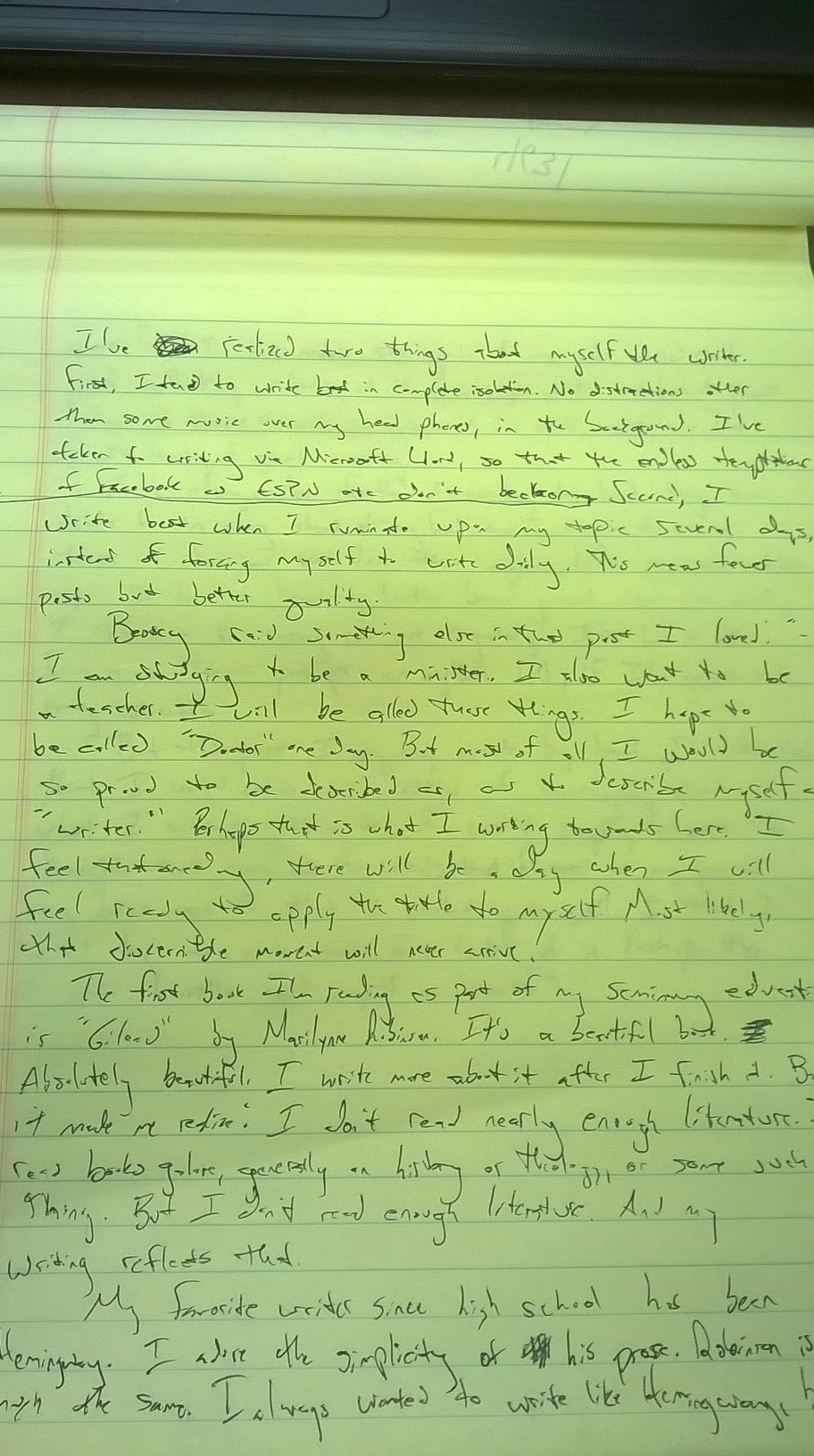
WP_20160202_16_07_52_ProFirst, I tend to write best in complete isolation. No distractions, other than some music over my headphones, in the background. I’ve taken to writing via Microsoft Word, instead of in the browser, so that the endless temptations of Facebook and ESPN don’t beckon. Sometimes even this doesn’t work. I’ve come to sympathize with author Sarah Bessey:

I hear from big and good writers that they require regularity and discipline to write: I am the same way. I know when I write the best stuff (early in the morning) and I know what helps me to write my best stuff (time outside in the wilderness, a clean house, a plan for supper, quiet, solitude) and yet I am rarely in that sweet spot.

Second, I write best when I ruminate upon my topic several days, instead of forcing myself to write daily. This means fewer posts but better quality.

Bessey said something else in that post I loved:

Now that I’ve published two books and countless articles, I have some legitimacy to my scribbling hobby. People call me a writer and the big miracle is that the word doesn’t make me feel like an imposter anymore, I even say it out loud when people ask me what I do (“I’m a …writer….”)

I am studying to be a minister. I also want to be a teacher. I will be called those things. I hope to be called “Doctor” one day. But most of all, I would be so proud to be described as, and to describe myself as, “Writer”. Perhaps that is what I am working towards here. I feel that one day, there will be a moment when I will feel ready to apply the title to myself. Probably, that discernable moment will never arrive.WP_20160202_16_07_58_Pro

The first book I’m reading as part of my seminary education is Gilead by Marilynne Robinson. It’s a beautiful book. Absolutely beautiful. I may write more about it when I finish processing it. But it made me realize: I don’t read nearly enough literature anymore. I read books galore, generally history or theology or some such thing. But I don’t read enough literature. And my writing reflects that.

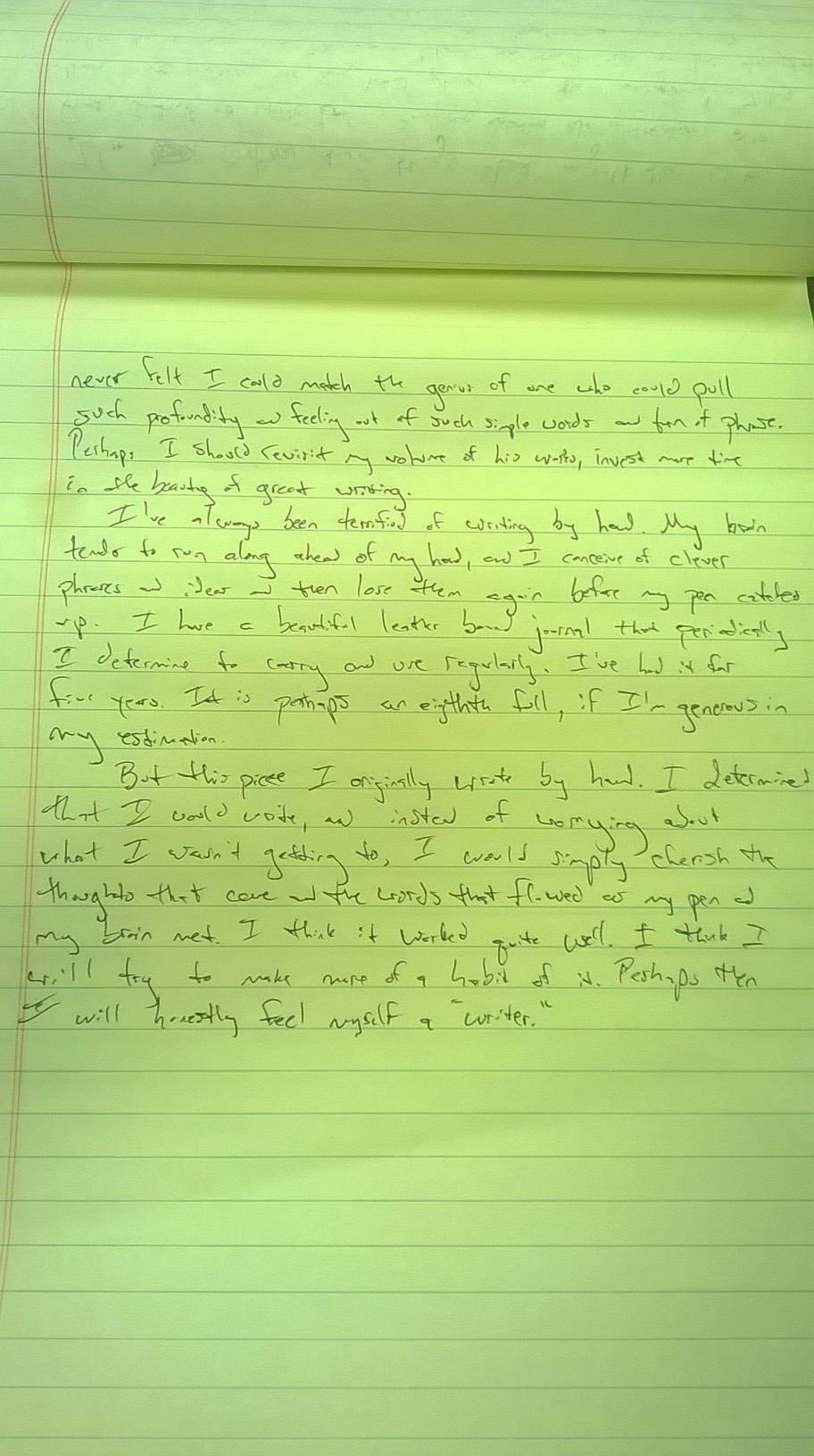
My favorite writer since high school has been Hemingway. I admire the simplicity of his prose. Robinson is much the same. I always wanted to write like Hemingway, but never felt I could match the genius of one who could pull such profundity and feeling out of such simple words and turn of phrase. Perhaps I should revisit my volume of his works, invest more in the beauty of great writing. Perhaps I should not try to be Hemingway.

I’ve always been terrified of writing by hand. My brain tends to run along ahead of my hand, and I conceive of clever phrases and ideas and then lose them again before my pen catches up. I have a beautiful leather-bound journal that periodically I determine again to carry and use regularly. I’ve had it for five year. It is perhaps an eighth full, if I’m generous in my estimation.

But this piece I originally wrote by hand. I determined that I would write, and instead of worrying about what I wasn’t getting to, I would simply cherish the thoughts that come and the words that flowed as my pen and my brain met. I think it worked quite well. I think I will try to make more of a habit of it. Perhaps then I will honestly feel myself a “writer.”