No Right to Forgive, Part Two: Krisis and Questions

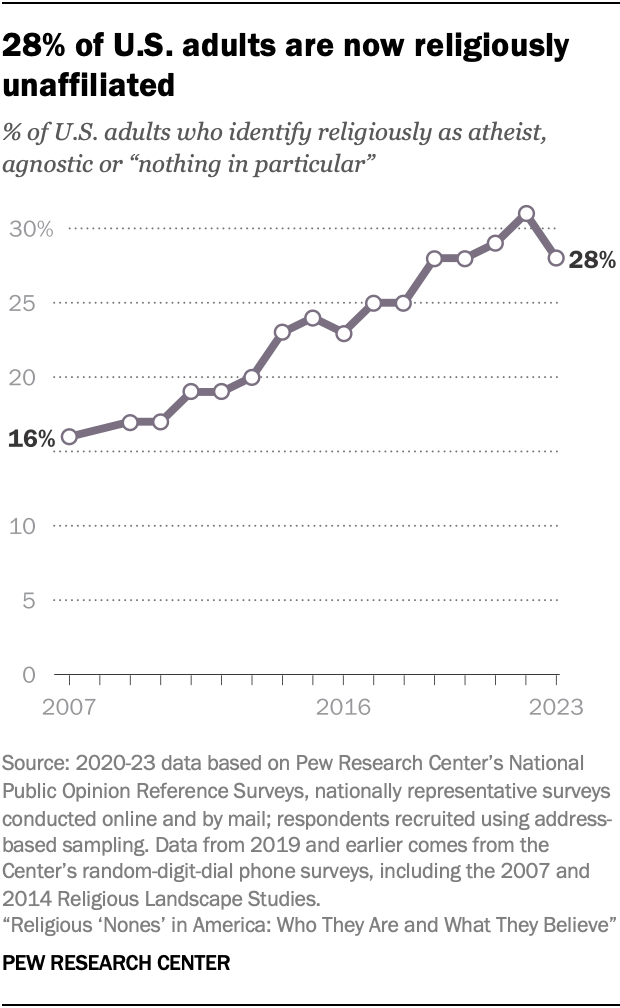
Every so often, Pew Research publishes their National Public Opinions Reference Survey, which includes a section on self-identified religious identity. Famously, this poll has been tracking the rise of the “nones” over the past three decades. Since the early nineties, the number of people self-identifying as unaffiliated with any religion has risen from 5% all the way to 28% in the most recent survey, from late last year.
Obviously, this rapid rise in the number of Americans who no longer identify with any religious faith has been the source of speculation for many breathless articles, books, podcasts, sermons, studies, and other forms of verbal angst among religious leaders, especially on the Christian right. The question “what is driving them away?” has been asked, of course, but more often, the primary question being asked – across the spectrum – is “how can we attract them back?” For many churches, the loss of membership is seen as a problem of marketing. How to compete with youth sports commitments and endless entertainment options and the rise of technology? By entertaining and exciting, obviously!

I don’t even need to say much about how this hasn’t worked. Nor am I here to proclaim “This is why they are really leaving, and that is what the church can do to bring them back!” I don’t have answers for this. As I stated in the first part of this series, I’m not trying to bring any answers to questions around doubt and anger and disbelief. I think a lot of people have really good reasons to not trust the church, to not believe in God, to not want any part of this flawed thing called Christianity any more. The church has worked hard to lose its credibility, and in doing so, has allowed the priorities of capitalism and modernity and nihilism to work wonders on the minds and the souls of people. 

Neither side of the left-right divide in the American church should be nodding their heads here, because both have worked their part in this collapse. I’ve written many times about the failings of the Christian Right, about their capture by right wing politics and the Republican Party and Donald Trump, about their interweaving of the Christian message with nationalism and bigotry and violence, about the numerous scandals around abuse of power driven by their misogynistic hierarchies that work to keep women out of the pulpit and scared to tell their stories. This plays a big, big role in the decline of Christianity in America, and conservatives who are out there bemoaning the secularization of culture need to take a long, hard look in the mirror.

But, the Christian left has largely abdicated the moral arena as well, becoming captured by the political left all too often, and too often more concerned with stripping Christianity of any metaphysical commitments to the point that there becomes very little to recommend Christianity to seekers over, say, just joining the Sierra Club or SDA. The church has to be more than a social justice service agency with all the moral fervor of a California country club. 


All that we’ve encountered so far should be understood as a crisis for the church. When I say crisis, I do not mean something like you would call an ambulance for, or that which causes C-suite types to scramble to put together a team of specialists building a response. Instead, this is a crisis in the Greek sense, a krisis, a moment of decision or choice or discrimination. The church faces a krisis, because the people in the pews are also facing a krisis, and they are choosing something other than church. Not because they are sinners or evil or idolators; but because they are in fact largely good, moral people, who look at the choices the church as an institution has made, and who then encounter a krisis of the heart.

In chapter 6 of The Crucified God, Jurgen Moltmann identifies this as “political and social crisis of the church.” For Moltmann, the crisis facing the church is more than just a question of ethics and social action; it is also a theological and christological crisis, a crisis arising from the church’s understanding of who God is. Our theology inevitably shapes our ethics, and conversely, our action in the world showcases just what kind of God we actually believe in. Consequently, this political and social crisis raises a key question for Moltmann: “Which God motivates Christian faith: the crucified God or the gods of religion, race and class?”

Thinking back to our purpose from the first essay of this series – to think about God in the face of the suffering and hurt of the world – causes us to see just how important this question is, and also to begin to better understand those who deconstruct their faith and reject the church. For the one who stands before the dead body of that child in Dostoevsky, or who sees the news of all the dead children in Gaza, we must ask: which God does this? Those of us who want to posit a loving, merciful and just God must grapple with the reality of those gods of religion, race and class, gods who often find a home in our churches and behind our theology and, most importantly, who come out in our actions. We must remember: those children did not just die unexpectedly. Choices were made, choices that often have those who claim the name Christian behind them. The cry of despair, and the subsequent rejection of God, becomes much more understandable when we begin to realize that the only God many people ever meet is one animated by racism, or bigotry, or hatred, or violence, or love of power. Like it or not, our God – the one we call loving and gracious – is on the hook for those other gods.

Where does Jesus fit into this? Moltmann asks the question: “Who really is Christ for us today?” Any conversation about God must take into account Jesus. But this sets up another crisis. When we look at Jesus, inevitably we also see the cross. In a world of suffering and injustice, we look to the One who we are encouraged to call Savior, and we see more suffering and injustice. Jesus lived among us, and then suffered at our hands. Even he could not escape our false gods, and the death that lurks behind them all. And so our crisis deepens. With Moltmann, we must ask: “What does the cross of Jesus mean for God himself?” 

These crises and questions put those of us who still cling to the name “Christian” in an uncomfortable place. How do we grapple with the suffering of the world, without hand waving it all away with empty pious platitudes and cheerful, oblivious theologies of glory? It is well and good to say that God is a gracious and loving God, that God wishes good for us, that God made all the world and rules over it today. But, again, how do we reconcile those claims with the fact of human suffering and death, and even more so, the suffering and death of the one claimed to be God’s very own Son?


Before we attempt to respond to these questions, a reminder: none of the work being done in these essays is an attempt to “solve” the problem of theodicy; that is, the problem of why suffering exists. I want to offer no solutions, or to try to tell you that this is why things happen, in order to put you at ease. Too often, those in the church want to be the ones who make people feel better, and in doing so, they offer rote answers that, while perhaps temporarily satisfying, ultimately fall apart, especially in the face of real suffering. But this is Holy Week; we are moving towards the death of Christ slowly, and we must not skip over Friday and Saturday to get to Sunday. Our task here is to ask these hard questions, to sit with them and the discomfort they stir up, and ultimately, to try to grapple with who God is if hurt and suffering are inevitable parts of life. Perhaps the place we get to will be comforting to some; to others, our tentative conclusions may still lead us to despair, rage, and rejection. Either response is acceptable to me, as the author. I simply want to wrestle with these questions, because I believe in so doing, we gain the courage we need to push back against that suffering, in whatever small way we can.

Our next move takes us into that which Moltmann refers to as “theism” and “atheism.” These are the two common answers to the crises facing Christians and the church. Our next two essays will explore these ideas, before we turn back to two key statements about the nature of God that, while not looking to provide answers to the question of suffering, instead point us towards trying to understand who God is, so that we can better grapple with death.

No Right to Forgive: Deconstruction, Protest Atheism, and The Crucified God

And what sort of harmony is it, if there is a hell? I want to forgive. I want to embrace. I don’t want any more suffering. And if the sufferings of children go up to make up the sum of sufferings which is necessary for the purchase of truth, then I say beforehand that the entire truth is not worth such a price. I do not want a mother to embrace the torturer who had her child torn to pieces by dogs. She has no right to forgive him. And if that is so, if she has no right to forgive him, what becomes of harmony? I don’t want harmony. I don’t want it out of the love I bear to mankind. I want to remain with my suffering unavenged. Besides, too high a price has been place on harmony. We cannot afford to pay so much for admission. And indeed, if I am an honest man, I’m bound to hand it back as soon as possible. This I am doing. It is not God that I do not accept, Alyosha. I merely more respectfully return him the ticket. I accept God, understand that, but I cannot accept the world he has made.

Ivan Karamazov, in The Brothers Karamazov by Fyodor Dostoevsky

Religious deconstruction has been one of the big buzzwords in Christian media over the last few years. The idea of taking apart your faith, especially a faith full of damaging, difficult, or confusing ideas, ideas that when held up against modern science and social norms and knowledge seem less and less defensible every day, is an enticing one for Christians all across the denominational and ideological spectrum. Books and podcasts and TheoEd talks and all variety of media have been produced to appeal to the deconstructing crowd, helping numerous folks find a new idea of Christianity that works for them, or to leave it behind all together.

Of course, this has also spawned a mirror image media explosion, of still-committed Christians (largely conservative and evangelical) who see the rise of deconstruction as an attack on faith, a buzzy idea hiding the spectre of postmodernism and atheism. This has also led to books and podcasts and megachurch sermons, all of them deconstructing deconstruction, if you will.

I deconstructed my faith, in the early and mid-2010s. In college, as I studied political science, became involved in electoral work and activist causes, and dove into philosophy and academics, the major claims of Christianity – especially the miraculous and bizarre – no longer made sense. Pairing that with a social impact that seemed largely negative and regressive made Christianity deeply unappealing. But I could never shake that intuition I had that God was real, somehow, and the longing for return to the ground of all being never left me. I found church settings and friends who helped me strip away so much of the accoutrement of faith, drilling down towards the words of Jesus and their ethical impact on the world.

Untitled (Ivan’s Dream) by Alice Neel

I like to say today that I’ve largely reconstructed faith. The edifice of orthodox Christianity makes sense to me, and I no longer reject the Trinity, the miracles, the Resurrection, or concepts like salvation, justification, or atonement. This isn’t to say I’ve returned to the faith I held 15 years ago. What I did do was take it all apart, look it all over, and put it back together, in a way that largely resembles the piece it was before, but with some new movements inside it that help it make sense of the way I see and experience and think about the world. All of my past – the faith I grew up with, the years of agnosticism at best, the political schooling and commitments I developed, the deconstruction, the academic dive into theology, the critical voice, the reconstruction – all of it informs and animates the faith I hold on to today. Deconstruction was not an endpoint, nor was it a theological death sentence. For me – and this is just for me – it was a necessary way station on the path to understanding who Jesus was and why he lived and died and anyone cared.


I’m getting a little far afield from what this essay is about, so let me pull us back towards the current. Recently, popular evangelical voices Alisa Childers and Tim Barnett released the book The Deconstruction of Christianity: What It Is, Why Its Destructive, and How to Respond. Childers and Barnett are both former deconstructors themselves, and you can find both of their stories out on the internet in a variety of places. I have not read the book yet, but I’ve read several reviews, a variety of interviews and pieces by the authors, and listened to them speak about it. This isn’t a book review and I’m not really interested in trying to evaluate their claims specifically; my point in bringing them up is to point out that deconstruction is a hot button issue in popular Christianity, all across the spectrum. For a while, the dominant strain about it was positive: a lot of stories about deconstructors and their experiences. Recently, the backlash in more conservative places has started to supplant that positive reception, and you see a lot of apologetics that frame their work as a response to deconstruction. Rarely are these defenses of the Christian message per se; more often, they are point-by-point critiques of deconstruction stories, or even more common, “How-To”-style pieces for those who know and love someone going through deconstruction.

One last point on this debate: one piece I read by Childers was an article at The Gospel Coalition, titled “Help! My Loved One is Deconstructing.” The piece provides five statements defining who deconstructors are, and the fifth one is “Deconstructors are Rebels.” Here is what Childers writes: “For many, deconstruction is about self-rule. They refuse to bow their knees to the sovereign Lord. No one, including God, gets to tell them what to believe or how to live.”

Ivan Karamazov was a rebel in this vein, although to call him a deconstructor would probably be too mild a phrase to use. Ivan rejects that sovereign God, not from disbelief, but because of his deeply held sense of compassion for those who suffer in this world. In the passage that opens this essay, Ivan speaks to his younger brother Alyosha after witnessing a serf child being killed by dogs at the direction of his master, after the child accidentally harmed one of his master’s dogs. Ivan (and perhaps all of us) cannot conceive of a good God who made a good world in which children are tortured and killed by a fellow human being.

The Night Before The Examination by Leonid Pasternak

Perhaps you feel this way looking at the crisis in Gaza. One does not have to take a political position on the status of Israel and Palestine to be struck by the horror of the knowledge that, in almost five months of warfare, over 12,000 children have died, or that many thousands more are actively starving. Where is God in this? 

I started this essay with a touch on the deconstruction issue because critiques of deconstructors like those levied by Childers and Barnett fail to take into account the Ivans of the world. For instance, this is how megachurch pastor and author John MacArthur describes deconstructing in a sermon:  “What I hear is this, and I read many of these testimonies this week: “I had a bad experience at church.” It all comes down to experience. It all comes down to what everything comes down to in this culture, and that’s “me,” that’s “me.”” Macarthur’s sermon is long and theologically dense and Scripturally informed. But it is, at its core, unserious, just like I feel sure that Childers and Barnett’s book is also unserious. The anti-deconstruction crowd seems to think all those deconstructing are just ignoring the “obvious” truths about God and Jesus that they seem to have such a firm grasp on. But how would they explain 12,000 dead children in Gaza? How would they look Ivan in the eye and explain the death of that child? By reciting well-trod pieties about sin and salvation and a loving but wrathful God?

I struggle with these kinds of questions, even today, even after deconstructing and reconstructing, even after a degree in theology and a thesis focused on the question of suffering and death. Every day, despite it all, I am left with a lingering question: why must so many suffer? Where is God? Why does God allow it all? 

I don’t really have any good answers to these questions, and this series of essays will not be an attempt to try to do so. Christians have been trying to do so for 2000 years, and while we have some interesting attempts, we don’t have a lot of good, satisfying answers- at least, not ones that are intellectually serious. I do think there is something to be said for sitting with these questions, for fully thrashing around in the consequences of sin and death in the world, and for trying to understand why. Maybe we’ll do so and you’ll come out the other side with no confidence in God. I think that’s highly likely for many, and no amount of Scriptural jujitsu from the Childers and Barnetts and Macarthurs of the world will do that. A mother whose child died today in a missile strike in Gaza will not be comforted to know that God wants her to proclaim Jesus Christ her Lord and Savior. Recognizing that those who cry out with Jesus, “My god, why have you forsaken me?”, do not give one shit about your idea that they are rebels against God is one small step towards deconstructing your anti-deconstruction instincts. 


My father-in-law died last summer, after a three year battle with cancer. One afternoon during the last week of his life, as we made the hour drive to Cushing to spend a little more time with him, my wife asked me “why is this happening to him? Why does he deserve this?” We had a little bit of conversation, around the randomness of the universe and the lack of any sense of just deserts, especially in cases like terminal cancer. But I was unsettled, as I sat there in the passenger seat and thought about all the theology I had read and studied, all the Scripture I had meditated on. I thought about my thesis, how I wanted to grapple with the problem of suffering and what it means for God. I thought about my turn towards process theology and the concept of a limited God. I thought about Jurgen Moltmann and the Crucified God, who suffered and dies with us, in solidarity. I thought about God’s pure radiance of love for all of creation. I thought about theories of atonement, and the introduction of sin into the world, and psalms of lament, and Job’s conviction of God.

And I thought to myself, no one gives a damn right now. None of that means very much to someone watching their dad – a Christian man, a good father, a kind, compassionate and loving human being – succumb to cancer before he turned 65. All that reading and studying and glorified academic excuse-making was rather meaningless on that two-lane highway in rural Oklahoma in early August. 

Nevertheless, just as I did over a decade ago, when I pushed away my faith and yet couldn’t shake that nagging feeling that God was still out there, somewhere, doing something, so did I feel in that car, and so do I feel today reading the news out of Gaza. God is still just…there. And so is death and suffering. And the Bible tells me God is love, and God is merciful, and God is just. And just how the hell am I supposed to reconcile all these things that I know to be true?


Jurgen Moltmann was drafted into the Nazi army at 16 years old, and was held by the British as a POW for three years after the war ended, during which time he absorbed the news that his country, the one he had fought for, had gassed 6 millions Jews. He became a Christian in that POW camp. After his release, he returned home and he went to Gottingen and studied theology. And all the while, he struggled to understand: what God is it that stands aside as human beings do such things to each other?

I first read his book The Crucified God in 2015, just as I was in the midst of deconstruction, but much closer to reconstruction than I knew. Moltmann is contending in this book with the problem of suffering, and does so through the lens of the Cross. Few works of Protestant theology in the 20th century were as pivotal as The Crucified God, and it certainly had a large impact on me. I’ve here numerous times about the impact of this book on my thought, and it influenced my academic work in seminary deeply. I’ve also run up against what I see as the limits of Moltmann’s thought, especially in the past couple of years as I’ve embraced the work of theologians like Stanley Hauerwas, John Howard Yoder, and Karl Barth.

The book centers around a chapter that shares a name with the book, and which takes up over 100 pages in the edition of the book I have. This chapter is the crux of Moltmann’s argument: that Christ’s Cross is the paradigmatic revelation of who God is, and what God is like: namely, that God is One who suffers and dies with humanity, in solidarity with our own suffering and dying at the hands of sin. This was a monumental idea when Moltmann published it in 1974. Moltmann had completely deconstructed and discarded the idea of an impassible God, a God who cannot and will not be changed or affected by Creation. The Unmoved Mover had been the primary theistic concept of God since Aristotle at least, and here was a German academic asserting a whole new concept in a way that could not be dismissed or written off. Here was a man who had grappled with the reality of Auschwitz as he thought about God, and had refused to be turned aside by the rote answers of traditional Christianity or postmodern atheism. This work could not, and will not, be dismissed. We must take the idea of a Crucified God seriously.

I said before, and I mean it still: this series of essays will not be drawing answers from Moltmann to try to solve theodicy. I originally conceived of this series as a full breakdown of all of chapter 6 of this book, but as I worked through it, I found myself returning to those difficult questions: how does any of this matter to the hurting and the suffering? What does a suffering God have to offer to a suffering world? I don’t know. I don’t have answers. I tried to press through and find some comforting ideas to fill these essays with. But I couldn’t and so I won’t. 

These days, I affirm the Creeds of the Church, and stand well within 2000 years of theological tradition on questions such as the Resurrection, the Incarnation, and the Trinity. But I still struggle every day with doubts so vast and so deep, they should crumble this edifice of faith right off its foundations. I guess that they haven’t done so is part of the Mystery that we talk about every week when we share the bread and the wine. I want to lean into both sides of that feeling in this series. I’ll only be tackling about half of the chapter, avoiding the answers (if they could even be called that) of the back half and focusing instead on Moltmann’s critique of traditional forms of theism and his affirmation of what he calls “protest atheism”: the well-founded and just cry of anguish from those who know that the suffering of the world is undeserved and that God must be put on the stand to answer for Creation. My goal here is simple: to affirm those who question and doubt and deconstruct, not because I think God doesn’t exist, but precisely because I know God does, and because of that, I think those who suffer and questions deserve to be taken a little more seriously than many mainstream Christians want to take them.

Today marks the beginning of Holy Week, the days leading up to Jesus’ betrayal, death and Resurrection on Easter Sunday. We’ve just been through Lent, a time of fasting and meditation on the theme of mortality. Every year during this time I turn back to The Crucified God. This is why I wanted to spend this week writing through this book that has been so important to me. During this week, we journey with Jesus, through the Last Supper on Thursday night, through the Stations of the Cross into Friday morning, before Jesus breathes his last midday on Friday. We then must dwell in the grief of defeat, through the darkness of Saturday, before the sun breaks the horizon anew on Easter morning. As we remember the suffering death of Christ, there is no better time to contemplate just what this all means, not just academically, but for our world. Why does Easter matter? Or, even more importantly, why does Good Friday matter? What is in it for those who hunger and thirst and suffer and die? Those are the questions I hope we can contemplate this week.

God never calls us “filth”

My city is currently gripped by grief over the death of a local LGBTQ+ teen named Nex Benedict. A couple of weeks ago, Nex was in a fight at school with three other students, and after sustaining some sort of head injury, died at the much-to-young age of 16. Nex was non-binary, and variously used she/her and they/them pronouns. A lot about Nex’s death is still not known, but what is known is this: a child died, and people in my state (and across the entire country) are deeply grieved by the ending of a life too soon, no matter the circumstances around that death.

Nex Benedict

Of course, when I say “my city” or “my state”, I wish I could say I was referring to everyone who lives in these places. But, as is far too often the case in Oklahoma, this is just not the case. Nex’s death, and the subsequent grief, has caused some fearful and small-minded people to react in hate and revulsion, as if they know deep within their souls that their continued actions and words about our LGBTQ+ siblings somehow contributes to deaths like Nex’s. Many of these same people want to appropriate the name “Christian” to lend support to their continued, backward attempt to turn LGBTQ+ people into an “other” who is outside the bounds of those they are committed to loving, protecting, and respecting. It is a heresy to use the name of Jesus Christ in this way, but one so common that many fail to see it for what it is: the opposite of the Gospel.

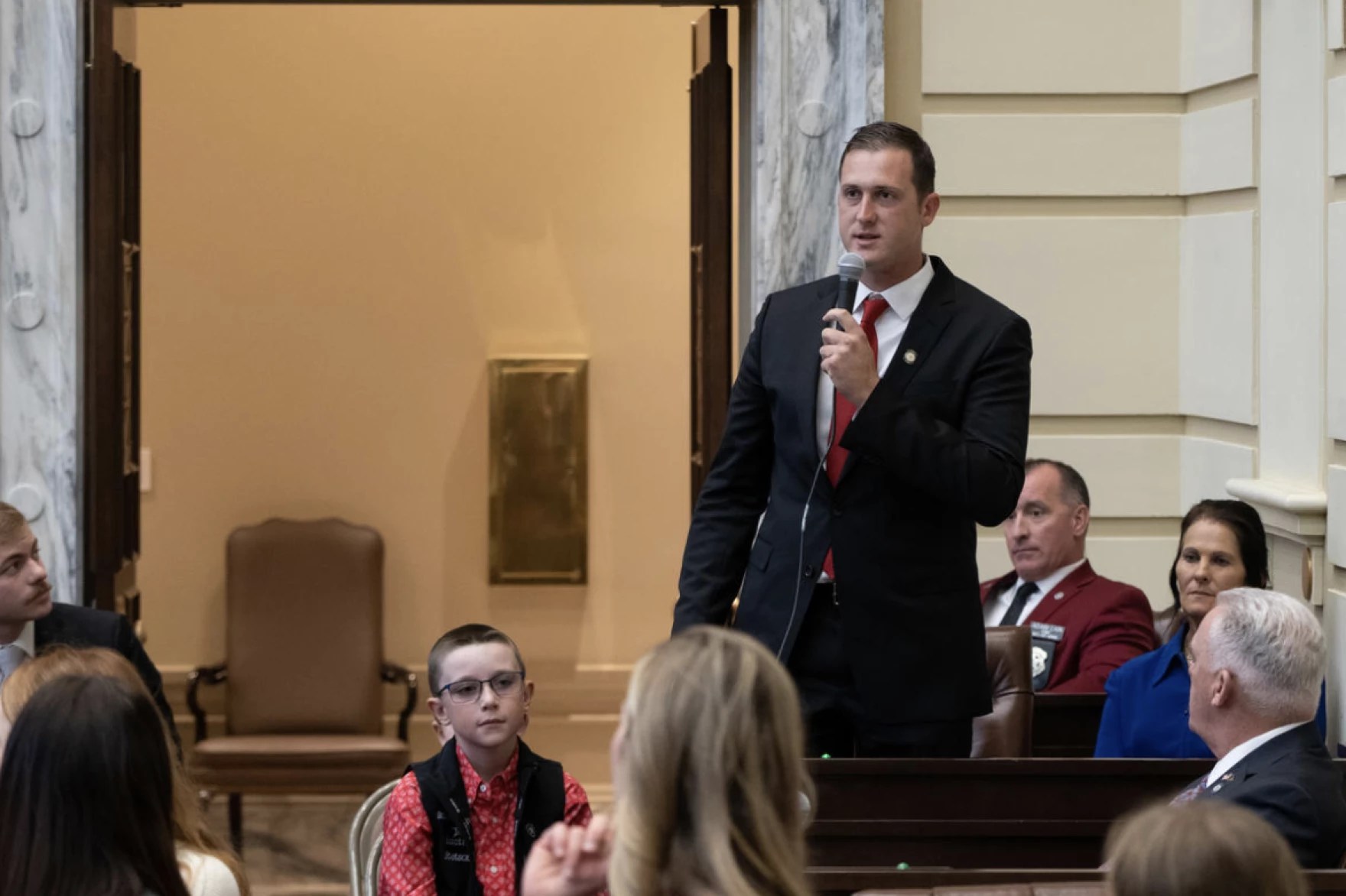
One of these heretics is state Senator Tom Wood, a Republican from Tahlequah (about an hour east of Tulsa.) In the wake of the death of a child, Senator Woods decided that now was the appropriate time to use the word “filth” to refer to LGBTQ+ people like Nex, and like a number of his own constituents that he supposedly was elected to represent the interests of (he clearly doesn’t take that part of his job very seriously, at least when it comes to people who look, think, believe or love differently from him.)

Filth Oklahome State Senator Tom Woods

Senator Woods has a very distinctive political theology he laid out in his remarks, one that is remarkably common in the places where a lot of Christians are found today: “We are a religious state. We are going to fight to keep that filth out of the state of Oklahoma, because we’re a Christian state. We’re a rural state. We want to lower taxes, and for people to live and work, and to go to the faith they choose.” This was the Senator’s answer to a question about Nex and the effect of legislation pending before our legislature here that places restrictions on LGBTQ+ people in Oklahoma.

Let’s just be really clear about this: we are not, in fact, a Christian state. I have many beloved friends here in Tulsa, and in other parts of the state, who are Jewish, or Muslim, or not religious at all. Our state, following the wise example of the First Amendment to the US Constitution, avoids establishing a state religion, and is constructed on a liberal democratic framework that presupposes the freedom of people to engage in whatever religion they choose to, without the state imposing one on them from above. This means that, in lawmaking, the state should not be enacting laws restricting the rights of people not just to practice their faith as they see fit, but their right to live their lifes in the way they choose to do so insofar as that living doesn’t restrict someone else’s right to do so as well. What this means is, kids like Nex Benedict have a right to exist just as they are; the fact that Nex was LGBTQ+, and went by certain pronouns, is completely and reasonably within their rights.

But, our leaders like Senator Tom Woods and Governor Kevin Stitt would like to restrict these freedoms, and more so, they would like to cast moral opprobrium on people like Nex, and worst of all, they want to do so in the name of Jesus Christ. As a Christian myself, let me just say, this is the worst kind of heresy, and aggrieves me deeply as a person of faith. I would never want the God I worship – the God of unconditional and boundless love, seen most clearly in the example of Jesus Christ, who loved and served and died to show us the full extent of God’s regard for us – to be used to denigrate and demean anyone, but especially not the most vulnerable among us. Our God is a God of the lonely and the oppressed, of the outcast and the marginalized, of the orphan and the widow and the immigrant. Our God tears down the mighty – the Senators and the Governors – in favor of the weak and the meek among us. Our God abhors empty worship and showy faith, and loves those who do justice and love kindness and walk humbly. Our God stands on the side our LGBTQ+ siblings, because God stands on the side of those who love wholly and without reservation, and against those who would restrict love and the welcoming of all peoples into God’s family.

God never calls people filth; God always comes to us with love, and calls us to act in the same way. Please send your prayers towards the family and friends of Nex Benedict, but also spare a prayer for the soul of Tom Woods; his heresy is dragging him down a bad road.