
The following is a paper I wrote last semester, for my Introduction to Theology class.
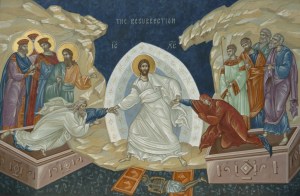
The Resurrection of Jesus Christ from the dead is at the heart of the Gospel story. This story, and the reality it invokes, defines Christian thought and sets the faith apart in a special way. St. Paul write to the Corinthians, “If Christ has not been raised, your faith is futile and you are still in your sins” (1 Cor 15:17 NRSV). But what does it mean that Christ has been resurrected? Is this a claim asking believers to suspend their understandings of metaphysical reality of life and death and accept that a fleshly body died and was reanimated two thousand years ago? Or does it mean something more? And if so, what? The Resurrection is crucially important to the Christian faith, not because it reveals a magic-working God, but because it reveals a God who stands in solidarity with human suffering, and consequently, proclaims hope to humans amidst our suffering.
 The writings of Paul are the earliest Christian writings we possess today. Written decades before the Gospels, Paul’s undisputed letters (Romans, 1 & 2 Corinthians, Galatians, Philippians, 1 Thessalonians, and Philemon) provide the earliest lens of what the church believed about Jesus, at a bare minimum. Surprisingly, there isn’t a lot. Ehrman relates what isn’t in Paul:
“We hear nothing here of the details of Jesus’ birth or parents or early life, nothing of his baptism or temptations in the wilderness, nothing of his teachings about the coming Kingdom of God. We have no indication that he ever told a parable, that he ever healed anyone, cast out a demon, or raised the dead. We learn nothing of his transfiguration or triumphal entry, of his cleansing of the Temple, of his interrogation by the Sanhedrin or trial before Pilate, of his being rejected in favor of Barabbas, of his being mocked, or flogged, and so on.”
We do, however, hear of the Resurrection, as one of the few important events surrounding Jesus that Paul describes. The longest and most important Pauline explication of the Resurrection can be found in 1 Corinthians, chapter 15, which was quoted above. This chapter serves as the center of Paul’s argument in the Epistle, and presents the Resurrection of Christ as the forerunner to the coming resurrection of all human beings at Christ’s Second Coming. His full account of the Resurrection tradition is “that Christ died for our sins in accordance with the scriptures, and that he was buried, and that he was raised on the third day in accordance with the scriptures, and that he appeared to Cephas, then to the twelve. Then he appeared to more than five hundred brothers and sisters at one time, most of whom are still alive, though some have died. Then he appeared to James, then to all the apostles. Last of all, as to one untimely born, he appeared also to me” (1 Cor 15: 3-8 NRSV). Notice that Paul’s account of his own encounter with the resurrected Christ does not need to be differentiated from the appearances that are recounted in the Gospels themselves; Paul understands it to be of the same form and importance.
The Resurrection sees great further development across the four Gospels included in Scripture. First, in Mark, the earliest of the Gospels, we get little more than we see in Paul. Chapter 16 tells the story of three women coming to the tomb and encountering a heavenly messenger who tells them Jesus is resurrected; however, many scholars now believe this chapter to be a later interpolation, which means originally Mark most likely included no Resurrection story.
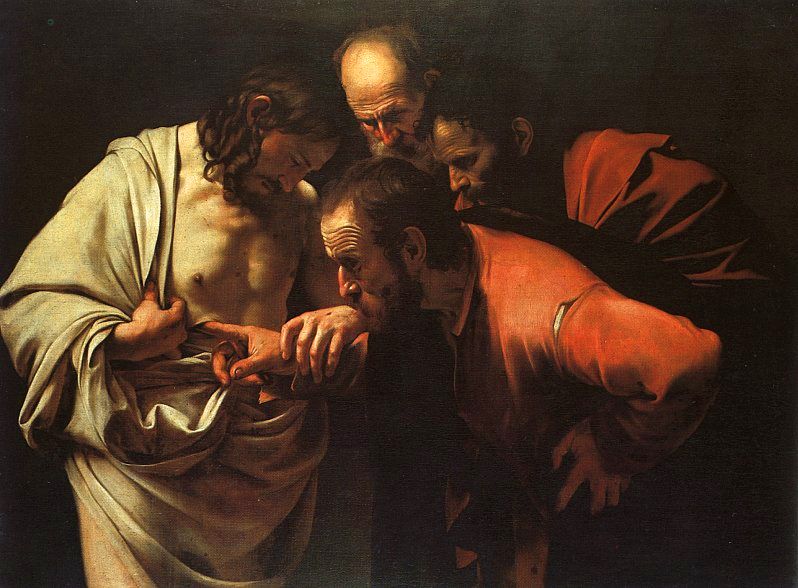
Matthew, the next earliest Gospel, includes a resurrection Jesus, who appears to his followers and gives them the Great Commission, whereupon the Gospel story ends. Luke has a resurrected Jesus who appears to two disciples on the walk to Emmaus, and then eats with them. Later, he appears to the full group of disciples and implores them to touch him, saying “Look at my hands and my feet; see that it is I myself. Touch me and see; for a ghost does not have flesh and bones as you see that I have” (Luke 24:39 NRSV). He then goes on to ascend into heaven. Finally, in John, Jesus is resurrected, and has many appearances to a great variety of people, including doubting Thomas, who sticks in hands in Jesus’ wounds and finds him to be a real, flesh-and-blood body. In this last Gospel, the story of Jesus’ Resurrection appearances goes on for two chapters. How far we have come from Paul’s bare account of the Resurrection, written half a century earlier!
The preceding inventory of Resurrection stories from Scripture serve to show that a uniform, clear understanding of the nature of the event was disputed and unclear even within the first hundred years of Christian tradition. What can we discern from these stories today, but more importantly, what do they mean to us today? Clearly, Paul’s understanding that Jesus’ Resurrection was but the first act in a rapidly approaching general resurrection has been proven false. And scientific advances over the last 500 years – in biology, physics, and cosmology – preclude a literal understanding of a dead body reanimating and ascending upwards to a heaven from fitting within a rationalistic worldview. So, what was the Resurrection, and what does it mean?
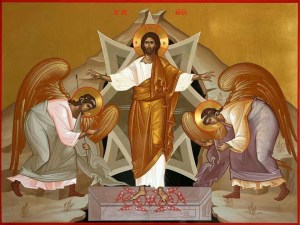 Tyron Inbody provides some powerful understandings of the event in The Faith of the Christian Church. “The New Testament does not speak of the resurrection directly.” Throughout Scripture, no physiological explanation of Jesus’ body is given. Thus, anyone who claims a physical reanimation of Jesus is speculating extra-biblically. Reason cannot be shed here. “Jesus was not resuscitated; he was resurrected.” What we know about the Resurrection, then, must only be speculation, formed within the bounds of reason, tradition and experience. “The resurrection is an inference; no one saw it.”
For Inbody, the theological significance of the resurrection turns on a non-physical understanding of its process. “The idea of resuscitation completely misses the theological meaning of the resurrection.” The resurrected person was most definitely Jesus; the Gospel stories place importance on the moment observers recognized Jesus: “there was a continuity of identity between the one who died and the one raised.” But that doesn’t mean it was the literal body that had hung on a cross appearing; in fact, to say so would defeat the importance of Resurrection story for Inbody. “It was his body transformed from one mode of existence to another, a new mode of physicality or a new mode of corporeality.”
The transference of Jesus’ identity to a new form of being, beyond death and a defeated human body, reveals the power of God over death and sin, not as a destructive power, but a recreating and reforming power. “The resurrection of Jesus Christ is the beginning of God’s great work of redemptive transformation, the seed from which the new creation begins to grow…God does not annihilate the past and death but transforms them, releases new power, makes them into a new creation.” Explaining scientifically how the resurrection happened isn’t what’s important; all that matters is that “something happened,” something that God did to defeat death, not in some other plane of metaphysics, but here in our world, as we understand and experience is now. “Though exactly what happened is beyond our understanding, it is an event affecting history.”
So, what does “what happened” mean for us? We can look back to Scripture for the answer: “Consider him who endured such hostility against himself from sinners, so that you may not grow weary or lose heart.” (Hebrews 12: 3) The resurrection of Christ reveals the fulfillment of God’s solidarity with those who suffer, in that death and sin does not have the final say. Instead, God reassures those who suffer by reminding them of God’s own experience of suffering, and God can work with those moments and experiences to create a new, better world.
Karen Baker-Fletcher understands this aim of God. “For many,” she writes, “the passion of Jesus Christ during his torture and crucifixion has meaning because they take comfort in the incarnation of God, a God who empathizes with their own experiences of being sinned against.” Baker-Fletcher uses the story of the contemporary lynching of James Byrd Jr by white supremacists in Texas as an example of God’s identity with the oppressed, and the solidarity God shows with those who sin, and with those who suffer from that sin. In the story of Byrd, but also in the story of his killers, is shown a God who weeps along with us. God weeps because God also experienced suffering, torture, and eventually, death, the end of fleshly existence, the literal embodiment of meaninglessness, which is the pathological human fear undergirding much of our actions.
But out of meaninglessness, God creates meaning. Only through resurrection can the experience of suffering and death be redeemed. Hope arises when we understand that God can take the suffering and death we see around us, and work for something better. This is not to excuse the sinful actions that so often cause suffering; but, instead, it is a word of hope for the oppressed, and a word of caution for the oppressors. Hope, in that God will remove the hand holding the weak in bondage; and caution, in that no matter how hard they try, the oppressor cannot win history on the backs of others. God’s love shines through the Resurrection, proclaiming victory for life for all peoples. “God, who is all-inclusive in God’s love for the world, experiences the suffering of all and graciously offers transformative visions of faith and courage to the world.”
The Resurrection was not a physical reanimation of the body of Christ that showcased the power of God over the laws of nature, in an effort to subordinate our fear of death to some hyper-rational faith in a magician God. This understanding of Resurrection isn’t comforting to those who suffer, but is instead terrifying, asking us to believe something many of us cannot in the vain hope that it will come true. No, the Resurrection of Jesus is the story of God recreating the world in a way that ensures that death does not get the final word, but instead, love does. Jesus rose from the dead in the view of his disciples not as a body, but as the ideal of God’s victory for them, the oppressed, as a liberation from the death-dealing powers of the world. Resurrection is important, because, as Paul wrote, it reminds us that “neither death, nor life, nor angels, nor rulers, nor things present, nor things to come, nor powers, nor height, nor depth, nor anything else in all creation, will be able to separate us from the love of God in Christ Jesus our Lord” (Romans 8:38-39 NRSV).
Bibliography
Baker-Fletcher, Karen. Dancing with God: The Trinity from a Womanist Perspective. St Louis: Chalice Press, 2006.
Ehrman, Bart D. The New Testament: A Historical Introduction to the Early Christian Writings. 6th Ed. New York: Oxford University Press, 2016.
Inbody, Tyron. The Faith of the Christian Church: An Introduction to Theology. Grand Rapids: William B. Eerdmans Publishing Company, 2005.

 Justin DaMetz