As things have been happening across our country in response to the murder of George Floyd at the hands of the police in Minneapolis last week, I have been sharing my thoughts on Facebook. I have decided to share them here, as well, going back a few days. Here is what I posted Wednesday:
As I think today about George Floyd in Minnesota, and Christian Cooper in the Bramble, and Ahmaud Arbery a few weeks ago in Georgia, I think this becomes an important time to cede my voice to that of Dr. James Cone and his idea of our Black God:
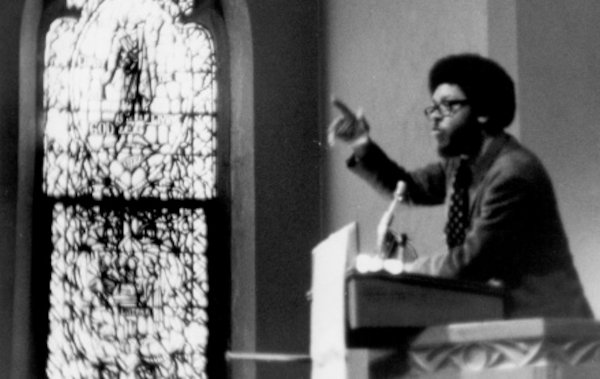
Dr. Cone preaching during his time as a student Garrett-Evangelical Theological Seminary
“The blackness of God means that God has made the oppressed condition God’s own condition. This is the essence of the biblical revelation. By electing Israelite slaves as the people of God and by becoming the Oppressed One in Jesus Christ, the human race is made to understand that God is know where human beings experience humiliation and suffering. It is not that God feels sorry and takes pity on them (the condescending attitude of those racists who need their guilt assuaged for getting fat on the starvation of others); quite the contrary, God’s election of Israel and incarnation in Christ reveal that the liberation of the oppressed is a part of the innermost nature of God. Liberation is not an afterthought, but the essence of divine activity.
The blackness of God means that the essence of the nature of God is to be found in the concept of liberation. Taking seriously the Trinitarian view of the Godhead, black theology says that as Creator, God identified with oppressed Israel, participating in the bringing into being of this people; as Redeemer, God became the Oppressed One in order that all may be free from oppression; as Holy Spirit, God continues the work of liberation. The Holy Spirit is the Spirit of the Creator and the Redeemer at work in the forces of human liberation in our society today. In America, the Holy Spirit is black persons making decisions about their togetherness, which means making preparation for an encounter with whites.
It is the black theology emphasis on the blackness of God that distinguishes it sharply from contemporary white views of God. White religionists are not capable of perceiving the blackness of God, because their satanic whiteness is a denial of the very essence of divinity. That is why whites are finding and will continue to find the black experience a disturbing reality. (…)
Those who want to know who God is and what God is doing must know who black persons are and what they are doing. This does not mean lending a helping hand to the poor and unfortunate blacks of society. It does not mean joining the war on poverty! Such acts are sin offerings that represent a white way of assuring themselves that they are basically ‘good’ persons. Knowing God means being on the side of the oppressed, becoming one with them, and participating in the goal of liberation. We must become black with God!”
A Black Theology of Liberation, Dr James Cone, pgs 63-65
As Dr. Cone goes on to say, this “becoming black with God” is not the work of our hands, but the work of God and God’s grace, righteousness and justice for God’s people. To be a part of God’s work in this world – God’s work for, with, and as an oppressed person – means we must see the culture of racism at work when people like Ahmaud and George lose their lives, or people like Christian have their lives threatened, all because of the color of their skin.
Lord, give all of us who are white and who are taking a part in the privilege that comes with that the humility to see the system we are part of, to repent of our sins, and to become able to be a part of your work of liberation and life for all your people, but especially for those who are oppressed and unable to breathe. We don’t deserve forgiveness for Ahmaud, for George, for Christian, and for all the other uncountable names whose blood and lives are on our hands, but we come on hands and knees asking for it nevertheless. May your mercy and your grace be wide enough.
I am a huge Star Wars fan. It started very young for me; I was an early reader as a child, and one of the first books I read (I kid you not) was the official novelization of The Empire Strikes Back, by Donald F. Glut, in about the second grade. I had so many Star Wars books and comics and toys growing up, it was kind of ridiculous, and I still have a pretty extensive book and comic collection (mostly Legends stuff, but working on collecting the new Canon stuff.)
I also have loved all the new Star Wars stuff from Disney. I think the sequel trilogy is great (yes, even The Rise of Skywalker – more on that below), and both Rogue One and Solo are near the top of my rankings of Star Wars movies. I love The Mandalorian, and I can’t wait for future series and movies. And, for the first time, I am working my way through The Clone Wars, Rebels, and Resistance television series.
One of the best parts of being a dad is the opportunity I’ve had to turn Julian into a Star Wars fan as well. I’ve been able to take him to every move in theaters, which is one of my prized experiences of being his dad. And I love watching him become more and more interested. This last December, I took Evelyn along to see The Rise of Skywalker as well, and having strong female heroes like Rey is so good for her. Being a Star Wars fan as a kid was a big part of childhood for me, and getting to being a Star Wars dad now is even better. Along with Lord of the Rings, Star Wars is my favorite section of nerd-dom to inhabit.
(Quick obligatory aside on Rise of Skywalker: I loved it. I had so much fun going to see it in theaters twice. I know there are problems with the story, and inconsistencies, and yes, there are story choices I wish they had made differently. But anytime I watch it, all those reservations wash away. Like the rest of this last trilogy, the movie is just so dang fun. I’ll take it over any of the three prequels any day. And don’t start talking to me about things that “aren’t realistic” or “illogical” story lines: this is a space opera about laser swords and telekinesis ninjas and faster-than-light space travel. Come on y’all. Chill, and have some fun.)
As a theologian, I also have enjoyed starting to think about the stories and themes in Star Wars along theological lines. There is a lot of stuff to unpack, especially around the Force, the conflict between the Jedi and the Sith, and the ethical and socio-political decisions and failings of the Jedi Order that paved the way for Palpatine and the Empire. Star Wars is our modern day myth, and myth always contains truth and glimpses of the priorities and beliefs of the people who create and sustain them.
But the biggest idea I’ve been playing around with when it comes to Star Wars and theology is about narratives and finding one’s place in a bigger story. One of the big through-lines in the Skywalker saga is that of unassuming, seemingly minor outsiders finding their place in the galaxy’s story. It starts with young Anakin Skywalker, a slave boy far beyond the Republic, on the Outer Rim world of Tatooine. Anakin dreams of being more than a slave, of escaping his home and traveling the galaxy. He has heard stories of the Republic, and the Jedi, and he longs to be part of that story.
Like his father before him, Luke Skywalker also looks up at the Tatooine sky and imagines more for himself. Having grown up with vague stories of a father who was a pilot during the Clone Wars, Luke harbors his own desire to become a pilot among the stars, to live into the family story he knows deep down in his being. When he meets Obi-Wan, and hears about the Jedi, this desire grows even deeper.
Finally, Rey carries on this legacy, on her own desert homeworld of Jakku. A scavenger and virtual slave, she too looks at the sky, and knows of vague stories of Jedis and Luke Skywalker and great battles. She holds vague memories of parents abandoning her, and feels deep down that those parents were important players in the story she knows; she, too, wants to make her mark on that story.
Through these heroes, we see a common theme: the drive to be more than the world (or the galaxy) tells them they are, to be a part of a bigger, more ancient story. All three grew up hearing just hints and rumors of the Jedi and the Republic and all that was happening at the center of the galaxy. And all three want to make their mark on galaxy, by writing their own chapters in the story of the galaxy. They must all leave their homes behind, and make sacrifices that include times of family, comfort, or friends, to go pursue that calling. Once in it, all three also find themselves challenged, tempted, tested, and most of all, accepted into the story of Jedi and the way of life if it prescribes for them.
For Anakin, his acceptance into the story of the Force is conditioned by his age and his anger, and he constantly hears worries from those around him about these things. What he also hears is that is the Chosen One, the central figure of this story, the one who can bring balance to the galaxy. Eventually, Anakin falls victim to his worst impulses, and alters the story in ways no one could have ever imagined. His fall, the central tragedy of the entire Star Wars saga, triggers the fall of the Republic, and all that comes after it. His redemption again triggers the fall of the established powers, as he kills the very man who tempted him and turned him to the dark. Anakin makes a series of important decisions throughout his life, decisions which change and shape the story he entered into as a nine year old boy. By exerting his own will on the Force and the galaxy, Anakin teaches us that our place in the story is not fixed; within the story we choose to enter, we still have the freedom and the power to shape and drive the story forward in unique, and unthinkable ways.
Luke, on the other hand, learns that he is part of a terrible and wonderful legacy, laid down before him by his father, and by his father’s teachers, who become his own teachers. Their hope for the galaxy has shifted from Anakin to Luke, and Luke must learn how to fit into that role. Unlike Anakin, however, Luke does not have a galaxy-spanning apparatus to guide him and teach him and help him grow. Instead, as the lone remaining Jedi to challenge the Empire, Luke must remake this ancient story, piecing it together as he can, but also writing it anew based on his own wisdom, and on the destiny imparted on him by Obi-Wan and Yoda. After he brings down the Empire and redeems the Skywalker story, Luke is then charged with rebuilding the Jedi Order. Eventually, this too comes crashing down, as he gives in to his own fears and launches his own nephew on a path all too similar to his father’s. Even so, after years of isolation and self-pity, Luke reclaims his place in the story and embraces his legacy again, sacrificing himself to give others the space needed to carry the story forward.
Through everything, Luke remains as the tie that binds together all the other characters. Despite the idea laid on him that he alone must rescue the galaxy from the fall triggered by Anakin, Luke understands that there are so many others who play an important role in rebuilding what was lost. After he disappears, the Republic begins to crumble, his friends are scattered, and his story begins to be forgotten. Yet, his memory still lingers, and his tie to the Force and the Jedi remains, for someone like Rey to rediscover and share again with the galaxy. Luke teaches us that, no matter how much the world wants us to think we are alone, we are in fact surrounded by allies on all sides when we enter and shape the story. When the way forward seems obscured or unsure, we don’t have to go it alone. We are part of a story, a tradition, and we always carry that within us. When we grow older, we will pass it along to the next generation. This is our charge, no matter how much we have failed, or been hurt, or fallen short. The story is bigger than us or our individual failings, and the galaxy relies on us to tell it anew.
Finally, Rey enters the story knowing, deep within her, that she is a part of the story, despite the very best efforts of those around her to constantly remind her that she is nothing but an orphan, a scavenger, a slave, an outsider, and that this story she has heard rumors of is nothing but a myth, far, far away from the sands of Jakku. Yet, she continues to believe, and the galaxy crashes the story down upon her, and she jumps at this opportunity to find her place. In doing so, she learns that not only is the story real, but that she is in fact a central player in it all: a Jedi, a student of Luke Skywalker, a friend of Leia and Han and Chewbacca, connected to Kylo Ren by the Force, and finally, the descendant of the Emperor himself. She is charged with carrying on Anakin and Luke’s story, and with changing it for good. Rey reminds us that hope is never a vice, and that hope lights the way towards our place in the story. No matter how dark things may seem, we have within us all that is needed to join the story, and continue it.
As Christians, we too are finding our place in a larger story. We too all grew up hearing tale of Christ, and of the Church that followed him. As we grew, we too encountered that Church, and had to make decision about whether we would accept that calling, and wed our stories to it, or remain in the comfort of home, of family, and of all we’ve ever known. That larger story becomes our story when we make the decision to write our story into it. And that story is our reminder that we are not solo actors on the world’s stage, but we are part of a bigger, more grand story, within which we find meaning and direction, and which teaches us how to cultivate the skills and wisdom needed to take part in writing the next chapter. Like Anakin, Luke, and Rey, as Christians, we learn that we can shape the story in new ways, that we are not alone in doing so, and that our hope is what sustains us, a hope embodied in the life, death, and resurrection of Jesus Christ. It is within this story, initiated on the Cross and told by the Church since, that we most fully find ourselves.
In the words of Stanley Hauerwas, “perhaps it is the case that the true stories that we learn of God are those that help us best to know what story we are and should be, that is, that which gives us the courage to go on.” It was the stories they heard that helped Anakin, Luke and Rey go on despite their circumstances, challenges, and pain. It is the story of Christ that helps us go on in the face of injustice, oppression, and violence. And it is stories like Star Wars, our modern myth, that help us keep that in perspective. The beauty of these stories, beyond just how fun they are, is that we learn from them. We learn about hope, about fear, about anger, about destiny, about fate, and about stories shape our favorite heroes and villains, how they aren’t too dissimilar from us. Any story that does that is, in my opinion, God-breathed in its own way.
Welcome those who are weak in faith,[a] but not for the purpose of quarreling over opinions. 2 Some believe in eating anything, while the weak eat only vegetables. 3 Those who eat must not despise those who abstain, and those who abstain must not pass judgment on those who eat; for God has welcomed them. 4 Who are you to pass judgment on servants of another? It is before their own lord that they stand or fall. And they will be upheld, for the Lord[b] is able to make them stand.
5 Some judge one day to be better than another, while others judge all days to be alike. Let all be fully convinced in their own minds. 6 Those who observe the day, observe it in honor of the Lord. Also those who eat, eat in honor of the Lord, since they give thanks to God; while those who abstain, abstain in honor of the Lord and give thanks to God.
7 We do not live to ourselves, and we do not die to ourselves. 8 If we live, we live to the Lord, and if we die, we die to the Lord; so then, whether we live or whether we die, we are the Lord’s. 9 For to this end Christ died and lived again, so that he might be Lord of both the dead and the living.
10 Why do you pass judgment on your brother or sister?[c] Or you, why do you despise your brother or sister?[d] For we will all stand before the judgment seat of God.[e]11 For it is written,
“As I live, says the Lord, every knee shall bow to me, and every tongue shall give praise to[f] God.”
12 So then, each of us will be accountable to God
Romans 14:1-12, NRSV
This passage from Paul’s letter to the Romans was part of my morning Scripture reading for Saturday, and it really struck me, as it always does.
Far too often, many Christians, of all denominations and backgrounds and persuasions, believe one of our tasks as disciples is to beat others over the heads with our own interpretations and readings of the faith, in order to win some argument and prove who is “right.” Yours truly is certainly guilty of that quite often.
Paul was, as well. Go read Galatians. Go read 1st Corinthians. Paul had a certain view of the Christian faith, one that he dedicated his life to traveling and preaching around the Mediterranean world. And, quite often, his views came into conflict with the views of other traveling preachers and disciples. Read what he writes in the first chapter of Galatians:
I am astonished that you are so quickly deserting the one who called you in the grace of Christ and are turning to a different gospel— 7 not that there is another gospel, but there are some who are confusing you and want to pervert the gospel of Christ. 8 But even if we or an angel[b] from heaven should proclaim to you a gospel contrary to what we proclaimed to you, let that one be accursed! 9 As we have said before, so now I repeat, if anyone proclaims to you a gospel contrary to what you received, let that one be accursed!
Galatians 1:6-9, NRSV
Paul certainly isn’t following his own, later words here. He had preached the Gospel to the churches in Galatia. After he left, their heads became turned by other voices, news of which gets back to Paul, who dispatches this angry and scathing letter. Paul definitely isn’t scared to quarrel over the Gospel, to use his own choice of accusatory verb.
Over at his blog, Alan Jacobs has been recording how he and several of his fellow Baylor faculty members are reading chronologically through the letters of Paul (something I tackled on this blog a few years ago. In his first post, Jacobs writes:
Here we discern a note of high anxiety creeping into Paul’s letters: he can visit and teach the members of a particular church, but once he has departed to teach elsewhere, he has no idea how faithful a given community will be to his instruction. He spends a lot of time reminding the Galatians of his God-given authority, of how he was converted not by human persuasion but by the direct intervention of Christ himself. (“Saul, Saul, why do you persecute me?”) Nevertheless, he notes, the other apostles, the ones who knew Jesus in the flesh, have heard from him and have accepted his apostolic authority. Why do “you foolish Galatians” fail to do so? The self-commendation here is relentless and, to some of us, rather off-putting.
How fascinating is the evolution of Paul we can watch through his letters? From the worried, anxious church-planting Paul of Galatians, to the calm, authoritative theologian Paul in Romans, we can track the evolution of this singular person as he read tiny glimpses into his correspondence.
I love, and am deeply challenged by, the book of Romans. As a theologian myself, I love that it is perhaps the most systematic work in all Scripture, as Paul attempts to tell a coherent story about the redemption found in Christ. But, as a deeply flawed person who often fails to live the ideals I aspire to as a Christian, it challenges me on every page. Paul’s theology in Romans isn’t a detached, academic theology; it is the first practical theology, the first praxis of faith produced for a public.
And so, as I said, Paul’s words in Romans 14 challenge me. They challenge me to remember that I do not have the market cornered on Christian interpretation. Nor do the people I read and respect. Nor do those who I deeply disagree with, but my own shortcomings remind me, they aren’t completely bereft of truth either. We all, to paraphrase Paul again, see in a mirror dimly, and are all grasping after the truth.
Paul’s words are a reminder that we each approach the faith from different starting points. Thus, we each are going to see things differently. So to expect each and every Christian to believe and act in exactly the same way is almost the definition of unrealistic. We must make ourselves open to difference, of opinion, of practice, of belief, of emphasis. And we must realize that this diversity, rather than detracting from the message of God, instead enhances it, as it reflects the multitude of ways we see God portrayed and modeled in Scripture. We are diverse because God is diverse.
Now, as someone who writes a blog that at times emphasizes calling out damaging and destructive forms of Christian faith in the world, far be it from me to discourage all forms of disagreement, and even quarreling, among Christians. I strongly believe the faith we practice is a human product, and thus to fires of struggle and debate are more often than not refining fires. Debate can be a powerful and wonderful force.
And beyond that, while there are a diversity of ways to be a Christian, there are unequivocally wrong ways to be a Christian. There are certainly practices and beliefs -particularly, those that dehumanize and exclude others – that it is wrong to apply the label of Christ to, and these must be confronted and exposed.
But, as Paul reminds us, we all stand before the judgement, ultimately, of God. To exclude others from the Table of Christ is to commit a deep wrong against God’s church. We must always recognize that others will live their faith differently than ours, and we must realize that in doing so, they too are seeking the Way of Christ.
To quote a favorite saying of Christian peacemakers, “In essentials. unity; in non-essentials, liberty; in all things, charity.”








 Justin DaMetz