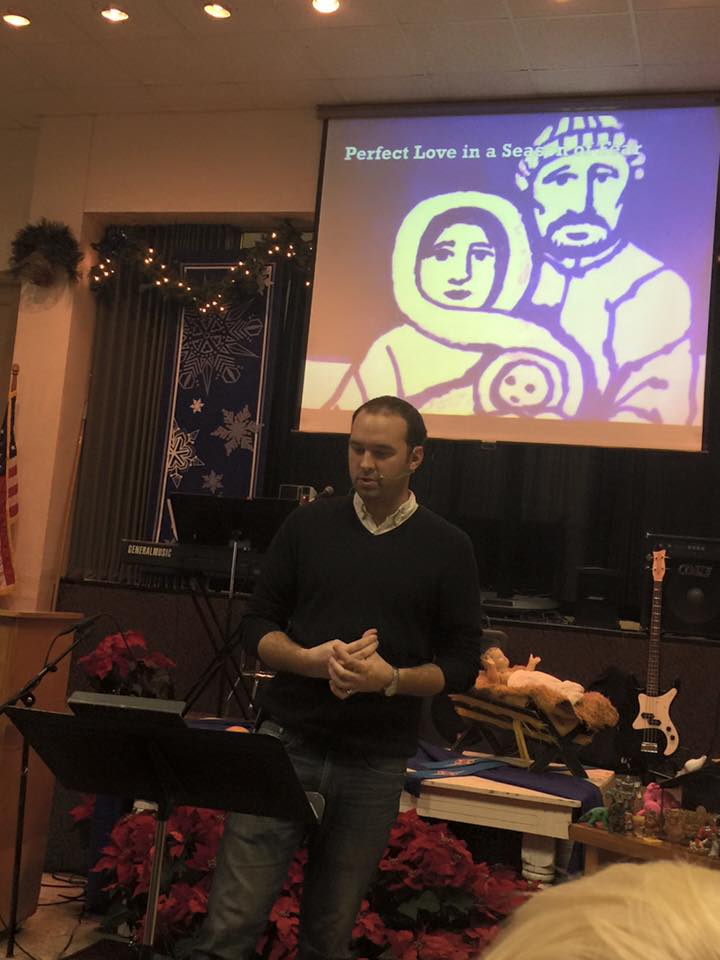
The following is the sermon I gave December 20th, 2015 at East Side Christian Church in Tulsa. The Scripture reading was 1 John 4:16-21.
 Before I get into my sermon, I want to talk about something completely unrelated. St. Nicholas, the real life Santa Claus, was a really awesome person. He was the Bishop of Myra, which is in modern day Turkey, in the 4th century. He is patron saint of sailors, merchants, archers, repentant thieves, children brewers and pawnbrokers. He has lots of wonderful legends attributed to him, including the freeing of slaves, rescuing girls from brothels, and giving away his entire large inheritance anonymously to orphans and the poor.
But the best thing about St. Nick is that, in the year 325, he attended the Council of Nicaea, which was a big meeting of bishops organized by the Emperor Constantine, out of which came the Nicene Creed. And the Council of Nicaea lasted for over month, and it lasted that long because they had one main disagreement: whether or not Jesus was of the just as divine as God, or whether he was just a little below God. Doesn’t that sound exciting? And in the midst of this debate, St. Nick got up and walked over to the originator of the idea of Jesus being just below God, a man named Arius, and St. Nick punched him right in the face. And then, rumor has it, that another bishop who supported Arius, Eusebius, subsequently urinated on St. Nick’s robe later during the council.
And you thought all those councils and stuff were boring.
So, if you just thought St. Nick was a jolly old man who gave away toys, well, you were wrong. He was actually a warrior of God.
Ok, anyways, on with the sermon.
So, I want us to start with the end today. Look at our sermon title: “Perfect love in a Season of Fear.”
The title is an allusion to one of the verses Fred just read: “Perfect love casts out all fear.”
That’s the idea I want us all leaving here today remembering. But I want us to deconstruct the idea of love in the Christian context a little bit, and specifically, I want to think about love as one of the four focuses of Advent, and even more specifically, I want to think about perfect love casting out fear in Advent 2015.
Got all that? Don’t worry, we can get through this together. Stick with me here.
Let’s make our starting point something else our Scripture reading said today, one of the central ideas in the entire Christian faith.
“God is love.”
God is love. The very essence, the very being of God is love itself.
This sentence is foundational to our faith. If you picture Christianity as a pyramid, standing strong and sturdy, the base of it, the bottom row of stones that holds everything else up, is our God as love.
Now think about this. Love is a verb. Love is not a noun. Usually, when we describe someone, we describe them with adjectives or nouns, right? Like, “Oh Evan is a stylish (adjective) fellow (noun.)” Right?
But that’s not how we describe God. We describe God as a verb, as something being done, an action occurring in the universe. I think this is because God is beyond our ability to describe. Human words cannot adequately express the idea of God, and certainly, there are no nouns or adjectives comprehensive enough to do so. The best we can do, the closest thing that can describe God, is to attribute to God the active descriptor of love, in the form of a verb. God is love in action, love happening to us and around us and through us, always, without ceasing. This is the closest we can get to describing God adequately, and even this falls short.
But, it also serves another important role. Classifying God as the verb love gives us not only an idea of God, but it also gives us a way to live. We can think of God as an action, and thus, we can think of how to act in this world.
In describing God’s plan for the world, the Gospel of John says, and I took this from the Message translation, so it may be a little different than you are used to hearing, but I think it better describes God’s actions than the traditional reading. It says, “This is how much God loved the world: He gave his Son, his one and only Son. And this is why: so that no one need be destroyed; by believing in him, anyone can have a whole and lasting life. God didn’t go to all the trouble of sending his Son merely to point an accusing finger, telling the world how bad it was. He came to help, to put the world right again”
This is God’s crucial action in our world. Through Jesus, we see how it is that God operates, how God’s love manifests itself in our world, and this how we are to act.
This then leads to the most important of Jesus’ teachings.
Jesus, when asked what the greatest commandment, said “Love. Love God, love yourself, love your neighbors, love your enemies.”
So this all makes sense so far. If God is love itself, an active love, then naturally, Jesus teaches us to be more like God by acting in love.
We do that by making love our defining action in all that we do.
We are to love God.
We are to love ourselves.
We are to love each other.
We are to love our enemies.
We are to love our earth.
And all this means more than just thinking about other people and our enemies and everything as abstract ideas, and then being, like, “oh I love them. Warm feelings all around.”
It means acting. And specifically, acting in a way that evokes God’s love in our world.
In the letter to the Galatians, Paul writes: “The only thing that counts is faith working through love…you were called to freedom brothers and sisters…use your freedom to serve one another in love.”
So Paul gives us even more detail about the action of love. We are compelled by our faith to working in love. I love the divine paradox Paul describes here: because of God’s immutable and never-ending love for us, we are freed from the fear of death, and specifically, we are freed to become slaves to one another through our service of love towards our brothers and sisters. Isn’t that wild? We are freed to become slaves, because the overriding love of God flows through us and we can’t help but serve each other.
And this is where our sermon title comes back in” Perfect love casts out all fear.” When we read of Jesus’ embodiment of God’s love, and when we emulate Jesus and begin also acting from love, then that love frees us from fear. We no longer have to be afraid of our enemies, we no longer have to be afraid of the people around us, we no longer have to fear death. Because love is bigger than death, bigger than the fear of death. We’ll come back to this, but for now, let’s go to the last verse I want to touch on.
The Apostle Paul writes to the Corinthians: “Love never fails. Faith, hope and love abide, and the greatest of these three is love.”
Again, we hear of the centrality of love to the Christian paradigm. And we hear that love never fails. In the end, in the words of Rob Bell, “Love Wins.”
This is where grace comes into picture. Grace is how we describe God’s love in the sense of it interacting with us. God’s grace is a gift of love to us. And there is nothing we can do to deny it, to turn it away, we can never refuse it. It is freely given. And it touches us all. And it never fails. In the end, God’s love always wins. And I mean that in the biggest sense, in an end-times, everybody-is-reconciled-to-God, no-one-is-denied-entry-into-heaven kind of way. We cannot escape the love of God; we are immersed in it. As Paul writes in Romans, “I am convinced that neither death, nor life, nor angels, nor rulers, nor things present, nor things to come, nor powers, nor height, nor depths, nor anything else in all creation, will be able to separate us from the love of God.” Nothing can separate us from this love. Nothing.
There is no more central idea to Christianity than love.
Ok let’s recap where we are so far. God is love, which mean God acts in no other way but love, and God’s loving action was to reconcile all people to God’s self by this love, which we were taught in word and action by Jesus, and which we come to understand as a love that frees us from the fear of death and compels us to a live of love and service, because we know that God’s love will not fail us and will never leave us, and thus are free to love in a wasteful and extravagant manner.
So, how does this fit into advent?
Advent is a season of hopeful expectation, as we wait the appearance of Jesus into our world. We believe Jesus to be the one who most clearly expressed the nature of God in our world. Now, if we believe God was love, then this means that the birth of Jesus signifies the inbreaking of love into our world. One of the things we are looking forward to during advent is the new world characterized by love that Jesus showed to us during his life and ministry. We celebrate the imminent arrival of God’s love in our world, a love that is given to all people, regardless of any qualifier or feature, as a gift of grace.
And, so, we are to reflect that love back into the world, by loving extravagantly, wastefully, without reservation or fear. We practice love in the way Paul wrote in First Corinthians, with patience and kindness and a longing for truth, bearing all things, believing all things, hoping all things, enduring all things; by refusing to be envious, or boastful, or arrogant or irritable or resentful, by not engaging in wrongdoings. This is how love acts; this is what love looks like. This is what we are to fill the world with during advent.
Yet, this Advent season seems a little out of whack.
We’ve endured a season defined by that thing we are supposed to be driving back: fear. This overwhelming cultural fear is partly driven by recent events, like Paris, and Planned Parenthood, and San Bernardino. But more responsible, I believe, is a political scene that is awash in a use of fear to seize power, to win a political contest and become enriched with dollars of those who are convinced these fear mongers will protect them.
We are being bombarded from all sides with calls to fear the world around us.
To fear immigrants and refugees.
To fear our Muslim brothers and sisters.
To fear women who make decisions and choices for themselves.
To fear people who don’t conform to the gender binary.
To fear our President.
To fear people who are crying out that their lives matter.
To fear anyone who doesn’t look like us, or think like us, or believe like us, or love like us, or worship like us. To fear anything different than us.
And this addiction to fear is being pushed by men and women who claim the mantle of Christianity as theirs, and their alone.
But that invocation of fear as a motivating factor, as the emotion that should drive our actions and decision making, is a heresy. It is a repudiation of everything that Jesus stood for, and a disgusting distortion of the Gospel message, a message of love and acceptance and compassion and mercy and grace and love.
To live in fear is to live at odds with Christ. Remember our reading today? “Perfect love casts out all fear.”
Ok, you know how said earlier that the whole Santa Claus/St. Nicholas thing was completely unrelated to the sermon? OK I was wrong. Arianna brought up a good point about Santa and the naughty v. nice thing earlier. As parents, we sometimes push this culture of fear on our kids by providing narratives that motivate our children to act from fear. For instance, when we tell our children that if they are naughty, Santa won’t visit them, this may be true in the context of that story, but it’s the opposite of how God operates. Fear-based acting to achieve a reward only available if we act right isn’t the story of God’s love. It’s that grace thing again. We don’t have to fear messing up, we don’t have to live in fear of our ultimate outcome, because the never ending love of God ensures us of God’s favor forever and ever. Now this isn’t our faults really. We are telling the stories we’ve been taught. But we need to make sure our theology pervades our whole lives. Love experienced as grace should permeate all our actions, our entire lives.
When we put our trust in God, when we accept God’s love and align our lives with that of Jesus, then we begin to let love direct our actions and our decisions. And then, all that fear begins to dissipate. And then, those who have chosen to become prophets of fear, who seek to manipulate our fear to gain power for themselves, they begin to lose their ability to influence our lives, and instead, the power of God begins to reign in the world bit by bit by bit.
And we get there by doing that most God-like of things: by acting from love. When we show love, when we live in a way that showcases the love of God, and makes it known that that love is here now, among us, then we begin to change the world. We begin to drive out all the fear, and replace it with love for our neighbors, for our brothers and sisters all around the world.
And the science actually backs this up. I was a political science major in college, and I still keep up with some of the poli sci literature that comes out regularly. And recently there was a study that came out that said when we are trying to persuade potential voters to vote a certain way, that introducing factual evidence about an issue or candidate into the calculus can make that voter less likely to be swayed to your side. So, if you have a person who believes a false idea, and then you show them evidence that their belief is wrong, they are more likely to double down on that wrong belief, than change their mind. Now, this is the probably the result of a pride-fueled response to someone who is challenging their intelligence on a given subject. And I can tell you what, as a political operative, that was a very depressing finding for me, because my thought was, man its hopeless to try to sway voters by educating them on things. How in the world do we change people’s minds?
The answer to that question is love. We change them through love. We don’t change people by ridiculing them, or by showing them how wrong or misguided they are. We change people, we liberate them from the shackles of fear, by showing them the love of God, by acting with love towards them just as God would.
Fear is the antithesis of love. Fear is the antithesis of God. Let us embrace the love of God, and turn this season of fear back into the season of Advent, the season of hope and peace and joy and love. Amen.


 Justin DaMetz