Myths of the Nativity

Advent and Christmas are two crucial elements of the yearly church calendar, stained glass nativitytrailing only Easter and Pentecost in ultimate significance. The birth of Christ, and the period of hope and expectation leading up to it, is a season of celebration for the church, perhaps the most beloved time of year, with the most well-known and loved hymns and traditions. At the center of it all is the Biblical story of the Nativity, the birth of Jesus Christ, in a manger, in Bethlehem.
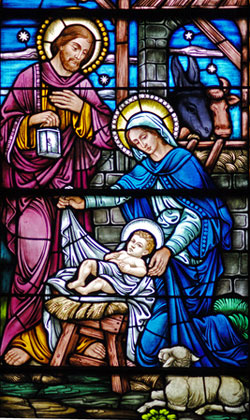
Yet, for Christians who read the Bible critically, with historical and cultural context scrutiny, it can also be a difficult season. Studying the text alongside commentaries and analysis reveals the shaky factual foundation of such things as the Roman census, the location of Bethlehem, the appearance of the magi, the identities and attributes of Mary and Joseph, the Virgin Birth, and the date of December 25th. The question emerges, what is left of Advent and Christmas when this foundation is shaken? How can we find meaning and power in a story that largely appears to be myth and embellishment?

These are the questions I want to answer with this series, Myths of the Nativity. These are questions I have struggled with and pondered, and I want to share that struggle and opportunity for new understandings here, with others who may feel the same way.

Over the next few days, we are going to discuss and think about several different topics pulled from the Nativity:

  • Mary, Joseph and the Virgin Birth
  • Bethlehem vs. Nazareth
  • The Adoration: Magi and Shepherds
  • the Flight to Egypt and Herod’s Decree
  • The Meaning of December 25th, Christmas Trees, Advent
  • Jolly Old St. Nick

All in all, over the course of a week, I want to look at how we, as critical readers of the Biblical text, can learn to think about and talk about the story of Jesus’ birth, and what Christmas means in light of all this.

I encourage you to participate: please comment, question, challenge, and doubt what I say, and join in learning about a new way of looking at Christmas.


The Temptation of Christ: Feeding the World

The temptor came and said to Him, “If you are the Son of God, command these stones to become loaves of bread.” -Matthew 4:3Temptations-of-Christ

Jesus, after his baptism, went into the wilderness to pray and fast, and to contemplate the calling on his life that he felt. How was he, a lowly peasant from Nazareth, going to rally the people of Israel behind him, and bring them back to the ways of God? What kind of leader, what kind of Messiah, would it require him to become?

He could become a provider for the children of God. He could simply overthrow the way of empire by flattening the playing field, by making all men equal in means. He could solve the material problems of the world, the hunger and poverty and need all around him, the same hunger and poverty and need he has grown up with.

He could give the people what they lacked materially, and thus rally them to his banner, convince them his way was a better option than the Temple’s way, than Rome’s way, because his way filled their bellies. They surely would follow this lead. Power could be had by showing his way as more likely to lead to material rewards than the ways of the world

But Jesus knew this wasn’t enough. He thought of Deuteronomy:

One does not live by bread alone,

but by every word that comes from the mouth of God.

Certainly, feeding the hungry, healing the sick, housing the homeless, all these actions are important, and necessary. More than once in his ministry, Jesus used his power to feed the hungry, and more than once he commanded his disciples to do the same.

But Jesus could not, and would not, guarantee a live free of need to those who took his Way. Living in the example of Christ, in the pursuit of relationship with God, in a life or service and love for others, is not a comfortable one. It does not bring big houses and great feasts.

It is a Way of hardship and rejection by the world. One who simply feeds others is one who is praised and worshipped; one who feeds other while asking why they are hungry, who identifies with them and thus convicts those who have enough but do not share what they have, is one who is labeled a traitor and a heretic and an anarchist.

Jesus saw in that desert, when he thought of becoming a provider for Israel, that it is not enough. He knew he must feed, but he must also help his followers understand that God is not satisfied with merely feeding. God wants us to go beyond the mercy of bread lines, to the justice of perpetually-filled pantries. And the way to do that is to fill people with the Love of God for one another.

And so Jesus declined the opportunity to turn stone to bread.

Blogging the NT: Ephesians 1-3

There isn’t a lot of meat in the first three chapters of Ephesians. Mostly, we get introductions, prayers and a recap of Paul’s ministry to the Gentile world.

bloggingthentThe best stuff comes in chapter 2, where the author ruminates on Christian unity and the building a universal church.

So, let’s take this opportunity to a little background on Ephesians, and the whole idea of “pseudo-Pauline.”

There is a lot of scholarly debate about whether these next few books-Ephesians, Colossians, 2 Thessalonians, 1 Timothy, Titus, 2 Timothy-were actually written by the apostle Paul. There are strong arguments for each, with Ephesians having the most claim down to 2 Timothy, which seems the least likely (I’m proceeding through them in order of most to least likely.)

So if not Paul, then who?

Good question. And not one we can really answer. But I have a theory. I think, especially for books like Ephesians and Colossians that seem especially close to Paul and his thought, that a close follower or student synthesized some Pauline thought, through their own eyes, into something they could send out to churches.

And remember, assigning another’s name to something even if they didn’t write it was a fairly common thing in the ancient world. Paul’s name carried a lot of weight in the early church, and so signing something in his name was a way to gain legitimacy, and to pay tribute.

Now, the condensation of Pauline thought in these letters is not perfect by any means. The theology is a little less universal than Paul was in his letters. In their great book “The First Paul,” John Dominic Crossan and Marcus Borg identify three distinct “Paul’s” among the authentic and pseudo letters: radical, conservative and reactionary. The authentic letters fall into the “radical” category; Ephesians, Colossians and 2 Thessalonians as “conservative”; and the three pastoral epistles as “reactionary.”

Borg and Crossan justify this categorization like this:

Our purpose is not to raise a debate about the use of terms like radical, conservative, and reactionary. Rather, it is to insist that the post-Pauline pseudo-Pauline letters are anti-Pauline with regard to major aspects of his theology. They represent a taming of Paul, a domestication of Paul’s passion to the normalcy of the Roman imperial world in which he and his followers lived.

Although it is the closest to the authentic Paul, you can definitely see a taming of Paul already present in Ephesians. We’ll explore that more as we move into the meat of this letter.

Next: Ephesians 4-6

For an explanation on this series, click here.