Matthew 1:1: The Beginning

I’m blogging my way through all four Gospels, in the order they appear in Scripture. Click here to read my introduction to this project.

1An account of the genealogy[a] of Jesus the Messiah,[b] the son of David, the son of Abraham.

New Revised Standard Version
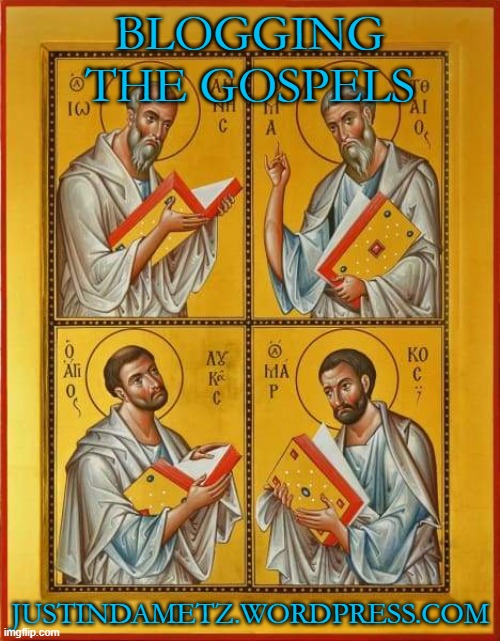
The Four Gospels, as they are ordered in the Christian New Testament, start where any good story does: with the beginning.

This may seem like an obvious statement. Of course it begins at the beginning; that’s literally how things work. On second glance, it may also seem ridiculous. What kind of beginning, at least in the sense of how we understand the beginnings of stories, is this one, which seems more suited to be a section heading.

But, when I point at Matthew 1:1 and say, this is the beginning, what I mean is, this is The Beginning. You know what I mean, right? Not, the beginning, but, The Beginning.

Yeah, exactly.

And that’s a weighty statement! One full of religious hubris, even, and one that can make any good Christian living in our religiously pluralistic world uncomfortable. To say that Jesus the Messiah, the son of David, the son of Abraham, is The Beginning, is to make a claim on history, even the parts of history held to be outside the scope of the Christian tradition.

But, that kind of weighty, uncomfortable, overreaching statement is exactly the one that the Gospel is trying to make. Matthew doesn’t begin with a scene-setting image of Nazareth or Bethlehem, or with Joseph and Mary, or even with “Once upon a time….”. Instead, Matthew kicks things off by making a declaration, that this is the story of Jesus, who is Messiah, the Anointed One of the God of Israel, the rightful inheritor of the throne in Jerusalem, descended from the first and most beloved of Kings, David, and from the progenitor of the Jews and the first carrier of God’s covenantal promise, Abraham. Jesus inherits the cultural, social, and religious burdens of these two men in this statement, taking into himself in these first seventeen words the entire weight of the people of God, and as a result, the weight of God’s own plan for humanity and the universe. Jesus enters into Israel’s story, which is God’s story, which is humanity’s story. Thus, by being the starting point of the Gospel story, Jesus becomes The Beginning for our story. It is no longer a dry header or precursor to the real narrative, but instead, is a statement that does in seventeen simple, declarative words the same thing the writer of the Gospel of John spends 18 long and poetic verses doing.

In an essay on Reinhold Niebuhr, Stanley Hauerwas writes:

For Christians history is not a realm of human endeavor or progress. Rather, it is a realm where sin and death reign and thus it is in need of redemption. The eschatological character of Christian conviction challenges any assumption that history can be construed as a continuous, or even progressive, process. Jesus is not a world-historical link in the chain of historical happenings, but the unique redeemer.

Stanley Hauerwas, “History as Fate: How Justification by Faith Became Anthropology (and History) in America” in Wilderness Wanderings: Westview Press, Boulder, Colorado (1997), 33.

Reading this in 2020, as a Protestant Christian in the cultural West, is uncomfortable. It’s borderline heretical, according to the dogmas and truisms of modern culture. Nevertheless, it is the Truth, one that transcends history, one that makes an unshakeable claim on the world and on all people in all places and all times. Jesus is not just another story in history, like Caesar or the Plague or the Peloponnesian War. Rather, Jesus is the start of a new age, the point on which all of human history turns. Jesus is The Beginning of The Story, not all the way back at some mythical starting point, but in all moments and all instances, inside and outside of time.

So, when the writer of Matthew begins by saying that this is the account of “Jesus the Messiah, the son of David, the son of Abraham”, they are saying “This is The Beginning of all that is and all that was and all that will be; that is, this is the story of Jesus the Christ. Amen.”

Blogging the Gospels: Introduction

I write about a lot of things on this blog. Theology, politics, culture, books, policy, religion, America. As intended, this blog definitely functions as a reflection of my own interests and obsessions.

But one thing I don’t spend much time on here that I enjoy and that I think I should is reading and commenting on Scripture. I love reading Scripture, and finding new meanings and interpretations and understandings and nuances. I don’t write about that nearly enough here. I’ve played with the idea of doing a Daily Office series, but committing to writing on a daily basis is not realistic for me.

However, I think I have found something I can do, that I know I will enjoy, and that would hopefully spark some good conversation: reading the Gospels. I want to do it along the lines of the Paul series I did five years ago, reading through the texts in their entirety, and finding something to say about each.

The question arises: why the Gospels? I believe Scripture is the leading teaching tool in our faith, and within Scripture, the Gospels are the center from which we read and interpret the rest of our faith. The story of Christ is the story we are baptized into, and Christ should be where we look first when trying to understand how to be a Christian, or more accurately, how to be a disciple of Christ. Thus, doing a close reading of the Gospel stories is an important task for any Christian. I love the example my home denomination, the Episcopal Church, sets in this respect: the Gospel reading is one of the central moments of Worship, where all stop and stand and turn their faces towards what they are hearing. I hope this endeavor plays a similar role for me, and for you as well, as together we take a moment to stop and remember the story of Christ.

So, starting soon, I will be reading the Four Gospels in order – Matthew, Mark, Luke, and John – and providing commentary on each passage. Some days, I’ll probably focus on just a couple verses. And other days, I may tackle a whole chapter at once. I’ll never settle on a single method of commentary: some days it may be historical critical, the next devotional style, and the next applying it as cultural commentary. Sometimes, I may even spend multiple days on a single verse, looking at it more than one way. I’ll go wherever the Spirit leads, as they say. I’m also not promising to write everyday. Some weeks, I may post three or four time; other weeks, not at all.

You’ll be able to find this series through the tag #BloggingtheGospels. I’ll be sure each time to indicate which verses will be coming next, so you can read along if you like. Let’s read!

My Favorite Bible Stories, Part 4: The Beatitudes

I started this series on my favorite parts of the Bible a looonnnng time ago, and now that I’ve returned to blogging, I want to pick it back up. You can find previous blog posts in this series at these links:

When Jesus[a] saw the crowds, he went up the mountain; and after he sat down, his disciples came to him. Then he began to speak, and taught them, saying:

“Blessed are the poor in spirit, for theirs is the kingdom of heaven.

“Blessed are those who mourn, for they will be comforted.

“Blessed are the meek, for they will inherit the earth.

“Blessed are those who hunger and thirst for righteousness, for they will be filled.

“Blessed are the merciful, for they will receive mercy.

“Blessed are the pure in heart, for they will see God.

“Blessed are the peacemakers, for they will be called children of God.

10 “Blessed are those who are persecuted for righteousness’ sake, for theirs is the kingdom of heaven.

11 “Blessed are you when people revile you and persecute you and utter all kinds of evil against you falsely[b] on my account. 12 Rejoice and be glad, for your reward is great in heaven, for in the same way they persecuted the prophets who were before you.

Matthew 5:1-12 (NRSV)

Early in his ministry, according to Luke, Jesus goes up on a mountain and, in the words of Shane Claiborne, gives his “platform” speech, his big “commencement address” to kick off his “campaign” announcing God’s kingdom. And he does so by first declaring a series of blessings on the people.

But, he doesn’t announce blessings on just anybody. He isn’t here to heap praise on the powerful, the strong, the wealthy, or the well-fed. Jesus’ campaign isn’t about putting the stamp of approval on the way the world works. Instead, Jesus declares a series of countercultural blessings, blessings that turn on its head the traditional understandings of what is good, and what is not.

“Blessed are the poor,” he says.

“Blessed are those mourning.

Blessed are those who are meek.

Blessed are those who hunger and thirst, not just for food and drink, but for the work of righteousness.

Blessed are those who practice mercy.

Blessed are those whose hearts remain pure and fixed on God.

Blessed are those who seek peace.

Blessed are those who are persecuted, who are oppressed, who are hated, who are lowly and weak.”

These aren’t the blessings that those who write the big checks in church, that make decisions and wield power and decide who is in and who is out, want to hear from their religious leader. This isn’t blessing on the rich, the smart, the leaders, the influential, the biblically sound, the self-righteous, the ones who stick to fundamentals.

No, Jesus’ inaugural blessings are reserved for those on the margins, the outcasts and the despised and the forgotten and the dirty.

The Gospel of Luke goes even further than blessings. Luke, working from much of the same source material as Matthew, has Jesus also proclaiming woes on some as well:

24 “But woe to you who are rich,
    for you have received your consolation.
25 “Woe to you who are full now,
    for you will be hungry.
“Woe to you who are laughing now,
    for you will mourn and weep.

26 “Woe to you when all speak well of you, for that is what their ancestors did to the false prophets.

Luke 6:24-26, NRSV

In this telling, it wasn’t just enough for Jesus to declare who is the favored of God. He also recognizes that the existence of the poor, of the mourning, of the hungry and thirsty, of the persecuted, implies the existence of oppressors, and of those who take more than their need, who cause situations of injustice.

These blessings and woes tell us something important about the Way that Jesus was leading his disciples down. The faith of Christians is one that recognizes those in need, and lifts them. It sees the people who are being held down, those are who are the margins, and it does what it can to make Jesus’ blessings real in their lives. But that’s not all. It is also a Way that calls out the reasons behind those oppressions, that points fingers, not in anger, but in order to heal and bring the created order back into harmony with God.

The Beatitudes is one of my favorite parts of the Bible for this reason. In reading them, you see Jesus giving us the clearest indication about why we are called to be Christians. We see in these blessings that we are called to be light to those who need not, and not in the sense that we must stridently evangelize them, but in the sense that we must free the imprisoned, and feed the hungry, and live in humility, and fight against persecution and oppression wherever we see it.


The Beatitudes have been an inspiration for Christians ever since they were first spoken. One way they have inspired people is through an on-going tradition of writing new Beatitudes, in response to the situations and oppression and injustice Christians have confronted throughout history. One of my favorite modern versions is the Beatitude Benediction written by Rev. Nadia Bolz-Weber. I’ve heard her proclaim them in person twice, once at the Why Christian conference at Fourth Presbyterian in Chicago in 2017, and another time at a book talk she gave at Old St. Patrick’s Church, also in Chicago, last year. Here is her version:

Blessed are the agnostics.

Blessed are they who doubt. Those who aren’t sure, who can still be surprised.

Blessed are they who are spiritually impoverished and therefore not so certain about everything that they no longer take in new information.

Blessed are those who have nothing to offer. Blessed are the preschoolers who cut in line at communion. Blessed are the poor in spirit. You are of heaven and Jesus blesses you.

Blessed are they for whom death is not an abstraction.

Blessed are they who have buried their loved ones, for whom tears could fill an ocean. Blessed are they who have loved enough to know what loss feels like.

Blessed are the mothers of the miscarried.

Blessed are they who don’t have the luxury of taking things for granted anymore.

Blessed are they who can’t fall apart because they have to keep it together for everyone else.

Blessed are those who “still aren’t over it yet.”

Blessed are those who mourn. You are of heaven and Jesus blesses you.

Blessed are those who no one else notices. The kids who sit alone at middle-school lunch tables. The laundry guys at the hospital. The sex workers and the night-shift street sweepers.

Blessed are the forgotten. Blessed are the closeted.

Blessed are the unemployed, the unimpressive, the underrepresented.

Blessed are the teens who have to figure out ways to hide the new cuts on their arms. Blessed are the meek.

You are of heaven and Jesus blesses you.

Blessed are the wrongly accused, the ones who never catch a break, the ones for whom life is hard, for Jesus chose to surround himself with people like them.

Blessed are those without documentation. Blessed are the ones without lobbyists.

Blessed are foster kids and special-ed kids and every other kid who just wants to feel safe and loved.

Blessed are those who make terrible business decisions for the sake of people.

Blessed are the burned-out social workers and the overworked teachers and the pro bono case takers.

Blessed are the kindhearted football players and the fundraising trophy wives.

Blessed are the kids who step between the bullies and the weak. Blessed are they who hear that they are forgiven.

Blessed is everyone who has ever forgiven me when I didn’t deserve it.

Blessed are the merciful, for they totally get it.

Amen.

You can subscribe to Rev. Nadia’s newsletter, “The Corners”, by clicking here.