a new moral majority

An aside in a recent Scott Alexander comments post caught my eye. The “this” he refers to in the first sentence is conflict theory:

The most famous example of doing this well was the Reagan coalition, where powerful business interests got to stay rich and powerful, and Moral Majority Christians got to have prayer in school or whatever. But the modern Democratic coalition works too – powerful class interests get to stay rich and powerful, and poor minorities get to have anti-racist math in school or whatever. This honestly seems like a pretty good deal for the Democrats, coalition-building-wise, and I’m not sure they can do better.

I had never thought about it in this way before, but as I become more critical of the identarian/”woke” wing of the left, this seems to ring true to me. Just as I strongly believe all of the culture war material on the right (Satanic panic, LGBT issues, euthanasia, stem cells, and above all else, abortion) has long been a convenient giveaway by economic elites in order to get everyday conservative voters to support an economic agenda that largely benefits the wealthy, I believe the same dynamic is increasingly at work on the left. These woke issues suck up a lot of time and energy and attention among progressive activists, and while they may in some ways be important, they also distract from economic issues that would be mire widely attractive to working class voters and harmful to elite interests. This kind of cultural distraction is very useful to those in power. The left would do well to re-embrace a class-focused progressivism, instead of allowing itself to fall into the trap of becoming a moral majority of the left.
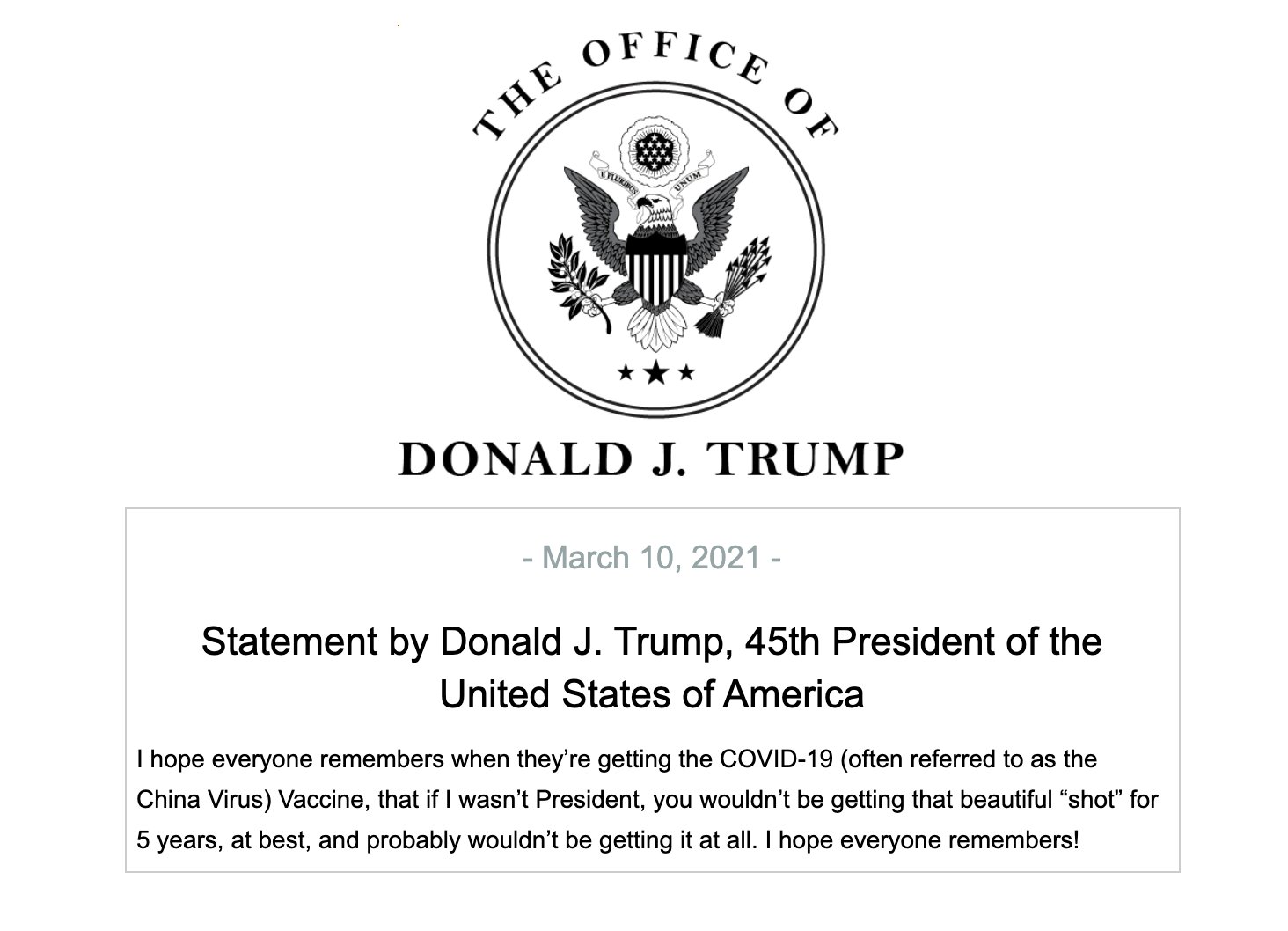
Oh, we remember all right

This is possibly the most pathetic thing I’ve ever read:

Sad.

Over here in reality, the Biden administration has done some great work rolling out vaccine distribution in amazingly short period of time, despite having to start almost from scratch amongst the wreckage left behind by the last administration.

The myth of political principles

I’m not sure why anyone would be surprised that Mitch McConnell would vote for Donald Trump as president on 2024. I assume all the handwringing and outrage among pundits is largely performative. Of course Mitch McConnell is going to vote for the Republican candidate in 2024. All of the incentives of American democracy as it is structured right now lead him to no other plausible outcome.

Here’s the key thing to understand about politics just in general: principle is not a consideration for decision-making. Or, if it every is, it comes into play way down the list of decision factors, behind things like self-interest, party loyalty, interest group influence, electoral impact, and a plethora of others. Conservative/progressive/liberal/libertarian/identarian principles very rarely come into the calculation when politicians make decisions about voting or public statements or when it comes to what to support or not support. This is true on the right and the left. Principles are just simply not luxuries politicians feel they can indulge, aside from a few iconoclastic personalities who rarely are able to muster support across a wide base (Bernie is the only moderately successful principled politician in recent history.) Principles are for the rest of us, and its up to us to figure out which party’s quest for power best benefits the principles and causes we might support.

And honestly, this is how the Founders designed our system to work. Those who crafted the Constitution understood that human motivation is very rarely principled, but instead is guided by baser instincts, and thus they put together a system replete with checks and balances and guardrails and funnels and other methods of channeling and focusing the various motivations of politicians towards the responsible use of power in a way that benefits the Republic.

I think our political culture has lost that plot, and this reaction to McConnell’s declaration of support is just another example of how our perceptions and expectations about politics are misguided. We need to stop reacting to our political leaders – and trying to influence our political leaders – like they are responsive to arguments about principles and values and ideas. Instead, we have to remember that what they respond to is arguments rooted in power and self-interest and electoral incentive. Is it the most virtuous system out there? Far from it. But we can either do politics in the world as it is, or as we wish it would be. I know which one Mitch McConnell has decided to operate in.